Breaking News
Breaking News
from Washington and beyond

Trump Says Putin Will Retaliate Soon After Call on Ukraine Attacks

Donald Trump seems to have no problem with what Russian President Vladimir Putin told him in a recent phone call.

Russian President Vladimir Putin speaks while seated at a table with a mic.
Contributor/Getty Images

Trump said he spoke with Russian President Vladimir Putin on the phone for over an hour on Wednesday, just to confirm that Putin will continue to carry out attacks on Ukraine.

“I just finished speaking, by telephone, with President Vladimir Putin, of Russia. The call lasted approximately one hour and 15 minutes. We discussed the attack on Russia’s docked airplanes, by Ukraine, and also various other attacks that have been taking place by both sides. It was a good conversation, but not a conversation that will lead to immediate Peace,” Trump wrote on Truth Social. “President Putin did say, and very strongly, that he will have to respond to the recent attack on the airfields.”

The president is referring to Ukraine’s successful drone attacks on multiple Russian airfields over the weekend, which destroyed 40 Russian aircraft.

Trump then provided an update on Iran nuclear deal talks.

“We also discussed Iran, and the fact that time is running out on Iran’s decision pertaining to nuclear weapons, which must be made quickly! I stated to President Putin that Iran cannot have a nuclear weapon and, on this, I believe that we were in agreement,” Trump said, using much harsher language than he did in the first half of his post.

“President Putin suggested that he will participate in the discussions with Iran and that he could, perhaps, be helpful in getting this brought to a rapid conclusion. It is my opinion that Iran has been slowwalking their decision on this very important matter, and we will need a definitive answer in a very short period of time!”

Trump is displaying much more trust and deference toward Putin here than he was just days ago, when he wrote that the Russian president was “playing with fire” by continuing to attack Ukraine.

The president continues to waffle in his support of Putin, oscillating between praise and rebuke all while getting nowhere closer to actually ending the war in Ukraine.
Education Secretary Fumbles Answer to Simple Question on Slavery

Linda McMahon is going to great lengths to defend Trump’s push for “viewpoint diversity” in schools.

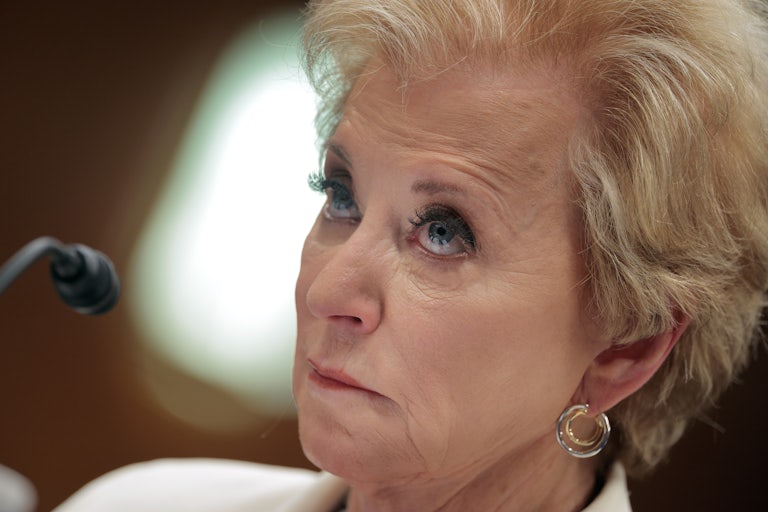
Education Secretary Linda McMahon looks up while testifying in the Senate
Chip Somodevilla/Getty Images

Education Secretary Linda McMahon wants the modern American canon to include alternative histories of some of the world’s most egregious tragedies.

Speaking before the House Education and Workforce Committee Wednesday, amid the White House’s efforts to dismantle her agency, McMahon claimed that the Trump administration’s treatment of Harvard University—which includes orders for the university to introduce conservative viewpoints into its curriculum—has been fair.

“You’re saying Harvard can have its funding and its international students back if and when it teaches what the Trump administration demands,” said California Representative Mark Takano, citing an April 11 letter from the Education Department, which effectively ransomed the university’s federal funding until Harvard abolished “all criteria, preferences, and practices … that function as ideological litmus tests.”

“Does refusing to hire a Holocaust denier as a member of Harvard’s history department faculty count as an ideological litmus test?” asked Takano.

“I believe that there should be diversity of viewpoints relative to teachings and opinions on campuses,” McMahon said.

“But what about this situation.… Would being a Holocaust denier count as that?” Takano continued.

But McMahon deflected answering the question directly, pointing instead to Harvard’s decision to fire the leaders of its center for Middle Eastern studies.

Takano also pressed McMahon on whether the ordinance would compel Harvard to hire faculty that reject the results of the 2020 presidential election or the efficacy of vaccines. In response, the education secretary insisted that there “should be different viewpoints” in America’s most elite universities—even if those viewpoints are not based in any matter of science, fact, or proof. McMahon also scolded Takano for impressing a “political ideology” that she argued was a “false narrative.”

Pennsylvania Representative Summer Lee also torched McMahon for using the Education Department to introduce dangerous and unfounded ideas into American history, asking the former professional wrestling promoter to explain what “both sides” of African American history would be.

“During your confirmation hearing you were asked by Senator Chris Murphy if an African American history class violated the administration’s position on diversity, equity, and inclusion. You said you would look into it,” said Lee. “Have you looked into it?”

“I do not think that African studies or Middle East studies or Chinese studies are part of DEI—if they are taught as the total history package,” responded McMahon. “So that if you’re giving the facts on both sides, of course they’re not DEI.”

“I don’t know what both sides of African American history would be,” Lee said.

“Well if African American history is part of—” McMahon started, before Lee interjected to argue that it would be impossible to teach the whole of history in singular semesters.

“Do you not agree that it makes sense that there would be separate courses for these courses of study?” Lee said, pointing out that the same teaching philosophy exists across areas of study, from literature to music. “One wouldn’t study baroque music and necessarily have to learn about African studies at the same time.”

McMahon eventually conceded that she agreed African history could be taught as an isolated area of study without being considered a “DEI course.”

Trump signed an executive order to strip the Education Department for parts in March. The order had McMahon’s approval.

The agency has historically been responsible for approving, monitoring, and distributing federal financial aid, such as Pell Grants and other aid made available to the public via the FAFSA. It’s also been responsible for assessing and analyzing America’s K-12 systems, as well as aggregating data and research on American educational policies. The department also oversaw the implementation of Title IX, and ensured that the American public had equal access to a valuable education.

In the immediate wake of the order, McMahon penned the mass layoff of more than half the agency’s staff.

The Education Department was already the smallest Cabinet agency, with just over 4,000 employees. Its budget cost American taxpayers $268 billion in 2024, roughly 4 percent of overall spending.

GOP Senator Gets Howard Lutnick to Admit Insane Logic on Trump Tariffs

Trump’s commerce secretary admitted there’s no real strategy when it comes to trade talks currently underway.

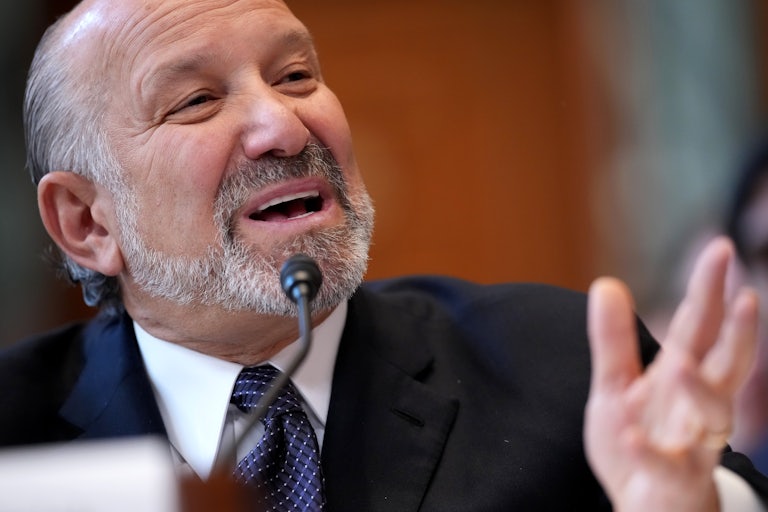
Commerce Secretary Howard Lutnick testifies in Congress.
Andrew Harnik/Getty Images

Commerce Secretary Howard Lutnick, the architect behind Donald Trump’s chaotic tariff policy, admitted in a Senate hearing Wednesday that there’s no real logic in how the trade talks are being conducted.

In a damning line of questioning, Republican Senator John Kennedy exposed that the Trump administration doesn’t even have a clear goal in mind, in terms of what it wants to see from other countries in the trade talks.

“If Vietnam, for example, came to you tomorrow and said, ‘OK, Mr. Secretary, you win. We’re gonna remove all tariffs and all trade barriers. Would the U.S. please do the same?’ Would you accept that deal?” Kennedy asked Lutnick.

“Absolutely not,” Lutnick quickly replied. “That would be the silliest thing we could do.”

“Vietnam has $125 billion exports to us,” he continued, his voice rising. “It imports from us $12.5 million. And you’re thinking, Vietnam exports $125 billion? But where do they get it from? They buy $90 billion from China, then they mark it up and send it to us. It’s just a pathway from China to us.”

“So you wouldn’t accept that deal?” Kennedy pressed.

“No, it’s a terrible deal. We’re the one with the money,” Lutnick said.

“What’s the purpose of reciprocity then?” Kennedy asked, surprised by Lutnick’s confession. “Is reciprocity not one of your goals? Are you telling the president that we shouldn’t seek reciprocity? If that’s what you’re telling me, why are you trying to do these trade deals?”

“What do we want?” Lunick asked in response, trying to answer Kennedy’s question as if he had never thought about it before. “We want to encourage Vietnam to get back to producing products they’re great at producing.”

“But I want to get back to reciprocity,” Kennedy pushed. “You just said you don’t believe in, you don’t accept reciprocity as a goal. What are you negotiating in these trade deals?”

“Why would we open our bank account and their bank account when ours is 10 times bigger?”

“Why are you negotiating trade deals? You’re trying to get other countries to lower their tariffs and trade barriers in return for us lowering ours. That’s called reciprocity,” Kennedy repeated, trying to explain to Trump’s commerce secretary the administration’s own talking point.

“Of course,” Lutnick replied.

“So are you or are you not seeking reciprocity in these trade deals?”

Kennedy’s line of questioning continued for a bit longer, until Lutnick said the Trump administration would “consider” a deal from Vietnam if they said they’d stop purchasing products from China.

The pivot is certainly different from what Trump said in April when he announced his tariffs on countries around the world (as well as uninhabited islands near Africa). At the time, Trump called his tariffs “reciprocal” and said they would remain in place until other countries remove their trade barriers for the U.S. Now it seems Trump’s logic has changed entirely—if there is any logic at all.

Trump’s FEMA Overhaul Is Creating Chaos Right Before Hurricane Season

Hurricane season is about to start, and FEMA is in shambles.

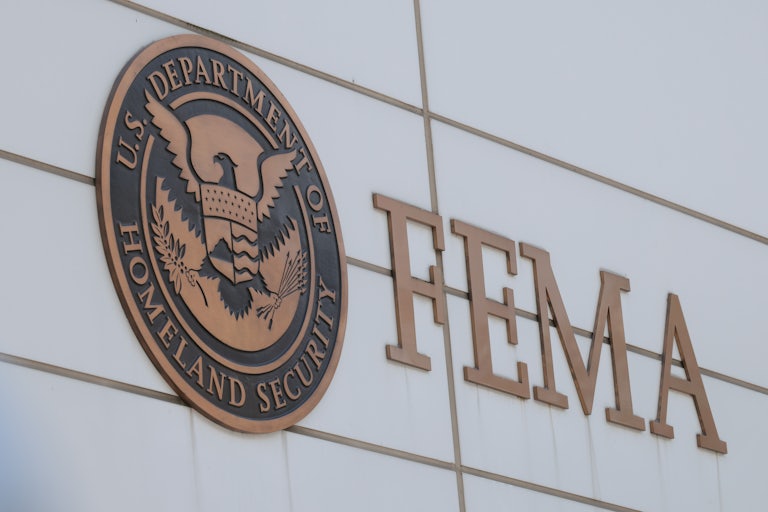
The FEMA building in Washington, D.C.
Kayla Bartkowski/Getty Images

Chaos in the White House is preventing federal disaster relief from reaching its recipients, sparking fears that the government may face more delays and lapses during the upcoming hurricane season.

The Trump administration issued millions of dollars in relief to Virginia in early April after the state was battered by severe winter storms, but in doing so, the West Wing failed to alert a key player responsible for actually distributing the relief: the Federal Emergency Management Agency.

Unidentified FEMA officials told CNN Wednesday that they only knew of the order thanks to newspaper headlines. Direct and official communication from the White House, according to the sources, did not reach FEMA for another four days. That left Old Dominion communities waiting an extra week for direly needed assistance.

Officials at FEMA claim that this is just one instance in a troubling pattern of miscommunication between the disaster relief agency and the Trump administration.

Typically, FEMA advises the White House as to which sites around the nation require federal assistance. That’s been true for practically every other administration, as well as Donald Trump’s first term. But since the MAGA leader has returned to the Oval Office, that relationship has been flipped.

“This is more than just who gets to tell who,” one longtime FEMA official told CNN. “There are regulatory timelines, especially for individual assistance, that are in play, and these delays do affect the delivery of assistance. It is very frustrating to the state and local partners because they think we should be doing things, but without the paperwork we cannot execute on the declaration.”

A similar slipup happened in early May, when the Trump administration failed to notify FEMA officials that it had reversed course on Arkansas’s aid request, approving distribution to the state. That stalled the process for an additional five days.

“A five-day lag is unheard of, as it prevents FEMA from fulfilling its statutory roles,” another longtime FEMA official told CNN. “It feels like a way to make it look like FEMA is being slow when we’re not yet authorized to act.”

Exactly who receives FEMA aid—and when they receive it—is no longer a guarantee under Trump’s direction.

In April, FEMA rejected North Carolina’s application for an emergency aid extension as the state grappled with recovery efforts in the wake of Hurricane Helene, a Category 4 storm that killed 250 people in September. It was the deadliest hurricane in state history.

Even Trump’s voting base has been left in the lurch. Months into his presidency, residents of devastated communities are still begging the president to send relief.

Since Helene, Trump and his allies have spread unfounded conspiracies that the lead response agency had run out of money and that the Biden administration had diverted funds from FEMA to assist undocumented immigrants enter the country. (FEMA administrators have fervently and repeatedly denied this.) Conservatives, at the time of the storm, claimed that working with the Biden White House to expedite disaster relief “seemed political” and even conspiratorially suggested that the hurricanes were a government manipulation.

Days after his inauguration, Trump pitched that it would be better to do away with FEMA altogether, in favor of handing the money directly to the states, though that plan never seemed to gain traction.

Since then, Trump has actively worked to dismantle the agency. The administration has blocked states across the nation, including California and Michigan, from accessing preapproved relief. A coalition of Democratic-led states have sued the federal government, claiming that “hundreds of millions of dollars in FEMA grants” are still inaccessible.

CBO Adds Fuel to Republican Budget Fight With Damning Deficit Forecast

Trump’s “big, beautiful bill” is a total disaster, according to the Congressional Budget Office.

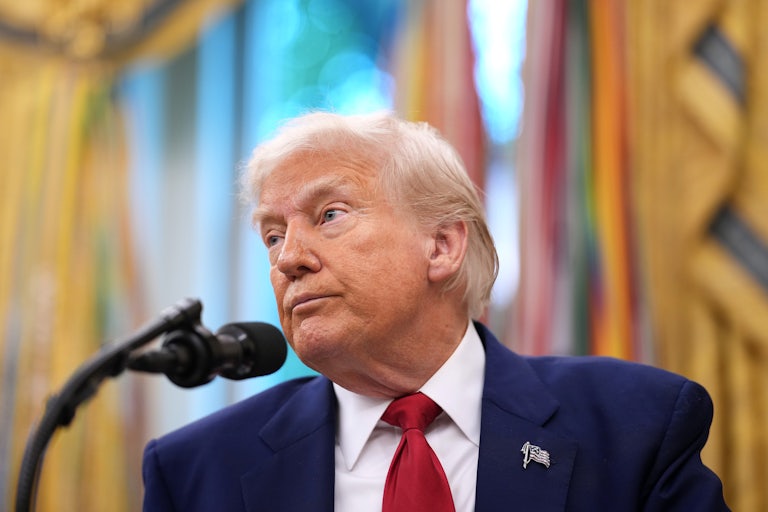
Donald Trump stands in front of a mic in the White House.
Andrew Harnik/Getty Images

The Congressional Budget Office’s most recent score of President Trump’s One Big Beautiful Bill Act is the worst one to date.

The agency estimates the legislation would add $2.4 trillion to the national deficit over the next 10 years. Most of that deficit would happen “in the first four years when it has the most tax cuts,” wrote PBS NewsHour’s Lisa Desjardins

The bill is expected to cut $1.3 trillion in spending, but also cut $3.7 trillion in total revenue, leading to the massive deficit. (The report also estimates that 10.9 million people will lose their health care by 2034 because of cuts to Medicare and the Affordable Care Act.)

This report will make it even more difficult to get this bill through the Senate, as it gives Democrats, Elon Musk, and the few actual fiscal conservatives left in the GOP even more fodder for their criticism and opposition to the bill.

MAGA Republicans backing the bill continue to claim that the CBO is biased, rather than make any concessions, and it appears that the GOP will try to force the bill through regardless.

At its core, the OBBBA is a classic Republican budget bill that provides tax breaks for wealthy people and corporations while making unprecedented cuts to Medicaid and food stamps. For it to cut so much from social programs only to saddle the country with trillions of dollars in debt is unfortunately ironic, and will hurt poor, working Americans more than anyone else. This recent CBO report only reinforces that.