Breaking News
Breaking News
from Washington and beyond

George Santos’s No Good, Very Bad First Day In Congress

The new congressman doesn’t seem to be having a lot of fun.

Representative George Santos stands in the House chamber, looking sullen.
Win McNamee/Getty Images

It was George Santos’s first day in Washington Tuesday, and it seems like his reliable political chops and gravitational charm are not working quite yet. While the serial liar, and now representative, has apparently enjoyed some allyship from Marjorie Taylor Greene, he wasn’t otherwise seen doing much socializing.

As members of Congress steered clear of fraternizing with the guy whose identity we just can’t be sure of, he didn’t seem keen to talk to the people giving him the most attention: members of the press.

Appearing less like a man trying to make a splash on his first day on the hill, and more like a man advised by his lawyer to remain silent, Santos certainly isn’t projecting confidence to voters, or even to people wondering if he deserves to be in Congress at all.

After being royally exposed for lie after lie during the past few weeks, Santos has shown no intention of resigning, and the Republican caucus overall hasn’t made any substantial indication of what they will do. It’s a bit concerning for such an unflappable liar to just be sitting in Congress like a bored middle schooler.

Meanwhile, Santos is facing reopened criminal charges in Brazil for allegedly stealing the checkbook of an elderly man his mother was taking care of as a nurse, and using it to buy some $1,300 worth of clothes and shoes.

Santos also faces legal scrutiny stateside. The congressman-elect recently came into an irregularly quick and massive fortune, and loaned more than $700,000 to his campaign. As a result, both federal and local authorities are probing into Santos’s campaign and financial dealings. So while we can’t seem to address Santos’s almost-criminal level of lying, he may be charged with actual gross criminality.

Kevin McCarthy Spent an Entire Day Losing Votes for House Speaker

After three rounds of voting, it’s not clear what his plan is for securing the gavel.

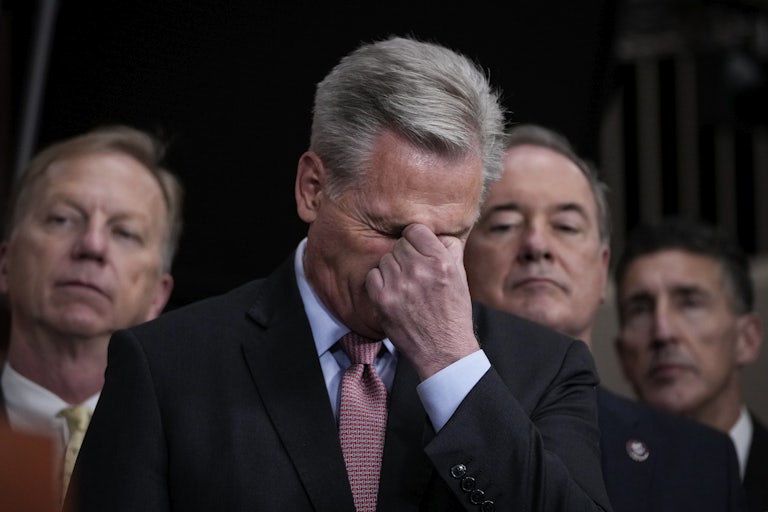
Kevin McCarthy speaks at a podium.
Alex Wong/Getty Images

Not only did Kevin McCarthy lose three rounds of votes Tuesday to become speaker of the House, but he also lost votes in the process.

In the first two ballots, McCarthy received only 203 votes out of the 222 seats his Republican Party holds in the House of Representatives. In the third round, he got 202 votes after Representative Byron Donalds switched his ballot.

McCarthy and his allies have been scrambling in the past couple months to amass the 218 votes necessary to secure the gavel. But he clearly thought he had the speakership on lock, telling Punchbowl News he was confident he would win by the second round of voting.

The California representative also refused to recess between votes on Tuesday to try to whip up the support he needs. Rather than try and make deals with his 19 staunch opponents, McCarthy seemed to believe that continuing to sit and mingle in the chamber as the session dragged on would do the trick.

The House adjourned after the third round of voting, leaving McCarthy to strategize (and stew) until the session resumes the following day.

Here are the 19 Republicans who have consistently voted against McCarthy’s bid for speakership.

  • Andy Biggs
  • Dan Bishop
  • Lauren Boebert
  • Josh Brecheen
  • Michael Cloud
  • Andrew Clyde
  • Eli Craine
  • Matt Gaetz
  • Bob Good
  • Paul Gosar
  • Andy Harris
  • Anna Paulina Luna
  • Mary Miller
  • Ralph Norman
  • Andy Ogles
  • Scott Perry
  • Matt Rosendale
  • Chip Roy
  • Keith Self

Republicans Remove Metal Detectors Installed in the Capitol After January 6

It’s been two years since the Capitol was attacked, and instead of rejecting the extremism that led to it, Republicans still have room for it.

Chip Somodevilla/Getty Images
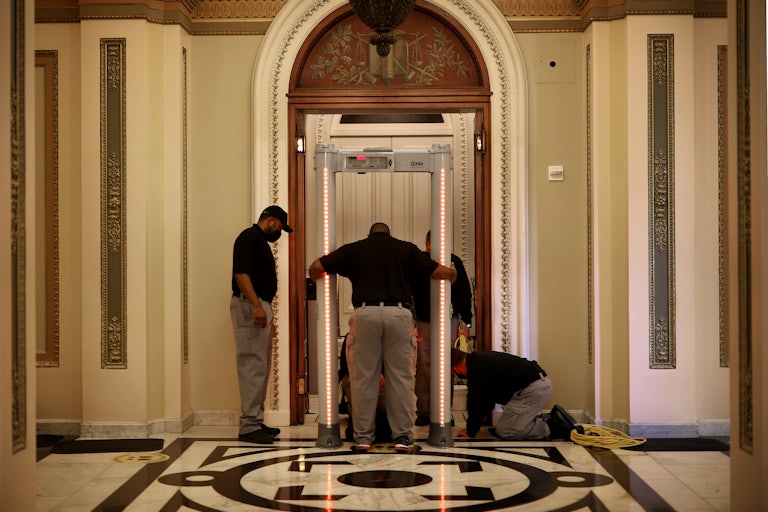
U.S. Capitol Police install a metal detector outside the House of Representatives Chamber on January 12, 2021.

Republicans opened their new House majority by removing metal detectors installed after the January 6 attack on the Capitol.

While much of the spotlight on Tuesday is on the House speaker’s gavel, the first convening of the 118th Congress also marks the persistence of an extremist politics that existentially threatened members of Congress just two years ago.

The metal detectors’ removal is just an emblem of this Republican-led Congress’s ambitions, which include things like seeking more information about perennial boogeyman Hunter Biden’s laptop. House Republicans have focused much of their January 6-related attention not on the attacks themselves but instead on how attackers were treated after being arrested.

More broadly, scores of Republicans either dismiss or even promote the extremism that led to January 6. Some have called investigations into the attacks “witch hunts.” One of the newly elected members, Wisconsin Representative Derrick Van Orden, even used campaign money to fund his own trip to the January 6 riots, where he proudly joined the attackers.

And yet Van Orden joins other far-right Republicans like Marjorie Taylor Greene in supporting Kevin McCarthy for House speaker; while Greene has spent substantial airtime defending the Republican leader, Van Orden joined 53 other “Only Kevin” Republicans expressing sole support for McCarthy as speaker.

In his attempts to curry favor with detractors, McCarthy has proposed numerous rule changes, including one that would gut the Office of Congressional Ethics. While his efforts haven’t yet convinced his opposition, it just goes to show that the folly of conservative governance will plague this Congress no matter who gets the gavel.

Agenda items already parroted most by Republican members are mostly steeped in conspiracy and cynicism. And their first major action, even without a House speaker, was to make it easier to bring weapons into the Capitol. So while there may be an entertaining element to the “Republicans in Disarray” narrative, one thing is unfortunately certain: The corrupt, dangerous far right will maintain stride in this Congress.

Kevin McCarthy Loses Speaker Vote in Historic Wave of Not Being Liked by His Own Party

This is the first time in 100 years that a majority party's nominee failed to win House speaker in the first round of voting. Congrats to Kevin McCarthy for making history by losing twice.

Kevin McCarthy buries his face in his fist in frustration last January.
Drew Angerer/Getty Images

It’s been a bad day for Kevin McCarthy, who lost two rounds of votes Tuesday to be speaker of the House, an outcome unseen in a century that threatens to unleash chaos as representatives rush to make deals.

The California Republican has made no secret of his desire to be speaker of the House, but he and his allies have been scrambling in the past few months to amass the votes necessary to win the gavel. Alabama Representative Mike Rogers went so far as to threaten to ban anyone who votes against McCarthy from sitting on a committee.

But McCarthy won a mere 203 votes out of the 222 his party holds in both rounds of ballots. His Democratic challenger Hakeem Jeffries won 211 and then 212 votes, consistent with party lines.

The two are now in a floor fight, or an instance when it takes multiple rounds of voting to pick a speaker. It will continue for as many rounds as are necessary to fill the position.

In Congress’s 200-year history, there have only been 14 instances in which it took more than two ballots to confirm the House speaker. The last one was exactly 100 years ago. It took nine rounds of votes to resolve that battle.

Lawmakers can adjourn between rounds of votes to try to compromise. But it’s still not clear if McCarthy can make enough deals to finally get what he wants.

Five lawmakers, who have dubbed themselves the “Never Kevin Five,” have sworn not to vote for him no matter what. Another seven also seem unlikely to come around, according to Time. The holdouts don’t trust McCarthy and consider him too wishy-washy on issues that are important to them, such as impeaching President Joe Biden, and too likely to bend in order to stay in power.

Congress cannot move forward until the speakership is filled, so the voting will continue until someone wins. McCarthy can still pull it off, but it will be a vicious slog.

This piece has been updated.

Is the NFL Lying About Wanting to Keep Playing After Damar Hamlin Collapsed?

When Buffalo Bills’ Damar Hamlin collapsed on the field, there were reports that players would have five minutes to warm up and then resume the game.

Damar Hamlin #31 of the Buffalo Bills on the sideline
Timothy T Ludwig/Getty Images

On Monday evening, 24-year-old Buffalo Bills safety Damar Hamlin collapsed during a late-season matchup between the Bills and the Cincinnati Bengals. As the athlete lay motionless on the turf receiving CPR, tens of thousands of fans went silent, players buried their heads in their hands in despair, and the Bills team knelt in prayer for their fallen comrade.

Hamlin collapsed right before 9 p.m.; an ambulance arrived to administer CPR around 9:03. At 9:17, officials announced the game would be temporarily suspended. The game was not announced to be fully suspended until 10 p.m., an hour after Hamlin first collapsed on the field. Hamlin remains in critical condition after what was deemed cardiac arrest.

After the collapse, and before the game was suspended, ESPN’s Joe Buck repeatedly stated that players would have five minutes to warm up in order to resume play. There even is a shot of the Cincinnati Bengals quarterback tossing a football, keeping his arm loose. “They’ve been given five minutes to quote unquote get ready to go back to playing,” Buck said. “That’s the word we get from the league and the word we get from down on the field.”

The report of a five-minute warm-up was also repeated elsewhere, including on ESPN Deportes and Westwood Radio, noted journalist Timothy Burke.

NFL Executive Vice President Troy Vincent claimed ignorance in a conference call hours later. “Five-minute warm-up never crossed my mind, personally. And I was the one … communicating with the commissioner,” Vincent said. “We never, frankly, it never crossed our mind to talk about warming up to resume play. That’s ridiculous. That’s insensitive. And that’s not a place that we should ever be in.”

It is certainly possible that there may have been miscommunication. But the ambiguity of what exactly happened offers another illustration of the struggle between the players and a league hungry to leach out as much as they can from them, even as the world watches one of them fall. After all, it seems the NFL was not eager to suspend the game in the first place:

This, while the NFL claimed the NFL Players Association was “in agreement with postponing the game,” feigning the idea that the league was leading the charge to stop play. We can be generous while we seek clarity about what exactly happened. But we ought not take statements from the NFL—which has allowed an alarming number of its players to develop brain degeneration and is famous for suppressing sexual assault claims against both players and executives—at face value. So the question stands: Is the NFL lying about how much it tried to stop the game after a player collapsed?

More on Sports