Breaking News
Breaking News
from Washington and beyond

Just Thousands of Votes Stopped Democrats From Keeping the House

A new report shows just how narrow Republicans’ margin of victory in the House really was.

Al Drago/Pool/Getty Images

While Democrats navigate a newly insecure 51–49 Senate, with Arizona Senator Kyrsten Sinema’s recent switch to independent, it’s worth revisiting how close they were to maintaining a majority in the House.

A new report from Inside Elections details how, in the five closest GOP House wins, the Republicans won by a combined measly 6,652 votes. Republicans’ gain of any seats at all came from just 22,370 votes, the combined margin of their nine closest victories.

The most razor-thin victory was Colorado Representative Lauren Boebert’s closing win over Democrat Adam Frisch. The far-right candidate, expected to win 97 times out of 100 in FiveThirtyEight’s election simulator, had won the district previously by six points. This November, she won by 546 votes—a 0.16 percent margin that triggered an automatic recount. (The Inside Elections report did not take into account Boebert’s even lower margin of victory after the recount, and we’ve updated the numbers in this piece accordingly.)

Elsewhere, in New York, the state Democrats allowed a disastrous string of losses, with two races being lost by less than one percent, including the chair of the Democratic Congressional Campaign Committee, Sean Patrick Maloney.

A combination of state party mismanagement, a lack of strong top-of-ticket campaigning from reelected Governor Kathy Hochul, and a disadvantageous redistricting spurred by former Governor Andrew Cuomo’s appointed judges all contributed to New York Democrats’ disastrous results.

In total, New York Democrats lost six races in redistricted sections that voted for Biden in 2020. Next year, the balance of power in the House will be 222–213, with a Republican majority. Six seats the other way, not even counting any other close race Democrats lost, would have made it 216–219, letting Democrats keep their hold of the House.

Of course, Democrats won narrow races too. And these wins came not just from coasting off attacking MAGA candidates as such but actually doing the work of campaigning.

As Slate’s Alex Sammon points out, one of Democrats’ major upsets—Marie Glusenkamp Perez’s House win in rural Washington—benefited from a massive organic ground game. The operation came despite lackluster financial support from the DCCC (losing-candidate Maloney’s committee), which dismissed the race as a “reach.”

The balance is nevertheless tight. Kevin McCarthy still hasn’t corralled together 218 votes to claim the speakership. Maybe Democrats could compensate for their losses and, instead of constantly leveraging the left, pressure McCarthy—or another potential Republican speaker—for some favors in exchange for the gavel.

Federal Reserve Hikes Interest Rates up 0.5 Percent, Slowing Pace of Increases

More on what exactly the increase in the interest rate means

U.S. Federal Reserve Chair Jerome Powell speaks at a podium
Liu Jie/Xinhua/Getty Images
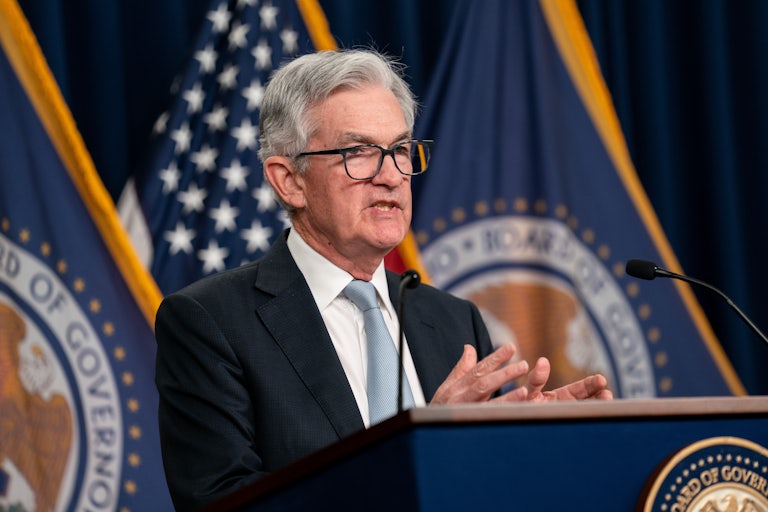
U.S. Federal Reserve Chair Jerome Powell

The Federal Reserve on Wednesday announced an interest rate hike of 0.5 percent, easing up a bit after a series of much higher increases.

With inflation at a record high, the Fed has been scrambling to get interest rates high enough to discourage people from spending money, slowing the economy down in turn. The last four rate hikes have been 0.75 percent.

The risk is that growth will slow while prices and borrowing rates stay high, sending the economy into a recession. Fortunately, there have been some signs that inflation is finally starting to ease a bit. But Fed Chair Jerome Powell warned that while “it’s good to see progress … we have a long ways to go to get back to price stability.”

In a statement, the Fed pointed to supply chain issues and high food and energy prices due to Covid-19 and the war in Ukraine as main factors for inflation continuing to stay high.

But also, “recent indicators point to modest growth in spending and production. Job gains have been robust in recent months, and the unemployment rate has remained low,” the statement said.

Dean Baker, senior economist at the Center for Economic Policy and Research, answered five questions about what this means going forward.

1. What does the 0.5 percent interest rate increase mean for consumers?

The interest rate hike means that rates for credit card debt, mortgages, and car loans will likely go up, Baker said—albeit less than after the Fed’s last policy meeting in November.

Over the past year, the rate hikes have also slowed down the housing market. However, Baker noted, “the number of construction workers has not fallen” due to a backlog in unfinished construction projects.

Jobs numbers have stayed high, which is positive for consumers but has caused concern for some experts that the economy has not slowed sufficiently to avoid a downturn.

Baker also warned that the higher interest rates push up the value of the dollar too, “which makes our goods less competitive internationally.”

2. What has changed in the past month that gives the Fed enough confidence to start slowing rate hikes?

But it’s not all bad news: “Inflation is clearly slowing in many areas,” Baker said. The October and November consumer price index, or CPI, a key government measure of inflation, indicate that inflation finally seems to be slowing a bit.

Baker attributes this to supply chain issues getting resolved. Costs for appliances and used cars, as well as shipping, have fallen.

3. Now that the Fed has been hammering away at inflation, what changes can people expect to start seeing?

The Fed indicated in its statement that it will continue to reevaluate the economic situation to determine what moves are necessary to get and keep inflation under control.

“The Committee anticipates that ongoing increases in the target range will be appropriate,” the statement said.

Powell told reporters that “it’s our judgment today that we’re not at a sufficiently restrictive policy stance yet, which is why we say that we would expect that ongoing hikes will be appropriate.”

But Baker said he hopes Powell “will indicate that he is prepared to adopt a wait and see attitude and hold off on further rate hikes.”

“This should mean further declines in mortgage and other interest rates,” he said.

4. Can a soft landing still be achieved?

The Fed has been clear its goal is to achieve a so-called soft landing, or a decrease in inflation without tipping the economy into a recession. And fortunately, the chances of a soft landing “look very good right now,” Baker said.

Inflation has slowed, but employment levels have remained high. It may take a while to reach the central bank’s target of 2 percent inflation, “but the direction of change is clearly downward,” according to Baker.

5. What are the current chances of a recession?

As the likelihood of a soft landing goes up, the likelihood of a recession goes down. In Baker’s opinion, the chances of a recession are “well under 50 percent at this point.”

The U.S. economy will probably take a hit from weaker markets abroad, as Europe struggles with direct effects from the Ukraine war and China battles a massive spike in Covid-19. But Baker is optimistic that won’t be sufficient to tip the U.S. into a recession.

“The biggest risks are from another wave of Covid or a big flare-up in the war in Ukraine,” the said.

This article has been updated.

The Right Won’t Stop Comparing Ilhan Omar to a White Supremacist

No, actually, Ilhan Omar isn’t anything like white nationalist Nick Fuentes.

Win McNamee/Getty Images

People on the right seem unable to stop comparing Representative Ilhan Omar to white supremacists.

David Friedman, an adviser to Donald Trump’s 2016 presidential campaign who served under him as the U.S. ambassador to Israel, shared a tweet Tuesday that put the congresswoman on a level with Holocaust denier Nick Fuentes.

It is, of course, absolutely bananas to compare Omar and Fuentes. Since taking office in 2019, Omar—one of the first two Muslim women elected to Congress—has been repeatedly accused of antisemitism.

In early 2019, she said the U.S.-Israel relationship was “all about the Benjamins,” a reference to $100 bills. Omar was accused of propagating an antisemitic trope that Jewish people use money for influence. When she heard the criticism, she “unequivocally” apologized for her language.

But the claim that Omar is an antisemite has continued, often fueled by bad-faith attacks on her criticism of Israel. She was accused of saying Jews hold dual loyalty, for example, when she was actually accusing U.S. politicians of being overly pro-Israel.

Fuentes, on the other hand, actively promotes antisemitic views, such as denying the Holocaust and praising Hitler. A white Christian nationalist, he has said Jews are not part of Western civilization because they’re not Christian, and he has expressed support for a Catholic autocracy in the U.S. He has spread Covid-19 conspiracy theories and embraced homophobic and transphobic stances.

He is also apparently now close with Kanye West, who said he sympathizes with Nazis and likes Hitler.

Friedman’s comments came after Representative Kevin McCarthy doubled down on his promise to remove Omar from the House Foreign Affairs Committee should he be elected speaker of the House, again accusing her of antisemitism.

A coalition of liberal Jewish groups pushed back on him, saying his decision was “based on false accusations that she is antisemitic or anti-Israel.”

“We may not agree with some of Congresswoman Omar’s opinions, but we categorically reject the suggestion that any of her policy positions or statements merit disqualification from her role on the committee,” the groups said in an open letter published Monday.

Leader McCarthy’s pledge seems especially exploitative in light of the rampant promotion of antisemitic tropes and conspiracy theories by him and his top deputies amid a surge in dangerous right-wing antisemitism.”

McCarthy has not explicitly condemned Trump for meeting with Fuentes last month, and actually defended the former president over it.

Omar has also hit out at McCarthy’s hypocrisy, saying on Twitter: “He does not care one bit about Jewish safety or any religious minority in our country.”

Power Substations Across the Country Keep Getting Attacked. What Gives?

A Homeland Security report warned that extremist groups have identified the electric grid as a “particularly attractive target.”

Two men in hard hats and a bunch of pipe/electric infrastructure looking things
Peter Zay/Anadolu Agency/Getty Images
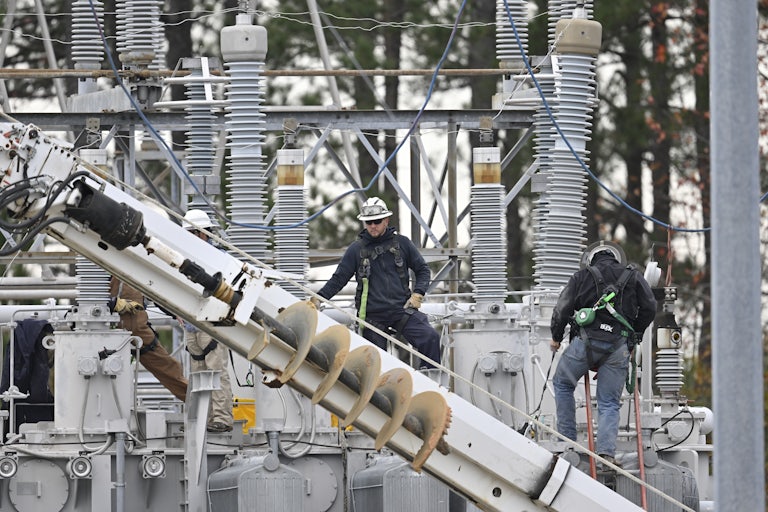
A view of the substation while work is in progress as tens of thousands were without power after an attack on two Duke Electric substations in Carthage, North Carolina, December 5

There have been at least 14 attacks on power stations across the country this year.

On December 3, two North Carolina power stations were struck with gunfire, leading to some 40,000 residents being without power, many of them for days.

Since mid-November, Oregon’s and western Washington’s electrical grids have been host to six attacks—some led by people with firearms—leaving customers experiencing brief outages in both states.

And in September, substations in Florida were targeted six times, with intruders forcing entry and tripping equipment that caused brief outages.

Federal agencies are becoming increasingly concerned amid the string of attacks. On December 2, the FBI co-issued a memo warning utilities about the attacks. North Carolina’s stations were attacked just a day later.

At the end of November, the Department of Homeland Security warned that “lone offenders and small groups” were continuing “to pose a persistent and lethal threat to the Homeland,” including on U.S. “critical infrastructure.”

In January, The Daily Beast obtained an earlier DHS intelligence report warning that extremist groups identified the “electric grid as a particularly attractive target given its interdependency with other infrastructure sectors.”

And earlier this month, CNN obtained a 14-page document circulating on Telegram that included a white supremacist instruction guide for how to conduct low-technology attacks that foment chaos, including attacking a power grid with firearms.

“When the lights don’t come back on … all hell will break lose [sic], making conditions desirable for our race to once again take back what is ours,” the document reads.

In February, three men pleaded guilty of plotting to attack substations with firearms; the trio were alleged white supremacists who had for years strategized how to incite civil unrest, a potential race war, and subsequently the second Great Depression.

The infrastructure connecting the nation is under increasingly high threat. And if enough light isn’t shined on what’s going on, we may soon lose that light, literally.

Oregon Governor Commutes Sentences of Everyone on Death Row

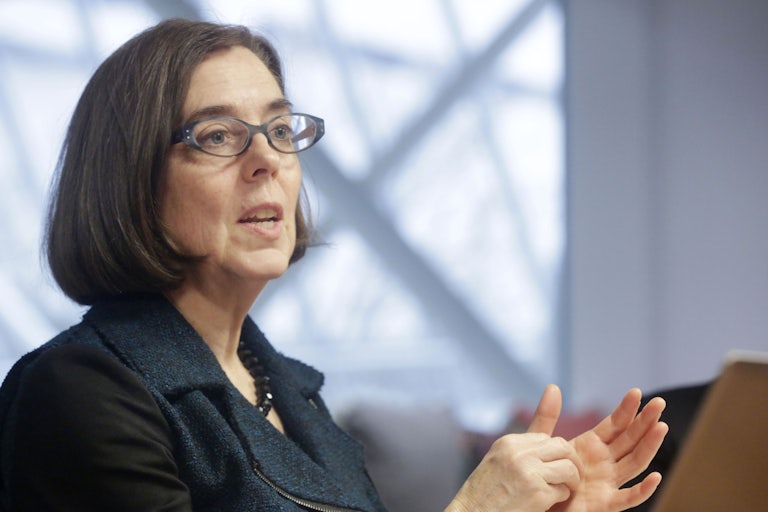
In her final weeks in office, Oregon Governor Kate Brown called the death penalty “immoral” and commuted sentences for all 17 inmates on death row.

Kate Brown
Meg Roussos/Bloomberg/Getty Images
Oregon Governor Kate Brown

On Tuesday, Oregon Governor Kate Brown announced the state will be commuting the sentences of all 17 people on death row in the state, moving them instead to life in prison without the possibility of parole.

“I have long believed that justice is not advanced by taking a life, and the state should not be in the business of executing people—even if a terrible crime placed them in prison,” Brown said in a statement.

Brown’s action pushes forward with moratoriums first established by her Democratic predecessor, John Kitzhaber, in 2011.

“I also recognize the pain and uncertainty victims experience as they wait for decades while individuals sit on death row—especially in states with moratoriums on executions—without resolution. My hope is that this commutation will bring us a significant step closer to finality in these cases.”

Brown’s decision, made as she prepares to depart office after being term-limited, follows a growing opposition to the death penalty. Twenty-three states and Washington, D.C., have abolished the death penalty, while two others, California and Pennsylvania, have governor-issued moratoriums, as Oregon previously had. The death penalty is still legal in 27 states, including the states with moratoriums.

According to the Death Penalty Information Center, 17 people have been executed in 2022, all in Alabama, Arizona, Missouri, Oklahoma, and Texas, as of November 29. And as of April 1, over 2,400 people are on death row.

“The death penalty is immoral. It is an irreversible punishment that does not allow for correction; is wasteful of taxpayer dollars; does not make communities safer; and cannot be and never has been administered fairly and equitably,” Brown said.