Breaking News
Breaking News
from Washington and beyond

Here’s Even More Evidence That Trump’s SPAC is a Scam

Three investors in an entity connected to it were just arrested for insider trading.

Photo by CHRIS DELMAS/AFP/Getty Images

The Trump Train is more of a clown car.

In the latest episode of Trump-adjacent criminality, three top-line investors have been charged with insider trading relating to a proposed merger with the company that owns twice-impeached and twice-indicted former President Donald Trump’s Truth Social social media platform.

The Floridian trio allegedly got away with over $22 million by illegally trading shares in Digital World Acquisition Corp, or DWAC, a shell company that was set to merge with Trump Media Technology Group, or TMTG. The three men, Michael Shvartsman, Gerald Shvartsman, and Bruce Garelick made the trades based on nonpublic information.

DWAC is what is known as a special purpose acquisition company, or SPAC, a tool that allows companies to merge with other entities and go public, all without having to formally file for IPOs. It is essentially a shell company that allows financiers to avoid finicky things like paperwork and rules—which are usually required when companies go public—in search of a quick payday.

According to the Securities and Exchanges Commission court filing, Garelick and both Shvartsmans had signed investor confidentiality agreements with DWAC in June 2021; after signing, the duo were first told about the company’s plans to merge with Trump’s media company.

Garelick had then joined the DWAC board of directors in July 2021. With his newfound position, he had come to learn of more details about DWAC’s plan to acquire Trump’s media company and also voted on actions related to the merger. The merger was officially announced on October 20, 2021.

Yet according to the complaint, Garelick had repeatedly purchased DWAC securities prior to that announcement date, didn’t complete required forms for directors who engage in securities trading of the companies they serve as director for, and shared additional nonpublic information about the merger with his boss at Rocket One Capital—Michael Shvartsman—who then tipped off his brother, Gerald.

After the merger announcement, the trio sold their DWAC holdings and pocketed almost $23 million.

Trump himself has not been named in the complaint. Meanwhile, the merger still has not happened, thanks in large part to numerous legal complaints. If DWAC and TMTG do not merge by September 8, the former is required to return $300 million to investors.

Days after the deal was first announced, The New York Times reported that DWAC may have violated securities laws that hold SPACs are not supposed to have a merger pre-planned prior to going public. Trump had reportedly been in talks with DWAC founder Patrick Orlando since at least March 2021.

In December 2021, it was revealed that the SEC and Financial Industry Regulatory Authority were looking into the company’s stock trading and communications with Trump’s media company before the deal was announced. Then, in June 2022, the SEC was reported to have expanded its inquiry. Days later, the Southern District of New York subpoenaed DWAC and each member of its board—with a special focus on communications with Rocket One Capital. Amid the chaos, Garelick had resigned from the board of directors. And now we know why.
More on Trump's Truth Social Scam

How Worried Should Democrats Be About 2024?

The presidential election may come down to just three states.

Photo by ANDREW CABALLERO-REYNOLDS/AFP/Getty Images

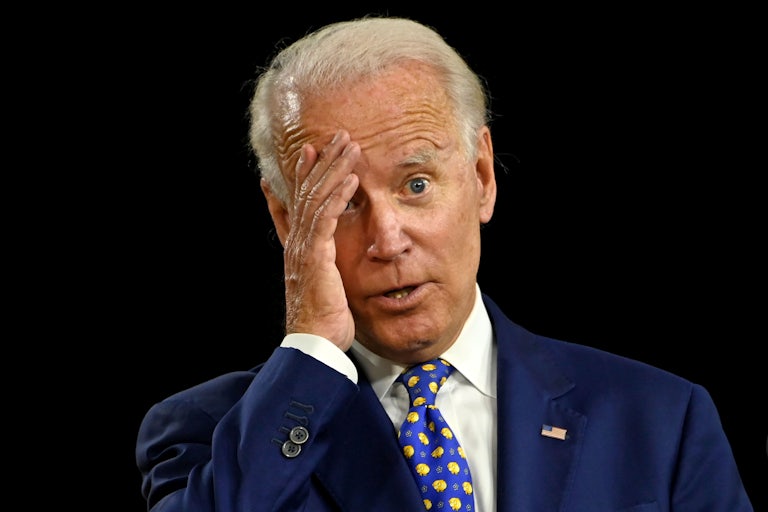
The 2024 presidential election is well over a year away—and the GOP nomination is still up for grabs, at least technically. And yet, early signs are pointing to another very close election: Most early polling shows that President Joe Biden and Donald Trump are neck-and-neck, albeit with large numbers of undecided voters, in national polling, and tight races in a number of swing states.

On Thursday, the University of Virginia’s Center for Politics released its Electoral College Rankings, which shows an astonishingly close race, with only 43 electoral votes up for grabs.

“We are starting 260 electoral votes worth of states as at least leaning Democratic, and 235 as at least leaning Republican,” writes the Center for Politics’s Kyle Kondick. “The four Toss-ups are Arizona, Georgia, and Wisconsin—the three closest states in 2020—along with Nevada, which has voted Democratic in each of the last four presidential elections but by closer margins each time (it is one of the few states where Joe Biden did worse than Hillary Clinton, albeit by less than a tenth of a percentage point). That is just 43 Toss-up electoral votes at the outset.”

This is still, broadly speaking, good news for Democrats. Nevada has been trending red, but its six electoral votes would likely not be decisive in this scenario. Democrats have reason to feel hopeful about Arizona, which went for Trump in 2016 and Biden in 2020, but where Democrats have recently done well—thanks in part to the general insanity of the state’s Republican Party. There are positive signs in Wisconsin as well, where Governor Tony Evers boasts a high approval rating. Still, with less than 18 months to go, this is a much tighter race than many Democrats would hope, especially given the fact that the presumptive Republican nominee is currently facing dozens of federal charges relating to mishandling classified information.

Mike Pence’s Incredibly Dumb Reaction to the Supreme Court’s Affirmative Action Ruling

He checked his privilege—and there’s definitely nothing to see there.

Chip Somodevilla/Getty Images

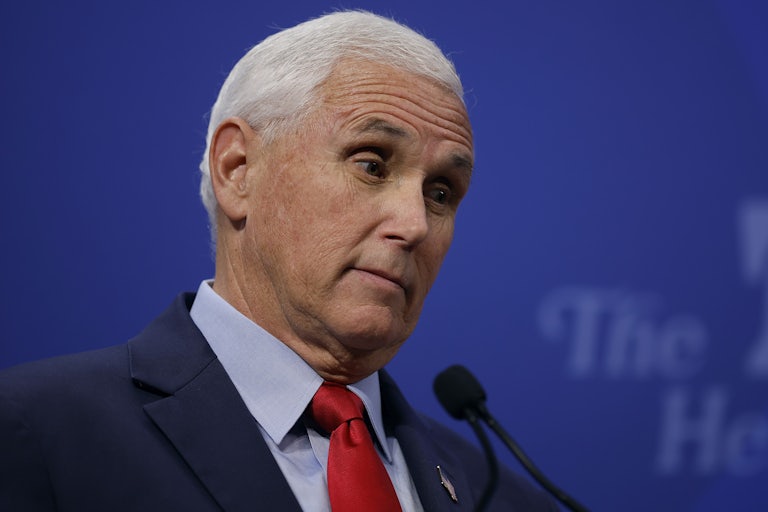
The Supreme Court this morning outlawed affirmative action in colleges, and Mike Pence quickly distinguished himself among the crowded 2024 GOP field with the dumbest reaction yet to the ruling.

“There may have been a time, 50 years ago, when we needed to affirmatively take steps to correct long-term racial bias in institutions of higher education. But I can tell you as the father of three college graduates, those days are long over,” Pence said Thursday. Those three children are all white.

One wonders what possibly could have occurred in 1973 to forever end “long-term racial bias” at colleges. But I guess we’ll just have to trust that the well-connected former vice president knows exactly what he’s talking about with regard to whether nonwhite Americans are still disadvantaged from getting to go to college.

Two More Federal Judges Smack Down Bigoted Anti–Trans Youth Bills

Trans health care bans were blocked in Kentucky and Tennessee—but not in North Carolina.

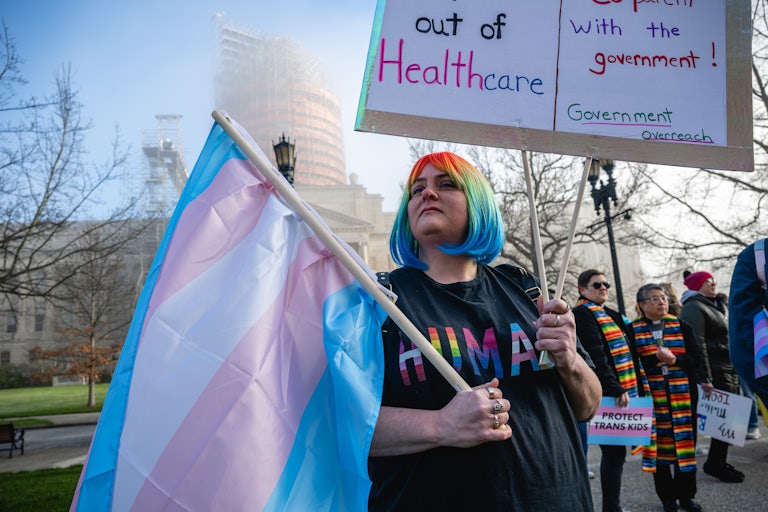
A protester at Kentucky's State Capitol
Jon Cherry/Getty Images
A protester at Kentucky's State Capitol in March

Federal judges in Kentucky and Tennessee have both rejected parts of Republican-led bans on gender-affirming health care for people under the age of 18—just days, even hours, before the anti-trans laws were set to take effect.

On Wednesday, U.S. District Judge David Hale issued a temporary injunction on Kentucky’s ban, allowing puberty blockers and hormone therapy to remain legal and accessible to people under the age of 18 while a broader legal battle proceeds.

The ACLU of Kentucky had filed a suit in May, after Democratic Governor Andy Beshear’s veto was overridden, arguing that the state’s ban on gender-affirming care was unconstitutional because it prevents trans kids specifically from receiving medically necessary care and infringes upon family privacy and doctors’ jobs. The court’s injunction only goes so far, however, as the suit focused mainly on puberty blockers and hormone therapy. Kentucky’s ban on gender-affirming surgeries for those under the age of 18 will still go into effect on Thursday.

Tennessee Judge Eli Richardson issued a similar ruling on Wednesday, stating that criminalizing gender-affirming care for trans kids but not cisgender or intersex kids “imposes disparate treatment on the basis of sex.” Tennessee’s law was set to go into effect on July 1 and would have banned hormone treatment or surgeries for transgender people under the age of 18. Richardson’s ruling did not block the law’s ban on surgeries.

Richardson, a Trump appointee, reiterated that his ruling follows numerous other decisions across the country blocking similar bans on trans health care. “If Tennessee wishes to regulate access to certain medical procedures, it must do so in a manner that does not infringe on the rights conferred by the United States Constitution, which is of course supreme to all other laws of the land,” Richardson wrote.

Richardson also confronted the basic logic of those seeking to defend the bans, and why the bans are not just constitutionally but practically misguided:

Defendants’ assertion that gender-affirming treatment does not improve mental health outcomes relies solely on the testimony of Dr. Cantor, who seems never to have treated an individual for gender dysphoria. But the weight of evidence in the record suggests the contrary—that treatment for gender dysphoria lowers rates of depression, suicide, and additional mental health issues faced by transgender individuals. And at the risk of sounding like a broken record, the Court notes that several courts, based on the respective records in those cases, have found the same.


In North Carolina, Republicans finalized a bill that will ban gender-affirming care—therapy, puberty blockers, and surgeries—for anyone under the age of 18. Democratic Governor Roy Cooper will likely veto the bill, but the Republicans have slim veto-proof majorities in both chambers of the state legislation.

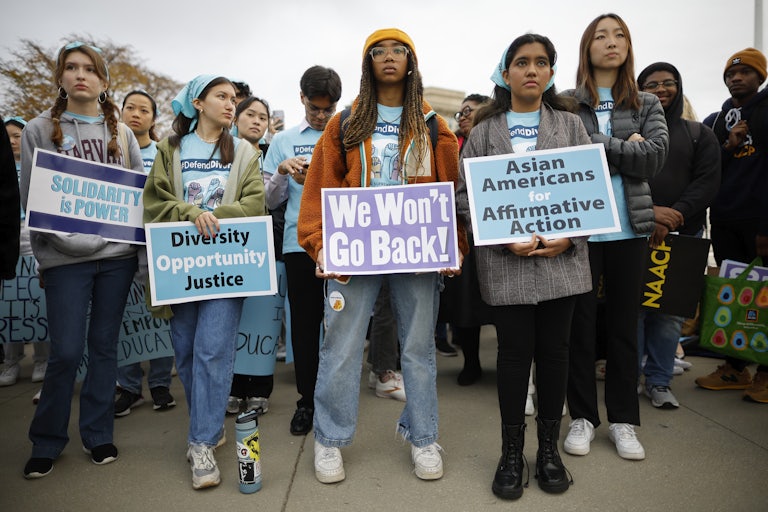
Affirmative Action is Over, Thanks to the Supreme Court

The rulings seriously curtail race-conscious college admissions, effectively ending a decades-old policy.

Photo by Chip Somodevilla/Getty Images

The Supreme Court has voted to end affirmative action in higher education, overturning decades-old policy originating from the presidencies of John F. Kennedy, Lyndon B. Johnson, and Richard Nixon.

“Harvard’s and UNC’s admissions programs violate the Equal Protection Clause of the Fourteenth Amendment,” the court’s majority opinion ruled.

The suits were brought by the anti–affirmative action group Students for Fair Admissions; one was against Harvard University, another against the University of North Carolina.

In the former, the court voted 6–2, with Justice Ketanji Brown Jackson recusing herself due to having served on Harvard’s Board of Overseers. In the latter, the court voted 6–3.

Affirmative action has been a point of legal contention for decades, but most cases regarding it have arrived at one general conclusion: Schools can consider a student’s race when making admissions decisions, but only as part of a broader comprehensive and holistic process. This was the finding in the landmark 2003 cases Grutter v. Bollinger and Gratz v. Bollinger, in which the court ruled that affirmative action in school admissions is constitutional if race is treated as one factor among many, if the purpose is to achieve more diverse classes, and if it doesn’t replace more individualized review of applicants.

In ruling affirmative action unconstitutional, the court overturns this focus on holistic balance.

Now schools across the country will need to overhaul their admissions processes to the new regime. Many schools have already begun to de-emphasize the need for standardizing testing; others are taking the stronger step to get rid of legacy admissions, which favor the children of alumni.

What’s clear is that unless schools take positive steps to ensure their student bodies grow more and not less diverse in the aftermath of this decision, the Supreme Court will leave yet another shameful legacy in its wake: this time, hamstringing our need to foster a strong diversity of thought in this country.

“In so holding, the Court cements a superficial rule of colorblindness as a constitutional principle in an endemically segregated society where race has always mattered and continues to matter. The Court subverts the constitutional guarantee of equal protection by further entrenching racial inequality in education, the very foundation of our democratic government and pluralistic society,” Justice Sonia Sotomayor wrote in her dissenting opinion.