Breaking News
Breaking News
from Washington and beyond

Days After Nashville Shooting, Florida Gov. Ron DeSantis Quietly Signs Bill Allowing Permitless Carry

It is now legal to carry concealed firearms in Florida without a permit, training, or background checks.

Ron DeSantis closeup
Paul Hennessy/SOPA Images/LightRocket/Getty Images

On Monday, Florida Governor Ron DeSantis quietly signed a bill to allow people to carry concealed loaded guns without any permits, training, or background checks.

The change, the execution of a promise DeSantis had repeatedly made in the past, comes after it passed the state legislative chambers largely on party lines.

Florida now becomes the twenty-sixth state to allow permitless concealed carry. One study found states that pass such laws experience a 22 percent increase in gun homicide during the three years after the law’s passage.

The bill was first introduced in late January, and just hours later, a mass shooting in Lakeland, Florida, left 11 people injured. Now the bill’s passage comes in the wake of a school shooting in Nashville, Tennessee, that left three children and three adults dead.

The timing, as well as the mass unpopularity of gun deregulation amid what is now a continual cycle of mass shootings, explains why DeSantis passed it with little fanfare (compared to the ceremony he exhibits when signing bills like the “Don’t Say Gay” bill, for example).

But, as with most changes Republicans pursue nowadays, permitless carry is massively unpopular.

A December poll showed 68 percent of voters in Miami-Dade opposing permitless carry,  including 65 percent of registered Republicans and 60 percent of voters who said they voted for DeSantis in November.

Moreover, once voters were told explicitly that the now-signed bill would allow anyone who can purchase a gun to carry it in public, opposition grew by 12, to 80 percent—with 81 percent of Hispanics and 69 percent of DeSantis voters being opposed to such a policy. And cutting against the bipartisan crime panic, more respondents attributed crime to lax gun laws than to a lack of police funding.

Another poll conducted last September yielded similar results, with 61 percent of Floridian voters opposed to permitless carry, including 71 percent of Hispanic voters.

Still—despite the unpopularity and the material threats such a bill introduces to his own people, all after yet another horrific mass shooting—DeSantis has now made it even easier for people to carry guns and schoolchildren to get murdered.
Thousands of Students Walk Out to Demand Gun Control After Nashville Shooting

“We all just want to live through high school.”

Seth Herald/Getty Images
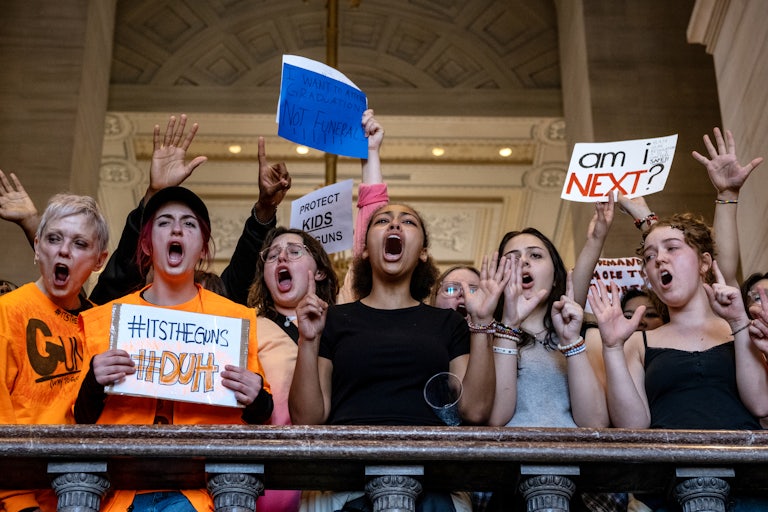
Protesters gather inside the Tennessee State Capitol on March 30.

Thousands of students in Nashville staged a walkout Monday to demand stronger gun control laws, a week after a shooter killed six people at a grade school.

A shooter opened fire at the Covenant School last week, killing three children and three adults and wounding several others. State Republicans have insisted that there is nothing they could have done or could do differently to prevent such a tragedy.

Thousands of students marched to the state Capitol building, chanting for more gun regulations. Local reporter Chris O’Brien estimated there were 2,500 to 3,000 people there. Gun control organization March for Our Lives put the number at more than twice as many.

They rallied outside the building, where they sang songs and called on lawmakers to protect them. “We all just want to live through high school,” one student said.

The students passed out a flyer with their list of demands, which include a red flag law, safe storage laws, and a ban on permitless carrying.

The protest comes just days after thousands of people, including students, rallied at the state Capitol building to protest Tennessee gun regulations.

Protesters marched inside the Capitol ahead of the House and Senate regular floor sessions on Thursday, calling for gun control and for lawmakers to “protect our kids!

Governor Bill Lee and his fellow Republicans have carefully evaded the fact that they helped create the circumstances that allowed the shooting to occur. The GOP holds a supermajority in the Tennessee legislature, as well as the governor’s office.

Two years ago, lawmakers failed to pass a red flag law that would have prevented the shooter from legally acquiring seven guns, three of which were used in the attack. In the past few years, Republicans also loosened gun restrictions, focusing instead on attacking LGBTQ rights.

This post has been updated.

What on Earth Was 60 Minutes Thinking With That Majorie Taylor Greene Interview?

This was a masterclass in how not to interview someone on the far right.

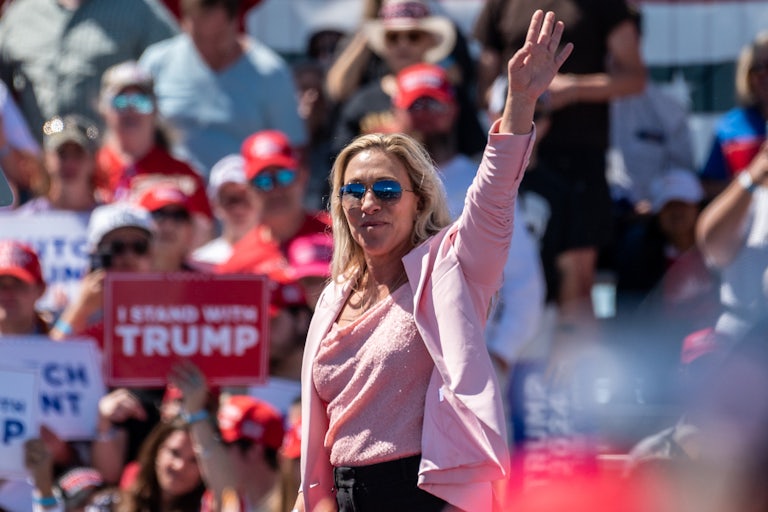
Sergio Flores/Bloomberg/Getty Images

Representative Marjorie Taylor Greene has called for a “national divorce”; lied about the 2020 election; spread conspiracy theories about 9/11, the 2018 Parkland shooting, and Jewish space lasers setting forests on fire in California; and repeatedly expressed support for fatal violence against Democrats.

And she was given an open platform on 60 Minutes.

On Sunday, the radical member of Congress joined CBS’s Lesley Stahl for an exclusive and much-promoted interview special, in which the duo were seen walking the halls of Congress and Greene was filmed showing off her CrossFit skills.

Aside from the odd “day in the life” aesthetic of the interview, Stahl’s interview of Greene, and perhaps CBS’s edits of it, displayed a shocking deference to the Georgia congresswoman and her dangerous ideas. One moment in particular embodied the shortcomings of the interview: just enough pushback to show an effort, not enough to prove that the effort meant anything at all.

Stahl asked Greene about things she has said in the past, like: “The Democrats are a party of pedophiles.”

“I would definitely say so,” Greene affirmed. “They support grooming children.”

“They are not pedophiles,” Stahl responded. “Why would you say that?”

“Democrats, Democrats support—even Joe Biden, the president himself, supports children being sexualized and having transgender surgeries,” Greene said. “Sexualizing children is what pedophiles do to children.”

“Wow. OK,” Stahl responded. “But my question really is, why can’t you fight for what you believe in without all that name-calling and without the personal attacks?”

That Stahl was unprepared to more directly confront for a major talking point among Republicans, and that she reduced their attacks on trans kids and gender-affirming care to “name-calling,” speaks volumes about the folly of the entire interview.

After an ensuing back-and-forth about name-calling, Stahl offered to move on. “Let me button this up, and we’ll move on,” she said, before asking about Greene’s hopes to bring America closer to her views, which include instituting a Christian government, banning abortion nationally, defunding the FBI, and stopping immigration for four years.

Stahl focused on the former. “The Constitution, the very First Amendment, prohibits having a religion in the government,” she pointed out.

“Yet the Founding Fathers quoted the Bible constantly and were driven by their faith,” Greene responded, somehow with the production leaving that as the last word.

The interview concludes almost like a foreboding movie trailer.

“As a fervent supporter of the now-indicted Donald Trump, she was a featured speaker at his rally in Waco last weekend. While she’s adored here, the latest national poll has her approval rating at just 29 percent,” a following voice-over read.

A clip of Trump follows.

“Marjorie Taylor Greene, you happened to be here,” Trump says. “Would you like to run for the Senate? I will fight like hell for you, I’ll tell ya.”

“The question for her, and the country, is can she expand her brash MTG brand beyond the right-wing, populist base?” the voice-over finishes.

This half-critical, half-not approach characterized much of the interview. “Before Congress, she helped run the family construction company in Georgia,” the interview’s voice-over read in another part of the special on Greene. It continued, describing her as “known to be smart and fearless and has a history of believing in conspiracy theories.” Why, exactly, she is characterized as “smart”—and by whom—is not completely clear. And in a broader sense, calling Green “smart and fearless” is like calling The SimpsonsMr. Burns “resourceful and bold.”

The production overall was too willing to move on, offering mere samplings of Greene’s issues paired with a touch of pushback. It embodied the sort-of journalism that insists on its merit by arguing that the best spokesperson for showing the wrongness of something is itself, rather than another observer explaining why exactly it is wrong. Stahl doesn’t need to actually interrogate the absurdity or danger of something Greene says; she just needs to push back once to show the contrast, and then the viewers can just see for themselves.

In some sense, the production felt like a time-warp back to 2016; the special was a piece built for intrigue, a self-proclaimed holistic examination into someone who is neither intriguing nor enigmatic. And though it should be needless to say, apparently it is not: Providing such room for complexity about someone so simply unfit to represent this country is exactly how we got Donald Trump—and exactly how we’ll keep getting more like him (heck, maybe even more of him).

Elon Musk’s New Plan Is to Make It Impossible to Tell Who Paid Him for a Blue Check

Everything is going just fine at Twitter under Elon Musk, thanks for asking.

 In this photo illustration, a Twitter logo is displayed on a smartphone with Blue Tick logo in the background.
Avishek Das/SOPA Images/LightRocket/Getty Images

Another day, another of Elon Musk’s Twitter ideas going exactly according to plan.

Pretty much everyone on Twitter has kept their blue check marks, despite Musk previously announcing a plan to phase out legacy verified accounts and require people to pay for verification beginning April 1.

Since taking over Twitter in October, Musk has launched a massive cost-cutting scheme, which includes laying off almost 75 percent of all staff, auctioning off everything in the company’s San Francisco headquarters, and just not paying rent.

He also unveiled Twitter Blue, a subscription plan in which users can pay for a verification check mark, as well as increased visibility on the platform. The plan costs $8 for individual users and $1,000 for U.S.-based businesses and organizations, plus $50 for each subaccount.

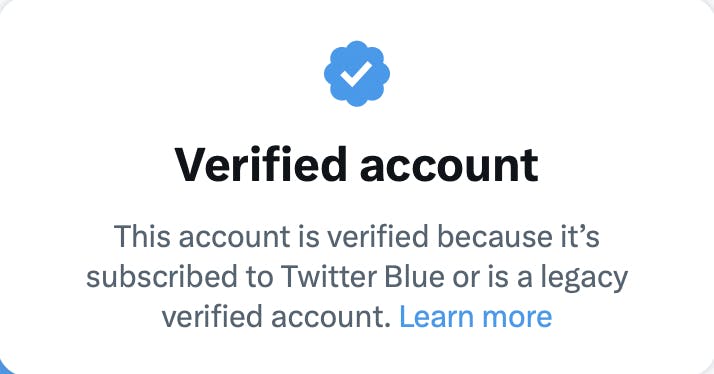
But as of Monday, everyone still had their check marks. The only difference was that, before, you could click on an account’s check mark to see if they were a legacy verified account or a Twitter Blue subscriber. Now, no distinction is made.

Screenshot/Twitter

Well, almost everyone: The New York Times no longer has a check mark. Twitter removed the Times blue check mark on Sunday, after a user pointed out that the paper has expressed no interest in paying to be a verified account. In a now-deleted tweet, Musk also said Sunday that Twitter would give verified accounts “a few weeks grace, unless they tell they won’t pay now, in which we will remove it.”

Considering that no one—from the White House to journalists and professional athletes—was going to pay for Twitter Blue, it’s no surprise that Musk had to pivot. But lumping paying users and legitimately notable accounts together is dangerous.

The point of verification is to prove that a person or organization of public interest is who they claim to be. Misinformation has already risen significantly since Musk took over and gutted Twitter’s content moderation policies. Now, it will be even more difficult to tell if the information an account shares can be trusted.

Sorry Elon, No One Cares About Losing Their Blue Check Mark on Twitter

The White House, news organizations, and celebrities are all saying they have no interest in paying for verification.

Jakub Porzycki/NurPhoto/Getty Images

On the eve of Elon Musk’s plan to phase out existing verified accounts and install a new order—in which anyone can pay a monthly fee in order to get a blue check mark next to their name, as well as a series of other privileges—it seems most users are simply … not interested.

Everyone, from professional athletes to elected officials to journalists, is opting out of Twitter’s attempt to fill the financial hole left gaping wide after Musk took over the social media website.

The cost for Musk’s Twitter Blue scheme is $8 (or $11 through Apple’s iOS) per month for individuals, while businesses and organizations in the United States would be charged $1,000 per month, plus a $50 fee for each affiliated subaccount (employees, other organizational divisions, etc.).

Musk’s Twitter has tried to mitigate the slow-motion car crash. An internal document revealed Twitter is considering waiving fees for the top 500 advertisers and 10,000 most-followed organizations that were previously verified. Unfortunately, it just doesn’t matter.

CNN’s Oliver Darcy reported that The New York Times, the Los Angeles Times, BuzzFeed, Politico, Vox Media, The Washington Post, and CNN will all not pay for Twitter Blue services for their journalists. Most confirmed their organizations will not pay for the institutional account either.

And on Friday, Axios reported that the White House also will not pay for Twitter Blue for its staffers or for the official White House account. “It is our understanding that Twitter Blue does not provide person-level verification as a service. Thus, a blue checkmark will now simply serve as a verification that the account is a paid user,” White House director of digital strategy Rob Flaherty wrote to staffers in an email.

Even star athletes like Lebron James and Patrick Mahomes have said they will not be paying for Musk’s last-ditch Hail Mary.

It’s all fun and games watching yet another Musk endeavor fall flat, but of course the stakes are indeed very high. One example of many came just this week, as a verified account tweeted a screenshot falsely depicting a news outlet sharing a fake quote from the father of a victim in the Nashville school shooting calling for “the end of the trans evil.” And that is just a drop in the bucket of all the moderation problems Twitter has already been dealing with; Musk’s overhaul of verification will escalate an ongoing disaster.