Breaking News
Breaking News
from Washington and beyond

A City in Tennessee Banned Public Homosexuality—and We All Missed It

Murfreesboro, Tennessee, is already beginning to implement the law.

Two people walk by a railing with several pride flags on it
Spencer Platt/Getty Images

A city in Tennessee is using a recently passed ordinance essentially prohibiting homosexuality in public to try to ban library books that might violate the new rules.

Murfreesboro passed an ordinance in June banning “indecent behavior,” including “indecent exposure, public indecency, lewd behavior, nudity or sexual conduct.” As journalist Erin Reed first reported, this ordinance specifically mentions Section 21-72 of the city code. The city code states that sexual conduct includes homosexuality.

Anyone who violates the new ordinance is barred from hosting public events or selling goods and services at public events for two years. Anyone who violates the ordinance “in the presence of minors” is barred for five years.

An ACLU-backed challenge to the ordinance has already been launched, but that hasn’t stopped city officials from implementing the measure. Last Monday, the Rutherford County steering committee met to discuss removing all books that might potentially violate the ordinance from the public library. The resolution was met with widespread outcry from city residents.

“When have the people who ban books ever been the good guys?” local activist Keri Lambert demanded during the Monday county meeting.

Murfreesboro city officials have already used the ordinance to ban four books that discuss LGBTQ themes. In August, the county library board pulled the books Flamer, Let’s Talk About It, Queerfully and Wonderfully Made, and This Book Is Gay.

The board also implemented a new library card system that categorizes books into certain age groups. When it takes effect next year, children and teenagers will only be able to check out books that correspond to their age group; they will need permission from a parent or guardian to check out “adult” books.

Library director Rita Shacklett worried in August that the new rules would prevent students from accessing books they need for a class. She explained that many classic high school books, such as To Kill a Mockingbird, are now classified as “adult.”

It’s unclear if the county steering committee plans to pull books such as the A Song of Ice and Fire series, which includes multiple depictions of heterosexual sexual conduct.

Murfreesboro’s new ordinance is part of a much larger wave of attacks on LGBTQ rights in Tennessee and the rest of the country. In the past year, the so-called Volunteer State became the first state to try to ban drag performances. That law was overturned in court.

In March, the Tennessee House of Representatives passed a bill that would allow people to refuse to perform a marriage if they disagree with it, essentially gutting marriage equality. The bill was introduced in the Senate but deferred until next year.
This Jenna Ellis Testimony Could Be the Writing on the Wall for Trump

New video shows Donald Trump’s former lawyer blaming him entirely for the attempted overthrow of the 2020 election.

John Bazemore/Pool/Getty Images

One of Donald Trump’s former attorneys told Georgia prosecutors that Trump knew he had lost the 2020 election but was simply “not going to leave” the White House, testimony that could signal his death knell in the Fulton County case.

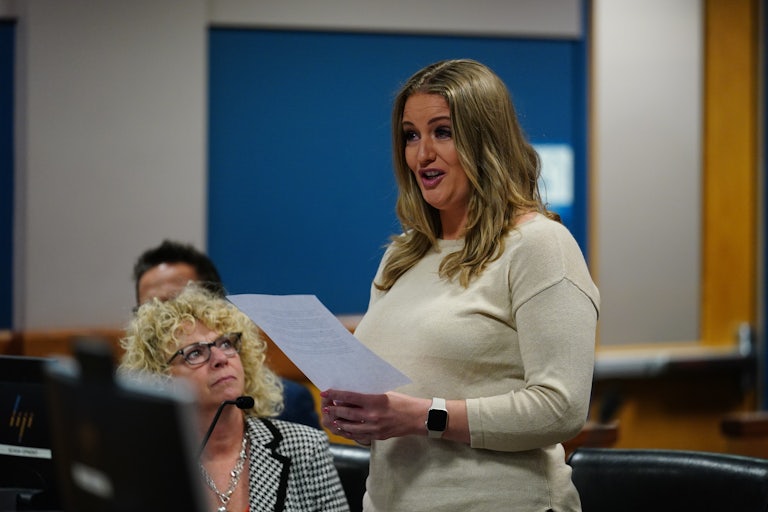
Jenna Ellis struck a plea deal with Fulton County prosecutors in late October, agreeing to testify against Trump in exchange for a lighter sentence. ABC News managed to acquire footage of her testimony, which it published Monday evening.

The video footage shows Ellis describing how senior Trump aide Dan Scavino told her during the 2020 White House Christmas party that “the boss” intended to simply stay in office. Ellis explained that everyone knew “the boss” meant Trump.

Ellis said she pointed out that Trump had lost the election and they had lost all of their attempts to challenge the result in court. Scavino replied, “Well, we don’t care, and we’re not going to leave.”

“And I said, ‘What do you mean?’ And he said, ‘Well, the boss … is not going to leave under any circumstances. We are just going to stay in power,’” Ellis said.

“And I said to him, ‘Well, it doesn’t quite work that way, you realize?’ And he said, ‘We don’t care.’”

ABC also obtained footage of former Trump lawyer Sidney Powell’s testimony. Powell, who claims she never actually worked for Trump, struck a plea deal with Georgia prosecutors in mid-October.

In her testimony, she describes being in frequent contact with Trump as she worked to seize voting machines nationwide. Powell also “reiterated the false assertion that Trump won the election—but acknowledged in the video that she didn’t know much about election law to begin with,” ABC reported.

Trump was charged with felony racketeering in Georgia for trying to overturn the state’s 2020 election results. He pleaded not guilty to all 13 charges. A big part of his defense is that he truly believed he won the election and was acting based on legal advice.

But Ellis’s testimony could prove to be his undoing. Neal Katyal, the former principal deputy solicitor general of the United States, said it was significant that Ellis’s conversation with Scavino took place after all of Trump’s election challenge cases were rejected, including by the Supreme Court.

“This evidence goes to criminal intent that Donald Trump wasn’t thinking about whether he won or lost, he was just going to stay in power no matter what,” Katyal said Monday night on MSNBC.

“All of this together paints a really damaging picture for Donald Trump.”

Why Michael Cohen Fears an Imprisoned Trump Will Sell Out America

Donald Trump’s former fixer had an interesting warning about what will happen if he ends up behind bars.

Fatih Aktas/Anadolu Agency/Getty Images

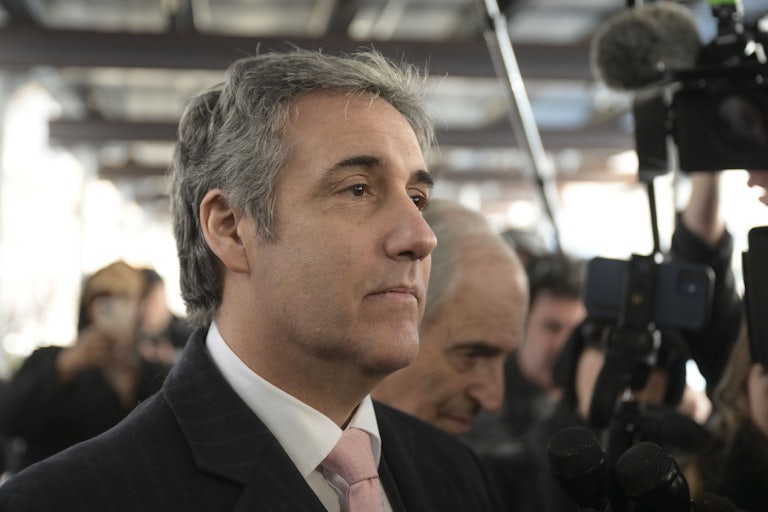
Michael Cohen doesn’t think that Donald Trump should be put behind bars—all because of his big mouth.

The former Trump fixer claimed imprisoning the former president could be “dangerous,” arguing that he belongs under house arrest instead.

“He needs to be held accountable,” Cohen told CNN on Monday. “Do I believe if it was anyone else that that individual would already be in prison or jail? The answer is emphatically yes.”

“But, because he was president of the United States, and for four years he was debriefed on a daily basis on our national security secrets, I personally as an American citizen, I would be concerned,” Cohen said, “because Donald is the kind of guy to sell any of that information for a bag of tuna or a book of stamps, and I do really mean that.”

“It’s dangerous for America to have somebody like Donald Trump in an environment where he can share the information,” he added. “Look, he’s shared it already with members of Mar-a-Lago as well as other individuals that came to visit, so why would he not do it if it benefited him somehow, in some way, in a prison situation?”

Last month, Cohen testified in Trump’s $250 million New York bank fraud trial that Trump made up numbers and then told Cohen to artificially inflate the real estate mogul’s net worth, sometimes by as much as billions of dollars, in order to broker better deals with banks and insurance companies.

“I was confused on how I was going to be,” Cohen said, recalling the moment he came face to face with Trump for the first time in years while taking the stand. “And actually, I felt nothing. It was so weird that here I am, sitting directly across from Donald Trump, and I felt absolutely nothing.”

But while Trump doesn’t face the ultimate consequence of prison time in that particular trial due to its nature as a civil case, he does in several other upcoming criminal trials, including the Georgia election interference case, the January 6 insurrection case, the classified documents case, and the hush-money case in which Trump surreptitiously paid off porn actress Stormy Daniels during his presidential campaign and then paid off Cohen while in the White House for helping him do it.

Trump Jr. Just Uttered the Word That Could Trip Up His Family’s Entire Defense

Donald Trump Jr. may have made a big error when testifying in the fraud trial against his family.

Donald Trump Jr.
Adam Gray/Pool/Getty Images
Donald Trump Jr.

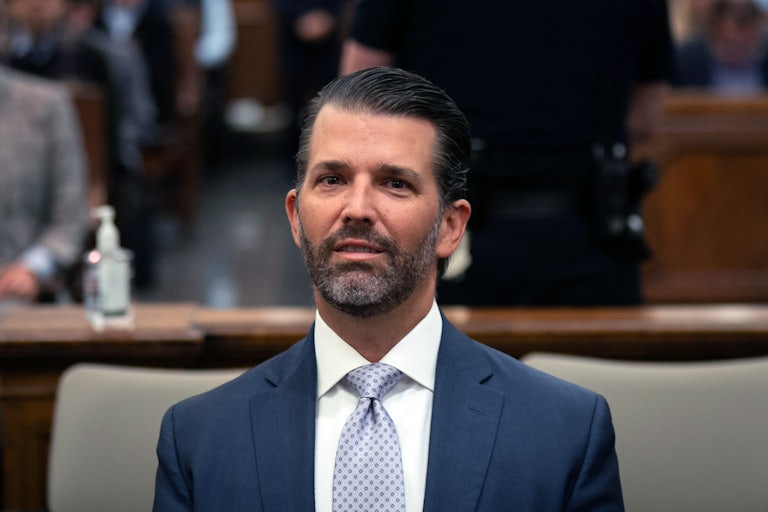
Donald Trump Jr. might have tripped up his legal team’s entire defense on Monday, slipping into his testimony that the family’s Florida property, Mar-a-Lago, is an “estate” rather than a club.

“My father purchased what was one of the finest estates anywhere in the world,” Don Jr. said Monday morning in reference to the building, which he called “amazing” and likened to an “American castle.”

But no amount of embellishment will hide Trump Jr.’s admission: The family’s beloved Florida home at Mar-a-Lago—which, incidentally, Trump has used as his primary residence since leaving the White House in 2021—is perceived by the family as an estate, or residential property.

The contested valuation of Mar-a-Lago is at the heart of the fraud trial against the Trump Organization. Last week, attorneys for the New York state attorney general’s office highlighted incongruous deeds and assessments for the former president’s various international properties, including a development deed for Mar-a-Lago that restricts the status of Trump’s primary residence to a club.

Despite the deed restrictions, the New York Attorney General’s Office argues, Trump overinflated the value of Mar-a-Lago on the basis that it was used as a private home and could be sold as such.

The $250 million bank fraud case hopes to prove that Trump deceived banks and insurers by massively overvaluing his net worth—with properties like Mar-a-Lago. So far, New York State Supreme Court Justice Arthur Engoron has already ruled that Trump and his two sons, Don Jr. and Eric, committed fraud.

After All That Pressure, Supreme Court Adopts Most Pathetic “Code of Ethics” Ever

It doesn’t seem like the court’s new code of ethics will do all that much.

Alex Wong/Getty Images

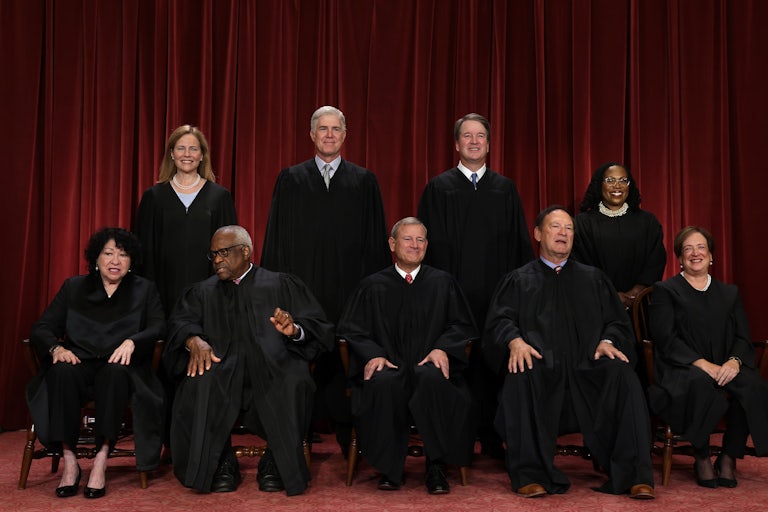
The Supreme Court unveiled a new, incredibly vague “code of ethics” on Monday, following several high profile ethics scandals.

All nine justices signed the 14-page document, which includes five canons of conduct under which the justices should recuse themselves and is based on similar codes used by lower courts.

It requires justices to “uphold the integrity and independence of the judiciary” and “avoid impropriety and the appearance of impropriety in all activities,” according to the code. The code does not mention any enforcement mechanisms, however, and disclosures are completely voluntary.

In a statement attached to the code, the justices highlighted that the court has “long had the equivalent of common law ethics rules,” which they believe added to confusion around the court’s behavior.

“The absence of a Code, however, has led in recent years to the misunderstanding that the Justices of this Court, unlike all other jurists in this country, regard themselves as unrestricted by any ethics rules,” the justices said in a statement. “To dispel this misunderstanding, we are issuing this Code, which largely represents a codification of principles that we have long regarded as governing our conduct.”

Yet the new set of rules fails to outline possible consequences should ethics violations persist.

“This is a long-overdue step by the justices, but a code of ethics is not binding unless there is a mechanism to investigate possible violations and enforce the rules,” said Senator Sheldon Whitehouse, a Rhode Island Democrat, noting that the court’s “honor system” holding justices accountable hasn’t worked in the past.

The court has faced increased scrutiny since several ProPublica investigations revealed that Justice Clarence Thomas had been pocketing favors from Republican real estate developer Harlan Crow, including private school tuition for his nephew, the renovation of the home where his mother still lives, and undisclosed trips on the billionaire’s yacht, private jet, and at his private resort. Two months later, the outlet unveiled a similar scandal with Justice Samuel Alito, who failed to report a luxury fishing vacation to Alaska with hedge fund billionaire ​​Paul Singer in 2008.