Breaking News
Breaking News
from Washington and beyond

The Billionaire Planning to Stick With Trump—Even If He Goes to Jail

The former president has at least one plutocrat pal willing to be his ride-or-die.

Eric Lesser/Getty Images
Former Home Depot CEO Bernie Marcus

The unwavering loyalty Donald Trump has managed to foster among his followers hit a new bar on Tuesday, when one of Trump’s billionaire donors said he would continue to fund the GOP front-runner’s presidential campaign—even if the former president gets convicted.

Bernie Marcus, the 94-year-old retired co-founder of Home Depot, has thrown his hat behind Trump’s latest White House bid, making it a third time, after lining up behind Trump’s efforts in 2016 and 2020.

In an interview with Reuters, Marcus made it clear that his support for Trump would be unwavering, no matter the outcomes of his several criminal trials, telling the outlet “I think it’s all trumped up.” Pun intended? Who knows?

Yet Marcus, who became one of the real estate mogul’s biggest champions in 2016 by signing checks to the tune of $7 million, clarified that there are some limits to his generosity and that he had no intention of breaking records for financial support this time around.

“Of course, I’m going to support him to some extent, but I’m not one of his big givers, that’s for sure,” Marcus told Reuters, adding that Trump was “very happy” about his support.

Trump is hardly in the position to turn away a benefactor. He’s currently staring down 91 charges across four criminal cases. He has denied all wrongdoing and has pleaded not guilty in all of his trials. A possible Trump conviction has raised legitimate questions about his eligibility for the White House, though none of that seems to matter to Trump’s most ardent followers—or, apparently, his donors—who foresee him snatching the GOP nomination not long after the Iowa Caucus kicks off on January 15.

“I never discussed his legal fees or his legal problems,” Marcus said.

Despite Trump’s volatile foreign policy stances, Marcus believed it was worth backing Trump for his stances on the Middle East. He also thought Trump was a “fixer” who could be beneficial to the U.S. economy, the outlet reported.

Other potential candidates in Marcus’s hand-out pool include former Ambassador Nikki Haley and Florida Governor Ron DeSantis, though he didn’t believe either of them had a fair shot against Trump, who is currently polling more than 45 percentage points higher than either of them despite skipping every GOP debate, according to a national aggregate poll by FiveThirtyEight.
Mike Johnson Just Blew a Hole in the GOP’s Biden Impeachment Inquiry

An awkward exchange between the speaker and a Capitol Hill reporter highlighted the weakness of the case against the president.

Jim Watson/Getty Images
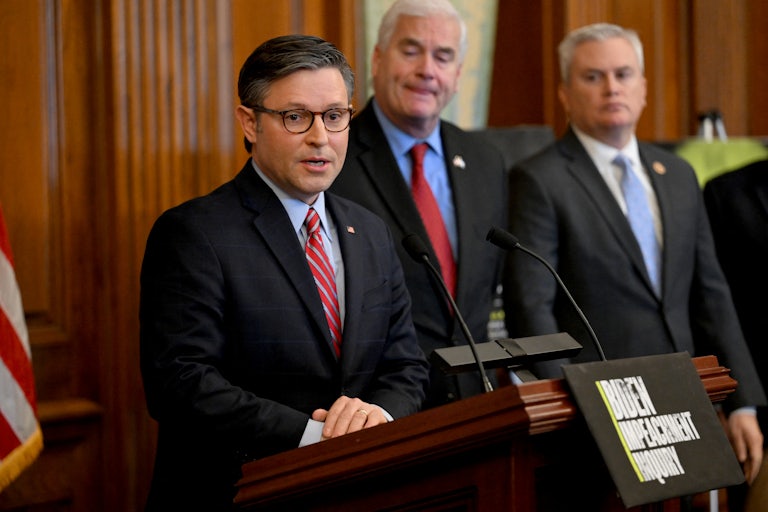
Speaker Mike Johnson at a news conference

Mike Johnson accidentally revealed just how weak the Republican impeachment inquiry into Joe Biden is, when he failed to actually defend one of the central accusations against the president on the merits.

Johnson held a Tuesday press conference with Representatives Jim Jordan and James Comer, who have spearheaded the investigation into Biden, to discuss the ongoing impeachment inquiry. Although Republicans have been levying various accusations against Biden for the past few months, making multiple allegations of political corruption, they have yet to produce any actual evidence demonstrating that their charges have merit.

One matter that Republicans have repeatedly harped on is their claim that Biden, while serving as vice president, said the U.S. would withhold aid money to Ukraine unless Kyiv fired Prosecutor General Viktor Shokin. Republicans allege that Shokin had been investigating Burisma, the Ukrainian oil company for which Biden’s son Hunter served as a board member. This claim has been repeatedly debunked by U.S. intelligence, the former Ukrainian president, and the owner of Burisma.

During Wednesday’s press conference, HuffPost reporter Arthur Delaney asked Johnson why the GOP continues to bring up Shokin’s firing. Delaney pointed out that during Donald Trump’s first impeachment trial, “a lot of State Department officials …came in and said, ‘This wasn’t Joe Biden’s policy, this was our policy. He didn’t do this to benefit his son, he did this because we wanted him to do it.’”

U.S. foreign aid is often given on the condition that the receiving country takes an official action that Washington considers important. In Ukraine, it was eliminating corruption in the government.

“So did they all commit perjury, or are you going to bring them back for more interviews?” Delaney asked. “Why are Republicans just ignoring all that testimony?”

“No one’s ignoring testimony,” Johnson said brusquely, before pivoting to listing foreign payments that the Bidens received.

Johnson also told Delaney he was “not going to answer outside questions about this,” despite the testimony clearly being directly relevant to a central pillar of the current impeachment inquiry.

Shokin was fired in 2016 for corruption. Three years later, Trump and Rudy Giuliani started a conspiracy theory that the Biden family accepted a $10 million bribe to remove Shokin to stop a probe into Hunter Biden’s role at Burisma. This claim has been repeatedly debunked by the owner of Burisma, Mykola Zlochevsky, Giuliani’s associate Lev Parnas, and former Ukrainian President Petro Poroshenko.

Mike Johnson Is Losing His Caucus to a Border Deal Breakdown

The House speaker’s honeymoon seems to be well and truly over, as Republican infighting returns to threaten another critical deal.

Tom Williams/Getty Images
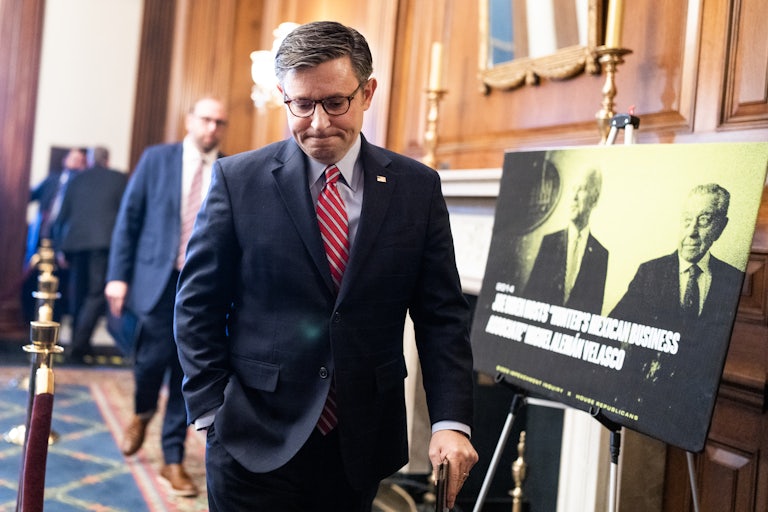
House Speaker Mike Johnson

Speaker Mike Johnson is facing down his first major challenge as the leader of the lower chamber’s Republican caucus: In just a matter of weeks, he’ll need Congress to reach a consensus on two contentious issues—border funding and international aid. It’s a feat that hasn’t been achieved in decades, in a venue where compromise has proven to be the Waterloo of Republican speakers.

Despite Johnson throwing his weight into securing a deal, it’ll be a “steep road” for the newly minted speaker, as one lawmaker told The Hill. Negotiators in the Senate, who face challenges of their own to surmount as its members debate their part of the pending deal, aren’t confident that their success—should it come to fruition—will be replicated by Johnson in the lower chamber.

At stake is a $105 billion national security package proposed by the Biden administration, which includes more than $13 billion to address border issues, along with $14.3 billion in aid to Israel and more than $61 billion in assistance to Ukraine, which Ukrainian President Volodymyr Zelenskiy has suggested could be the difference between winning or losing the war.

The major obstacle is a familiar bugaboo: Republican infighting, fueled by a razor-thin conservative majority in the House. The fractious Republican caucus, whose famous inability to work together led to Johnson’s anointment in the first place, has already started to seep into the discussions on this latest deal, with some lawmakers outright refusing to negotiate.

The chaos within the caucus is being furthered by outside pressure. Conservative policy group Heritage Action urged lawmakers on Tuesday to strike down any plans etched by the upper chamber, insisting that H.R. 2, an asylum-limiting immigration bill proposed by Representative Mario Diaz-Balart, was the “only solution to securing the border.”

“Worse, the proposal coming out of these ‘negotiations’ will likely be used as leverage to advance President Biden’s request for $106 billion in fiscally irresponsible spending, including an additional $60 billion for Ukraine that fails to meet conservative standards and $13.6 billion for fake ‘border security’ that would accelerate Biden’s open border operations,” wrote Heritage Action’s president, Kevin Roberts, in a statement.

“House and Senate conservatives should reject this proposal and commit to supporting H.R. 2 to restore safety and security for the American people. Anything less is unacceptable,” he added.

Even as conservatives stall, Democrats have agita of their own regarding a deal in which many fear their party is poised to give away too much to the GOP in the terse negotiations.

“We have been willing to give a lot in these talks. We are way out of [our] traditional comfort zone for Democrats,” one of the negotiators, Democratic Senator Chris Murphy, told reporters. “At some point, Republicans are going to have to say ‘yes.’”

Republicans Are Escalating Their Attacks on the Voters They Hate the Most

The GOP’s broad war against voting rights is increasingly being fought on America’s college campuses.

Michael Ciaglo/Getty Images
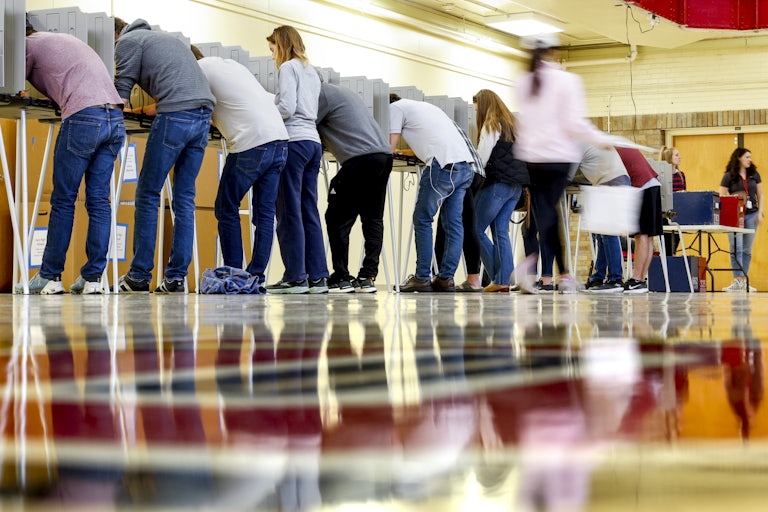
People vote at Denver East High School on November 8, 2022, in Denver, Colorado.

In recent election cycles, young voters have consistently delivered major wins for Democrats. Republicans have decided that the best response is to try to disenfranchise young people.

This year alone, at least 15 Republican-controlled states have introduced or implemented legislation to change the rules around using student IDs at voting booths, according to the Voting Rights Lab. And Rolling Stone reported Tuesday that there is a wider push afoot among GOP lawmakers to eliminate some students’ ability to vote in their school’s state altogether.

“Young people are the reason why Biden won in 2020 and Democrats up and down the ballot won in 2022 and 2023,” Abhi Rahman, the national communications director for the Democratic Legislative Campaign Committee, told Rolling Stone. “If Gen Z continues to vote, we’re on the cusp of the most progressive era in our country’s history. Republicans know this as well, and that’s why they’re doing everything they can to stop young people from voting.”

The GOP’s effort to suppress the vote of college students is well underway in the state of Wisconsin, where the state Supreme Court just last week heard arguments to overturn the Badger State’s heavily gerrymandered district maps. That court leans left for the first time in 15 years, after the April election of Justice Janet Protasiewicz—who won in large part due to massive youth voter turnout.

Immediately after the election, former Wisconsin Governor Scott Walker declared that “younger voters are the issue.” Months later, the state Republican convention considered a resolution to require out-of-state college students to vote absentee in their hometowns. The resolution ultimately failed to advance, but it’s just one part of a much larger effort from the Wisconsin GOP to curtail the youth vote by whatever means available.

In recent years, Wisconsin Republicans have tried to make it harder to register, taken steps to decrease the number of ballot drop boxes and voting booths and to shorten the early voting period, and tried to impose more onerous residency requirements, as well.

In New Hampshire, state Republicans introduced a bill in March that would bar any out-of-state college students from voting in local and state elections. The bill was ultimately killed.

A Texas Republican lawmaker also introduced a bill in March that would prohibit polling booths on college and university campuses (the bill has not advanced out of committee). And Virginia Republicans unsuccessfully tried to repeal a law that would let people age 16 and older register to vote if they will be 18 by the next major election.

Despite appearances, this is no piecemeal effort: Such measures are all part of a larger plan outlined by Republican strategist Cleta Mitchell. Speaking at an RNC donor retreat in April, shortly after Protasiewicz’s win, Mitchell called on the GOP to limit voting on college campuses, same-day voter registration, and automatic mailing of ballots to registered voters. Both young voters and mail-in votes tend to skew Democratic. Mitchell insisted the U.S. electoral systems must be changed in order “for any candidate other than a leftist to have a chance to WIN in 2024.”

Republicans can see the writing on the wall, but they’re taking away the wrong message—and there’s been little, if any, talk among national Republicans about winning young voters back. Increasingly, the GOP seems bent on simply eliminating younger voters from the electorate entirely. During the 2022 midterms, young voters turned out in record numbers and overwhelmingly voted Democratic. GOP luminaries responded with calls to raise the voting age.

Rather than implementing policies about things that young people actually care about—such as environmental protection, increased abortion access, and LGBTQ rights—Republicans are instead embracing stances that alienate huge swathes of the new generations of voters. And then they get angry when young people don’t support them, and the cycle of pushing younger voters out begins anew.

Rupert Murdoch Has Some New Legal Entanglements, Thanks to Fox News

The media mogul is the latest figure to get sucked into the widening gyre of the Smartmatic lawsuit.

Victoria Jones/Getty Images

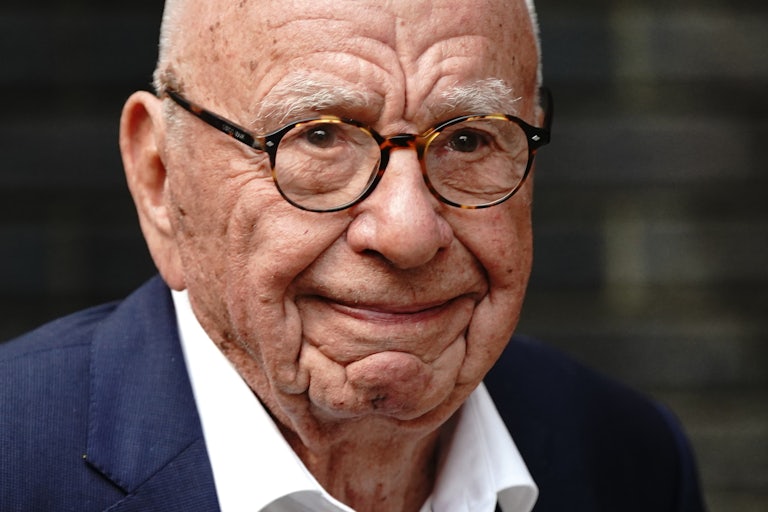
Rupert Murdoch is set to be deposed on Tuesday and Wednesday in relation to the $2.7 billion defamation lawsuit between Smartmatic and Fox News. The questioning will take place in Los Angeles and has not appeared on the public docket for the case, according to Reuters.

Smartmatic filed its lawsuit in 2021 after the conservative broadcast giant baselessly touted Trumpian conspiracies that the voting machine company had participated in election fraud. Fox has subsequently spent the better part of the last two years trying and failing to throw the case out of court.

“They needed a villain,” the lawsuit said. “They needed someone to blame. They needed someone whom they could get others to hate. A story of good versus evil, the type that would incite an angry mob, only works if the storyteller provides the audience with someone who personifies evil.”

“Without any true villain, defendants invented one,” the lawsuit noted. “Defendants decided to make Smartmatic the villain in their story.”

The deposition will be the second time this year that Murdoch has had to sit for questioning related to Fox’s spindly election lies, after the corporation reached a historic $787 million settlement with Dominion Voting Systems in April over similar allegations.

Along with Fox Corporation and Fox News, Smartmatic is seeking damages from five individuals: Trump attorneys Rudy Giuliani and Sidney Powell, as well as Fox hosts Maria Bartiromo and Jeanine Pirro, and former host Lou Dobbs. In order to win the defamation case, Smartmatic will need to prove that the defendants spread the lies with “actual malice,” meaning that they either knowingly spread misinformation or recklessly disregarded the truth.

Although Murdoch’s name is missing from the list of defendants, proving that he was personally involved in the decisions that shaped Fox’s coverage while serving as chairman of the company could help Smartmatic prove that Fox Corp is liable.

The 92-year-old retired from his perch as king of his media empire—which encompasses Fox, The Wall Street Journal, The New York Post, and the Dow Jones Newswire, among others—in September, turning the management of the company over to his son, Lachlan Murdoch.