Breaking News
Breaking News
from Washington and beyond

Just What Does the Koch Network Have Against Donald Trump?

The Republican Party’s most celebrated donors have made big bets against the former president—and they appear to be losing.

Mario Tama/Getty Images

The political network founded by Republican billionaire megadonor brothers Charles Koch and the late David Koch endorsed Nikki Haley on Tuesday for the Republican primary, the latest snub in the Koch network’s ongoing (and so far fruitless) campaign against Donald Trump.

Americans for Prosperity Action, the Koch network’s advocacy arm, sent out a memo to conservative grassroots activists announcing its endorsement, as well as a coming multimillion-dollar campaign for pro-Haley online and television ads.

“When we announced our decision to engage in our first ever Republican presidential primary, we made it clear that we’d be looking for a candidate who can turn the page on our political dysfunction—and win. It’s clear that candidate is Nikki Haley,” AFP Action senior adviser Emily Seidel said in a statement.

The Koch network has spent the past year steadily ramping up its strident rejection of Trump. Just Monday, AFP Action sent out leaflets urging voters to “stop Biden by letting go of Trump.”

The network’s efforts to keep Trump from winning another presidential nomination kicked off in earnest back in February, when AFP Action sent out a memo stating that the group wanted to help the U.S. “move on” from Trump. The Koch network launched a wave of anti-Trump digital ads in June, arguing that “Trump can’t win.”

That same month, the Koch network revealed it had already raised more than $70 million to donate to non-Trump political races. Koch Industries and Stand Together each donated $25 million, for a combined $50 million of the total funds raised. David Koch died in 2019, but Charles Koch is a major shareholder in Koch Industries, and he founded the nonprofit Stand Together.

The Koch network is one of the most influential conservative political groups, and yet its efforts to stop Trump have been foiled at every turn. In the months since the Koch network proclaimed that Trump “can’t win,” the former president has established himself as the Republican primary front-runner—by a massive margin. National polls show him with an average of 61.6 percent support. Haley has climbed steadily in recent months, but she’s still sitting in third place with a nationwide average of just 9.8 percent support.

It’s also unclear exactly why the Koch network dislikes Trump so much. While in office, he successfully carried out moves long sought by the organization, including the gutting of the Environmental Protection Agency, a single-minded strategy of deregulation to strengthen the hand of private businesses, and tipping the Supreme Court conservative—with a majority that’s proven to be well inclined to favor the interests of big business and the decimation of the administrative state.

Whether or not there is a difference of opinion beyond mere aesthetics, it seems the animosity is mutual. Trump said in 2018 that he never sought the Koch network’s backing because “I don’t need their money or bad ideas.” In September, he once again dismissed the Koch network, calling Charles Koch “highly overrated.”

“Very stupid, awkward, and highly overrated Globalist Charles Koch of the Koch Network doesn’t have a clue,” Trump said on Truth Social. “He said his best years were the four years during the Trump Administration, and now his people are aimlessly throwing away other people’s money.”

It’s Beginning to Look a Lot Like a Republican Government Shutdown

Mere weeks after the House GOP tore themselves apart over their inability to pass a funding bill, they’re back at it again.

Anna Rose Layden/Getty Images
House Speaker Mike Johnson

Government shutdown is back on the menu. The House GOP has made some ominous omissions from this week’s agenda: the appropriations bills that are meant to forestall—say it with us, once again—the impending government shutdown that is now scheduled to occur in mid-January.

After this week ends, the House will have just 16 legislative days to come up with a solution before the first of a two-part deadline is breached, which will set off a partial shutdown on January 19. Should the House continue to flail after that date, the government will roll into a full shutdown two weeks later, on February 2.

Funding the government for which they work hasn’t been a major priority for House Republicans this year. So far, the caucus has passed two stopgap spending measures, narrowly avoiding shutdowns on crunched deadlines, all while garnering attention for their penchant for toxic infighting, which reached a fever pitch in early October when former House Speaker Kevin McCarthy was ousted from his leadership position for daring to arrange a bipartisan spending bill to prevent a shutdown calamity.

It has yet to be determined if the man who replaced him, Speaker Mike Johnson, is operating under the same conditions—risking losing the gavel for simply doing what needs to be done to keep Capitol Hill’s lights on.

“We need to show some real guts [on spending cuts],” Tennessee Representative Tim Burchett told The Hill. “That’s what we’ve kind of asked for.”

While the names have changed atop the House GOP caucus, Johnson faces the same predicament as McCarthy—a divided yet rambunctious GOP with a razor-thin majority, set against a Democratic Party with a strong opposition to any cuts.

Conservatives are hoping to get through all 12 of the government’s annual appropriations bills on a case-by-case basis, a strategy that might give them a slight edge in negotiations with the Senate, reported The Hill.

Republican Senator Chuck Grassley said he supported that plan on Monday, noting that he’d prefer to see the bills passed before Congress breaks for Christmas. His Democratic counterparts weren’t so hopeful.

“If you can’t do it by September, then you can’t do it by the middle of November, and you can’t do it by December, why the hell do you think you’re gonna get it done in January?” Montana Senator Jon Tester told Politico. “There’s never any urgency around this place to get shit done.”

However, the appropriation bills are just one part of the puzzle. Congress has several big legislative matters on the near-term horizon, including about a half-dozen major priorities that could touch off showdowns of their own, including a border security bill and contentious foreign aid packages to Israel and Ukraine.

The same time constraints apply in these instances as well. But rather than forging ahead on this long parliamentary to-do list, the House GOP will first have to cope with another salacious story that’s returned to the front and center this week: the proposed expulsion of Representative George Santos, who faces 23 charges related to wire fraud, identity theft, and credit card fraud. And if Santos gets expelled, that thin margin that Johnson is working with to prevent a shutdown and keep the lower House on track will become even more fragile.

Hunter Biden’s New Defense Strategy May Be Crazy Enough to Work

His legal team's new aggressive, winner-takes-all approach has won some early praise—but not everyone at the White House is a fan.

Ryan Collerd/Getty Images
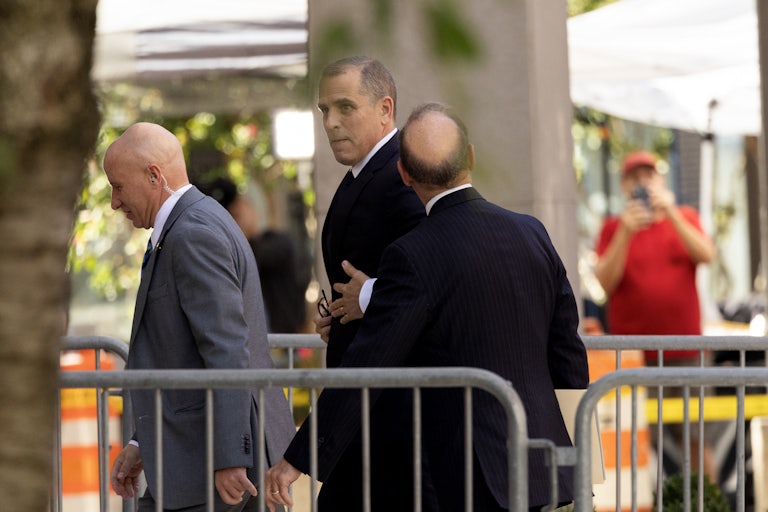
Hunter Biden arrives at federal court in Wilmington, Delaware.

Hunter Biden’s lawyer offered Tuesday to have the embattled first son publicly testify in front of the House Oversight Committee, a marked shift in what has, until now, been a much less aggressive strategy.

Biden has until recently made a practice of keeping his head down as he battles multiple legal cases—including federal charges for owning a gun while using illegal drugs, as well as the ongoing House Republican investigation into his business dealings. Led by Oversight Chair James Comer, the probe has accused Biden and his father, President Joe Biden, of corruption. It has yet to produce any evidence of wrongdoing by the president.

“Here we are, eleven months into your so-called investigation, and every objective review of your ‘revelations’—including by some of your colleagues—has declared your exploration as one turning up only dry holes,” Biden’s lawyer Abbe Lowell said in a Tuesday letter to Comer, which was obtained by The New Republic.

Comer issued subpoenas in early November to multiple members of the Biden family, including Hunter and his uncle Jim. He has repeatedly demanded that they testify. Lowell accused Comer in the letter of using “closed-door sessions to manipulate, even distort the facts and misinform the public.”

“We therefore propose opening the door,” Lowell wrote. “Mr. Chairman, we take you up on your offer. Accordingly, our client will get right to it by agreeing to answer any pertinent and relevant question you or your colleagues might have, but—rather than subscribing to your cloaked, one-sided process—he will appear at a public Oversight and Accountability Committee hearing.”

Based upon recent reporting, this more tenacious approach to Hunter Biden’s legal defense will become the norm, as his legal team abandons an old strategy that sought to keep the president’s son out of the spotlight. As Politico reported in its Tuesday morning edition of Playbook, Biden attorney Kevin Morris says the rationale behind the shift to a more “bare-knuckled approach” is simple: “We want to go on offense because we know we can win. That’s the whole point.”

In addition to offering to publicly testify, Biden has threatened to sue Fox News for former host Tucker Carlson’s claims that Joe and Hunter Biden were involved in a money-laundering scheme. Biden has sued Rudy Giuliani and his former lawyer Robert Costello for allegedly hacking into and distributing Biden’s data.

Biden has also sued the IRS for allegedly failing to keep his tax information private, and he has attempted to subpoena former Trump Justice Department officials, including former Attorney General Bill Barr.

This new strategy has ruffled feathers at the White House, where officials worry it could hurt the president’s reelection chances, Politico reported Tuesday. But some political experts think the new approach might pay off in a way that benefits the president.

“The American public likes to see people fight back,” Jamal Simmons, a former communications director for Vice President Kamala Harris, told Politico. “People who fight for themselves tend to get the benefit of the doubt from the public. And I actually think that probably does help the president in the long run.”

Sports Illustrated Has Hired—and Fired—Some Strange New Writers

The venerable magazine briefly took A.I.-generated content to a hilarious new extreme.

Shane LaVancher/Getty Images

Something funky is going on at Sports Illustrated—several of their authors don’t seem to exist.

According to an investigation by Futurism, the illustrious sports magazine lately seems to be relying on work produced by artificially generated journalists, who sometimes publish artificially generated articles, as well.

“Drew has spent much of his life outdoors, and is excited to guide you through his never-ending list of the best products to keep you from falling to the perils of nature,” read the bio of Drew Ortiz, one of the publication’s new robot stowaways. “Nowadays, there is rarely a weekend that goes by where Drew isn’t out camping, hiking, or just back on his parents’ farm.”

Ortiz, however, has no social media presence and no publishing history outside of Sports Illustrated. One thing the son of a farmer and allegedly avid hiker does have going for him, however, is a profile picture harvested from a website selling A.I.-generated headshots, according to Futurism’s Maggie Harrison, who confirmed with several sources at Sports Illustrated that Ortiz’s content was fabricated.

Ortiz is apparently not the only digital apparition hard at work in their newsroom.

“There’s a lot,” one anonymous source told Futurism regarding the fake authors. “I was like, what are they? This is ridiculous. This person does not exist.”

Over the summer, Ortiz’s account vanished, and in its wake the author’s byline suddenly redirected to a new A.I.-generated writer with no social media presence, no publishing history, and a profile picture from the same A.I.-photo marketplace: someone named Sora Tanaka.

None of these changes came with editor’s notes or corrections explaining the switch-up. What’s more, Harrison’s inquiry was met with a puzzling response: “After we reached out with questions to the magazine’s publisher, the Arena Group,” Harrison reports, “all the AI-generated authors disappeared from Sports Illustrated’s site without explanation.”

Sports Illustrated is not the only publication that’s gotten caught dipping its toes into the murky, plagiarism-laden waters of A.I.-generated content. In January, CNET was caught red-handed publishing A.I.-generated articles containing what have been charitably referred to as “very dumb errors.” In August, newspaper giant Gannett opted to pause its own A.I. experiments when it became clear their bot had no idea how to describe a high school football game. (It’s still unclear if the national publication is still utilizing A.I. for product reviews.) The U.K.-based publications The Daily Mirror and The Express also began publishing artificially generated content in 2023, though their owner says they’re not looking to fire their journalists anytime soon.

Meanwhile, the media industry cut more than 17,000 jobs in 2023 alone—a record number—thanks in large part to dwindling subscriptions and a slow ad market. Losses were felt at some of the industry’s largest and sometimes revolutionary players, including the Los Angeles Times, Buzzfeed, VICE, Vox Media, NPR, and The Washington Post. We may never know what, if anything, Drew Ortiz thinks about that—or anything else.

The Hilarious Reason Elon Musk May Regret Going to War With Sweden

Tesla’s workers in the Scandinavian country have gone on strike—and they’re getting a little help from their friends.

Jessica Gow/Getty Images
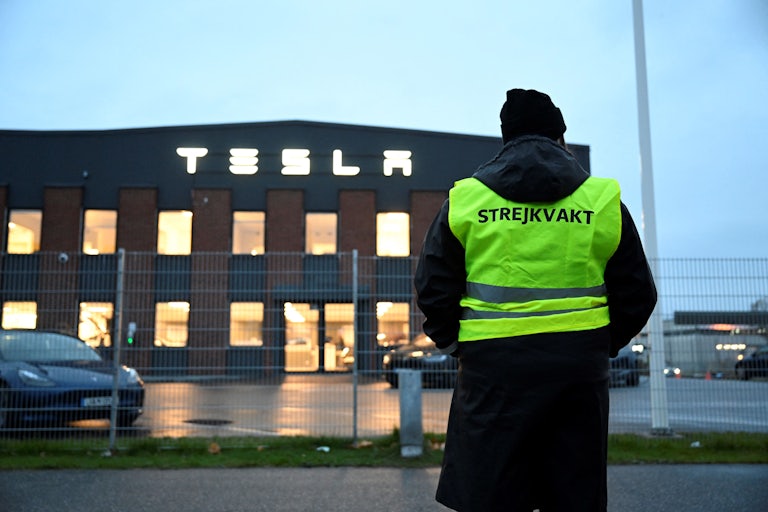
Emma Hansson, chairman of IF Metall Stockholms län stands in front of the electric car company Tesla’s Service Center in Segeltorp, south of Stockholm, as workers strike for the signing of a collective agreement.

Tesla sued the Swedish Transport Agency on Monday, accusing the government office of discriminating against the electric carmaker and gumming up the firm’s ability to provide its customers with new cars. How did the automaker run afoul of the Swedish Transport Agency? Well, first the firm ran afoul of its workers—and then the government agency joined in the conflict, in accordance with a specific labor tradition that’s popular in the Nordic states.

Tesla’s Sweden-based workers have been on strike for five weeks in an effort to win collective bargaining rights. The strike, organized by the union IF Metall, has sparked what are known as sympathy strikes across multiple Swedish industries (and one in Norway). In a sympathy strike, other unions in related or adjacent industries act in solidarity with their fellow laborers, lending their organizing heft to the cause.

One such sympathy strike was launched by the Transport Agency, which is refusing to deliver license plates to new Tesla owners. Naturally, the firm takes a dim view of this: “This confiscation of license plates constitutes a discriminatory attack without any support in law directed at Tesla,” its lawsuit alleged.

There’s one problem: Sympathy strikes are legal in Sweden, so Tesla’s lawsuit doesn’t have much standing there. A district court ruled that Tesla can pick up the plates itself from the manufacturer and then privately distribute them to new Tesla owners while the lawsuit plays out. The Transport Agency has seven days to agree to these terms or be fined one million kroner ($96,000).

“We at the Swedish transport agency now need to analyze the announcement and assess what consequences this has for us and what measures might need to be taken to implement the decision,” Anna Berggrund, director of the Transport Agency’s vehicle information department, told The Guardian. “It is currently too early to say exactly what that would mean.”

Meanwhile, Tesla’s Swedish workforce has been the beneficiary of other sympathy strikes on their behalf, including Swedish dockworkers refusing to unload Tesla shipments, electricians declining to repair charging stations, and cleaning companies withholding their labor, leaving Tesla’s facilities to fend for themselves in terms of cleaning. And the workers’ Norwegian neighbors have gotten into the act as well: Norway’s largest private sector union has said it will block the delivery of Swedish Teslas.

Last week, the Swedish postal union said it will no longer deliver Tesla’s mail, a move that carmaker Elon Musk called “insane.” Tesla’s Swedish subsidiary, TM Sweden, is now suing the postal union over the group’s decision.

“We note that Tesla has chosen to take the long route, starting legal proceedings,” a senior IF Metall official, Veli-Pekka Säikkälä, told The Guardian. “There is a simple and quick way to solve this situation, and that is to sign a collective agreement. As soon as Tesla does that, the conflict ends.”