Breaking News
Breaking News
from Washington and beyond

Ohio Republicans Force Through Cruel Ban on Gender-Affirming Care for Minors

The GOP-controlled legislature ignored pleas for compassion in overriding the governor’s veto.

Drew Angerer/Getty Images
Governor Mike DeWine had vetoed the bill, but later signed an executive order banning gender-affirming surgeries for minors.

Ohio’s Republican-controlled General Assembly has voted to override Governor Mike DeWine’s veto of a bill that would ban gender-affirming care for minors. The measure will now become law, a further blow to LGBTQ Ohioans.

The state Senate voted 23–9 on Wednesday in favor of the override, primarily along party lines. The state House of Representatives passed the measure two weeks ago with a vote of 65–28.

Senate Minority Leader Nickie Antonio, a Democrat, urged her colleagues not to pass the bill. She pointed out that state residents had already rejected government intervention in health care when they voted in November to enshrine abortion rights in the state constitution.

“The voters spoke when they voted in the last election that the government should not be in charge of their health care decisions,” Antonio said.

“If what we all agree on today is that this is a complicated issue that none of us have all the answers for, I don’t understand why we would just close the door,” she continued. “We don’t know what their lives are like, but the parents do. The families do.”

House Bill 68 bans gender-affirming care for transgender and nonbinary teenagers. The measure applies to treatments including puberty blockers, hormones, and medical procedures; it also prohibits trans high school and college students from participating on sports teams that match their gender identity.

DeWine shocked everyone when he vetoed the bill in late December, a rare bright spot in the current onslaught of measures restricting access to gender-affirming care. DeWine cited the medical community’s support for gender-affirming care as a factor in his decision, as well as conversations he had with trans teens and their parents.

“Parents have looked me in the eye and told me that but for this treatment, their child would be dead,” he said. “And youth who are transgender have told me they are thriving today because of their transition.”

But just a week later, DeWine undid everything when he signed an executive order banning gender-affirming surgeries for minors in Ohio and even restricting access to care for adults. Under the new rules, people of any age seeking gender-affirming care must get permission from multidisciplinary teams. Those teams could include an endocrinologist, a bioethicist, a psychiatrist, and more.

Ohio is now one of the few states to mandate these extra steps, which will add an undue burden for patients. The requirements will likely rack up significant medical expenses and dramatically extend how long people must wait to access what is widely viewed as lifesaving care.
Conservatives Are Totally Not Mad About Jon Stewart’s Return to The Daily Show

Apparently the political comedian pushes the right’s buttons without even saying a word.

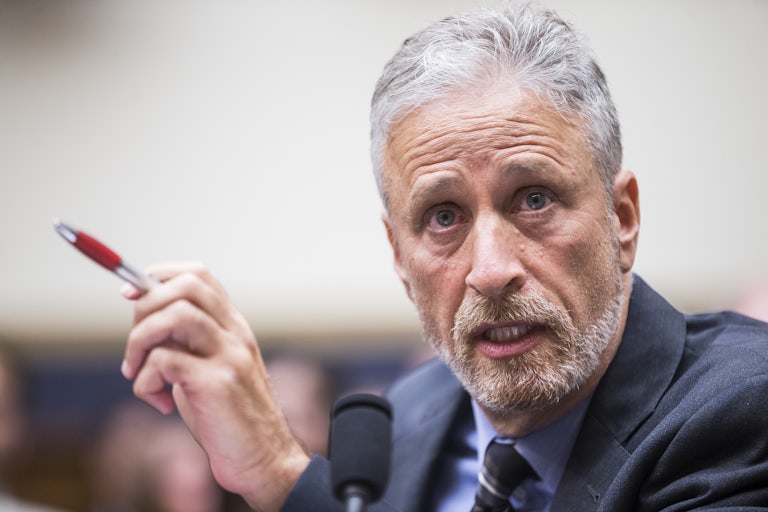
Stewart in 2019
Zach Gibson/Getty Images
Stewart in 2019, testifying in support of the September 11th Victim Compensation Fund

Fans of The Daily Show rejoiced on Wednesday after Comedy Central announced the triumphant return of Jon Stewart, who will serve as an executive producer and Monday host through the rest of the election cycle. Prominent Substacker Charlotte Clymer compared the news to Michael Jordan’s return to the NBA, and a U.S. senator, Jon Tester, also extended a hand in welcoming Stewart back.

But not everyone was sunshine and roses about Stewart’s new weekly gig, with some on the right complaining that the choice to bring back the show’s former 16-year host would only bring more volatility to American politics.

“Jon Stewart, who did so much to create the current political environment of inter-tribal vilification in place of argument, returns to survey the wreckage,” Dan McLaughlin, a senior writer at National Review, wrote in a post on X.

Nate Hochman, his former colleague at the conservative magazine, chimed in, “Jon Stewart’s brand of smirking, needling, speaking-truth-to-power liberalism made sense in the specific context of the Bush era, when there was at least a plausible case that the Left was ‘anti-establishment.’”

Others attempted to falsely conflate the industry’s recent wave of layoffs and hedge fund–induced instability with Stewart’s return. Right-wing podcaster and Substacker Stephen Miller tweeted:

But even some on the left dismissed the 61-year-old’s return on the basis of his canceled Apple TV+ show, The Problem With Jon Stewart. Ben Dreyfuss, formerly of Mother Jones, wrote:

Latest From Politics

No Labels Is Getting Sued by Its Own Donors for Its Third-Party Chicanery

A pair of deep-pocketed real estate moguls aim to hurt the organization that wants to hurt Joe Biden’s chances.

Andrew Burton/Getty Images
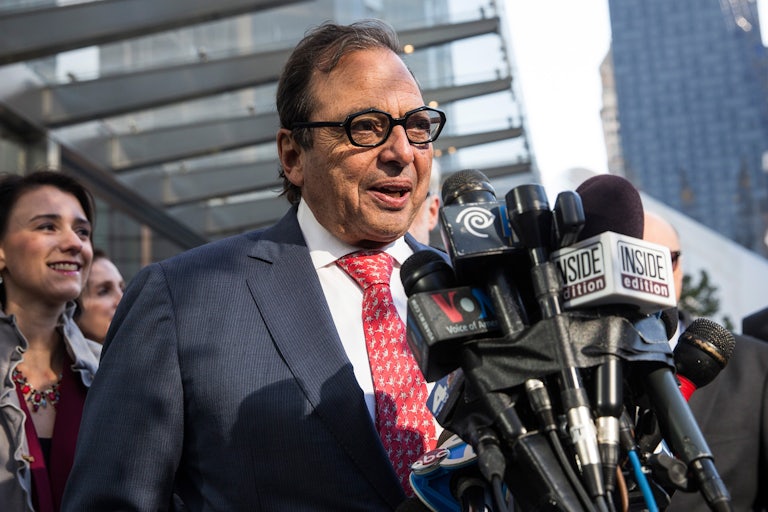
New York City real estate developer Douglas Durst

New York City real estate titans Douglas and Jonathan Durst of the Durst Organization sued No Labels on Tuesday, claiming the centrist political advocacy nonprofit pulled a “bait and switch” after the group announced it had plans to run a third-party campaign in the upcoming presidential election.

The suit, filed in New York State Supreme Court, claimed that No Labels “lost its way” after receiving $145,000 from the cousins under the pretense that it would organize voters against partisanship and offer a home for the “politically homeless”—not stack the chances against President Joe Biden in an increasingly grave race for the White House.

The Dursts argue that the current iteration of No Labels—which claimed to be “not a third party, but rather a third bloc,” according to the moguls’ legal complaint—has “become the opposite” of what they initially set out to fund.

“The promise of promoting bipartisan government that No Labels made to donors such as the Dursts has now been irretrievably broken, and the Dursts, for one, want their money back,” reads the complaint. “They want no part of an organization that seems bent on pursuing a doomed third-party presidential bid outside the nation’s de facto two-party system.”

Although the nonprofit’s website says it has yet to commit to running a candidate in the race, it has clearly been paving the way for the possibility of doing so. Earlier this month, No Labels announced that it had gained ballot access in 13 states, from Hawaii to Maine.

“A third-party ticket option will only discourage bipartisan reform because it will take votes away from one of the major political candidates, giving an advantage to the other candidate,” the suit says.

But a leader and lawyer for No Labels, Dan Webb, described the suit to Courthouse News as “frivolous,” pointing out that the Durst cousins last sent checks to the nonprofit in 2020 and 2017. Webb told The New York Times that No Labels’s “fundamental mission has never changed.”

“This is nothing more than an organized distraction. Douglas’ last contribution was six years ago, and Jody’s last contribution was over three years ago. These contributions were spent on priorities that the Dursts had no complaints about at the time,” Webb told Courthouse News. But as they say, money—much like No Labels’ convictions—is fungible.

Donald Trump’s Relationship With Lindsey Graham Is About to Go Very Ba

A new book describes how the South Carolina senator threw the former president “under the bus.”

Drew Angerer/Getty Images
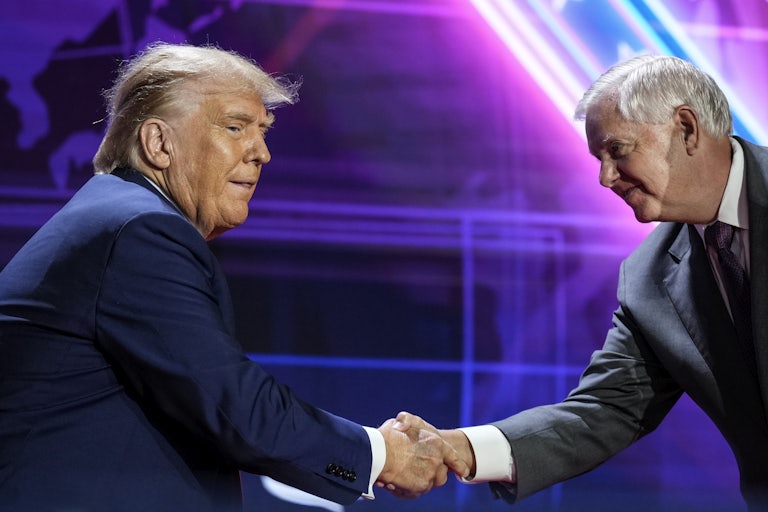
President Donald Trump and South Carolina Senator Lindsey Graham, in happier times

South Carolina Senator Lindsey Graham completely threw Donald Trump “under the bus” when the senator testified before the grand jury in Georgia’s election interference case, a new book reveals.

Graham, who has spent most of the last half-decade as a steadfast Trump loyalist, had been summoned to testify before the grand jury over a phone call he had made to Georgia Secretary of State Brad Raffensperger. After fighting the subpoena for months, Graham finally appeared to testify—and flipped immediately, according to a new book by investigative reporters Michael Isikoff and Daniel Klaidman.

“After fighting a four-month legal battle all the way to the U.S. Supreme Court to block his grand jury subpoena—and losing—South Carolina Senator Lindsey Graham turned on a dime ‘and threw Trump under the bus,’” Isikoff and Klaidman wrote in their book Find Me the Votes: A Hard-Charging Georgia Prosecutor, a Rogue President, and the Plot to Steal an American Election, citing anonymous sources.

According to the testimony, which the authors confirmed, Graham said that if you told Trump “that Martians came and stole the election, he’d probably believe you.”

Outside of the pages of Isikoff and Klaidman’s book, Graham has positioned himself as one of the president’s most ardent defenders. Last month, he took a harsh stance against the effort among a handful of secretaries of state to kick Trump off their presidential ballots via the language of Article 3 of the Fourteenth Amendment. And as recently as three weeks ago, Graham defended the former president’s actions on January 6, 2021, telling Face the Nation that Trump’s claim of presidential immunity was “valid.”

“Now, if you’re doing your job as president,” Graham said, a defense substantially at odds with the account documented in Isikoff and Klaidman’s book, “and January the sixth, he was still president trying to find out if the election, you know, was on the up and up—I think his immunity claim, I don’t know how it will bear out, but I think it’s a legitimate claim.”

In a hilarious side note, Graham also hinted that Trump cheated at golf, a sharp contrast to comments he made a few years earlier. In 2017, a more deferential Graham insisted that Trump “shot a 73 in windy and wet conditions!”

After his grand jury testimony, Isikoff and Klaidman wrote, Graham bumped into Fulton County District Attorney Fani Willis, who led the investigation into Trump and ultimately indicted the former president. Graham actually thanked Willis for letting him share his side of the story.

“That was so cathartic,” he said. “I feel so much better.”

Graham then hugged Willis, who seemed unperturbed by the encounter, an eyewitness told Isikoff and Klaidman.

The backstory will live in infamy: Graham called Raffensperger on Trump’s behalf soon after the 2020 election, after it became clear that Joe Biden was set to take the White House. According to Raffensperger, Graham asked whether the secretary had the power to throw out all mail-in ballots from certain counties.

Raffensperger told The Washington Post he felt Graham was asking him to illegally discount valid ballots. This phone call occurred a week before Trump’s own infamous phone call to Raffensperger, during which he begged the secretary to “find” the exact number of votes needed to flip Georgia to Trump. Raffensperger held firm in both cases.

Graham was so involved in the scheme that the special grand jury actually recommended he be indicted for his actions. The special grand jury’s full report was released in September, and it revealed that Graham and former Georgia Senators Kelly Loeffler and David Perdue all narrowly escaped charges for their role in trying to overturn the 2020 election.

Everyone Agrees the GOP Primary Is Over—Except Nikki Haley

The former South Carolina governor is hell-bent on pressing on, but Republicans are closing ranks.

Brandon Bell/Getty Images

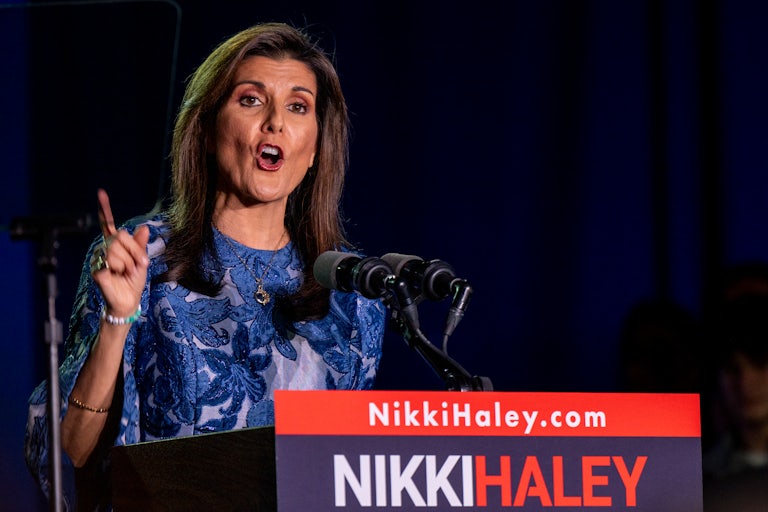
Donald Trump’s double-digit win in Tuesday’s New Hampshire primary has pretty much everyone arguing that it’s time to either rally around Donald Trump as the GOP candidate or, if you’re not so inclined, to begin the campaign against him in earnest.  There is, however, one person not on board with this plan—Nikki Haley.

“You’ve all heard the chatter among the political class. They’re falling all over themselves saying this race is over,” Haley told a crowd of supporters after acknowledging Trump’s win in the Granite State. “Well I have news for all of them—New Hampshire is first in the nation. It is not the last in the nation.”

“This race is far from over. There are dozens of states left to go,” Haley added.

Technically, that is true. But positioning herself once again as Trump’s leading rival doesn’t seem to be convincing anyone—including President Joe Biden, whose campaign took Trump’s Tuesday night win as the starting gun for “one of the longest and most grueling general elections in modern American history,” according to Politico.

Typically, a candidate needs to win 1,215 delegates across the country to secure their party’s nomination for the White House. But the resilience of Trump’s personality-cult fandom and his nationalist appeal to the Republican base, which at times has put him more than 55 percentage points ahead of his opponents in nation-wide polls, have singled him out as an “unbeatable” candidate in the GOP race, even with just 32 delegates in the bag. 

“I’m looking at the math and the path going forward, and I don’t see it for Nikki Haley,” Republican National Committee Chair Ronna McDaniel told Fox News’s Bret Baier and Martha MacCallum on Tuesday. “I think she’s run a great campaign, but I do think there is a message that’s coming out from the voters, which is very clear.”

“We need to unite around our eventual nominee, which is going to be Donald Trump, and we need to make sure we beat Joe Biden,” McDaniel added.

Other prominent figures from Republican leadership agreed with the sentiment, pushing Trump forward as their nominee after just one primary.

“It’s time for Republicans to unite around President Donald Trump and make Biden a one-term president,” Nebraska Senator Deb Fischer said in an announcement endorsing Trump.