Breaking News
Breaking News
from Washington and beyond

Ron DeSantis Suddenly Pretends He Hates the Thing He Loves the Most

The Florida governor is trying to backtrack on some of his signature legislation.

Ron DeSantis holds his hand to his chest as he speaks into a microphone
Paul Hennessy/SOPA Images/LightRocket/Getty Images

Florida Governor Ron DeSantis is backtracking on his statewide book restrictions, signing a bill that will limit how—and who—can propose limits on local reading.

The new law, signed Tuesday, will give non-district residents just one opportunity per month to challenge a book they’d like to restrict access to. According to a February press release, some of the many objections made over the past year were submitted by individuals “who don’t have children learning in Florida.”

According to DeSantis’s office, the new legislation “protects schools from activists trying to politicize and disrupt a district’s book review process.” That includes texts such as Johnny Appleseed, The Giver, and the Bible, all of which DeSantis’s office has previously cited as targets.

“I think what’s happened though, is you have some people who are taking the curriculum transparency, and they’re trying to weaponize that for political purposes,” DeSantis said during a press conference.

Actual residents will, however, retain unlimited opportunities to propose book bans. Local organizations attempting to combat the statewide book restrictions noted that the law is but a paltry gain for book access.

“The point is, HB 1285 is not ‘mission accomplished’ on stopping the needless censorship happening in FL schools, but it might slow it in certain areas,” posted the Florida Freedom to Read Project on X. “So for that, thanks for this small amendment to 1006.28. Let’s tackle this again in 2025.”

Despite repeatedly insisting that his state’s education restrictions don’t amount to a “book ban,” DeSantis has undoubtedly wielded a heavy hand in rewriting Florida’s educational code. In the last few years, DeSantis has banned classroom discussion of gender and sexuality, gutted DEI programs within the state, and, of course, allowed unlimited challenges to which reading texts can be accessed by Florida students.

Just Wednesday, the Florida governor was hard at work in another sphere of education, signing a bill requiring state educators to teach students about the “dangers and evils of Communism.” The legislation will “prepare” students to “withstand indoctrination on Communism at colleges and universities,” and proposes the creation of a museum that covers the “history of communism,” according to a release by DeSantis’s office.

Many of the books targeted under DeSantis’s signature 2022 legislation deal with topics such as race, gender, and sexuality, but others should be far less controversial. Some of the challenges have been over cartoon illustrations of naked goblin butts and even the dictionary.
Jamie Raskin Went Up Against James Comer. Guess Who Came Out Ahead?

A House hearing was derailed when Raskin and Comer couldn’t stop sniping at each other.

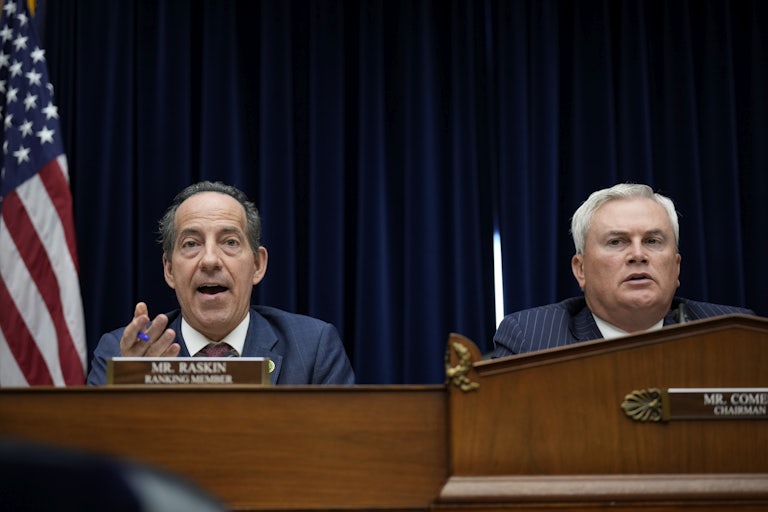
Jamie Raskin and James Comer sit next to each other
Drew Angerer/Getty Images

A House Oversight Committee hearing on Wednesday quickly devolved into leading Representatives James Comer and Jamie Raskin arguing over Joe Biden’s (nonexistent) crimes.

Although the hearing was on China’s political warfare against the United States, it wasn’t long before Comer managed to shift the topic to his pet project: trying to impeach Biden. Things started to go off the rails when Comer repeated a long-discredited claim that Biden was bribed by China, an allegation that came from shady witness Tony Bobulinski. Raskin called out Comer for repeating the claim without actually moving forward on impeaching Biden.

With no trace of irony, Comer then accused Raskin and his fellow Democrats of being obsessed with Russia and Donald Trump, ignoring his own fixation with Joe Biden. He mentioned that Raskin might “need therapy.” The two argued back and forth, talking over each other until Comer resorted to pounding his gavel. Raskin, for his part, slammed Comer for failing to find a high crime or misdemeanor committed by the president.

“What is the crime that you want to impeach Joe Biden for and keep this nonsense going? Why? What is the crime? Tell America right now,” Raskin demanded at one point.

Speaking over Raskin, Comer said, “You’re about to find out very soon,” despite having witnesses repeatedly contradict and debunk Republican claims.

Raskin also called out Comer for wasting money on the investigation, which Comer denied, despite the fact that it has stretched on for months.

This isn’t the first time that Raskin, the ranking member on the committee, has torched the GOP’s Biden impeachment attempt. Only two weeks ago, he called it a “foreign disinformation” campaign without a basis in facts.

House Republican Delays Departure to Screw Over His Own Party

Representative Mike Gallagher is staying an extra few days to help with a foreign aid package.

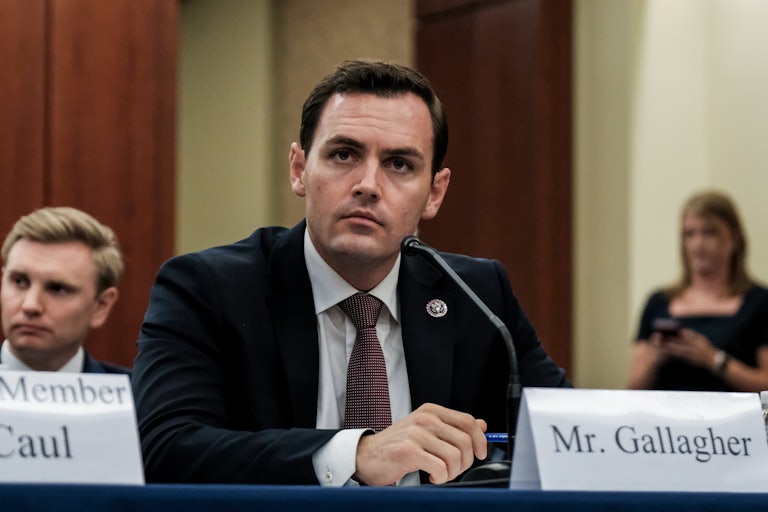
Mike Gallagher sits at a table
Michael A. McCoy/Bloomberg/Getty Images
Representative Mike Gallagher

Representative Mike Gallagher’s last day in Congress was supposed to be Friday, but some wavering votes on upcoming legislation might delay his exit.

The Wisconsin Republican confirmed Wednesday that he would be sticking around for an “extra day or so” to help push through Speaker Mike Johnson’s foreign aid package for Taiwan, Israel, and Ukraine, according to CNBC’s Emily Wilkins.

“His office says he has the flexibility,” Wilkins wrote on X, formerly known as Twitter.

Gallagher’s decision to stay may help offset a growing number of Republicans who appear upset about a series of forthcoming bills, which include the foreign aid package, a border security bill that will include “core components” of the GOP’s border security proposal known as H.R. 2, an amendment process on the Rebuilding Economic Prosperity and Opportunity for Ukrainians Act, and Gallagher’s TikTok ban.

One of those uncertain Republicans is South Carolina Representative Ralph Norman, who reversed his stance on the supplementary aid package on Tuesday after supporting it for the better part of the last week, telling Politico’s Jordain Carney that he wasn’t sure he’d vote in support of it in the Rules Committee anymore.

“I don’t know. This is very upsetting. And I don’t understand it,” Norman told Carney.

And Gallagher’s delayed leave will push back a proposal by Georgia Representative Marjorie Taylor Greene to strip Johnson of the gavel over his support for Ukraine, an effort that received a small boost of support on Tuesday after Kentucky Representative Thomas Massie announced he was also sick of Johnson. That effort needs just one more conservative defector in order to oust the speaker—or it could move forward with just the two of them, if it takes place after Gallagher’s exit.

When the Wisconsin lawmaker announced his leave in March, he chose the original exit date of April 19 with apparent disregard for how his caucus might replace him. That date was already too late to host a special election to refill his seat and help Republicans keep their razor-thin majority. The new date of departure, which seems to be foggy, won’t make that process any easier.

Kari Lake Has a Terrifying Prediction Ahead of the 2024 Election

The Republican Senate candidate warned that the next six months will be intense.

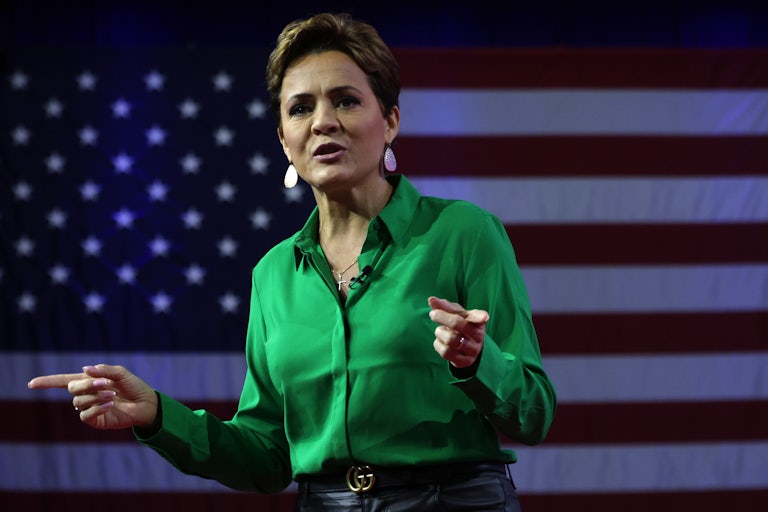
Kari Lake talks
Alex Wong/Getty Images

One of Donald Trump’s favorite acolytes, Arizona Senate candidate Kari Lake, wants MAGA to be strapped in time for the elections coming up in November.

“We are going to put on the armor of God. Then maybe strap on a Glock,” Lake said to cheers at a rally Sunday.

“You can put one here,” she continued, touching her right hip. “And one in the back, or one in the front, whatever. You guys decide.”

The apparent call to violence comes alongside Senator Tom Cotton’s post on X (formerly Twitter) Tuesday, in which he suggested that peaceful protesters who block traffic should be removed with physical violence. The rhetoric hints at possible violent reactions to the election results, whether they turn out good or bad for MAGA Republicans. Trump himself has warned that “it’s gonna be a bloodbath” if he loses in November (he later claimed he was talking about the automotive industry) and said that 2024 could be the “last election we ever have.”

The memory of the January 6 attack now looms large over every election in the United States, and right-wing figures are making no attempt to calm the mood. The fact that Trump’s trial over the insurrection has been held up by the Supreme Court also sends the message that encouraging violence carries little, if any, real consequences.

Lake is running to fill the seat vacated by the quixotic Kyrsten Sinema, who resigned from the Senate in March. Lake herself lost the race for Arizona governor in 2020 after running a hyperbolic, fearmongering campaign focused on voter fraud and the “Big Lie,” and refused to concede afterward. This time, Lake is up to her old tricks and has even been accused of blackmail by other Arizona Republicans.

But polls have her running behind Democrat Ruben Gallego in the Senate race, and the news that the Arizona Supreme Court upheld a 160-year-old law banning nearly all abortions in the state won’t help Lake’s cause. As a result, she’s desperately flip-flopping on abortion, even trying to run away from her previous stance.

Read about Republicans calling for political violence:

Trump Hush-Money Jurors Receive Chilling Warning From Legal Expert

Potential jurors are being kept anonymous for a reason.

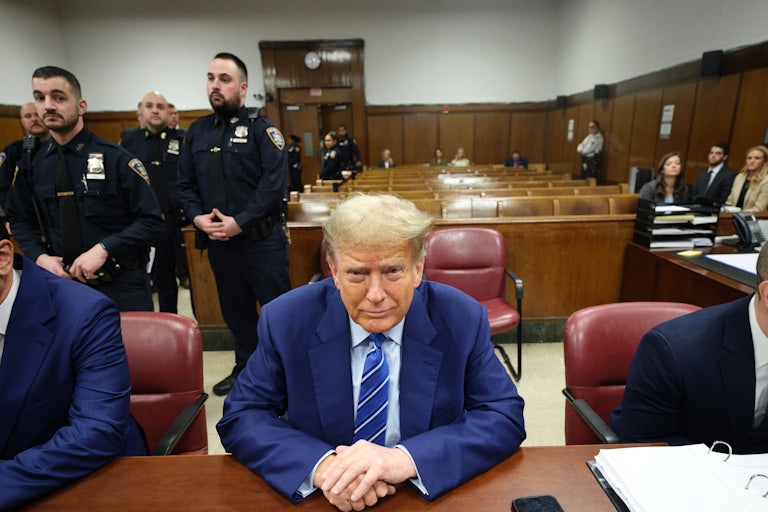
Donald Trump smiles as he sits at a table with his hands folded
Curtis Means/Pool/Getty Images

The jurors in Donald Trump’s hush-money trial are anonymous, with their names only shared among the trial’s judge and prosecution and defense teams. But some legal experts are still concerned about their safety.

Former federal prosecutor Ankush Khardori warned Tuesday that the onslaught of available information about the forthcoming jury—which included a Washington Post reporter outing one potential juror’s profession and identifying the businesses where they work—might be too much to keep them safe during the first criminal trial of a former president in U.S. history.

“What’s going through the minds of these jurors right now?” prompted CNN anchor Wolf Blitzer.

“I have some thoughts about the jury’s position here,” replied Khardori. “First of all, I imagine it’s somewhat surreal, right? To be selected. I am wondering if some of them are a little unhappy with the amount of information that is being made public about them.”

But Khardori doesn’t blame the press for their role in amplifying the sensitive details. Instead, he blames the gatekeepers of the information, the Manhattan District Attorney Alvin Bragg’s office and Judge Juan Merchan, for failing to safeguard it.

“Now, this is not the fault of the media. I wanna be very clear about this,” he continued. “Responsibility to guard all of the very specific information that we’re learning resides with the D.A.’s office and with the judge.”

“I’m a little surprised that we are learning all of this because I do not think this jury is gonna remain anonymous necessarily if they keep this up,” Khardori said.

“You’re worried about their safety?” asked Blitzer.

“Yeah, I’m worried about their safety,” Khardori said. “I mean, it’s up to them if they want to write a book after all this is said and done, but that’s their option. They shouldn’t be outed this way. They’re not supposed to be outed this way.”

There’s a reason that the potential jurists’ identities are supposed to be so carefully guarded. When Trump and 18 of his allies were indicted in Georgia, the people on the grand jury were kept anonymous. But when their names and other personal, identifying information about them began circulating on the internet, a wave of threats quickly crashed on top of them.

That prompted Judge Lewis Kaplan, who presided over E. Jean Carroll’s defamation trial against Trump, to take extraordinary measures to help the jurists maintain their anonymity, including keeping them not just anonymous but also partially sequestered.

“My advice to you is that you never disclose that you were on this jury,” Kaplan warned them after the trial ended in January.