Breaking News
Breaking News
from Washington and beyond

Cognitive Decline? Trump Makes Bonkers Claim About Drug Prices

Donald Trump exposed his own cluelessness about how drug pricing works.

Donald Trump gestures and speaks while sitting next to Robert F. Kennedy Jr.
Jim Watson/AFP/Getty Images

The president’s great solution to equalize America’s prescription costs with countries around the globe apparently boils down to raising the cost of drugs everywhere else.

Donald Trump explained during the unveiling of Robert F. Kennedy Jr.’s “Make America Healthy Again” report Thursday that his administration had had intense discussions with the country’s biggest pharmaceutical companies, allegedly cornering them into lowering the cost of drugs by raising them in other nations.

But further details of Trump’s plan didn’t sound like a leader that was hard on drug companies.

“The companies are all coming in, we’ve had some very promising interactions,” said former TV host and Centers for Medicare and Medicaid Services Administrator Mehmet Oz. “People have talked about drug prices in a silo in isolation, but when you start going to the countries where they give discounts to because they’re getting beat up there and you support these companies, they see a huge upside potential. Even greater than the numbers you mentioned.

“They should be able to charge more than what they would have historically been tolerant of, if they have the support of the U.S. government and you,” he continued, mentioning that Kennedy was aware of the conversations with drug companies.

“Well, they were artificially low and artificially high. We were artificially high, they were artificially low,” Trump responded, emphasizing that the government would be acting expediently to enact the international price changes.

It’s not the first time that Trump has lied that America subsidizes the health care of other countries, and that low drug prices outside the U.S. are because the American government has financially offset would-be high prices in other countries.

But that’s detached from reality: The U.S. pays more for drugs because it’s an outlier among high-income, developed countries, which predominantly support universal public health coverage—not because the U.S. government “subsidizes” drug costs in other developed nations.

Other things that researchers point to as potential solutions for high drug prices in the U.S. include restricting pharmaceutical monopolies within the country, reworking insurance benefits to restrict out-of-pocket, and recentralizing price negotiations through the leverage of a single-payer system (like those in Australia, Germany, the U.K., or any number of other wealthy nations), according to a report by the Commonwealth Fund, a private American foundation focused on health care reform. It’s unclear how the Trump administration would work to undo the policies and regulations in foreign countries that keep their drug prices low.

Beyond that, America’s lax drug pricing has historically been thanks to Trump’s party.

In a post on Truth Social earlier this month, Trump pledged that his executive order focused on hacking prescription drug prices would save the government trillions of dollars. He also falsely claimed that Democrats had stood in the way of this kind of pharmaceutical reform, ignoring the fact that health care and pharmacy drug reform has been a pillar of the progressive platform in recent years (see: Representative Alexandria Ocasio-Cortez’s “Medicare for All” 2021 revival, which would have created a single-payer system in this country).

“Campaign Contributions can do wonders, but not with me, and not with the Republican Party. We are going to do the right thing, something that the Democrats have fought for many years,” Trump wrote at the time.

But in 2006, Republicans were the ones who adamantly stood in the way of federal drug price negotiations, ripping the teeth out of a bill that would have mandated drug companies to negotiate lower drug prices with Medicare officials.

“Instead of actually tackling the issues that concern average American families, the Republicans have passed legislation to help their wealthy friends and the huge corporations that support their campaigns,” said former North Carolina Representative G.K. Butterfield at the time before the measure passed.
Trump’s FTC Goes to War Against Media Group Elon Musk Despises

The Federal Trade Commission is launching an investigation into Media Matters, a nonprofit organization also being sued by Elon Musk.

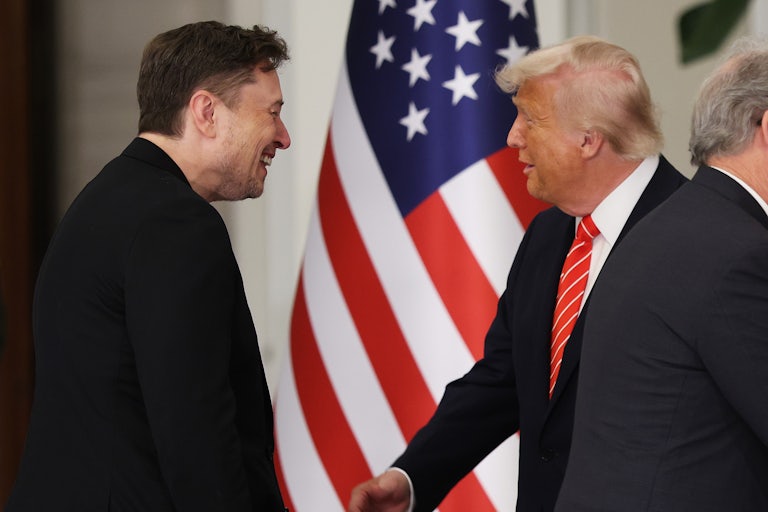
Donald Trump and Elon Musk laugh while standing in front of a U.S. flag.
Win McNamee/Getty Images

The federal government is now investigating the liberal media watchdog Media Matters, an organization that Elon Musk is currently suing. 

The Federal Trade Commission on Wednesday announced the investigation into whether the nonprofit illegally colluded with advertisers in a boycott of X, The New York Times reports, citing two unnamed sources. The investigation demands that Media Matters turn over all documents the organization has received or created regarding advertiser boycotts. 

FTC Chair Andrew Ferguson, appointed by President Trump, hinted at conducting such investigations in December, saying, “We must prosecute any unlawful collusion between online platforms, and confront advertiser boycotts which threaten competition among those platforms” in a statement about an unrelated case. 

In 2023, Musk filed a lawsuit against Media Matters, which is still ongoing, claiming that it attempted to damage his social media company X’s relationship with advertisers.  That lawsuit seems hinged on research published by Media Matters on antisemitic and hateful content flourishing on X, shortly after Musk’s purchase of the platform. 

The study pointed out that the platform placed ads for major brands, including Apple, Bravo, IBM, Oracle, and Xfinity, next to pro-Nazi content. The report resulted in Apple and IBM ending their advertising relationship with X, and most other major brands followed suit. 

In March, Media Matters, which monitors conservative media, sued X for breach of contract over the tech oligarch suing the nonprofit in Texas, Ireland, and Singapore, alleging that X’s terms of service required legal action to be filed in San Francisco. The organization called Musk’s actions “a vendetta-driven campaign of libel tourism.”

Media Matters alleges that Musk’s lawsuits have cost the organization millions of dollars and led to employee layoffs. 

“X’s worldwide campaign of intimidation seeks to punish Media Matters for exercising its core First Amendment rights on a matter of public importance,” the lawsuit states. “This Court should stop X’s antics and enforce the forum selection clause that X itself drafted.”

If Musk’s lawsuits proceed against Media Matters, they could open up X to the legal discovery process and expose internal communications within the company over how it handled hateful content and whether it knew about failed safeguards against brand advertisements appearing next to such content.  

Now, though, Musk not only has his pending lawsuits to bleed the nonprofit organization but also the power of a government agency investigation. All of this will help the world’s richest man silence media criticism of how his social media platform has helped racism, antisemitism, and other hateful content proliferate around the world.

Karoline Leavitt Snaps When Asked About Trump’s White Genocide Rant

Donald Trump continues to insist that white farmers are under attack in South Africa.

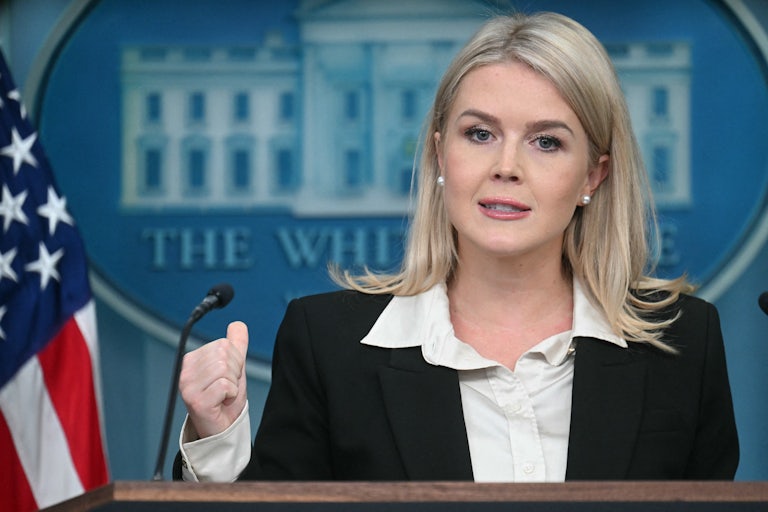
Karoline Leavitt gestures while speaking at the podium during a White House press briefing
Jim Watson/AFP/Getty Images

The U.S. president’s meeting with South African President Cyril Ramaphosa Wednesday featured a clip cooked up by the White House falsely alleging “white genocide” in the post-apartheid nation. But when pressed as to why Donald Trump lied that thousands of white farmers had been “murdered” in South Africa, administration officials balked.

“The president showed a video that he said showed more than 1,000 burial sites of White South Africans that he said were murdered,” said NBC News’s Yamiche Alcindor, during a press briefing Thursday. “We know that that was not true, and that the video wasn’t true. So I wonder, why did the president choose to show that?”

“No, it is true that the video showed the crosses,” said White House press secretary Karoline Leavitt. “The video showed images of crosses in South Africa about white farmers who have been killed and politically persecuted because of the color of their skin, and those crosses are representing their lives and that they are now dead and their government did nothing about it.”

The clip in question showed a thin strip of highway from Newcastle and Normandein in South Africa. It was not a “burial site” as Trump had claimed, locals told the BBC Thursday. Instead, it was a “temporary memorial” to symbolically commemorate murdered farmers across the country. South Africa has 64 million people in it, but every year more than 26,000 people are murdered, making the country’s murder rate roughly nine times higher than that of the United States.

Studies indicate that the vast majority of murder victims in South Africa are Black or mixed-race men between the ages of 15 and 44 and that most of them are economically disadvantaged.

South Africa notoriously maintained its oppressive system of apartheid through the early 1990s, segregating Black South Africans from white residents and depriving them of civil and political power.

Despite that history, the world’s richest man—and richest white Afrikaner, Elon Musk, has used his platform to push the narrative that South Africa oppresses white people, particularly white people of means, claiming that the nation unfairly restricts white citizens via “racist laws.” (Ramaphosa offered Musk a Starlink contract ahead of the head of state’s meeting with Trump, Bloomberg reported Tuesday, in spite of the fact that Musk’s business doesn’t fit the parameters of South Africa’s Black Economic Empowerment laws.)

Even white South Africans have protested that claims of a “white genocide” in their country are false.

“There’s no sign of it, never has been. In fact, Whites are economically the strongest group” in the country, Piet Croucamp, an academic at North-West University in South Africa, told CBS News. “Sixty-four percent of all boardrooms in South Africa are still White. The average incomes of White South Africans are vastly higher than Black South Africans’.… They have better schools, they have better education, private health care. This is the land of milk and honey if you’re white.”

Judge Dumps Cold Water on Trump’s International Student Crackdown

Donald Trump’s administration has been targeting international students.

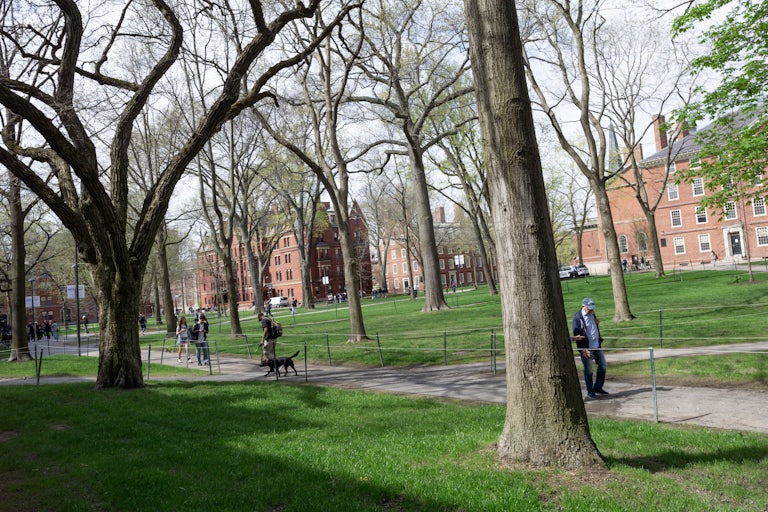
People walk on Harvard University’s campus
Andrew Lichtenstein/Corbis/Getty Images
A federal judge blocked Donald Trump’s latest escalation against foreigners in the U.S. on Thursday, a ruling that came just hours after the Department of Homeland Security announced that it would revoke Harvard University’s ability to enroll international students.
U.S. District Judge Jeffrey White in California barred the government from changing international students’ legal status until cases challenging previous visa revocations are resolved. He said that the government’s actions had “wreaked havoc not only on the lives of Plaintiffs here but on similarly situated F-1 nonimmigrants across the United States and continues do so.”
White’s ruling came on the heels of a DHS statement that said Harvard “can no longer enroll foreign students and existing foreign students must transfer or lose their legal status.”
DHS alleged that Harvard had created an unsafe campus by allowing “anti-American pro-terrorist agitators” on-site, and claimed without evidence that the university had collaborated with the Chinese Communist Party. Earlier this week, the House Select Committee on the Chinese Communist Party launched an investigation into Harvard’s partnerships with organizations with alleged ties to the CCP.
This latest escalation follows a threat from Secretary of Homeland Security Kristi Noem, who threatened to revoke the “privilege” of enrolling foreign student visa holders unless the university turned over records on the “illegal and violent” activities of its students.
Despite the fact that Harvard had delivered some unspecified documentation to the Trump administration, Noem claimed that the university had failed to adhere to the law. “Harvard had plenty of opportunity to do the right thing. It refused,” she said in a statement.
Here, the Trump administration’s mounting campaigns against Harvard and international students go hand in hand. Last month, the Department of Justice was forced to back off of efforts to revoke student visas over minor legal infractions, after a staggering number of legal challenges. But the DOJ said that it would be developing a new policy to change F-1 visas to make it easier to remove foreign students.
At the same time, the Trump administration has moved to severely restrict the free speech of international students, who have been arrested by ICE for pro-Palestinian speech the government alleges interferes with its foreign policy interests.
This story has been updated.

Karoline Leavitt Says You’ll Never Know Who’s at Trump’s Crypto Dinner

Trump’s press secretary made a shocking defense of the obvious pay-to-play dinner with Trump.

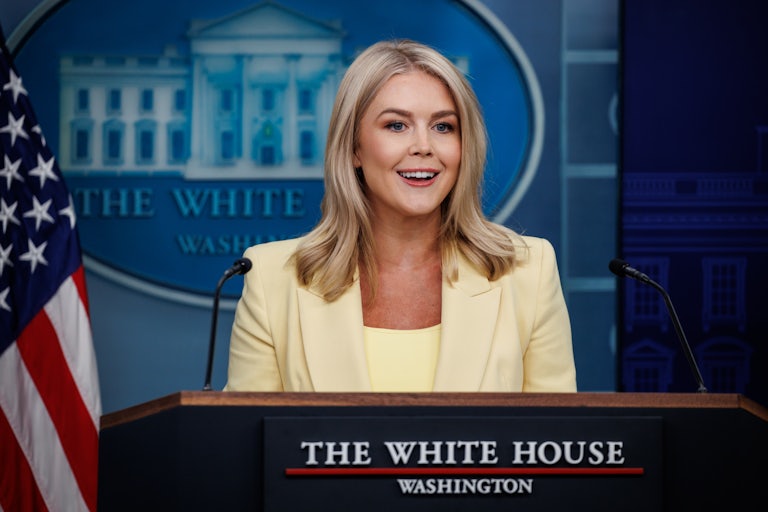
Karoline Leavitt smiles at the podium in the White House Press Briefing Room.
Samuel Corum/Bloomberg/Getty Images

President Trump is refusing to release the guest list of his pay-to-pay crypto dinner, as his press secretary Karoline Leavitt argues that the dinner is in his “personal time.”

“On the president’s dinner tonight, will the White House commit to making the list of the attendees public so people can see who’s paying for that kind of access to the president?” a reporter asked Leavitt at the White House press briefing on Thursday.

“Well as you know, Garret, this question has been raised with the president. I have also addressed the dinner tonight; the president is attending it in his personal time, it is not a White House dinner, it is not taking place here at the White House,” Leavitt responded, ignoring the specific question about who was going to be at this dinner. “Certainly I can raise that question and try to get you an answer for it.”

The dinner will be held at Trump’s private golf club in northern Virginia on Thursday evening for the top 220 holders of the president’s cryptocurrency—after an auction that brought in $147,586,796.41. The event is being promoted as the “most EXCLUSIVE INVITATION in the world,” according to an email about the event. The top 25 buyers will get an “ultra-exclusive private VIP reception” and “Special VIP Tour” with the president.

All of the donors/guests of this event will be completely anonymous, leading to legitimate questions about corruption and foreign influence, like the one Leavitt refused to answer. Many of the buyers are foreign, as well, based in countries like Singapore and Hong Kong—directly contradicting the “America First” narrative that Trump has built his brand on.

The top spender, holding close to $18.5 million of Trump’s coin, is called “SUN” and is held by a Seychelles-based crypto exchange known as HTX. Justin Sun, a Chinese national accused of fraud, known for spending $6.2 million on a banana and then eating it, is on HTX’s board and already has a financial relationship with Trump.

The president is having a private dinner for anonymous foreigners who bought his cryptocurrency—a scam in and of itself—and is acting as if he’s just taking a personal day that will have no impact on American politics.

“The sitting president appears to be selling personal cryptocurrency while in office, granting access to people who buy it, and thereby enriching his business and his family. It’s gobsmacking,” Senator Jon Ossoff said to Politico earlier this month. “I’d like to hear one Republican senator defend it. Any self-respecting Congress would demand an accounting of everyone trading this coin who has any business before the government.”