SCOTUS Sides With Straight Woman in Sexuality Discrimination Case
The Supreme Court just made it easier for a a majority group that historically has not faced oppression to claim they are being discriminated against.


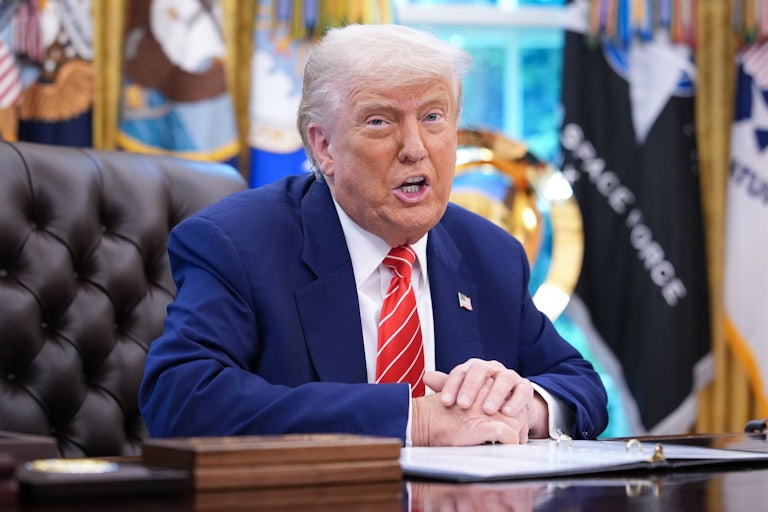
President Trump is spending $2.1 million on an investigation into whether diversity, equity, and inclusion policies played a role in the January plane crash at Ronald Reagan Washington National Airport and other recent aviation accidents, according to The Atlantic. This comes after he blamed the January plane crash—which killed 67 people—on diversity hiring.
The investigation, which began in March, is being led by Alex Spiro, a high-profile celebrity lawyer who has represented Jay-Z, New York City Mayor Eric Adams, and most notably billionaire Elon Musk. The investigation is expected to end soon and yield nothing, all while potentially costing even more than the $2.1 million Trump initially budgeted in March.
This investigation is a massive waste of taxpayer funds, especially while federal aviation is in the midst of an employment crisis. Millions will go down the drain based on Trump’s “very strong opinions and ideas,” according to the investigation’s scope of work document.
“The [Federal Aviation Administration] is actively recruiting workers who suffer severe intellectual disabilities, psychiatric problems, and other mental and physical conditions under a diversity and inclusion hiring initiative spelled out on the agency’s website. Can you imagine?” Trump said back in January. “Hearing, vision, missing extremities, partial paralysis, complete paralysis, epilepsy, severe intellectual disability, psychiatric disability, and dwarfism, all qualify for the position of a controller of airplanes pouring into our country.”
When Trump was pressed about how he could blame women, disabled people, and people of color for a plane crash well before any evidence was found, he doubled down, saying he just had “common sense.”

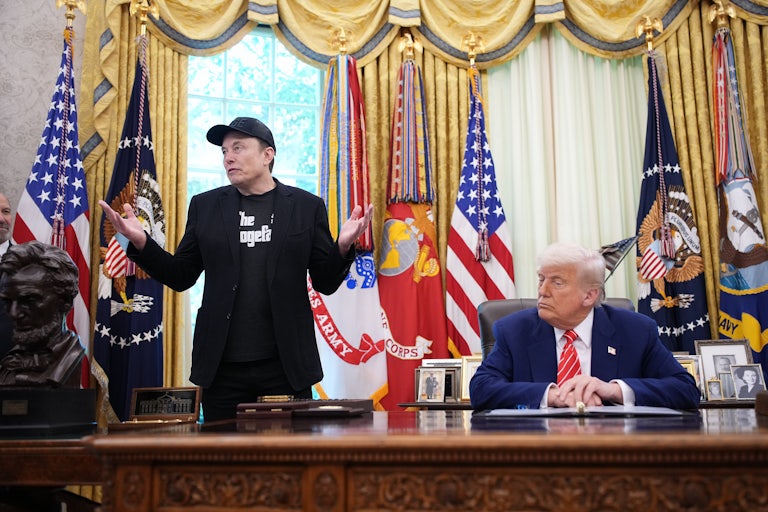
Tensions are rising between Donald Trump and his biggest 2024 campaign financier, Elon Musk.
The dynamic duo—who were practically inseparable after November—are driving apart over their differing opinions on Trump’s “big, beautiful bill,” an extension to his 2017 tax cuts for multimillionaires and corporations that is projected to add trillions to the national deficit.
The president reportedly “wasn’t happy” and was left “confused” as to why his richest MAGA ally had become more outspoken in his criticism of the bill since exiting his role as a special government employee, according to senior White House officials who spoke with The Wall Street Journal. The whole situation caught senior Trump advisers off guard, the Journal reported.
Last month, Musk confessed in an interview with CBS that he believed Trump’s spending package was actually a bad idea. But the tech billionaire has become more brazen in his read of the bill in the weeks since he’s left the White House.
“I’m sorry, but I just can’t stand it anymore,” Musk wrote Tuesday afternoon on X, the social media platform he owns. “This massive, outrageous, pork-filled Congressional spending bill is a disgusting abomination. Shame on those who voted for it: you know you did wrong. You know it.”
In a separate post, the world’s richest man—who had promised to bankroll Republican primaries mere months ago—made clear what he now planned to do with his cash.
“In November next year, we fire all politicians who betrayed the American people,” wrote Musk.
The bill passed the House by a vote of 215–214, with two Republicans joining all Democrats in voting against it.
By Wednesday, Musk’s directive for more than 200 million of his social media followers was clear: “KILL the BILL.” That same day, Trump posted an image of Musk’s exit message from the previous week without further comment.
Media commentators picked up on the signal, with CNN host Erin Burnett laughing off Trump’s response to Musk’s online tirade against his “entire domestic agenda” as “thinly veiled.”
Republicans plan to offset the expensive tax cut by slashing some $880 billion from Medicaid. But Musk’s issue with Trump’s plan has little to do with slashing programs aimed at supporting and uplifting the most vulnerable Americans—instead, he’s condemned the bill on the basis that it would effectively undo his work atop the Department of Government Efficiency, which was tasked with paring down government spending.
Musk was Trump’s top financial backer in the 2024 election, spending at least $250 million in the final months of the president’s campaign after Trump was shot in July. Musk had also promised to funnel funds toward other Republicans, declaring in the wake of the November election that his super PACs would “play a significant role in primaries.” In the following months, Musk threatened to use his money to fund primary challengers to Trump’s agenda and go after Democrats, and that he would be preparing “for the midterms and any intermediate elections, as well as looking at elections at the district attorney level.”

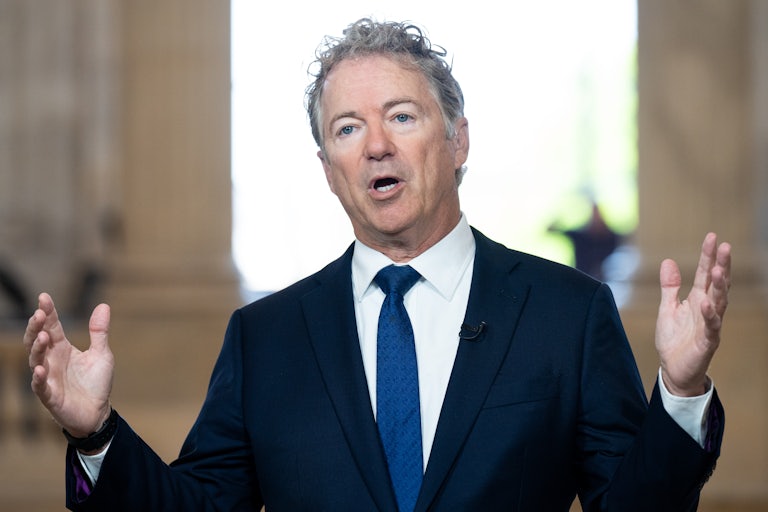
Kentucky Senator Rand Paul threw shade at his South Carolinian colleague Lindsey Graham while excoriating Donald Trump’s “big beautiful bill” on Fox Business.
In an appearance Wednesday night, Paul argued that Graham had his own reasons for rubber-stamping Republicans’ gargantuan budget bill, which will add $2.4 trillion to the national debt over the next 10 years, according to an estimate from the Congressional Budget Office. The bill is expected to cut $1.3 trillion in spending but also cut $3.7 trillion in total revenue, leading to the massive deficit.
“This bill is really a vehicle for Lindsey Graham to secretly explode beyond on the military budget,” Paul said. “They want to explode the military budget beyond the caps. That’s really what the bill is about. So there is a lot of new spending in this bill. If the new spending weren’t in there, it truly would be a bill that would be saving money.”
The legislation would dramatically increase military and border spending, bringing $150 billion to the Pentagon over the next 10 years. Graham, a longtime war hawk, has urged the Trump administration to take a tougher stance on Iran.
Paul also said he didn’t think Congress was mature enough to raise the debt ceiling.
“If you have teenage children and you gave them a credit card and they maxed out $2,000 on booze and gambling, would you give them a bigger credit line or a smaller credit line?” the Kentucky Republican said. “Congress is worse than a bunch of drunken teenagers. They have a history of not being fiscally responsible. You should give them a very short debt ceiling increase and say, ‘Show me and prove to me you’ll act responsibly, and I’ll give you more money.’”
Paul told CNN Wednesday that he could understand Elon Musk’s frustration with the gargantuan spending bill. “The new spending in this bill actually exceeds all the work he did to try to find savings, so I can understand his disappointment,” he said. Earlier that day, Paul had quote-tweeted Musk, arguing that Congress knows adding another $5 trillion to the national debt would be a “huge mistake.”

Donald Trump’s new travel ban is hard to make sense of.
In a sweeping order Wednesday night, Trump fully banned travel from 12 countries: Afghanistan, Chad, Equatorial Guinea, Eritrea, Haiti, Iran, Libya, Myanmar, Somalia, Sudan, and Yemen.
The order, which is set to go into effect on June 9, targets mostly African and Muslim-majority countries, and many of the banned countries were also on Trump’s original travel ban in his first term. The new ban also partially restricts travel by nationals from an additional seven countries: Burundi, Cuba, Laos, Sierra Leone, Togo, Turkmenistan, and Venezuela.
The order includes exceptions for lawful permanent residents, existing visa holders, and certain visa holders such as Special Immigrant Visas (which many Afghans received after helping U.S. forces).
Trump framed the ban as necessary to combat terrorism and strengthen national security in a video announcement posted to social media. But if that’s the case, the order is full of contradictions.
In his video, Trump specifically cited Sunday’s attack in Colorado as why the ban is needed. “The recent attack in Boulder, Colorado, has underscored the extreme dangers posed to our country by the entry of foreign nationals who are not properly vetted, as well as those who come here as temporary visitors and overstay their visas,” he said.
But the man charged in that attack was an Egyptian national who initially arrived on a tourist visa, and Egypt isn’t even on Trump’s list of banned countries.
Trump’s order also cites visa oversays as a reason why multiple countries were targeted. But as The Washington Post reported, it’s not clear why some countries were added to the list while others with higher visa overstay rates weren’t. In some cases, the visa overstay rate was high but the total number of overstays was relatively low.
The justification listed for specific countries was a mess. The order cited the establishment of “criminal networks” and “national security threats” as justification for the ban on nationals from Haiti. But there is little evidence that Haitian gangs are taking over the U.S., nor is there much evidence that Haitian gang members are among the small number of Haitians entering the country.
“Haitians as a group have not exerted any kind of violence,” Renata Segura, director of the Latin America and Caribbean program at the International Crisis Group, told the Post. “The idea that Haitian gangs could be traveling to the U.S. by legal means is completely out of the realm of the possible.”
And in the case of Venezuela, which is facing partial restrictions, Trump’s order claims the country has “historically refused to accept back its removable nationals.” But in the past few months of Trump’s second term, Venezuela has repeatedly accepted Trump’s deportation flights, even sending Venezuelan planes to pick up immigrant deportees from the U.S.
For those trying to make sense of Trump’s logic with this order, don’t even bother.