Newsletter
Power Mad
A weekly review of the rogues and scoundrels of American politics

The Media’s Groundbreaking Discovery: Anti-Corruption Is Good Politics

The chattering classes have belatedly stumbled upon a way to defeat authoritarianism. Now if they can only practice what they preach.

Hungary’s Prime Minister Viktor Orbán shakes hands with Donald Trump at the “Board of Peace” meeting during the World Economic Forum annual meeting in Davos.
Fabrice Coffrini/Getty Images
Hungary’s Prime Minister Viktor Orbán shakes hands with Donald Trump at the “Board of Peace” meeting during the World Economic Forum annual meeting in Davos.

Good news has been something of a precious commodity of late, what with the Trump administration still engaged in its slop-conflict with Iran and the president himself taking to depicting himself as a messianic figure online. But in last weekend’s elections in Hungary, Péter Magyar and his Tisza party resoundingly defeated international fascist darling Viktor Orbán and his far-right Fidesz minions. Tisza did so well in these elections, in fact, that they will have the numbers to enact crucial constitutional reforms and undo at least some of the damage of 16 years of authoritarian rule. As a side note, Orbán’s defeat is a black eye for his stateside backers, including Vice President JD Vance, who had personally stumped for the defeated strongman in the waning days of the campaign.

This was, in other words, a good outcome for freedom-loving people everywhere and a result that will hopefully yield further fruit. But there is one by-product that’s truly been a puzzlement. Across the media landscape, the chattering class has assayed the election and made what is—to it, anyway—a fresh discovery: What if political corruption is bad? And what if campaigning against corruption is a winning issue?

The Washington Post’s edit board said that “the main reason for Orbán’s fall was endemic corruption” and the fact that he had constructed “a mafia state.” The Wall Street Journal’s William Galston similarly enthused that Magyar’s focus on “a handful of issues—cronyism and corruption, economic stagnation and inflation, and decaying public services” was a “lesson for Democrats.” And The New York Times edit board, in a piece titled “Here’s How to Defeat Trumpism,” highlighted the fact that Magyar “made corruption a core campaign issue,” and then confidently intoned, “It is easy enough to imagine an American version of this strategy.”

It’s something of a marvel to have so many people so confident in their public declarations that they’ve finally cracked this code, several years after it might have been a useful insight. Trump, who will never be on a ballot again, is corrupt—and maybe that’s his Achilles’ heel! As someone who was trying to explain the depths of Trump’s corruption and the importance of safeguarding the constitutional bulwarks against a president using his position to enrich himself before Trump’s first inauguration, I can only say that these folks are a little late to the party.

It’s extremely cute that so many media elites have decided that this is a lesson Democrats need to learn when, in fact, many Democrats have actually already figured it out. Here, for example, is Georgia Senator Jon Ossoff, speaking in September 2025 to Pod Save America: “Vast sums of corporate and billionaire money in our political system—with or without Trump—are why ordinary people are so ill served by elected officials and by Congress.… If we don’t solve this problem, even once we put Trump back in the box in the midterms and once he’s gone, the country will still be in deep trouble.”

Ossoff is one of 120 Democratic candidates who long ago signed onto End Citizens United’s “Unrig Washington” pledge, which asks candidates to support three agenda items: a total ban on congressional stock trading, a refusal of corporate PAC money, and a promise to undo the damage of the Citizens United ruling and to crack down on dark money in our politics. Maybe everyone at the big newspapers missed this. Notably, NOTUS—the upstart publication that’s lately been eating The Washington Post’s lunch—took stock of the scene two months ago and found that “Democratic candidates are leaning into anti-corruption messaging this cycle, seeing it as an opportunity to emphasize what they see as excessive corporate influence, unethical stock trading and shady behavior from their opponents.”

Democrats coming out against corruption in the Trump era isn’t even this recent a phenomenon. The Washington Post’s editors would do well to occasionally read their own newspaper’s reporting: As their own Mike DeBonis reported in the run-up to the 2018 midterms, anti-corruption was a major plank in the Democratic Party’s (successful) campaign.

So what, if anything, has been holding Democrats’ efforts back despite this being such a robust line of attack on Trumpism? Well, as the aforementioned NOTUS report noted, “Democrats were seen as more corrupt than Republicans by a five-percentage point margin in a 2025 battleground poll by End Citizens United.” There’s no doubt that some of this was a self-inflicted wound: There’s been significant intraparty resistance to a ban on stock trading, for instance. And the party has been slow to deal with its own corrupt members—like letting noted sleaze-pump Bob Menendez hang around the Senate until his crimes finally became too comical to tolerate.

Still, for the public to have the opinion, in 2025, that the Democrats were more corrupt than a party whose leader enmeshed himself in several Teapot Dome–level scandals in that same calendar year—including the creation of an unaccountable crypto slush fund to facilitate all manner of quid pro quo exchanges—suggests that the same media that’s recently tripped over the idea that corruption is a bad thing has impeded the public’s ability to see this for themselves.

It’s absolutely the case that we would know very little about Trump’s crimes were it not for the reporters who’ve ferreted out all these important stories. But where the mainstream media falls down on the job is its lack of civic impulse to properly paint Trump and his enablers as agents in a de facto criminal enterprise. And just as the media has indulged in sanewashing the president’s demented ravings, so too has it sanded off the edges of Trump’s corrupt practices. The way Trump’s story gets told, serial violations of the Constitution become mere “departures” from previous norms; his mafioso-like demands of the international community aren’t described as extortion—Trump is simply being “transactional.”

Just this week, days after the Associated Press joined their peers in the post-Orbán Great Corruption Awakening, they reported at length about how the Trump White House is basically a racket of double-dealing, favor-trading, and self-enrichment. Somehow, the word corrupt doesn’t appear in the article. There are no plain-English explanations of the historic criminality, either—merely allusions alongside laughable denials from various Trump spokespersons. In fact, the AP’s main concern, per their headline, is that the “Trump family deal spree could open [the] door for future presidents to profit from office.” This is the View From Nowhere at work: What if the criminal president we have now corrupts a future president?

Look, I think it’s great that so many media elites have woken up to the fact that political corruption is a great civic evil, and that Trump is politically corrupt. But by the transitive theory of equality, that means Trump is a great civic evildoer, and a media that can’t tell that truth—and which instead seeks to obscure it—is this corrupt president’s brilliant ally. I’m hoping this will change, but I rather think that the people who possess the means to shape the discourse back into something that reflects reality, and actually help restore our once flourishing democracy, all lack the guts to join this fight. Hopefully, as in Hungary, we will end up not needing them.

This article first appeared in Power Mad, a weekly TNR newsletter authored by deputy editor Jason Linkins. Sign up here.
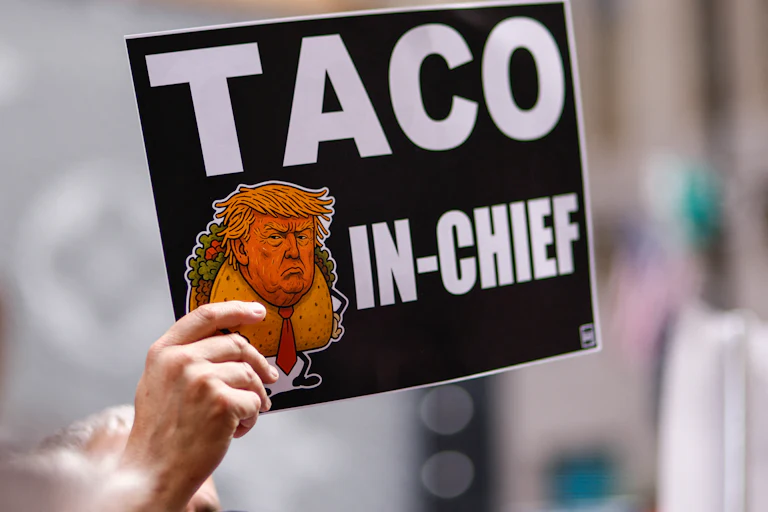
“TACO” Trump Is a Dangerous Mirage

“Trump Always Chickens Out” has been fashioned into a dig at the president over the years. But the gibe is obscuring some difficult truths.

A person holds a sign with an image of Donald Trump as Taco in Chief as people demonstrate during a Labor Day “Workers over billionaires” rally outside Trump Tower in New York City on September 1, 2025.
Kena Betancur/Getty Images

Most of us were duly alarmed on Tuesday morning when the president of the United States threatened to end a civilization by 8 p.m. Eastern time. It seemed entirely possible that if Iran did not “Open the fuckin’ Strait,” as Donald Trump put it, he would drop a tactical nuke on Tehran or do something slightly less apocalyptic but nonetheless genocidal. When a feebleminded lunatic runs the world’s most well-funded war machine, it’s best to worry and risk being accused of overreaction. The problem is that a significant swath of Americans aren’t alarmed enough.

I am speaking of the “Trump Always Chickens Out” maxim that has taken root since the beginning of Trump’s second term. This refers to the persistent belief that Trump is perpetually climbing down from his most dire threats—a paper tiger forever on the verge of folding. TACO theory always gives you the out when it comes to worrying about Trumpian misrule. It also gives Trump’s opponents an easy shorthand for insulting him and making themselves feel better. But it’s worth questioning whether TACO actually has much merit. Off the top of my head, I’m guessing that an untold number of obliterated Iranians may take issue with this contention.

It’s fitting that the TACO meme was largely birthed by Wall Streeters, operating under the shield of plutocratic wealth and chronic naïveté that is intrinsic to the financial services sector. As the Huffington Post reported back in May 2025, the term was cooked up by the Financial Times’ Robert Armstrong to refer to how the markets reacted to “the president’s tendency to announce massive tariffs, causing the markets to plunge, only to back off days later, causing them to rise again.” A certain swath of investors were using TACO theory to do some heavy-duty buckraking. As Ted Jenkin, the president of Exit Stage Left Advisors, told the New York Post, the strategy worked like this: “Once he delivers bad news, investors are buying those stocks when they are beaten down waiting for him to chicken out and watching those stocks rebound in value.”

Over time, TACO morphed from a form of tariff-whispering to a sort of catch-all delusion for markets to pretend that the damage Trump is doing to the economy never really has to be priced in. But it also expanded beyond the concerns of Wall Streeters to become a comforting security blanket anytime Trump either seems to be on the brink of doing something catastrophic or has backed down from escalations.

The Trump administration has actually grown pretty adept at managing and manipulating the TACO theory to its own advantages. Earlier this year, the ouster of Customs and Border Protection commander Greg Bovino, the real-life version of Sean Penn’s character in One Battle After Another, was widely depicted in the press as a sort of chickening out: Trump was forced to retrench in the face of widespread public horror over the administration’s deadly operations in Minneapolis. But under the new management of border czar Tom Homan, the terror machine kept running in the city for several more weeks. Similarly, at the Department of Homeland Security, Kristi Noem’s dismissal in favor of Markwayne Mullin was seen as a setback for the administration, but really it just traded new excesses for old ones. If you were sitting there thinking that the temperature had been lowered or the administration had been chastened, you got played.

It may be comforting to think that in Iran, Trump once again chickened out. After all, a civilization threatened on Tuesday has made it to the end of the week, and there’s a two-week hold on all the proposed war crimes in Trump’s latest atrocity pitch deck. If you’re of the mind that any of this is true, check yourself. Trump has not chickened out; he’s already gone all in: This war of choice has bequeathed a mountain of casualties, tons of destruction, and economic ramifications that will linger for years. What you think looks like a cowardly retreat is actually Trump flailing. He is not in control of the situation, and the danger is far from over.

Also not over: the aforementioned buckraking. Trump’s TACO cycle continues to be fodder for insider trading and market manipulation. Trump’s late-March threat to “obliterate [Iran’s] various POWER PLANTS, STARTING WITH THE BIGGEST ONE FIRST!” was followed by a belligerent response from Iran and a hasty Sunday-show appearance from Treasury Secretary Scott Bessent to head off any market volatility on Monday morning. Trump retreated from his threats in an early morning missive on Monday, citing the phantasmal success of nonexistent diplomatic discussions. But as FT reported, people were getting rich behind the scenes: “Traders made bets worth half a billion dollars in the oil market about 15 minutes before Donald Trump’s post touting ‘productive’ talks with Iran sent the price of crude tumbling and ignited volatility in other assets.”

Once you crack open the shell of this TACO, what you’ll find isn’t a source of reassurance or a fun gibe to toss in Trump’s direction. It’s all the same misrule, criminality, and corruption. Paul Krugman, who credibly argues that these insider trades are tantamount to treason, bottom-lines it in this way: “You can’t trust a corrupt government to protect national security. And our government is now utterly corrupt: It’s hard to find a single senior official, from the president on down, who treats public office as a grave responsibility rather than an opportunity for personal self-aggrandizement and profit.”

As the events of this week prove, life under these arrangements is scary and frustrating. We bear the cost of Trump’s belligerence and suffer psychically as he swings from one unimaginable threat to the next. Meanwhile, insiders get to manipulate the mass media and the markets to further their authoritarian political goals and self-enrichment. This TACO party is proving to be extremely profitable for an elite few, but I’d bet you won’t be invited to it anytime soon.

This article first appeared in Power Mad, a weekly TNR newsletter authored by deputy editor Jason Linkins. Sign up here.
Sending ICE to the Airports Is Trump’s Dumbest Idea Yet

Weary travelers already mired in the president’s ineptitude are getting a potent and visible reminder of this administration’s authoritarian misrule.

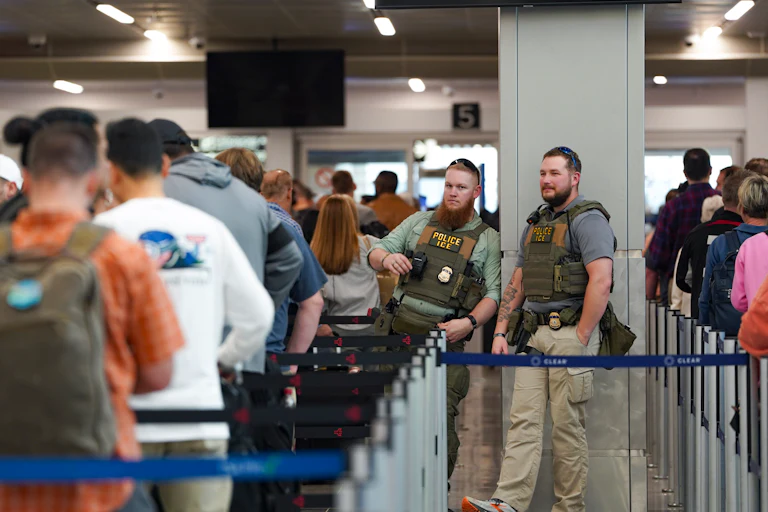
ICE agents stand next to a security line at Hartsfield-Jackson Atlanta International Airport
Megan Varner/Getty Images
ICE agents stand next to a security line at Hartsfield-Jackson Atlanta International Airport on March 23.

In recent months, we’ve reached the stage of President Donald Trump’s second term where some of his greatest problems are the result of misguided solutions to his previous screwups. We are spending millions on farm bailouts to cover Trump’s devastating tariffs. We’re in a war with Iran to reopen a shipping lane that was open before we started the war. And we are lifting sanctions on the oil that’s floating around at sea on tankers from the country we’re at war with because we need that oil in the market to reduce the cost of gas that spiked because, again, of the war we chose to start.

Essentially, the backlash to the problems Trump first caused forced a response that is destined to lead to more backlash. It’s a comically vicious cycle, but hey, this is kind of what you get when you elect a president who ran on the platform of “If I become president they can’t prosecute me for my many crimes.” But now, everyone who is flying out of a major U.S. airport can have themselves an up-close look at the clattering irony of Trumpian misrule as they stand in epically long security queues to watch recently redeployed ICE agents lumber around, stewing in their own pointlessness.

This decision by Trump, like so many others, really requires one of those “Let me get this straight” paragraphs to truly appreciate the ouroboros of ineptitude on display. So let me bang one out. ICE agents previously deployed to terrorize American cities have engendered such a heavy amount of blowback from the American public that Democrats were able to find the courage to stand firm against further funding of the agency until significant reforms are agreed to in a deal. Trump, who can’t tolerate negotiating with Democrats, has killed off compromises that would permit the funding of the Department of Homeland Security’s other agencies. Because of this department-wide shutdown, the TSA is unfunded, so unpaid workers are dropping like flies and people are having to spend hours in the airport security lines.

The solution to all of this: Send hundreds of ICE agents to these airports to … well, beyond a few reports of agents making cursory and redundant ID checks, it’s not clear what they were meant to do in this situation, and by all accounts they aren’t improving things at all. (Though Lauren Boebert did claim that ICE was making things great again at Minneapolis-St. Paul International Airport before it was pointed out to her that ICE had not been deployed to that airport.) Because this is ICE we’re talking about, there was mayhem to be had: San Francisco travelers were witness to a particularly horrific arrest this week. But as Defector’s Barry Petchesky reported, the agents are mostly just standing around, diddling on their phones, and begging for a coffee shop manager to hit them with a classic, “If there’s time to lean, there’s time to clean.”

The origin story of the plan to send Immigration and Customs Enforcement thugs to the airport truly is nutty. As CNN reported, this all began when “Linda from Arizona” called in to The Clay Travis and Buck Sexton Show last week to make her pitch: “I think I have a solution to the TSA problem.” She said, “We need to bring in ICE agents.” Travis took the idea to Fox News to make a direct appeal to the president. Per the report, “CNN searched TV transcript databases and found no other mentions of the idea on major networks until Travis brought it up.” Naturally, Trump ended up insisting that the idea was his. Look, I know this has been a bad week for the AI industry (or as I call it, the “use-up-all-the-energy-to-build-soulless-data-centers-to-steal-the-whole-of-human-endeavor-and-creativity-in-order-to-make-shittier-facsimiles-of-things-people-already-do” industry), but for all the talk of AI slop, here we have some human slop that, against all odds, is substantially worse.

ICE deployments have caused no small amount of harm to the American people. Besides the terror they cause, they are one of the big drivers of the affordability crisis in the United States. Just this week, the Financial Times reported how ICE crackdowns have essentially broken the home-building industry in Texas’s Rio Grande Valley. So the decision to make ICE agents—who are a sort of sprawling reminder of how Trumpism isn’t working—more visible to the public is an odd one.

While no one wants to encounter Trump’s brownshirts on the streets of their town, their presence has proven to be oddly galvanizing to the growing dissident movement against Trump. It takes the stupidity and ineptness of authoritarianism and shifts it from a theoretical concern to something local and tangible. It gives people the opportunity to perceive misrule for themselves, and provides a target for their ire. And it keeps people well brined in the salty swirl of everything being politicized.

I personally don’t know if the wreckage of Trump’s own policy stupidity is evident to him. He is, after all, fighting a daily battle with his flagging cognitive abilities. He may perceive the economy as great solely because his many avenues to personal self-enrichment are all paying off. We learned this week that his daily Iran war briefing consists of two-minute montages of stuff blowing up. The barriers between Trump and information awareness, in other words, remain strong. But with his approval ratings tanking, the economy cratering, and the undistilled chaos of his presidency spreading, Republicans might rue the day Trump decided to send a potent reminder to your local airport about how he’s making everything suck.

This article first appeared in Power Mad, a weekly TNR newsletter authored by deputy editor Jason Linkins. Sign up here.

Trump’s War With Iran Is a Product of His Deep Stupidity

There’s a simple and obvious reason we’re in this mess.

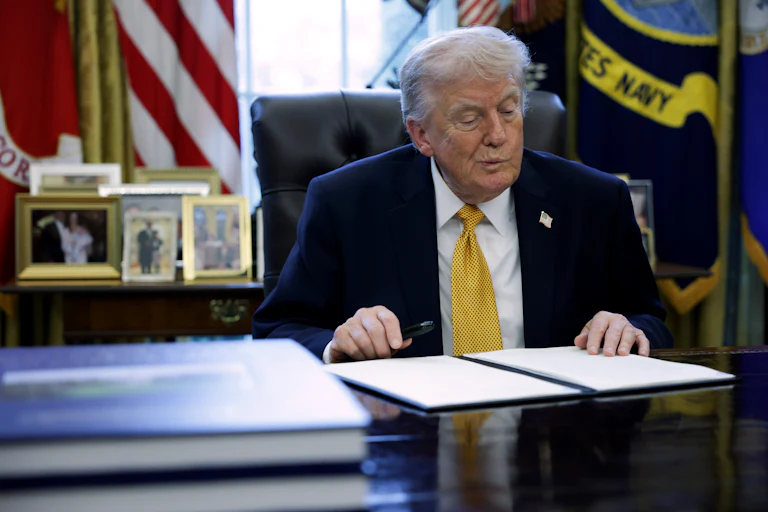
Donald Trump prepares to sign paperwork during a White House signing ceremony.
Alex Wong/Getty Images

What can be said about Trump’s war with Iran that isn’t already abundantly obvious? The answer: not much. It is not going well, and it probably won’t end well. But having spent time in the salt mines of Trump punditry, I can tell you that we’re going to endure a difficult round of think pieces purporting to explain How This Happened. So maybe this is the best time to assert the obvious, using my favored rubric of Trump analysis: Imagine if the dumbest person in the world and humanity’s biggest asshole were the same person, and that guy was president. Then imagine he started a war with Iran. Now check the news. One look, and here’s what you should be thinking: “Yep, that tracks.”

As with all of Trump’s presidential exploits, success is always constrained by two factors: The aforementioned sharp limitations of his intellectual capabilities and the fact that he is perpetually surrounded by an inner circle made up of clowns somewhere on the spectrum between “rampantly evil” and “thoroughgoing dipshit.”

“Why did President Trump decide to attack Iran?” The Atlantic’s Yair Rosenberg recently mused. “It depends on what day of the week you ask.” On some days, Trump was acting on (roundly discredited) intel that Iran was on the verge of acquiring nuclear weapons. On others, there is a scent of regime change in the air. Sometimes we are told that we were doing a classic “leading from behind” maneuver, trailing Israel into a conflict it’s long sought. Frankly, I give a lot of credit to the “wag the dog” scenario: With the economy in shambles and Jeffrey Epstein riding high in the headlines, Trump needed a distraction. Also, we mustn’t forget that he’s a warmonger who just thinks it’s fun to blow things up. (For Iran War Stupidity completists, Popular Information’s Judd Legum has rounded up 17 separate and frequently contradictory reasons that the administration has submitted for our approval.)

I’ve been reading the comment sections (of the Financial Times, anyway), and Trump is getting his ass roasted: “Let me get all of this straight in my head. They want their allies to join in an ill-thought-out war of choice with unclear aims and an uncertain chance of success for any of the myriad aims stated so far. They want everyone else to just absorb any of the externalities, like influxes of refugees, disruptions to shipping, higher oil and commodity prices, and maybe even some incoming missiles. And then they also want to tariff everyone at 15 percent.” Brother, you seem confused, but you got it absolutely correct.

Trump is really going through it with the nations that were once, putatively, our allies before Trump launched a trade war with all of them and threatened to seize Greenland in an act of colonial conquest. In the space of days, Trump has gone from begging for European naval support to free the Strait of Hormuz to having those requests punted back in his face to spiraling out on Truth Social about how he didn’t actually need anyone’s help in the first place. Since then, he’s petulantly suggested that he might wreck the whole shop and leave the nations that rebuffed him to clean up the mess. Meanwhile, countries like France and Italy are simply working on side deals with Iran to be allowed to use the strait.

My colleague Heather Souvaine Horn recently expressed to me how maddening it is to see the Trump administration treat Iran’s clampdown of the Strait of Hormuz as if it’s some unfair trick the Iranians pulled and not one of the most singularly obvious strategic choices the regime could make under the circumstances—the other being Iran’s decision to attack other Gulf states, knowing that it would be a pain point for the U.S. both economically and diplomatically. But by Trump’s own admission, the very fact that Iran retaliated in any way has caught him completely flat-footed. “They weren’t supposed to go after all these other countries in the Middle East,” he told reporters on Monday. “They hit Qatar, Saudi Arabia, UAE, Bahrain, Kuwait. Nobody expected that. We were shocked!” Right now, there are 13-year-old kids about to invade Kamchatka in their first-ever game of Risk that look like Carl von Clausewitz compared to Trump.

This week, The New Republic’s Alex Shephard wrote that it will be Iran, not Trump, that dictates when and how this conflict ends. At least one anonymous administration official concurs, telling Politico that Iran’s leaders “hold the cards now.” “They decide how long we’re involved—and they decide if we put boots on the ground. And it doesn’t seem to me that there’s a way around that, if we want to save face.” Sounds great. Until then, if you want a vision of the future, imagine a boot stamping on a rake—forever.

This article first appeared in Power Mad, a weekly TNR newsletter authored by deputy editor Jason Linkins. Sign up here.

The Corporate Miscreants Driving the Affordability Crisis

These 20 firms all have something in common: Their CEOs get paid millions, their workers are being pushed onto public assistance, and voters are fed up with them.

Brian Niccol, chief executive officer of Starbucks Corp., during a Bloomberg Television interview.
Michael Nagle/Getty Images
Brian Niccol, CEO of Starbucks, during a Bloomberg Television interview

During his recent State of the Union address, President Donald Trump took a few minutes to talk about the affordability crisis that’s been gripping the nation—which is to say, he threw some balderdash in the direction of Democrats. Blaming the high prices he once referred to as a “hoax” on the “dirty, rotten lies” of the opposition party, he then neatly pirouetted into his next point: declaring the crisis over. “Their policies created the high prices. Our policies are rapidly ending them,” he said. “We are doing really well. Those prices are plummeting downward.”

It’s not hard to understand why Trump wishes this to be true. He is, after all, a one-man driver of the affordability crisis. As we’ve noted before, the mayhem he has unleashed on the streets of cities like Minneapolis is making it harder for ordinary Americans to make ends meet. The American people are bearing most of the cost of his chaotic tariffs scheme. And gas prices are set to spike anew now that he’s launched a war in Iran. Still, as with any problem playing out in the pocketbooks of voters, the president has plenty of company on the wrong side of the fight—like the corporate privateers who are driving the crisis deeper while profiting off of our pain.

A new report from the Institute for Policy Studies, or IPS, takes a deep dive into the battery of corporations they call the “Low Wage 20”: 20 firms that currently employ 6.7 million people across the United States. The names are familiar—Amazon, Starbucks, FedEx, Walmart, and Tyson Foods are habitual malefactors—but their sins are growing more mortifying by the day.

The most mortal of these, per the IPS, is the way these 20 firms’ “low-wage business models have left many of their workers with no choice but to rely on public assistance.” Fifteen of the companies’ median pay last year was “below the $35,631 income limit for a family of three to be eligible for Medicaid in most states”; at 13 of them, the pay fell short of the “$33,576 threshold for a family of three to be eligible for SNAP.” It’s bad enough when your business model essentially plans for government programs to provide the money you’re not willing to pay. But as TNR’s Grace Segers has relentlessly reported over the past year, the funding cuts and regulatory hurdles embedded in Trump’s “One Big Beautiful Bill” have pushed these programs, and their beneficiaries, into crisis.

The IPS says corporate power is driving the affordability crisis in other ways, as well, including a very basic one: They’re just paying people less. “Half of Low-Wage 20 firms reported a decline in their median pay between 2019 and 2024, after adjusting for inflation,” the report says. “Average median pay for the group dropped 4.6 percent, from $30,474 (in 2024 dollars) to $29,087.” These workers are increasingly getting priced out of the American dream too. All 20 of these corporate miscreants’ reported median pay last year was below the $59,600 needed to afford the rent on a two-bedroom apartment; seven of the firms’ median salaries are lower than the $25,533 average price of a used car.

Meanwhile CEO pay is doing what it always does—driving income inequality. The average CEO pay at these 20 firms was $18.6 million last year, while average CEO-to-median worker pay ratio “stood at a staggering 899 to 1, compared to the S&P 500 average of 285 to 1.” Brian Niccol of Starbucks took home the award for the most nonsensical disparity between CEO and employee income: He earns $95,801,676, while the median salary for a Starbucks employee was a mere $14,674.

There are a slew of policy decisions that can be made to alter this trajectory, from raising the minimum wage to bolstering labor rights to imposing a tax on stock buybacks. The IPS even suggests we adopt the practice of “bad business fees” designed to penalize companies for paying such paltry wages that their employees have no choice but to rely on public assistance to make ends meet. And of course, corporate democracy would go a long way to taming these excesses. As TNR contributor Osita Nwanevu has argued, more worker ownership can help limit income inequality while also providing firms with ballast to survive economic downturns.

It goes without saying that the ideological orientation of the White House and Congress guarantees little progress will be made on any of these fronts—especially with Trump looking backward to blame Democrats for the wreckage he’s meted out. But November’s elections loom—and as TNR contributor Dylan Gyauch-Lewis reported, poll after poll reveals a public hungry for lawmakers to confront corporate power directly, and that “large majorities of Americans blame corporations for their affordability issues.” There’s never been a better time to make some corporate enemies. These 20 will do for a start.

This article first appeared in Power Mad, a weekly TNR newsletter authored by deputy editor Jason Linkins. Sign up here.