Breaking News
Breaking News
from Washington and beyond

Trump’s War Is More Unpopular Than Iraq and Vietnam, New Poll Shows

It took years for the Iraq and Vietnam wars to hit this low point.

Donald Trump turns to the side and speaks while sitting at his desk in the Oval Office
Aaron Schwartz/CNP/Bloomberg/Getty Images

It’s official: Donald Trump’s war in Iran is less popular than some of the least popular wars of all time.

Sixty-one percent of Americans said that using military force in Iran was a mistake, according to a Washington Post/ABC News/Ipsos poll Friday, placing how Americans feel about Trump’s campaign in Iran on par with attitudes about the Iraq and Vietnam wars.

In May 2006, three years after U.S. forces invaded Iraq, a Washington Post/ABC News poll found that 59 percent of Americans said that the war was a mistake.

By that point in the war, more than 2,400 U.S. troops had died and the U.S. military was embroiled in some of the bloodiest fighting of the entire conflict. But the Iraq War was still more popular than Trump’s so-called “excursion” into Iran, which has killed an estimated 13 service members.

In January 1973, the same year that U.S. troops withdrew from Vietnam, 60 percent of Americans believed that it had been a mistake to send troops there in the first place, according to a Gallup poll.

Trump has repeatedly bragged about how quickly he would have ended the war in Vietnam—despite the fact that he dodged the military draft multiple times—because of his supposedly resounding success in Iran. But only 19 percent of Americans say that the U.S. military campaign in Iran has been successful, according to the Friday poll.

It’s not entirely clear how that 19 percent arrived at that conclusion. While Trump has repeatedly declared victory, so has Iran.
Republican Governor Refuses to Join Trump’s Gerrymandering Wars

Georgia’s Brian Kemp is refusing to take action after the Supreme Court ruling—for now.

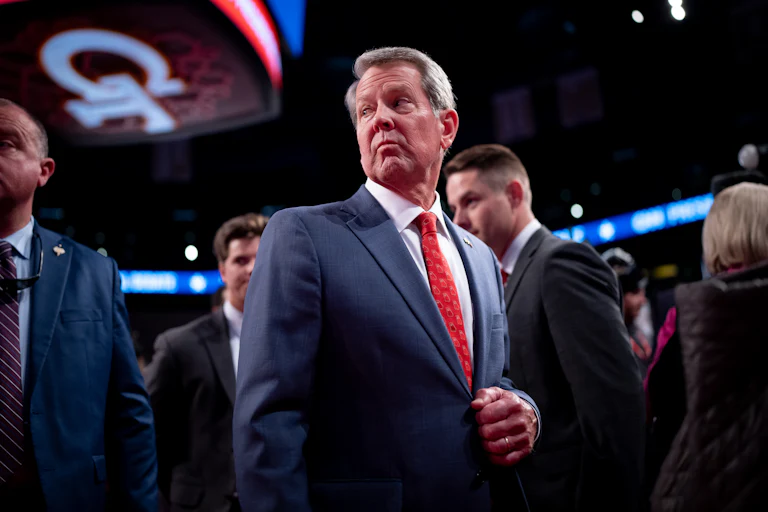
Georgia Governor Brian Kemp looks over his shoulder
Andrew Harnik/Getty Images
Georgia Governor Brian Kemp

One Republican governor isn’t going along with President Trump’s attempt to redraw congressional maps around the country.

Georgia’s Brian Kemp said Friday that he isn’t going to cancel the state’s May 19 primary elections in order to draw new maps in time for November, following the Supreme Court’s ruling in Louisiana v. Callais Wednesday, which severely weakened the Voting Rights Act.

Kemp still praised the decision, telling The Atlanta Journal-Constitution that the ruling “restores fairness to our redistricting process and allows states to pass electoral maps that reflect the will of the voters, not the will of federal judges.” But it’s too late for the midterms, he added.

“Voting is already underway for the 2026 elections,” Kemp said. “But it’s clear that Callais requires Georgia to adopt new electoral maps before the 2028 election cycle.”

Several Republican-run states, particularly in the South are scrambling to make changes to their congressional maps due to the high-court ruling, including Florida, Mississippi, Tennessee, and South Carolina. Louisiana Governor Jeff Landry even announced that he was suspending his state’s May 16 primary elections in order to redraw the state’s congressional map.

Still, Trump is not likely to be happy that one Republican governor won’t follow along with his efforts, especially in Georgia, where the president still claims that Joe Biden winning the state in 2020 was rigged due to fraud. Kemp was in his first term as governor at the time, and Trump held him responsible for not overturning the results. Kemp might see an angry Truth Social post directed at him pretty soon.

Trump’s Sons Land Massive Pentagon Deal as They Flaunt Corruption

Donald Trump Jr. and Eric Trump also bought a stake in a federally contracted mining company.

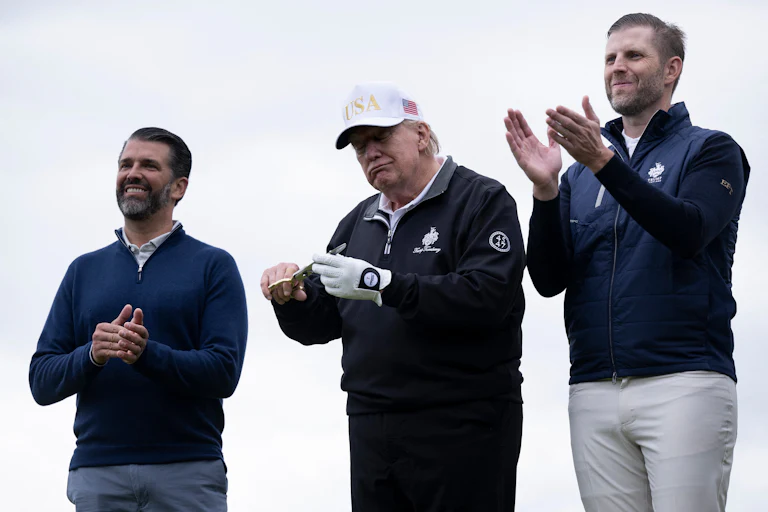
Donald Trump Jr. and Eric Trump clap and smile while flanking their father on a golf course
BRENDAN SMIALOWSKI/AFP/Getty Images

The president’s elder sons are making money hand over fist off of their father’s office.

At least two companies tied to Don Jr. and Eric Trump have won large government contracts, setting the stage for the Trump family to make a sizable chunk of change from their involvement in the federal government.

Powerus, a drone manufacturer led by former U.S. Army Special Operations veterans, was founded last year. Trump’s two sons became tied to the company’s board after it merged with a golf club in March, a decision that took the company public via a reverse merger. The brothers’ investment firm, American Venture, has backed the combined entity, and their boutique investment bank, Dominari Securities, was also involved in the transaction.

This past week, the U.S. Air Force agreed to buy an undisclosed number of drones from Powerus as America’s war with Iran hits the 60-day mark. The company’s co-founder, Brett Velicovich, claimed the decision had nothing to do with its investors’ obvious ties to the White House.

“They’re not going to pick a system because of who’s on an investor list,” Velicovich told Bloomberg. “They’re picking because they need it now.”

There are at least 187 drone manufacturers based in the United States, according to a November report from Georgetown’s Center for Security and Emerging Technology.

But that isn’t the Trump family’s only financial coup this week: A shell company backed by Don Jr. and Eric agreed to merge with a major tungsten mine in Kazakhstan that just last year secured $1.6 billion in U.S. government support.

The two brothers bought into a construction company, Skyline Builders, last August, through a special-purpose vehicle arranged by Dominari Securities, sources told the Financial Times.

Weeks later, in September, Kazakhstan’s President Kassym-Jomart Tokayev told Donald Trump that he intended to award a major tungsten project to U.S. investment group Cove Kaz Capital, an entity backed by the U.S. government, to compete against Chinese and Russian mining companies. That story emerged in the press on October 21.

By October 28, Eric and Don Jr. had added almost $24 million to their Skyline investment. On October 31, Skyline paid $20 million for a 20 percent stake in Kaz Resources, a subsidiary of Cove Capital, an investment company that controls Cove Caz.

Cove Capital’s deal with the National Mining Company of Kazakhstan became public on November 6, with an announcement that they would jointly develop “the largest known undeveloped tungsten resource in the world.”

Cove Kaz Capital and Kaz Resources agreed to merge with the brothers’ investment firm, Skyline, on Thursday, reported the Financial Times, which noted that there was no mention of either Trump brother in the merger announcement.

A representative for Don Jr. denied that he had any knowledge of his father’s dealings prior to the initial investment or the merger.

“Don is a passive investor in American Ventures and has no operational involvement in the company,” his spokesperson told the Financial Times. “He does not interface with the federal government on behalf of any company he invests in or advises.”

Not Even Republicans Are Buying Pete Hegseth’s New Iran War Logic

Apparently the ceasefire means Donald Trump doesn’t need congressional approval yet?

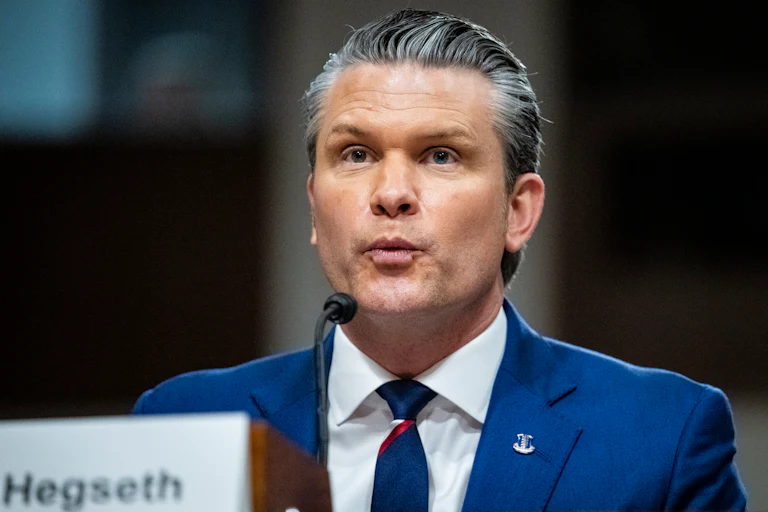
Defense Secretary Pete Hegseth puckers his lips while speaking during a Senate committee hearing
Graeme Sloan/Getty Images

Some Republican lawmakers aren’t buying Defense Secretary Pete Hegseth’s excuse to skirt congressional authorization for Donald Trump’s war in Iran.

The War Powers Act Resolution of 1973 states that the president can deploy armed forces in a hostile environment for up to 60 days, but must withdraw if he does not then receive congressional approval for an extension.

As that deadline arrived Friday, Hegseth claimed that the clock on Trump’s 60 days had actually paused when a ceasefire was announced halfway through April. But Republican lawmakers aren’t convinced, The Wall Street Journal reported.

“It stopped from the ceasefire? Which ceasefire? Does the ceasefire still count if they don’t cease firing?” Indiana Senator Todd Young told the Journal Thursday. “I don’t know. Is there any legal precedent to this? I mean, these are the sorts of questions members would ask.”

The U.S. tested the boundaries of the ceasefire by installing a military blockade on Iranian ports, and even seizing an Iranian cargo ship. Meanwhile, Israel, America’s ally in its joint military operation, did not stop its intense strikes in Lebanon.

North Carolina Senator Thom Tillis questioned whether Hegseth understood the legal guardrails placed on his military campaign.

“I’ll let my legal experts tell me if they agree.… I felt like the War Powers Resolution says in 60 days you have to take some action,” Tillis told the Journal.

Missouri Senator Josh Hawley also pushed back on Hegseth’s casual delivery of the claim that congressional approval would apparently not be needed. “The right way to make that argument to Congress would be to put that in writing and send that up here to us,” he said.

Hawley said that if the White House did not officially request an extension, it would be up to Congress to debate legislation to authorize the war. “I don’t really want to do that, because I don’t want to open up further conflict. I want to wind it down,” he said.

Epstein May Have Left a Suicide Note—and DOJ Didn’t Mention It

Jeffrey Epstein’s former cellmate revealed everything he could remember about the note.

Two computer screens show the Department of Justice's library of files on Jeffrey Epstein and a photograph of his face
Véronique Tournier/Hans Lucas/AFP/Getty Images

Jeffrey Epstein’s 2019 death—ruled a suicide by a New York City coroner—has been pored over by conspiracy theorists. The financier was arrested for running a child sex-trafficking ring, and was friendly with many politicians and celebrities. His trial could have led to the arrest of an entire network of elites. And he was supposed to be in a high-security cell with guards nearby to prevent him from harming himself. How could this even happen?

Answers since then have been hard to come by, but on Thursday, another sliver of information was revealed: Epstein may have written a suicide note the previous month. The New York Times interviewed a cellmate of Epstein, Nicholas Tartaglione, who claimed he found a note after an incident in which Epstein was found unresponsive a few weeks before his actual death.

The note said it was “time to say goodbye,” Tartaglione said, and contained a line similar to, “What do you want me to do, bust out crying?” Tartaglione said it was written on a legal pad and found in the pages of a graphic novel.

Epstein survived this first incident, and in fact told jailers afterward he was not suicidal and the marks on his neck came from Tartaglione. Then he walked that accusation back, telling Bureau of Prisons investigators on July 31 he did “not have any issues” with his cellmate.

Epstein’s purported suicide note has not been reviewed by the public. The Times found that it was sealed by a federal judge during Tartaglione’s own criminal case. (Tartaglione has been charged with a life sentence for a quadruple homicide, and is appealing his conviction.)

On Thursday, the paper asked the judge to unseal the note. “Investigators scrutinizing Mr. Epstein’s high-profile death lacked what could have been a key piece of evidence,” the Times concluded.

A Department of Justice spokeswoman told the paper that the agency had not seen the note. It was also not mentioned in the DOJ’s investigations into Epstein’s death.

Information surrounding Epstein’s death continues to fuel a conspiratorial fire. Back in 2019, a 4chan user posted about his death before any media outlets had gotten word of it. In Donald Trump’s second term, the administration released an 11-hour surveillance video, which they claimed proved no one entered Epstein’s cell on the night he died. Reporters quickly found discrepancies in the footage.

Trump Ramps Up Threats to NATO Allies Who Won’t Help Him on Iran

Donald Trump is furious that his allies won’t help him clean up the mess he made.

Donald Trump makes a weird face while sitting at his desk in the Oval Office
Andrew Harnik/Getty Images

The way the White House is operating, it seems that the United States doesn’t want allies.

Donald Trump told reporters in the Oval Office Thursday that he’s open to the idea of pulling troops from other allies Italy and Spain due to the European continent’s lacking support for his invasion of Iran and the subsequent blockade in the Strait of Hormuz. Trump already threatened Wednesday night to withdraw from Germany, and verbally attacked German Chancellor Friedrich Merz.

“You talked about possibly pulling some troops out of Germany. Would you be considering the same thing for Spain and Italy?” asked a reporter.

“Yeah, probably,” Trump said. “I probably will. I mean, look, why shouldn’t I?

“Italy has not been of any help to us, and Spain has been horrible,” he continued. “Absolutely horrible. As has NATO.

“It’s not even the fact that they’re better, it’s one thing if they said it nicely, or if they said, ‘OK, we’ll help but the help’s a little slow,’ but the level. And we helped them with Ukraine. You know they made a mess out of Ukraine, a total mess. Ukraine is nothing to do—we’re an ocean apart, it has to do with them,” Trump said, calling it “insane” that former President Joe Biden provided aid to the war-torn, Russian-invaded country.

“But uh, when we needed them they were not there. We have to remember that,” Trump continued. “And so if we ever have a big one, because we didn’t need any help with Iran. We had Iran right from the first day, it was over. It was over.”

That’s not true. The war with Iran is currently in its eighth week with no end in sight. The ramifications of the war, including the total blockade to Iran’s oil trade, have thrust the world into a global energy crisis that has raised the cost of living practically everywhere.

Furthermore, Trump has repeatedly asked for assistance from America’s European allies to help reopen the strait. Just yesterday, the Trump administration floated the possibility of building an international coalition in order to restore freedom of navigation along the critical waterway.

Within the same answer, Trump then claimed that he only asked for foreign participation in the effort to “see if they’d do it.”

“In all cases, they said, ‘We don’t want to get involved,’” he said.

Trump’s Wednesday announcement that he was considering pulling U.S. troops out of Germany stunned the Pentagon as much as it did U.S. allies.

The Defense Department “was not expecting it and has not been planning any kind of drawdown,” a congressional aide familiar with the situation told Politico. “But we have to take him seriously because he was serious about it during his first administration.”

In July 2020, Trump proposed pulling 12,000 troops out of Germany in order to punish Berlin for its low defense spending. That order was never implemented.

Republicans Cave and End DHS Shutdown—Without Funding ICE

Republicans in Congress have finally voted to end the government shutdown, with no money for federal immigration enforcement.

House Speaker Mike Johnson
Chip Somodevilla/Getty Images

Republicans in Congress voted to fund the Department of Homeland Security Thursday, effectively ending the 76-day shutdown of the department.

The bill, passed by a voice vote in the House, is a win for Democrats, as it still includes no money for ICE or Border Patrol, and is now headed to President Trump’s desk to be signed into law. House Speaker Mike Johnson reportedly decided to finally support the bill after a private meeting with his fellow Republican leaders earlier in the day, where they agreed that the situation couldn’t continue.

The GOP will still try to fund ICE through the reconciliation process, which takes much longer but only requires a simple majority in both chambers of Congress. Previously, House Republicans had criticized their counterparts in the Senate for passing the measure with a voice vote, which doesn’t record individual members’ votes, only to adopt the same method on Thursday.

Conservatives were not happy with the decision, but didn’t see any good options. Representative Chip Roy said, “I think it’s asinine that we’re funding the government this way,” but Representative Clay Higgins said, “The speaker, I think, handled, under the circumstances, very well.”

DHS Secretary Markwayne Mullin complained last week that the department was almost out of money and soon wouldn’t be able to pay its employees. Now, assuming Trump doesn’t veto the bill, employees will still be paid. But the question of ICE’s future is still unanswered, as Democrats want the agency reformed at a minimum, with some calling for its abolition, and Republicans seem to be fine with the violence it visits on American cities. For now, at least, ICE won’t get any more money.

Visibly Declining Trump Demands Candidates Prove Mental Wellness

Donald Trump made the demand just days after falling asleep during a public meeting.

Donald Trump leans forward on his desk in the Oval Office with his eyes closed
Will Oliver/EPA/Bloomberg/Getty Images

Now that he’s no longer eligible for the office, Donald Trump—a 79-year-old who routinely falls asleep in critical meetings—believes it’s pertinent for all future presidential candidates to undergo a cognitive examination.

“Anybody running for President or Vice President should be forced to take a Cognitive Examination prior to entering the Race!” Trump posted on Truth Social Thursday afternoon. “By doing so, we wouldn’t be surprised at people like Barack ‘Hussein’ Obama, or Sleepy Joe Biden, getting ‘ELECTED.’ Our Country would be a much better place!”

Trump had demanded former Vice President Kamala Harris take a cognitive test while on the campaign trail in October 2024, and he has previously suggested Biden should have taken such a test before being allowed to take office.

“I took the Exam three times during my (‘THREE!’) Terms as President, and ACED IT ALL THREE TIMES—An Achievement that, even on a single Exam, according to the Doctors, has rarely been done before!” he added.

But Trump’s health isn’t actually that impressive—particularly as it relates to keeping his eyes open. Just last week, the president was caught falling asleep during another White House event, slumping over in his chair and fluttering his eyes for nearly a minute as his aides announced a new pharmaceutical deal.

Trump has an oddball history with reportedly “acing” cognitive exams. Since 2024, the self-styled “stable genius” has taken several such tests, but his recollections of their contents has called into question whether he actually took them at all.

While bragging about his results to the press, Trump would invariably tweak the questions he allegedly nailed, at times boasting that he had correctly recited five words and performed basic multiplication while at other times insisting that he had passed thanks to correctly identifying a whale. That is, in spite of the fact that the test’s authors reported that none of the three versions in circulation actually had a whale on them. Other test creators have said their exams are to check for dementia, not cognitive speed.

Since then, the MAGA leader’s health has become a much graver topic. Over the first year and change of his second term, Trump’s speeches have become more disjointed and incoherent, and his behavior has grown increasingly erratic. The 79-year-old has spent hours at Walter Reed Medical Center, fallen asleep during more than a dozen critical meetings, appeared lost and disoriented around foreign heads of state, frequently slurred his speech, and appeared with discolored and bruised skin on several occasions.

Just this month, Trump attacked several of his longest allies, pledged to annihilate Iranian civilization via a social media post, and started beef with Pope Leo XIV, claiming that the Catholic pontiff was “weak on crime.”

He also forgot when Supreme Court Justice Ruth Bader Ginsburg died, and that one of his most fervent GOP critics—North Carolina Republican Thom Tillis—is still in the Senate.

His escalatory behavior, particularly as it relates to the Iran war, spurred new calls for the president to have his brain tested yet again, though White House physicians missed the April 25 deadline demanded by Representative Jaimie Raskin.

Elon Musk Demolishes His Own Case Against OpenAI as He Takes the Stand

Musk is having a tough time in this trial—thanks to himself.

Elon musk frowns and gives a thumbs up
David Paul Morris/Bloomberg/Getty Images
Elon Musk inside the federal court in Oakland, California, on April 29

Elon Musk is not availing himself well in court.

The tech mogul and fascism enthusiast is suing Sam Altman and OpenAI, the organization he co-founded, for moving the nonprofit organization to a for-profit company. Musk took the stand three days this week in Oakland, and his testimony is not helping his cause.

Throughout his time on the stand, Musk didn’t answer yes or no to yes-or-no questions, claimed to forget his earlier testimony, and lost his temper at Altman’s counsel, William Savitt, accusing him of trying to trick him. Judge Yvonne Gonzalez Rogers, after the jury had left Wednesday, said that “[Musk] was at times difficult.”

On Thursday, things got so bad that the judge had to remind Musk that he isn’t a lawyer after he accused Savitt of asking “leading” questions.

“He can lead,” Rogers said, referring to the opposing counsel. “That’s not how it works. Let’s remind everyone in the courtroom that you’re not a lawyer.”

A day earlier, Musk appeared to undermine his entire case. During direct testimony, Musk’s lawyers tried to paint a positive picture of the executive. He said that “I don’t lose my temper,” and “I don’t yell at people,” adding that he may have once called someone a “jackass,” but only to say, “Don’t be a jackass.”

But Savitt easily demonstrated that this wasn’t true, as Musk openly lost his temper in the courtroom. He nitpicked simple questions and contradicted an earlier deposition. The opposing counsel was trying to make the case that Musk wasn’t suing over his desire to keep OpenAI nonprofit but because he wanted to control the company—and Musk made their case for them.

Defense presented an email Musk wrote in 2016 to a colleague at Neuralink, one of his companies, where he said, “Deepmind is moving very fast. I am concerned that OpenAI is not on a path to catch up. Setting it up as non-profit might, in hindsight, have been the wrong move. Sense of urgency is not as high.”

When asked about this on the witness stand, Musk said he was merely speculating. Savitt asked him, “Those are your words, yes or no?” Musk replied that “this is a hypothetical.”

“So you thought it might have been a wrong move? That’s what you said?” Savitt followed up. Musk finally admitted yes.

Savitt later caught Musk testifying that he didn’t read a 2017 document about OpenAI shifting to a for-profit company.

“I didn’t read the fine print. We’re going into the fine print of this document,” Musk claimed, saying he had only read the first section or paragraph.

“It’s a four-page document,” Savitt replied.

Savitt then referred to Musk’s deposition, where he said he didn’t even read one paragraph. “I don’t think I read this term sheet,” Musk had admitted. “I’m not sure I actually read this term sheet.… I did not closely look at this term sheet.”

This got Musk to raise his voice and contradict his earlier claim that he never lost his temper, shouting in the courtroom, “I said I didn’t look closely! I read the headline!”

All of this is more proof of Musk’s own ego being the real reason for his biggest problems, and shows how his time in the federal government also went badly. The case is not looking good for the world’s richest man.

Pete Hegseth Can’t Defend Why He Made It Easier to Kill Civilians

The Defense secretary found himself on the back foot when trying to explain his decision to cut a crucial team.

Defense Secretary Pete Hegseth speaks into a microphone during a Senate hearing
Bill Clark/CQ-Roll Call, Inc/Getty Images

Defense Secretary Pete Hegseth ignored military officials when he gutted a Pentagon oversight office designed to limit the risk of civilian deaths in war. Then the U.S. killed thousands of Iranian civilians amid its war with Tehran.

The results of the war were apparently beyond explanation during a Senate Armed Service Committee hearing Thursday, when Hegseth stumbled trying to rationalize his decision to nix the critical department during a heated exchange with Senator Kirsten Gillibrand.

“Let’s talk about how you’re prosecuting the war. What is your response to targeting that has resulted in the destruction of schools, hospitals, civilian places? Why did you cut—by 90 percent—the division that’s supposed to help you not target civilians? And do you know the impact of a strategic failure in a war when you have so many civilian casualties?” pressed Gillibrand.

“You may have tactically completed a mission well, but strategically [it] is not meeting your goals because of the casualties,” the New York lawmaker stressed. “What is the cost of that?”

But Hegseth did not have an answer for her. Instead, he ducked the line of questioning entirely, opting to repeat a vague principle rather than address the fallout of his decisions.

“No military, no country, works harder at every echelon to ensure they protect civilian lives than the United States military,” Hegseth said. “And that is an ironclad commitment that we make, no matter what systems we use.”

“Well then why did you cut the department by 90 percent?” repeated Gillibrand before Mississippi Senator Roger Wicker—the committee’s Republican chairman—cut her off.

The war has killed at least 1,701 civilians in Iran, according to an analysis by the Human Rights Activists News Agency released last week. That figure is even higher in Lebanon, where Israeli strikes have killed more than 2,496 people, according to the Lebanese health ministry. The war has also claimed the lives of 13 U.S. service members throughout the region.

Meanwhile, the ongoing blockade of the Strait of Hormuz has caused a global energy crisis, choking off a critical tradeway for the Middle Eastern oil trade. In the U.S., the lagging oil and gas deliveries have caused transportation costs to surge, affecting virtually every commodity on the market. At the time of publication, the average cost for a gallon of gas was above $4.30, according to a AAA analysis. In some areas of California, such as San Francisco, Napa, and San Jose, gas was at least $6 per gallon.

The economic consequences have sparked concerns within the Republican Party—and in the White House—that the wildly unpopular war could bode poorly for conservatives and their majority in Washington come November.