Breaking News
Breaking News
from Washington and beyond

No, Progressives Didn’t “Make” Sinema Leave the Party

Arizona Senator Kyrsten Sinema alienated her own voters. Let's not pretend otherwise.

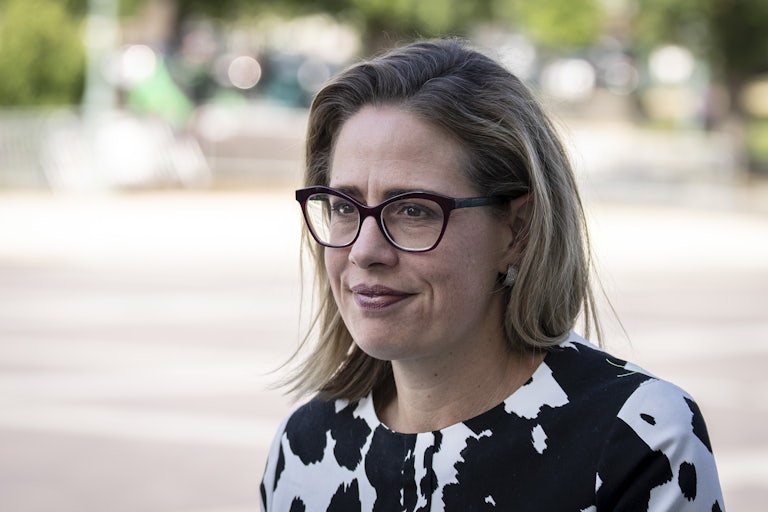
A grimacing Kyrsten Sinema is confronted by reporters.
Samuel Corum/Getty Images

On Friday morning, Arizona Senator Kyrsten Sinema bravely announced she is now a registered independent, rejecting the “partisan process” in favor of “solving problems and getting things done.”

Already, pundits are arguing that this is a situation where “progressives chase a moderate out of the party.” In the coming days, there will be even more arguments about how the Democratic Party is so radical it pushed out a key senator.

But this notion infantilizes one of the most powerful people in America and downplays Sinema’s own track record.

In reality, Sinema has a long history of obstructing the Democratic agenda. And whenever Sinema has blocked legislation, she has typically served the interests of the few.

Yes, there’s her stubborn support for the filibuster in lieu of pushing forward democratic reform. But there’s also the time Sinema stopped Congress from eliminating a tax loophole that served rich financiers. Or her opposition to raising taxes on wealthy individuals and corporations, reining in drug prescription prices, and spending even a fraction of what’s necessary to support the climate—ultimately sinking the Build Back Better agenda. And lest we forget Sinema’s infamous let-them-eat-cake thumbs down to giving working people a $15 minimum wage.

All this while Sinema has enjoyed massive hauls of cash from the pharma industry, payday lenders, and the financial sector. Doesn’t sound so “independent,” does it?

Progressive did not direct any “ire” at Sinema for no reason. Her own actions prompted it. When “solving problems” and “getting things done” is just in favor of the few, it’s only natural that she’ll alienate voters from her own party.

Let’s not conflate “free thinking” with an unaccountable one.
Arizona Voters Hate Kyrsten Sinema Across Party Lines

Kyrsten Sinema left the Democratic Party and registered as independent. But polls show the majority of Arizona voters, regardless of party, hold her in low regard.

Drew Angerer/Getty Images

Senator Kyrsten Sinema may have thought that switching political affiliation Friday would help her get reelected, but in fact, she is deeply unpopular in Arizona across party lines—which is unlikely to change anytime soon.

FiveThirtyEight founder Nate Silver tweeted a graphic from an AARP poll conducted in September showing low support for Sinema among Arizona voters.

Only 37 percent of all likely voters viewed her favorably. Among Democrats, 57 percent viewed her unfavorably. Even among independents, her new team, 51 percent said they viewed her unfavorably.

In a reply to someone else’s comment, Silver estimated that Sinema would have had a 40 percent chance of winning her primary as a Democrat, and then about a 60 percent chance of winning the general election.

But now that she’s an independent, he put her chances of winning at only 25 percent.

Another poll, conducted in July by Data for Progress and the local Arizona news outlet The Copper Courier, found that Sinema had only a 42 percent approval rating among state residents. Only 34 percent of Arizona Democrats viewed her favorably.

Sinema’s abysmal approval levels should come as no surprise. Since being elected to Congress, she seems to have undergone a massive ideological transformation.

A former Green Party activist, Sinema had protested the Iraq War with the left-wing social justice group Code Pink and warned against the dangers of capitalism. But once she reached Capitol Hill, she swung much more moderate.

Most notably, she voted with a flippant thumbs-down against increasing the minimum wage—despite previously being vocal in support of raising it.

The Arizona state Democratic Party had censured Sinema in January for opposing the removal of the filibuster. The group similarly did not hold back in response to Sinema’s party change, charging that she had failed to stand up for her constituents in key areas such as voting rights and holding major corporations accountable.

“Senator Sinema may now be registered as an Independent, but she has shown she answers to corporations and billionaires, not Arizonans,” the party said in a statement. “Senator Sinema’s party registration means nothing if she continues to not listen to her constituents.”

Kyrsten Sinema Says 51 Senate Seats Is a “D.C. Thing to Worry About”

After switching from Democrat to independent, the Arizona senator refuses to say how she'll vote in the Senate.

Drew Angerer/Getty Images

Kyrsten Sinema seems unaware of or unwilling to acknowledge the potential consequences of changing parties just days after the Democrats secured a 51-49 majority in the Senate.

The Arizona senator announced Friday that she was changing her political affiliation from Democratic to independent, a major blow to her now former party. But when she was asked by CNN’s Jake Tapper about how her move will affect Democrats’ power in the Senate, she dodged.

Sinema insisted that concerns about 51 versus 50 seats was “kind of a D.C. thing to worry about” and said she was more focused on sticking to her values and those of her voters.

Except, the difference between 51 and 50 set votes for the Democratic Party is not a “D.C. thing.” It has massive implications for national legislation and the future of the country.

There’s a reason that Senator Raphael Warnock campaigned so hard during the Georgia runoff. Even though Democrats already had 50 seats in the Senate, his victory would have given them far more influence in the chamber.

Fifty-one seats meant that Democrats would control committees and could more easily approve judicial appointments. They could block dangerous legislation or investigations from the Republican-controlled House.

And crucially, 51 seats meant that if a Democratic senator stonewalled—usually Sinema herself or Joe Manchin—then major legislation would no longer automatically tank. Now, Sinema’s decision has thrown all of that up in the air once more.

Sinema has not said if she will run for reelection, but she told Politico she also would not caucus with Republicans. She said she intends to vote the same way she has for the past four years.

Her spokeswoman told reporters that Sinema “intends to maintain her committee assignments through the Democrats. She has not ever and will not attend caucus messaging and organizational meetings.”

But considering her history, there would seem to be small comfort in that.

The Chaos Maker: Kyrsten Sinema Ditches the Democrats

The Arizona senator says “nothing will change about my values or my behavior,” but Democrats should be forgiven for not taking much solace in that.

Anna Moneymaker/Getty Images

Friday started out with an undeniable political bombshell: Senator Kyrsten Sinema, the former-Green Party-turned-conservative-Democrat, has decided to once again switch parties and become an Independent. She’s making this announcement through embargoed news interviews and an op-ed in The Arizona Republic. She also taped a short two-minute video:

Sinema throughout the Biden administration has been a thorn in Democrats’ side. She managed to leverage her way into countless one-on-one meetings with President Biden as she dangled her support for the Biden administration’s Build Back Better set of proposals. There were always rumors floating around that Sinema would leave the party and maybe, just maybe, even join the Senate Republican caucus.

Turns out Sinema was in fact toying with leaving the party. She says she’s going to continue to caucus with Democrats and get her committee assignments. Her announcement, conspicuously, comes after Senate Majority Leader Chuck Schumer was reelected majority leader and after Senator Raphael Warnock won reelection out in Georgia. Democrats’ majority is not in full jeopardy. She told Schumer of her decision on Thursday.

At the same time though, when Sinema says “nothing will change about my values or my behavior,” Democrats should be forgiven for not taking much solace in that. Sinema has established herself as a Democrat open to bucking the party. She may not be a Republican now, but her decision to shrink the actual Democratic majority back to 50 seats scrambles the dynamic, gives Senator Joe Manchin more power, and opens Sinema up to doing pretty much what she’s always done: whatever she wants.

In a round of snap interviews with some top Democratic Senate staffers Friday morning, one predicted to me that Senate Democratic leadership will continue to engage with her the way they have: “not an automatic vote on tough issues.” That’s been the status quo up until now but given the opportunity to make things slightly easier for the Democratic Party, Sinema, once again, opted to go in a different direction.

Her future is unclear. She won’t say whether she will run for reelection. It’s up to Schumer and the Democratic Senatorial Campaign Committee to decide whether it will provide air cover for her if she does or let an extended Democratic primary in a purple state sort itself out. Congressman Ruben Gallego, a potential candidate for Sinema’s seat, is already interviewing consultants, according to Politico. What’s clear in terms of that 2024 race and the Democratic Party’s agenda now is that it all just got a little more chaotic.

Thousand of Airport Workers Across the Country Strike

The workers are pushing for a bill in Congress that would bring better pay and working conditions.

Photo by Horacio Villalobos/Corbis/Getty Images
Few passengers are seen in Humberto Delgado International Airport, due to a strike called by the National Union of Aviation Flight Personnel, or SNPVAC, on December 8, in Lisbon, Portugal, in solidarity with U.S. airport workers.

On Thursday, thousands of airport workers from at least 15 American airports rallied to call for better working conditions. In three airports—Boston Logan International, Chicago’s O’Hare International, and Newark Liberty International—workers went on a full strike, calling attention to unfair labor practices by their employer, Swissport USA and Swissport Cargo, including poor working conditions and improper payment and wage theft.

The workers are pushing Congress to pass the Good Jobs for Good Airports Act. The bill would introduce national wage and benefit standards, setting a $15 minimum wage for all airport service workers (including those working at vendors like restaurants or retail stores) and baseline benefit standards for paid time off and health care.

Introduced in June by Representative Jesús “Chuy” Garcia and Senator Ed Markey, the bill holds 15 Senate and 89 House co-sponsors. There has been little Republican support for the bill, even as Republicans last week pretended to care about America’s rail workers.

Senators Markey, Blumenthal, Schumer, as well as Representative Garcia and D.C. House Delegate Eleanor Holmes Norton appeared alongside workers on Thursday in Washington, D.C., lobbying for the bill’s passage.

Resonance with the rail workers’ struggle can’t be missed. “We don’t get enough paid time off. We’re supposed to get a week of paid sick days. But we’re so short-staffed they make it almost impossible for you to take a sick day,” said Omar Rodriguez, a ramp agent and cabin cleaner employed by Swissport USA, in a statement provided by the SEIU. “We get blamed for delays, but we’re only given a few minutes to clean and don’t have enough people to do the work.”

“No one wants to stay because the pay and benefits are not enough for what we do,” he added.