Breaking News
Breaking News
from Washington and beyond

Mike Pence’s Incredibly Dumb Reaction to the Supreme Court’s Affirmative Action Ruling

He checked his privilege—and there’s definitely nothing to see there.

Chip Somodevilla/Getty Images

The Supreme Court this morning outlawed affirmative action in colleges, and Mike Pence quickly distinguished himself among the crowded 2024 GOP field with the dumbest reaction yet to the ruling.

“There may have been a time, 50 years ago, when we needed to affirmatively take steps to correct long-term racial bias in institutions of higher education. But I can tell you as the father of three college graduates, those days are long over,” Pence said Thursday. Those three children are all white.

One wonders what possibly could have occurred in 1973 to forever end “long-term racial bias” at colleges. But I guess we’ll just have to trust that the well-connected former vice president knows exactly what he’s talking about with regard to whether nonwhite Americans are still disadvantaged from getting to go to college.
Two More Federal Judges Smack Down Bigoted Anti–Trans Youth Bills

Trans health care bans were blocked in Kentucky and Tennessee—but not in North Carolina.

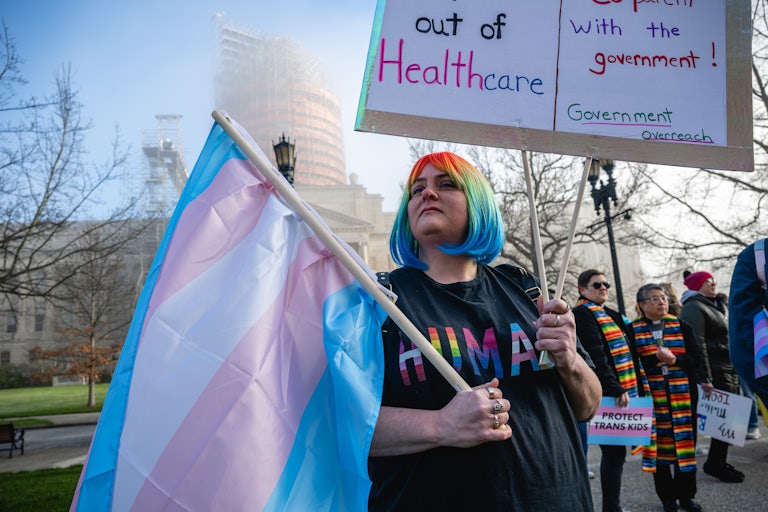
A protester at Kentucky's State Capitol
Jon Cherry/Getty Images
A protester at Kentucky's State Capitol in March

Federal judges in Kentucky and Tennessee have both rejected parts of Republican-led bans on gender-affirming health care for people under the age of 18—just days, even hours, before the anti-trans laws were set to take effect.

On Wednesday, U.S. District Judge David Hale issued a temporary injunction on Kentucky’s ban, allowing puberty blockers and hormone therapy to remain legal and accessible to people under the age of 18 while a broader legal battle proceeds.

The ACLU of Kentucky had filed a suit in May, after Democratic Governor Andy Beshear’s veto was overridden, arguing that the state’s ban on gender-affirming care was unconstitutional because it prevents trans kids specifically from receiving medically necessary care and infringes upon family privacy and doctors’ jobs. The court’s injunction only goes so far, however, as the suit focused mainly on puberty blockers and hormone therapy. Kentucky’s ban on gender-affirming surgeries for those under the age of 18 will still go into effect on Thursday.

Tennessee Judge Eli Richardson issued a similar ruling on Wednesday, stating that criminalizing gender-affirming care for trans kids but not cisgender or intersex kids “imposes disparate treatment on the basis of sex.” Tennessee’s law was set to go into effect on July 1 and would have banned hormone treatment or surgeries for transgender people under the age of 18. Richardson’s ruling did not block the law’s ban on surgeries.

Richardson, a Trump appointee, reiterated that his ruling follows numerous other decisions across the country blocking similar bans on trans health care. “If Tennessee wishes to regulate access to certain medical procedures, it must do so in a manner that does not infringe on the rights conferred by the United States Constitution, which is of course supreme to all other laws of the land,” Richardson wrote.

Richardson also confronted the basic logic of those seeking to defend the bans, and why the bans are not just constitutionally but practically misguided:

Defendants’ assertion that gender-affirming treatment does not improve mental health outcomes relies solely on the testimony of Dr. Cantor, who seems never to have treated an individual for gender dysphoria. But the weight of evidence in the record suggests the contrary—that treatment for gender dysphoria lowers rates of depression, suicide, and additional mental health issues faced by transgender individuals. And at the risk of sounding like a broken record, the Court notes that several courts, based on the respective records in those cases, have found the same.


In North Carolina, Republicans finalized a bill that will ban gender-affirming care—therapy, puberty blockers, and surgeries—for anyone under the age of 18. Democratic Governor Roy Cooper will likely veto the bill, but the Republicans have slim veto-proof majorities in both chambers of the state legislation.

Affirmative Action is Over, Thanks to the Supreme Court

The rulings seriously curtail race-conscious college admissions, effectively ending a decades-old policy.

Photo by Chip Somodevilla/Getty Images

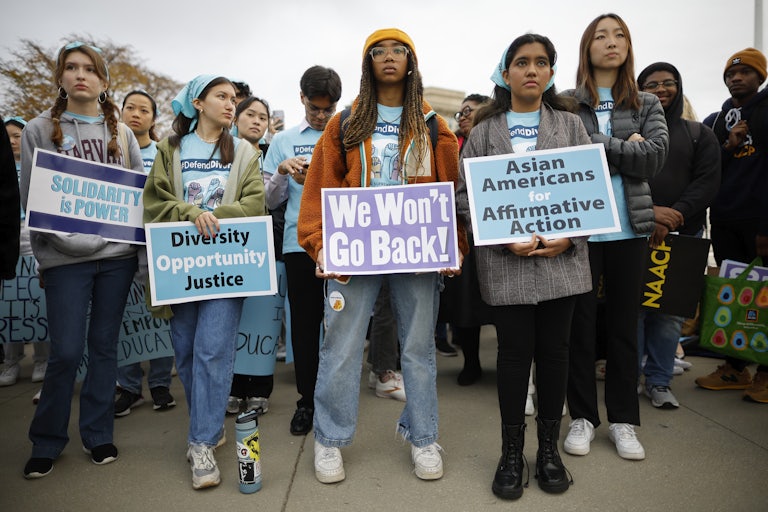
The Supreme Court has voted to end affirmative action in higher education, overturning decades-old policy originating from the presidencies of John F. Kennedy, Lyndon B. Johnson, and Richard Nixon.

“Harvard’s and UNC’s admissions programs violate the Equal Protection Clause of the Fourteenth Amendment,” the court’s majority opinion ruled.

The suits were brought by the anti–affirmative action group Students for Fair Admissions; one was against Harvard University, another against the University of North Carolina.

In the former, the court voted 6–2, with Justice Ketanji Brown Jackson recusing herself due to having served on Harvard’s Board of Overseers. In the latter, the court voted 6–3.

Affirmative action has been a point of legal contention for decades, but most cases regarding it have arrived at one general conclusion: Schools can consider a student’s race when making admissions decisions, but only as part of a broader comprehensive and holistic process. This was the finding in the landmark 2003 cases Grutter v. Bollinger and Gratz v. Bollinger, in which the court ruled that affirmative action in school admissions is constitutional if race is treated as one factor among many, if the purpose is to achieve more diverse classes, and if it doesn’t replace more individualized review of applicants.

In ruling affirmative action unconstitutional, the court overturns this focus on holistic balance.

Now schools across the country will need to overhaul their admissions processes to the new regime. Many schools have already begun to de-emphasize the need for standardizing testing; others are taking the stronger step to get rid of legacy admissions, which favor the children of alumni.

What’s clear is that unless schools take positive steps to ensure their student bodies grow more and not less diverse in the aftermath of this decision, the Supreme Court will leave yet another shameful legacy in its wake: this time, hamstringing our need to foster a strong diversity of thought in this country.

“In so holding, the Court cements a superficial rule of colorblindness as a constitutional principle in an endemically segregated society where race has always mattered and continues to matter. The Court subverts the constitutional guarantee of equal protection by further entrenching racial inequality in education, the very foundation of our democratic government and pluralistic society,” Justice Sonia Sotomayor wrote in her dissenting opinion.

What Is Robert F. Kennedy Doing in the Democratic Primary?

Republicans love him. Democrats? Not so much.

Photo by Sean Gallup/Getty Images

Robert F. Kennedy Jr. theoretically has one big thing going for him in the Democratic presidential primary: He is a Kennedy. Possessing one of the most famous names in Democratic politics is a clear boon, even if Kennedy Jr.’s bid for the party’s nomination is a long shot given that the current occupant of the White House, Joe Biden, is a Democrat. Still, Kennedy Jr.’s name has given him a boost in this early stage of the Democratic primary: With many voters looking for alternatives to the octogenarian Biden, Kennedy Jr. surged in the polls, hitting the high teens in some cases.

The big problem with Kennedy Jr.’s candidacy, however, isn’t just that he’s running against a president most Democratic voters like. It’s that he’s basing much of his candidacy around fringe issues that are directly opposed to the views of most of the Democratic electorate. For decades, Kennedy Jr. has pushed a number of dangerous and unfounded conspiracy theories about the safety of vaccines and the Covid-19 vaccine in particular. Democratic voters like the vaccine—and vaccines more broadly—a lot. Kennedy Jr. has similarly campaigned aggressively against continued support for Ukraine, while arguing to end the war on terms that would be highly favorable to Russia—yet another viewpoint that is wildly out of step with his ostensible party. He has meanwhile appeared with a number of fringe figures, like Joe Rogan, and accepted kudos from Tucker Carlson, among other right-wingers. Donald Trump recently gave him a pat on the back, calling him a “commonsense guy.”

On the right, particularly on Fox News, Kennedy Jr. has been presented as an insurgent and a threat to Biden’s renomination. But that simply isn’t the case. Kennedy Jr.’s popularity has actually fallen as he’s received more media coverage. And it’s easy to see why: Much of the hype is coming from the right. And much of the coverage is focusing on the many, many ideas Kennedy Jr. has that are not shared by his party. In recent weeks, the percentage of Democrats holding strongly favorable opinions of RFK Jr. fell from 20 percent to 14, while those with strongly unfavorable opinions rose to 22 percent, per YouGov polling. Biden currently leads him by 63 points among Democratic voters, though he only bests him by 44 among independents.

Robert F. Kennedy Jr. is a conspiracy theorist and an anti-vaxxer running on ending the war in Ukraine on pro-Putin terms. Still, he could make a dent in an election next year—provided he switches parties. He’s running a decent campaign to become the Republican presidential nominee. He’s running a terrible one to replace Biden at the top of the ticket.

Newly Unearthed Photos of Ron DeSantis Prove He’s Just a Normal Human Person, OK?

The internet has discovered a 2015 campaign photo shoot in which Florida’s future governor pretends to look like an approachable guy (and definitely not a robot).

DeSantis for Senate/Flickr

Ron DeSantis is in a bit of a pickle: He is quite unpleasant personally (as can be seen by interrogations into his physical humanity, let alone his spiritual humanity; or in watching how many Republicans immediately endorse Trump after meeting with DeSantis). He is not necessarily more unpleasant than a lot of other politicians. But his particular brand of unpleasantness has made it so that we as observers are much more primed to pick up on his specific oddities or downright distastefulness.

Enter DeSantis’s photo shoot from 2015, when he was briefly running for Senate after Marco Rubio initially said he would not run for reelection while running for president. An old Flickr account shows DeSantis glad-handing with the same charisma that has recently left him with a net approval rating of negative 19 points—results coming as more and more people across the country have learned more and more about the presidential hopeless.

Take a look here:

DeSantis for Senate/Flickr

Even eight years ago, DeSantis displayed the same level of attentive presence as he has maintained while encountering voters on the campaign trail this year:

Meanwhile, the Florida native known for attacking LGTBQ people and local schools also snapped some headshots in peak high school graduation photo-shoot form. Here, he smiles at the beach.

DeSantis for Senate/Flickr

The photo presents a genial homage to Florida—especially in light of the governor’s strained efforts to contrast being “geographically raised” in Tampa Bay to being “culturally” brought up in Pennsylvania and Ohio. In the latter, he learned how to be “God-fearing, hard-working, and America-loving,” while, apparently in the former, he learned how to deregulate guns while most of America fears increased gun violence, or how to roll back regulations that could have stopped the collapse of Silicon Valley Bank.

DeSantis, like America: a complicated body of contrasts.

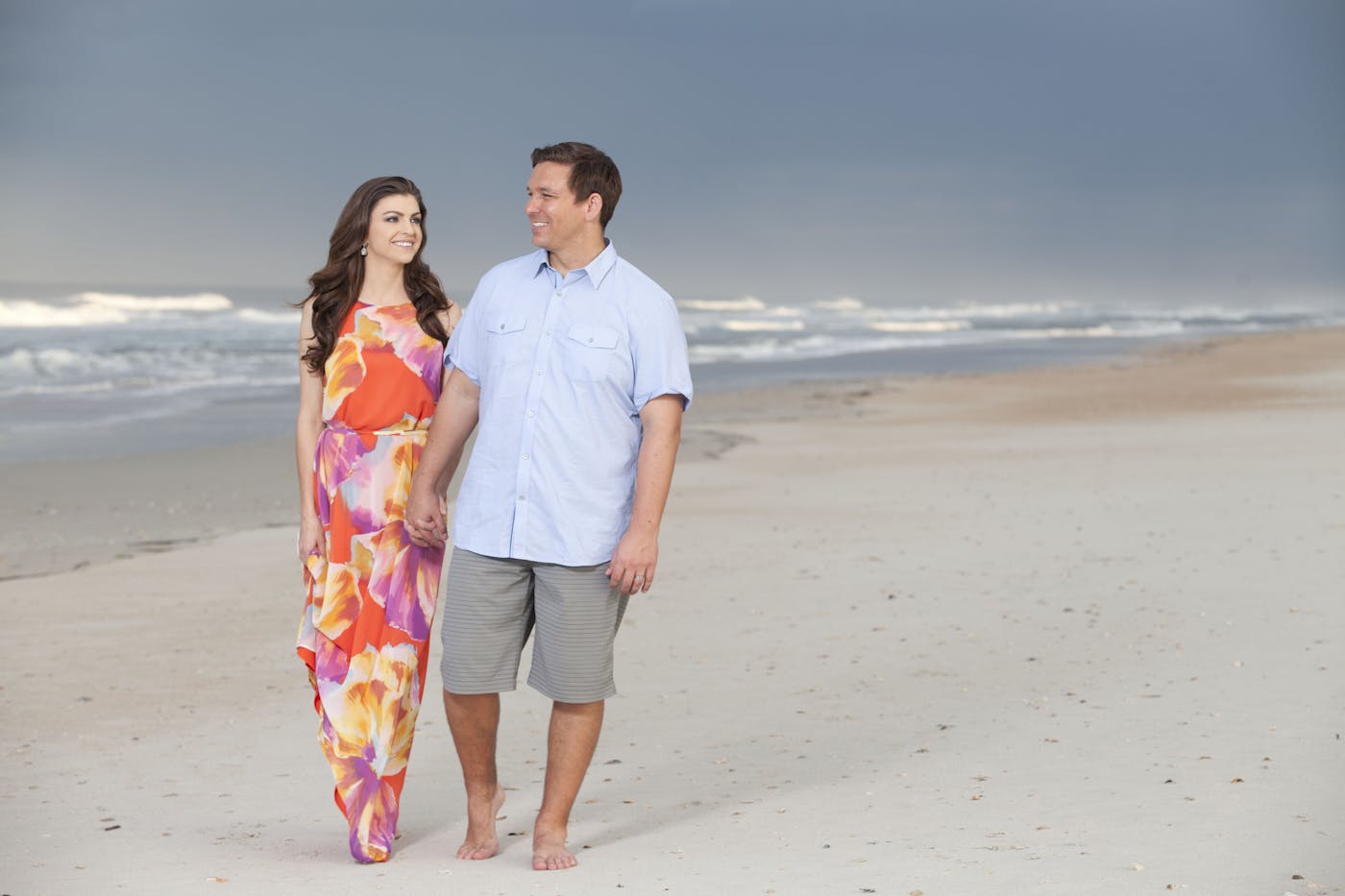
But perhaps the landmark photo of the collection is one of the Florida governor and his wife, Casey, sharing a warm stroll on the beach.

DeSantis for Senate/Flickr

The image evokes memories of how the duo aspiring to be America’s couple first tied the knot: at Walt Disney World in the fall of 2009. The place where dreams come true, after all. One may be prompted to wonder whether a planned Mickey Mouse meet-and-greet or princess-themed performance went awry at the wedding, given DeSantis’s relentless war on one of the most recognizable names in America.

Disney aside, DeSantis of 2015 seemed to have forgotten one of the golden rules of online photography: no free feet! Perhaps his open exposure of the dogs just goes to show how charitable the Florida governor really is.

TNR reached out to the account to ask for more details about what the creative direction was behind the photos but did not hear back by publishing time.