Breaking News
Breaking News
from Washington and beyond

Judge in Abortion Pill Case Cited Study So Bogus It Was Just Retracted

A study used as justification to ban the abortion pill was just retracted by the journal that published it.

Combipack misoprostol and mifepristone tablets
Soumyabrata Roy/NurPhoto/Getty Images

An academic publisher has retracted three studies about the adverse effects of the abortion pill mifepristone, two of which are central to the ongoing lawsuit to ban the medication nationwide.

Sage Publishing announced its decision Monday to pull the studies after they were revealed to have been funded and produced by the Charlotte Lozier Institute, the research arm of the powerful anti-abortion group Susan B. Anthony Pro-Life America. The studies were published in 2019, 2021, and 2022. Sage began reviewing the 2021 study last year after a pharmaceutical sciences professor raised concerns about how it was cited in the mifepristone case.

Ultraconservative Judge Matthew Kacsmaryk, who presided over the initial mifepristone trial in Texas, used the 2021 study to justify his ruling invalidating the Food and Drug Administration’s approval of mifepristone. Another one of the studies, also since retracted, was used by the anti-abortion plaintiffs in the case.

The Sage investigation found that all but one of the study authors, including the lead author on each study, were affiliated with at least one of the anti-abortion associations Charlotte Lozier Institute, Elliot Institute, and American Association of Pro-Life Obstetricians and Gynecologists. The AAPLOG is listed as a plaintiff in the mifepristone lawsuit. One of the peer reviewers was also associated with Charlotte Lozier. None of the authors or the reviewer disclosed these affiliations.

Since all three studies had the same lead author, Sage carried out an independent post-publication peer review of the data in all three studies. Two subject matter experts determined that the 2021 and 2022 articles, which use the same dataset, had “fundamental problems with the study design and methodology, unjustified or incorrect factual assumptions, material errors in the authors’ analysis of the data, and misleading presentations of the data.”

These issues “demonstrate a lack of scientific rigor and invalidate the authors’ conclusions in whole or in part,” according to the experts.

Similarly, the 2019 study, which used a different dataset, included “unsupported assumptions and misleading presentations of the findings that … demonstrate a lack of scientific rigor and render the authors’ conclusion unreliable.”

Kacsmaryk ruled in April that mifepristone had been improperly approved and should be yanked from the U.S. market. The Department of Justice appealed the decision, first to the Fifth Circuit Court, which only partially stayed the ruling. The Justice Department then appealed the case to the Supreme Court, which issued a temporary stay while the lawsuit plays out. The Supreme Court will hear arguments in the case next month.

Kacsmaryk’s initial ruling hinged on several heavily biased “studies.” In addition to the faulty Charlotte Lozier article, he cited another study that claimed to find most people who had medication abortions reported negative effects. The sample size was 98 blog posts from an anti-abortion website. The study authors only analyzed 54 posts and then just cherry-picked quotes from the rest.

Medication abortions make up more than half of all abortions performed in the United States. These drugs can be ordered online and delivered via mail, making them a key resource for people who live in states that have cracked down on abortion access since Roe v. Wade was overturned.

A bigger issue at play, in this case, is that nonelected judges who do not have medical backgrounds are now making decisions about medication. When the lawsuit first began to play out, Rachel Rebouché, the dean of Temple University’s law school, told The New Republic, “The question for appellate courts is not just about abortion but about deference to a federal agency’s expertise.”

The Texas case “undermined” the FDA’s authority, she said. “To take seriously that it ignored risks, risks unsupported by any credible evidence, suggests questions as to what federal courts might decide about other federal agencies’ decisions.”
Brutal Immunity Decision Quotes Brett Kavanaugh Against Trump

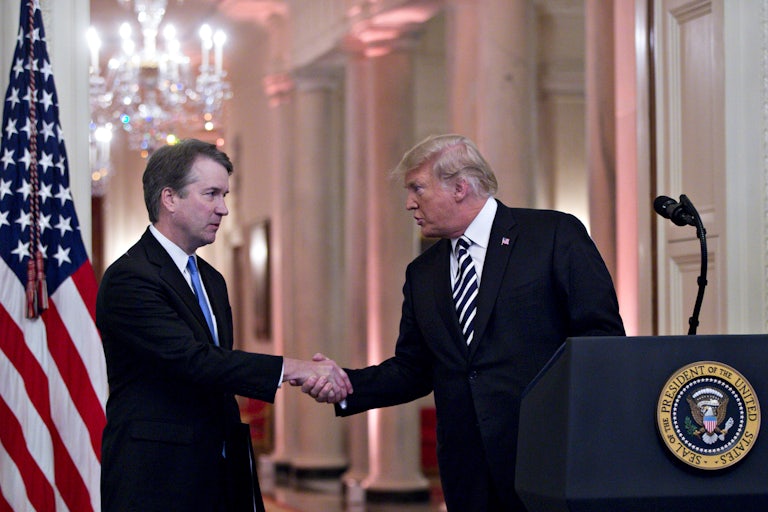
A federal appeals court struck down Donald Trump’s immunity claim—and used a ruling from Trump appointee Brett Kavanaugh to do it.

Andrew Harrer/Bloomberg/Getty Images

A Washington, D.C., appeals court issued a blistering takedown Tuesday of Donald Trump’s arguments that he has “presidential immunity” against criminal proceedings—including a savage citation from Supreme Court Justice Brett Kavanaugh.

Trump has repeatedly insisted that he cannot be prosecuted for trying to change the 2020 election results because he has presidential immunity. One of his arguments is that the separation of powers prevents state and federal officials from judging official presidential acts. He claims that the 1803 Supreme Court case Marbury v. Madison established this precedent.

But “former President Trump misreads Marbury and its progeny,” the three-judge panel said in its ruling. “Properly understood, the separation of powers doctrine may immunize lawful discretionary acts but does not bar the federal criminal prosecution of a former President for every official act.”

The judges then quoted one of those progeny cases, the 1882 ruling in United States v. Lee. The majority opinion in that case stated, “No man in this country is so high that he is above the law. No officer of the law may set that law at defiance with impunity. All the officers of the government, from the highest to the lowest, are creatures of the law and are bound to obey it.”

What’s more, “that principle applies, of course, to a president,” the judges wrote, citing Kavanaugh’s concurring opinion in the 2020 case Trump v. Vance, in which the Supreme Court ruled that Manhattan District Attorney Cyrus Vance could access Trump’s tax records as part of his investigation into alleged hush-money payments to Stormy Daniels.

The judges’ decision to cite Kavanaugh, even fleetingly, is both clever and devastating. Trump and his legal team have previously hinted that the justice, a Trump appointee, owes the former president some sort of loyalty. But the appeals court ruling shows that Kavanaugh operates independently from Trump.

Trump is expected to appeal the ruling to the Supreme Court. He has until Monday to do so. If the high court takes up the question of his immunity, it is starting to look increasingly likely that the justices will concur with the lower courts.

Trump Is Going Absolutely Bonkers After Losing Presidential Immunity Claim

Donald Trump is having a proper meltdown after that brutal court ruling.

Alex Wong/Getty Images

Moments after a federal appeals court unanimously voted against all three of Donald Trump’s presidential immunity arguments in his January 6 case, the former president was back on TruthSocial, insisting that he was going to win the upcoming election.

In a flurry of back-to-back posts, Trump wordlessly reshared polls indicating that he was leading President Joe Biden in their 2024 rematch. One screenshot captured Trump’s odds on Polymarket, an online betting platform, which saw traders banking on the GOP front-runner holding a 17 percent edge over Biden.

Despite the digital diversion, it’s clear where Trump’s head was shortly before he went to sleep. In the late hours of Monday night, the felony-charged pol took one last stab at his immunity claim.

“IF IMMUNITY IS NOT GRANTED TO A PRESIDENT, EVERY PRESIDENT THAT LEAVES OFFICE WILL BE IMMEDIATELY INDICTED BY THE OPPOSING PARTY. WITHOUT COMPLETE IMMUNITY, A PRESIDENT OF THE UNITED STATES WOULD NOT BE ABLE TO PROPERLY FUNCTION!” Trump posted.

After the ruling on Tuesday, Trump campaign spokesperson Steven Cheung echoed essentially the same sentiment.

“If immunity is not granted to a President, every future President who leaves office will be immediately indicted by the opposing party,” Cheung said. “Without complete immunity, a President of the United States would not be able to properly function! Deranged Jack Smith’s prosecution of President Trump for his Presidential, official acts is unconstitutional under the doctrine of Presidential Immunity and the Separation of Powers.”

Trump has not clarified why he thinks overturning an election is within the realm of his presidential duties.

Trump’s legal team has until February 13 to seek a Supreme Court review of the decision—otherwise the mandate will be sent back to Judge Tanya Chutkan, per the court.

The January 6 trial was initially removed from the docket, as Chutkan was awaiting the immunity decision. It’s not yet clear when it will resume, but the Supreme Court could kick it back to her as soon as the end of the month.

Busted: Dem Makes House GOPer Eat His Own Words on Impeachment

Representative Mark Green was caught arguing against his own op-ed, in a telling exchange on the Biden impeachment farce.

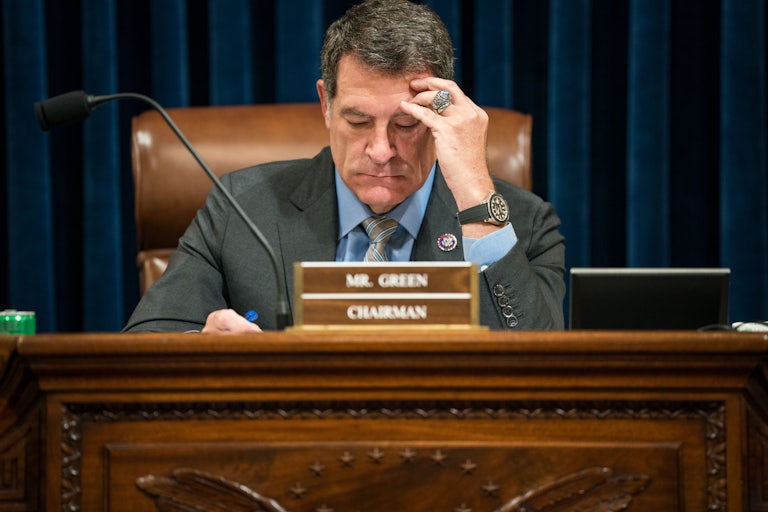
Representative Mark Green sitting in a hearing, holding his hand to his forehead and looking down.
Kent Nishimura/Getty Images
Homeland Security Committee Chair Mark Green

Democratic Representative Joe Neguse went for the jugular on Monday, forcing the Homeland Security Committee’s Republican chairman to eat crow on his impeachment stance.

During a Monday committee hearing on the impeachment resolution to oust Homeland Security Secretary Alejandro Mayorkas, Neguse had questions for Representative Mark Green about an op-ed from five years ago.

“I’m going to enter it into the record. The title is, ‘Americans are the Victims of the Impeachment Inquiry,’” Neguse said. “The subtitle … is, ‘A lot of bipartisan legislation that enjoys support sits gathering dust while Congress focuses on the impeachment inquiry.’”

“I assume you disagree with this?” Neguse prodded.

“I do,” Green replied.

But that turned out to be the wrong answer, trapping Green in a web of his own making.

“This is an editorial that you wrote five years ago during the debate about the impeachment of former President Trump,” Neguse went on, referring to the November 2019 piece by Green that ran in The Tennessean.

Neguse then attacked Green for attempting to unseat Mayorkas for his own political gain, referring to a New York Times article from last April that stated Green had “promised donors this month that he would produce an impeachment case against” Mayorkas.

“This is before your committee has heard from Secretary Mayorkas,” Neguse said. “It’s before you’ve had the witnesses that have apparently come before your committee. It’s before you’ve had any meaningful debate. You decide a year ago?”

Later that night, the House Rules Committee voted 8–4 along party lines to send impeachment articles to the House floor. It’s unclear how the final vote will play out—the divided Republican caucus currently holds a razor-thin majority in the lower chamber.

Trump Just Lost His “Presidential Immunity” Argument. Thoughts, Prayers.

Trump can protest all he wants, but he’s not immune from prosecution over his efforts to overthrow the 2020 election, a federal court has ruled.

Donald Trump
MAANSI SRIVASTAVA/POOL/AFP/Getty Images

A Washington, D.C., appeals court ruled Tuesday that Donald Trump most certainly does not have “presidential immunity” in the indictment against him for trying to overthrow the 2020 presidential election.

Trump has repeatedly insisted that he cannot be prosecuted for trying to change the election results because he has presidential immunity against criminal proceedings. His lawyers argued his case to a panel of three appellate judges in Washington in early January.

The judges, however, ruled unanimously that Trump is wrong.

“For the purpose of this criminal case, former President Trump has become citizen Trump, with all of the defenses of any other criminal defendant. But any executive immunity that may have protected him while he served as President no longer protects him against this prosecution,” the judges said in the ruling.

“We have balanced former President Trump’s asserted interests in executive immunity against the vital public interests that favor allowing this prosecution to proceed,” they wrote. “We conclude that ‘Concerns of public policy, especially as illuminated by our history and the structure of our government’ compel the rejection of his claim of immunity in this case.”

“We also have considered his contention that he is entitled to categorical immunity from criminal liability for any assertedly ‘official’ action that he took as President—a contention that is unsupported by precedent, history or the text and structure of the Constitution. Finally, we are unpersuaded by his argument that this prosecution is barred by ‘double jeopardy principles.’”

Trump will likely appeal the ruling, meaning the case will head to the Supreme Court. This will delay Trump’s trial, which was originally set to begin on March 4, the day before Super Tuesday. The judge presiding over that trial, Tanya Chutkan, called off the March 4 start date last week and said she would set a new schedule once the appeals court ruled on Trump’s immunity.

Now that the court has ruled, it is not clear when the trial could resume. Chutkan has previously kept things moving fairly quickly, but she predicted Monday that the trial could be delayed until much later in the year. If that is the case, then the next trial Trump faces will be in his indictment for his role in hush-money payments to porn star Stormy Daniels. That trial is set to begin March 16.

Trump was indicted in August for his role in the January 6, 2021, insurrection and other attempts to overturn the 2020 presidential election. He faces one count each of conspiracy to defraud the United States, conspiracy to corruptly obstruct an official proceeding, obstruction of and attempt to obstruct an official proceeding, and conspiracy against the right to vote.

Trump has pleaded not guilty to all of the charges and has insisted the case should be dismissed altogether. He argues that former presidents can’t be criminally charged for actions related to their official responsibilities. He did not explain how overturning an election was related to official presidential duties.

While many critics say Trump’s immunity claim is a desperate attempt to avoid accountability, it could also be an attempt to ease his path toward increased power. As Greg Sargent wrote for The New Republic, “If he wins on this front, he’d be largely unshackled in a second presidential term, free to pursue all manner of corrupt designs with little fear of legal consequences after leaving office again.”

Trump’s own lawyer accidentally revealed as much while arguing why the former president should have immunity. During the hearing, Judge Florence Pan asked if a president would be immune from criminal prosecution if he had ordered Seal Team 6 to assassinate a political rival. She noted that an order to Seal Team 6 would be an official act. Trump’s lawyer John Sauer said the president could be prosecuted, but only if he had been impeached and convicted first—essentially saying that presidents should be able to order political assassinations in certain circumstances.

This article has been updated.