Breaking News
Breaking News
from Washington and beyond

What Can the FDA Actually Do About the Abortion Pill Ruling?

As the nation awaits a final decision on the abortion pill, amid dueling legal cases, there is one easy way the FDA could help make sure people still have access.

Paul Ratje/The Washington Post/Getty Images
A doctor prepares doses of mifepristone, the abortion pill, in his clinic in Santa Teresa, New Mexico.

A shocking ruling out of Texas looks like it could take abortion pills off the market, but all hope is not lost. The Food and Drug Administration has a course of action that will let it comply with the court and still maintain access to the drug.

Texas federal Judge Matthew Kacsmaryk ruled Friday that mifepristone, one of the medications used to induce an abortion, had been improperly approved by the FDA and should be yanked from the U.S. market. Another judge has filed a dueling injunction to keep the drug available, and the Department of Justice has appealed the case.

So as the conflicting law proceedings swirl around, what can the FDA do to keep mifepristone available for the people who need it?

Lawmakers, including Democrats Ron Wyden and Alexandria Ocasio-Cortez and even Republican Nancy Mace, have called for the administration to ignore the ruling and keep mifepristone on the market.

“I believe the Food and Drug Administration has the authority to ignore this ruling, which is why I’m again calling on President Biden and the FDA to do just that,” Wyden said Friday.

But law experts warn against urging the government to “ignore” the ruling, which has no legal precedent.

“Ignoring court rulings is a very serious thing that undermines basic principles of law,” David Cohen, a professor at Drexel University’s Kline School of Law, told The New Republic. While he wouldn’t take ignoring Kacsmaryk’s ruling off the table if the situation became extreme enough, he pointed out that there is another, better option.

Enforcement discretion is a decades-old practice established by a 1985 Supreme Court case that determined administrative agencies can decide when to enforce their own rules, based on which offenses are the most important to target. Cohen compared it to police officers not ticketing everyone who drives a few miles over the posted speed limit, focusing instead on people who drive far too fast.

“It’s a normal part of the American justice system,” he explained. “It’s a problematic part, in some ways, because people can use discretion to go after people of color more. But it is a normal part to weigh the pluses and minuses of different offenses and different levels of offenses and go after the ones that you feel you need to use your resources most for.”

The Biden administration has already indicated that it does not intend to ignore the Texas ruling and will wait for the result of the appeal. Business as usual will continue until the end of the week, when Kacsmaryk’s ruling goes into effect, or until the appellate court rules.

But a judge in Washington state has ruled to maintain the status quo, which directly contradicts the Texas ruling.

The only way for the FDA to comply with both rulings, which are both legally binding, is to use enforcement discretion. In doing so, the agency acknowledges that the approval on mifepristone has been suspended. But the FDA also acknowledges that mifepristone is safe for use and that a better use of agency resources is to go after what Cohen describes as “serious offenders,” or other, nonabortion drugs that are unapproved and risky.

Mifepristone was approved for use in 2000. Since then, it has remained categorized as a high-risk drug, even though there have been more than 100 medical studies proving its safety and it is safer than thousands of other FDA-approved drugs, including penicillin and Viagra. Rachel Rebouché, the dean of Temple University’s law school, pointed out that the FDA has “arguably over-regulated mifepristone.”

But this case isn’t just about whether mifepristone is safe or even about the right to an abortion. It’s also about “deference to a federal agency’s expertise.”

The FDA’s authority has been undermined by the [Texas] suit and reaffirmed by the [Washington] suit,” Rebouché told TNR. “To take seriously that it ignored risks, risks unsupported by any credible evidence, suggests questions as to what federal courts might decide about other federal agencies’ decisions.”

Even if the appellate court upholds the Texas ruling, enforcement discretion gives both Biden and the FDA the ability to keep mifepristone on the market while still complying with the judicial system. Cohen, Rebouché, and Pitt University law professor Greer Donley were some of the first to raise this option back in February, noting in a Slate article that even if mifepristone loses its approval, things aren’t necessarily as bad as they seem.

“People have been very quick to make this judge have more authority than we should be giving him,” Cohen said of Kacsmaryk.

There’s been a lot of hand-wringing over the lawsuit, well before Kacsmaryk ruled. People are rightly concerned: More than half of all abortions in the United States are done via medication, a two-step process that consists of taking a dose of mifepristone and then a dose of misoprostol.

These drugs can be ordered online and delivered via mail, making them a key resource for people who live in states that have cracked down on abortion access since Roe v. Wade was overturned last summer.

So the thought that one man could take that away is understandably frightening. By raising the alarm, people brought national attention to the issue. The governments of both Washington state and Massachusetts announced plans to stock up on mifepristone in case residents need it. The widespread outrage could also be used to raise donations for abortion rights groups.

But some of the concern also stems from a lack of general understanding about the legal nuances and complexities of the case.

As Cohen, Rebouché, and Donley say in their Slate piece, Kacsmaryk “is not all-powerful.” The FDA still retains the ability to keep mifepristone on the market, and it should flex that power now.

But “to just throw up their hands in the air and say, ‘Nothing we can do, the drug is now banned,’ (a) that’s not a correct reading of the order,” said Cohen. “And (b) that’s giving up.”

Reinstated Tennessee Lawmaker Promises Every New Bill He Files Will Be on Guns

Justin Jones is back in his seat after Republicans expelled him. And he’s advancing the fight that got him kicked out in the first place.

Seth Herald/Getty Images
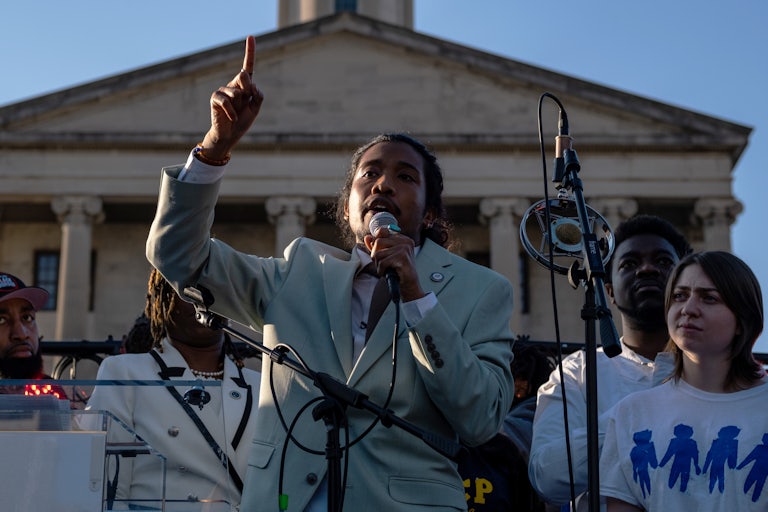
State Representative Justin Jones of Nashville speaks outside the Capitol on April 10.

Tennessee state Representative Justin Jones is back in the seat Republicans expelled him from after the Democrat stood in solidarity with thousands protesting gun violence. And now, he promises that every single bill he introduces as a “new member” will be focused on advancing the fight that prompted his expulsion: stopping gun violence.

“They told me today I can file 15 bills because I’m now technically a new member. Every one of those bills is going to have to do with commonsense gun laws,” Jones told CNN on Monday. “Every single one of those bills is going to have to do with that because that’s what these young people are begging us to do. And so when I come tomorrow, I’m going to work on that legislation, get it to the speaker’s office, and let’s take action before we adjourn from session.”

Jones was expelled from the Tennessee state legislature last week, before the Nashville Metro Council unanimously voted Jones right back on Monday night. He and colleague Justin Pearson, who are both Black, were expelled by Republicans after standing in solidarity with thousands of Tennesseans protesting gun violence in the aftermath of the Nashville mass shooting that left three children and three adults dead. Their colleague Gloria Johnson, who is white, joined them in the protests but survived an expulsion proceeding by one vote.

Jones and Pearson, if reelected as expected, will be interim representatives until special elections are held for both districts.

Republicans, in their anti-democratic efforts to remove members inconvenient to their ideology, have in effect lost on all counts. By so blatantly disregarding public concern after a horrifying mass shooting, they’ve awakened and mobilized thousands of Tennesseans who may have previously been apolitical, unmotivated, or even conservative. They’ve brought nationwide attention to their misdoings—not just the expulsion of members who stood in solidarity with parents, teachers, and students but also the way they have used their supermajority to make up their own rules, filing bills with no notice to the public and killing other bills on no coherent basis other than their own personal preferences.

Finally, they’ve brought millions of people’s attention and support to Jones, Pearson, and Johnson. And with Jones returning, and Pearson perhaps not far behind, the expulsion is not martyrdom but the start of a new battle against the Republican Party.

Millions of people are now monitoring Republicans’ every single move—and what they choose to do with every one of the 15 gun control bills Jones has promised to file. Any further inaction is all the more blatant in the aftermath of yet another mass shooting in neighboring Louisville, Kentucky. Republicans’ time of lazily waving away bills or making up their own rules has come to an end.

And it was all their own doing.

Florida Republican Calls Trans People “Mutants” and “Demons” on House Floor

The representative was expressing support for an anti-trans bill under consideration.

Eric Thayer/Bloomberg/Getty Images

A Florida Republican lawmaker compared transgender people to “mutants” from the X-Men while debating yet another bill that would curtail LGBTQ rights.

During a debate Monday about House Bill 1421, which would ban gender-affirming care for minors and prohibit trans people from using the bathroom that aligns with their gender, Republican Representative Webster Barnaby went on a strange and vitriolic rant.

“I’m looking at society today, and it’s like I’m watching an X-Men movie,” he said. “It’s like we have mutants living among us on planet Earth.”

“This is the planet Earth, where God created men male and women female!” he continued. “The Lord rebuke you Satan, and all of your demons and all of your imps who come and parade before us.”

Barnaby ended his rant by urging his colleagues to vote for H.B. 1421, which would also make it a third-degree felony for doctors to provide gender-affirming care to trans kids.

Republicans across the country have introduced bills targeting a variety of LGBTQ rights, particularly health care for trans and nonbinary people. Most insist they are protecting children by doing so, but Barnaby went right ahead and said the quiet part out loud: They don’t see trans people as human and worthy of care.

If Republicans really wanted to protect children, they would leave gender-affirming care alone. Such treatments decrease the amount of depression and anxiety that trans and nonbinary teenagers feel, and it makes them less likely to consider suicide. But by passing legislation targeting LGBTQ people, lawmakers demonize the community and put people at risk of real harm.

Expelled Tennessee Lawmaker Justin Jones Is Back in the House (for Now)

The representative was one of two Black Democratic lawmakers expelled after talking about gun control on the House floor.

Seth Herald/Getty Images
Democratic state Representative Justin Jones of Nashville gestures to supporters during a vote on his expulsion on April 6.

It’s been just days since Tennessee Republicans brazenly expelled Democratic Representatives Justin Jones and Justin Pearson from the House, but Jones is already on his way back.

On Monday, the Nashville Metro Council voted 36–0 to send Jones back to represent the constituents who already elected him.

Typically, the council would have elected an interim representative, a process that could’ve taken at least four weeks. But members decided to vote to suspend the rules and hold a nomination vote for Jones’s reappointment as the interim representative.

The vote will have Jones back in the state Capitol for House business Monday. The 4:30 p.m. vote came just prior to a House session scheduled for 5 p.m.

Jones, Pearson, and their colleague Gloria Johnson disrupted House proceedings two weeks ago, in solidarity with thousands of children, teachers, parents, and other residents who had been protesting against gun violence outside the state Capitol. The protests erupted after a Nashville school shooting left three children and three adults dead.

Johnson, who is white, survived an expulsion by just one vote. But Jones and Pearson, who are both Black, were expelled.

The Shelby County Commission, home to Memphis, will be hosting a special meeting on Wednesday to vote on an interim representative as well; the vote will essentially be a vote to determine whether the commission will reappoint Pearson back to his seat.

Both seats will still have special elections in the coming months, and Jones and Pearson have expressed their plans to run and officially retake their seats.

Not to be outdone, Republicans are still finding a way to impose their anti-democratic desires on the process. Republican state lawmakers are reportedly threatening to take away government funding for Memphis projects if Pearson is reappointed. The money being threatened is reportedly appropriated for schools and even sports stadiums, like NBA team Memphis Grizzlies’ FedExForum or the University of Memphis’s Simmons Bank Liberty Stadium.

Tennessee Republicans’ Power Grab Has Been in the Works for a Long Time

Even before they expelled two Black Democratic lawmakers, Republicans were using their supermajority to undermine democracy.

Seth Herald/Getty Images
Democratic Representatives Justin Pearson of Memphis and Justin Jones of Nashville at the State Capitol Building on April 6, before they were expelled from the state legislature.

Last week, Tennessee Republicans expelled two Black Democratic lawmakers, Justin Jones and Justin Pearson, for standing in solidarity with the thousands of people demanding gun reform after the Nashville school shooting that left three children and three adults dead. What many have rightfully derided as an anti-democratic action seems to be more of a symptom of a broadly poisoned state legislature, in which Republicans are using their supermajority to make their own rules at whim.

An investigation conducted before last week’s drama from Nashville-based NewsChannel5 revealed how Tennessee Republicans have introduced legislation with no notice to the public, denied roll call votes on bills, and killed bills on the basis that their side apparently sounded louder in voice votes.

In so doing, they’ve shut down even the most inoffensive Democratic-led bills, like one that would direct schools to inform high schools seniors how to register to vote, or another that would study whether college ID cards could be used for voting.

“You have committee chairs single-handedly deciding whether bills live or die. Is that democracy?” NewsChannel 5’s Phill Williams asked Republican House Speaker Cameron Sexton, who responded by insisting that there’s no problem.

Yet a problem there is.

On the college student ID bill, pushed by the now-expelled Representative Jones, Republican Elections and Campaign Finance Subcommittee chair Tim Rudd gavelled the vote as a “No” before the voice vote was even finished. Such brazenness certainly cuts against the already condescending charges made by some Republicans last week that members like Jones and Pearson were complainers and not legislation pursuers.

NewsChannel5 gave Rudd the opportunity to explain why he killed the bill before even hearing the vote. “I don’t know what you’re talking about,” Rudd said twice, with not an ounce of shame of what was clearly seen on camera.

Another bill, advanced by local students, that would’ve directed high schools to guide students on how they could register to vote, was denied a roll call vote by Republican Local Government chair John Crawford on the basis that the committee had already voted on an amendment to the bill.

House rules explicitly state that “a roll call vote shall be taken at the request of the sponsor of the bill or resolution under consideration.”

On the voice vote, it sounded to many in the room like the “Aye’s” had won. Crawford, however, deemed that the “No’s had it.”

“Democracy is dead here in Tennessee as it stands right now,” said House Democratic Caucus Chair Vincent Dixie, who sponsored the bill.

Tori Venable, from the libertarian group Americans for Prosperity, told NewsChannel5 how, with the House voice votes, a vote having “sounded one way, [can go] another way,” all by the unchecked discretion of the Republican majority.

On the student voter registration bill, Dixie had also attempted to file an amendment clarifying some language, but Crawford deemed it “untimely” and unacceptable. When NewsChannel5 asked about the rationale, Crawford talked himself in circles, first claiming that if someone makes a motion and gets a second, then he wouldn’t have a choice but to take it to a vote. When the local reporter pointed out that Dixie had received a second on his motion and Crawford had still denied the motion, Crawford then justified himself by saying, “Well, I said, We don’t take up any untimely filed amendments.’ We hadn’t taken any up to that point all year long.”

Two weeks later, House Speaker Sexton filed a last second amendment to a bill that no one else had seen. In this “untimely” scenario, Crawford gladly gavelled it through.

Contrary to Crawford’s claims, NewsChannel5 noted that their investigation found numerous other cases in which Republican chairs readily accepted late filed amendments the public had never seen.

“This is not democracy as far as I’m concerned,” said Democratic Representative Gloria Johnson, who survived her own Republican-led expulsion threat last week by just one vote.