Life in a Warming World
A weekly reckoning with our heated planet—and the fight to save it

The Wrong Question to Ask About Climate Change

Saying people support “steps” to address climate change is meaningless unless we specify what those steps are.

An aerial photo shows trees growing in a wetland in a manmade pattern.
VCG/Getty Images
A man-made metasequoia forest at Sihong Hongze Lake Wetland Scenic Area in China

Remember when people weren’t even sure climate change was real?

According to a new CBS News poll, 70 percent of Americans support the “U.S. taking steps to reduce climate change.” That’s a big number—so big, in fact, that you’d think political action would be guaranteed, and that we’d be well on our way to halting global warming altogether.

Then how come Congress isn’t passing bills to do that right now? There are a lot of possible answers. That 70 percent finding doesn’t say anything about where climate action lies on respondents’ priorities list. It doesn’t shed light on what sort of actions and policies respondents would support. And perhaps most fundamentally, it doesn’t even define what climate change is.

This last part is particularly important, because it’s the only way to make sense of the CBS poll against others in the past year. Last August, Pew Research Center reported that only 46 percent of Americans believe the “Earth’s temperature is getting warmer mostly due to human activity.” Another 26 percent said it was “mostly due to natural patterns,” with “not sure” and “no solid evidence” receiving 14 percent each. That paints a very different picture of political support for climate policy, because if you think global warming is mostly due to natural patterns, you’re probably not going to support immediate curtailment of fossil fuels.

Pew also asked about prioritization. Only 37 percent said that “the president and Congress dealing with climate change should be a top priority.” Another 34 percent said it should “be an important but lower priority”—which roughly adds up to that 70 percent support for climate action in CBS’s poll.

So why isn’t Congress putting the finishing touches on energy efficiency legislation as you read this? Instead, House Republicans seem inclined to declare war on home appliances that use too little energy.

Much like “do you believe in climate change?” before it, “do you support steps to reduce climate change?” or “do you think addressing climate change should be a priority?” may today be questions that have outlived their usefulness, obscuring more than they inform. Without identifying what those steps are, the questions are nearly meaningless. For while there are many policies that could be construed as “addressing climate change,” those that don’t actually result in reduced emissions don’t fix the fundamental problem.

This conundrum is on full display in the conflicting assessments of the U.S.’s biggest climate legislation yet: the Inflation Reduction Act. By many measures, the IRA has been a smashing success, its tax incentives stimulating green investment all over the nation. Yet the law was tremendously difficult to pass, and probably only did so because the final text didn’t include any policies directly reducing, say, the combustion of fossil fuels. Oil and gas production has actually gone up dramatically since then. As TNR’s Kate Aronoff put it:

As a piece of green industrial policy, the principal aim of the IRA is to foster the development of strategic economic sectors so as to make the U.S. economy more competitive. Any emissions reductions it generates en route to that goal are largely incidental… businesses that take advantage of [the tax incentives]—including fossil fuel companies—are largely free to simply add lower-carbon lines of business onto their core, polluting business models.

You can see a similar problem in some “bipartisan” climate solutions being proposed, like one Time magazine published earlier this week for Earth Day: planting trees. It’s not that planting trees is bad. It’s often very good! But “planting a trillion trees,” as former Speaker Kevin McCarthy proposed last year, would only prevent 0.15 degrees Celsius of warming while requiring 900 million hectares of land (land that may already be already storing carbon and supporting diversity in the form of prairies and wetlands, or that may be needed to produce food or renewable energy). And planting trees doesn’t actually transition the economy to more sustainable forms of energy. So it starts to look like a political sleight of hand to avoid the real need: reducing fossil fuel consumption and production (which McCarthy absolutely does not support).

While the CBS report didn’t mention it, its poll did ask people about specific policies: While 63 percent said they supported the Biden administration’s rebates and tax credits for energy efficiency, and 70 percent supported the reduction of toxic chemicals in drinking water, only 47 percent said they supported the administration reentering the U.S. into the Paris Climate Agreement, and 49 percent supported “spending on projects to reduce climate change.” Tellingly, only 14 percent of respondents overall said they’d heard “a lot” about these policies, while 28 percent said “not much” and 22 percent said “nothing at all.”

Climate scientist Katharine Hayhoe has famously argued over the past decade that “the most important thing you can do to fight climate change” is to “talk about it,” which spreads awareness and may build political will for addressing it. But as awareness of climate change spreads, perhaps it’s time to tweak that prescription. The most important thing you can do to fight climate change may be to talk, specifically, about what policies and steps you support.

Good News/Bad News

Tribal leaders are celebrating the release of juvenile salmon by the California Department of Fish and Wildlife into the Klamath River, following dam removals that are expected to increase the salmon’s chances of survival and spawning.

Three offshore wind projects in New York have been canceled, one of a string of developments complicating the state’s progress toward 70 percent renewable energy by 2030. Read TNR’s coverage of this goal here and here, and coverage about the challenges facing offshore wind here.

Stat of the Week
1,700 coal plants

That’s how many coal plants it would take to equal the emissions produced by plastic production if industry growth continues on its current trajectory, according to a new report covered by The Guardian. Read more of TNR’s coverage of the plastics industry here and the UN negotiations for a plastics treaty here.

What I’m Reading

As the climate changes, cities will scramble to find trees that will survive

Trees are struggling to keep up with the warming world, Laura Hautala writes. Varieties that used to do well in certain areas aren’t doing well anymore, and that challenge will only increase with time. That may seem like a problem for forest conservationists, but it also presents a challenge for cities:

Urban arborists say planting for the future is urgently needed and could prevent a decline in leafy cover just when the world needs it most. Trees play a crucial role in keeping cities cool. A study published in 2022 found that a roughly 30 percent increase in the metropolitan canopy could prevent nearly 40 percent of heat-related deaths in Europe. The need is particularly acute in marginalized communities, where residents—often people of color—live among treeless expanses where temperatures can go much higher than in more affluent neighborhoods.… Urban botanists and other experts warn that cities are well behind where they should be to avoid overall tree loss. The full impact of climate change may be decades away, but oaks, maples, and other popular species can take 10 or more years to mature (and show they can tolerate a new climate), making the search for the right varieties for each region a frantic race against time.

Grist | Lauren Hautala

This article first appeared in Life in a Warming World, a weekly TNR newsletter authored by deputy editor Heather Souvaine Horn. Sign up here.
The U.N. Is Running Out of Time to Draft This Plastics Treaty

Meanwhile, it has yet to ban plastics industry lobbyists from the talks.

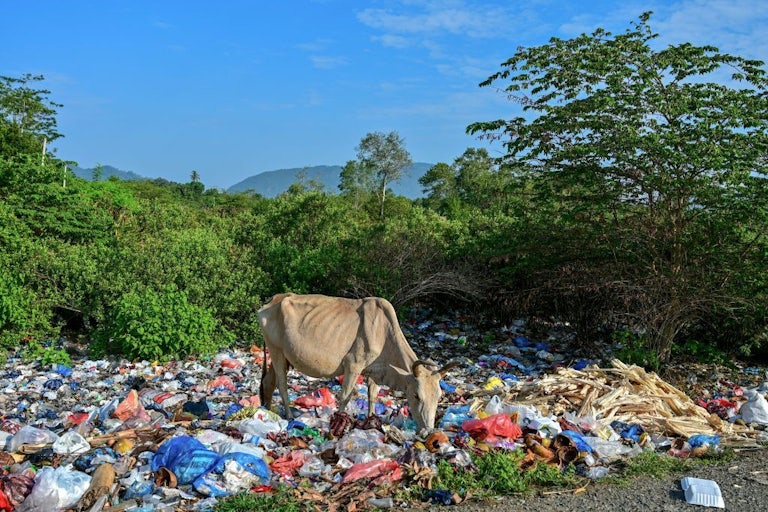
A cow stands in a field of discarded plastic.
Chaideer Mahyuddin/Getty Images
A cow forages amid plastic garbage in Indonesia’s Lhoknga, Aceh province.

In March 2022, U.N. delegates met in Ottawa and struck a historic agreement to produce, by the end of 2024, a legally binding treaty to “end plastic pollution.” “Plastic pollution has grown into an epidemic. With today’s resolution we are officially on track for a cure,” Espen Barth Eide, then Norway’s minister for climate and the environment, said at the time. Now, more than two years later, the mission looks dangerously close to derailing.

Next week, when delegates reconvene in Ottawa, it will be their penultimate chance to achieve their stated goal (the final meeting is in November). “This meeting is, to a degree, make or break,” the International Pollutants Elimination Network’s Björn Beeler told Inside Climate News.

Given the proliferation of plastics alternatives these days, you might think this treaty would be in the shrimp shell–derived sustainable bag, so to speak. Nope. A meeting in Nairobi in November 2023 ended with very little progress. Perhaps relatedly, as this newsletter noted at the time, the Center for International and Environmental Law tallied 143 fossil fuel and petrochemical industry lobbyists registered to attend that meeting. It’s not known yet how many have registered to attend next week’s.

Since last November, several new reports have shed further light on the deception of the plastics industry. In February, the Center for Climate Integrity released a report on what it called a “decades-long campaign of fraud and deception about the recyclability of plastics,” as newly uncovered documents from trade group the Vinyl Institute explicitly acknowledged in the 1980s that “recycling cannot go on indefinitely, and does not solve the solid waste problem.”

Last month, the Environmental Integrity Project announced another finding: that some $9 billion in U.S. taxpayer money has been used, via tax breaks and subsidies, to build plastics manufacturing facilities. Many of those facilities, in turn, have “repeatedly exceeded legal limits on the air pollution they release into surrounding communities, disproportionately affecting people of color,” DeSmog’s Sara Sneath wrote. Volatile organic compounds of the sort released by these plants have been “tied to a broad range of potential health impacts, from nosebleeds to cancer.”

These two reports aren’t the first and won’t be the last to showcase the plastics industry’s bad faith or the catastrophic consequences of public credulity. But taken together, they’re a striking indictment of the position that reportedly tanked the talks in Nairobi in November. The basic problem then was that countries with big petrochemical industries, like the United States, Saudi Arabia, Russia, and China, opposed the idea of “binding provisions” for reducing plastic production, and in some cases explicitly advocated focusing on recycling instead.

In light of these two reports, at least two things may be said about this position. First: Given that the plastics industry has admitted internally for decades that recycling doesn’t work, a recycling-first approach to plastic pollution is basically a pro-pollution stance. And second: While countries may value the wealth produced by their large fossil fuel industries, they also have ample evidence that these industries will not hesitate to take taxpayer money and, in return, poison taxpayers.

Meanwhile, the political systems for addressing this problem are deeply dysfunctional. It’s not uncommon, in U.N. climate talks, for oil industry execs to actually be part of official governmental delegations for some countries. And in the U.S., even if a useful treaty does get drafted this year, a Trump victory in November “would likely impact how such an agreement gets implemented in the U.S. and ratchet up the already long odds that any final accord would be approved by the U.S. Senate,” E&E News reports.

Still, kicking straight-up lobbyists out of the talks shouldn’t be too much to ask. U.N. member nations are well overdue in acknowledging what many credible news outlets have now reported, and what ought to be common sense: that plastics industry representatives are not disinterested parties here. Any sincere attempt to curb the global disaster of plastic pollution isn’t going to come from them.

Good News/Bad News

As experts warn about plummeting biodiversity and California bans salmon fishing for a second year due to dwindling populations, The Guardian reports one small, potentially positive development in Europe: Around 500 barriers (think dams, fords, etc.) were removed from European waterways last year, helping to restore riparian ecosystems and allowing fish to travel upstream to breed.

Researchers are expecting “the most spatially extensive global bleaching event on record” for the world’s coral, National Oceanic and Atmospheric Administration coal expert Derek Manzello tells The New York Times.

Stat of the Week

$150,000 per lease

That’s the new price for drilling on federal lands, up from $10,000. The rule was finalized by the Bureau of Land Management on Friday, part of a big push to finalize environmental rules before President Biden’s term runs out.

What I’m Reading

How Fast Fashion Is Driving Land Grabs and Violence in Brazil

While brands like H&M promote their cotton clothes as particularly sustainable, courtesy of the Better Cotton Initiative, environmental nonprofit Earthsight has cast doubt on that, Sophie Benson reports for Atmos. Earthsight examined two major cotton producers who export to manufacturers that make clothes for H&M and Zara:

SLC and Horita Group stand accused of deforestation on a grand scale.

In 2014, Bahia’s environmental agency Ibama found 25,153 hectares of illegal deforestation on Horita farms at Agronegócio Condomínio Cachoeira do Estrondo, a vast agribusiness estate, the report outlines. In 2020, the same agency stated it could find no permits for 11,700 hectares of deforestation carried out by the company between 2010 and 2018. Between 2002 and 2019, Horita Group’s owners were fined over 20 times for environmental violations, totalling $4.5 million.

Meanwhile, three of SLC’s cotton farms lost at least 40,000 hectares of native Cerrado wilderness in the last 12 years, per Earthsight’s reporting. SLC has also been fined around $250,000 by Ibama since 2008 for environmental infractions in Bahia. Both companies are further alleged to have cleared land which has been legally earmarked for regeneration or preservation.

Read Sophie Benson’s full report at Atmos.Earth.

This article first appeared in Life in a Warming World, a weekly TNR newsletter authored by deputy editor Heather Souvaine Horn. Sign up here.
Fish Are Behaving Erratically and Dying. No One Knows Why.

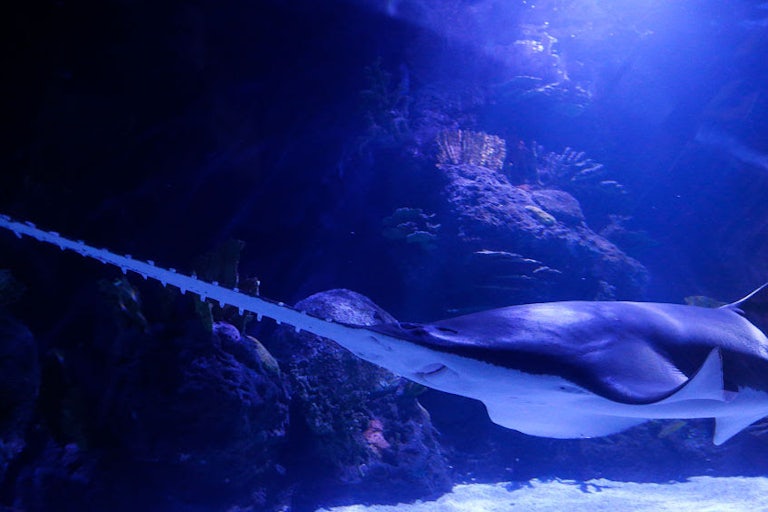
Endangered smalltooth sawfish are one of many species that have been seen spinning around and beaching themselves off the Florida Keys.

A smalltooth sawfish
Houston Chronicle/Hearst Newspapers/Getty Images
A sawfish in an aquarium

Something strange is happening in the waters off the Florida Keys. For months now, thousand-pound fish with three-foot serrated beaks have been spinning around in seeming distress, beaching themselves, and dying. The news largely escaped national attention until the National Oceanic and Atmospheric Administration announced last week that it would be coordinating an “emergency response effort” to rescue these fish, prompting a string of pieces in major outlets.

It’s not a story that gets less disturbing or strange the more you learn about it. Quite the opposite.

NOAA is mobilizing because the fish in question, the smalltooth sawfish, is an endangered species—one of only five sawfish species in the world, all of which are threatened. “It’s a big ray with a big crazy hedge trimmer on the edge of its head,” says Florida State University marine biologist Dean Grubbs, who’s been on NOAA’s Smalltooth Sawfish Recovery and Implementation Team since 2009. The fish, “which are close to bull sharks in terms of where they are on the food chain,” Grubbs added, have been hit hard by commercial fishing bycatch, trophy hunting, and habitat loss—particularly of the mangroves where young sawfish hide from predators while they grow. They’ve been protected in Florida since 1992 and listed under the Endangered Species Act since 2003. “We were sort of celebrating the twentieth anniversary of the listing,” Grubbs said, because “we were actually seeing some positive signs of recovery”—until this happened.

But sawfish aren’t the only ones behaving strangely. “There have been I think over 40 species of fishes that have been seen doing this weird spinning behavior,” Grubbs said, and it started months ago, as early as November of last year. People simply started noticing it more when they saw the sawfish with their giant rostrums—that’s the big serrated beak-like apparatus—in the shallow water starting in January. “Most residents of the Florida Keys have never seen a sawfish, and that’s why it caught everybody’s eye.”

Fish losing their minds en masse is alarming, although it seems confined to the Keys. “The theory is that it’s something that seems neurotoxicological,” Grubbs said, but the routine water testing isn’t showing anything suspicious. The head of Mote Marine Laboratory, involved in the response, told CBS News, “This seems to be some kind of an agent that is in the water that is negatively impacting just the fish species.”

While many fish may die while awaiting an answer, the sawtooth population is particularly vulnerable. Given that genetic analysis of the smalltooth sawfish population estimates that there could be only around 400 breeding females left, Grubbs said, this sort of unexplained phenomenon is pretty worrisome. Nearly 30 adult sawfish have been confirmed dead, with possibly many more whose carcasses simply haven’t been found, and over 100 live sawfish have been observed exhibiting this odd spinning behavior. That’s a sizable portion of the total population, which doesn’t have a great capacity to bounce back. Researchers think it may take sawfish a decade or more to reach sexual maturity.

The plan to buy the sawtooths time while researchers figure out what’s going on is pretty wild: to capture live sawtooths, take them out of the ocean (so they can’t beach themselves or get any sicker if the problem is being caused by the water), and quarantine them until they recover and researchers have answers. This is not a minor task when talking about an animal 10 to 15 feet long that weighs about as much as a horse and needs to remain submerged. NOAA’s statement last Wednesday listed Ripley’s Aquariums, the research nonprofit Mote Marine Laboratory, and aquarium and pet store supplier Dynasty Marine Associates as three locations where sawfish might be taken for quarantine. To make this work, NOAA also has to find “transport routes,” Grubbs noted. Meanwhile, the testing will continue—of water, of samples from dead sawtooths and other fish, and of samples from healthy fish, which Grubbs and his team helped provide from a recent research trip.

These sorts of mass mortality events, as Marion Renault wrote for TNR last year, are becoming more common. “We’re nowhere close to grasping the repercussions these cascades of death have on ecosystems,” Marion wrote. “One catastrophe makes it more likely that you’ll suffer a second or third,” one zoologist told her. “And every devastation,” Marion wrote, “leaves an ecosystem more vulnerable for the next.”

The mystery of the spinning fish is strange enough, hopefully, to seize the nation’s attention. But it’s just one part of a larger onslaught on Florida’s coastal ecosystems, degraded by runoff and sewage, toxic algal blooms, and soaring temperatures that reduce the amount of oxygen in the water. Those studying sawfish may be particularly anxious, unsure whether the population can rebound. But, said Grubbs, “I think it’s a big environmental concern for all of us.”

Good News/Bad News

There are a growing number of alternatives to plastic when it comes to food packaging, The New York Times reports. But current systems for distributing food, and patterns people have when it comes to buying and consuming food, aren’t going to make eliminating plastic easy.

Landfills are emitting way more methane than previously thought.

Stat of the Week

140%

That’s the increase in incidence of dengue fever in Puerto Rico so far this year compared to this time last year. Read Zoya Teirstein’s report at Grist about the disease’s alarming spread.

What I’m Reading

HOAs are blocking solar panels and native lawns. Here’s how to fight back.

This column from The Washington Post’s “climate coach” tells the story of two people—a software engineer near D.C. and a climate journalist in Lockhart, Texas—who have defied homeowners associations to transform their front lawns into a vegetable garden and a miniature prairie landscape, respectively. It also contains advice for those who want to follow in their footsteps.

Power is shifting back into the hands of property owners after state legislators have begun rolling back decades of escalating HOA restrictions. But many members of HOA boards don’t know these provisions, or ignore them.

“Unfortunately, it sounds cliché, but there are association board members who are on a power trip,” says Luke Carlson, an attorney and founder of LS Carlson Law specializing in HOA disputes. “They will not listen to reason until you notify someone in their camp that what is happening is wrong, and it’s violating the owners’ rights and well-established law. But it takes a little bit of fight to get some traction.”

Read Michael J. Coren’s column at The Washington Post.

This article first appeared in Life in a Warming World, a weekly TNR newsletter authored by deputy editor Heather Souvaine Horn. Sign up here.

How to Avoid Food System Collapse

If Atlantic Ocean currents break down, the Northern Hemisphere could face crop failures. So why isn’t there a plan for that?

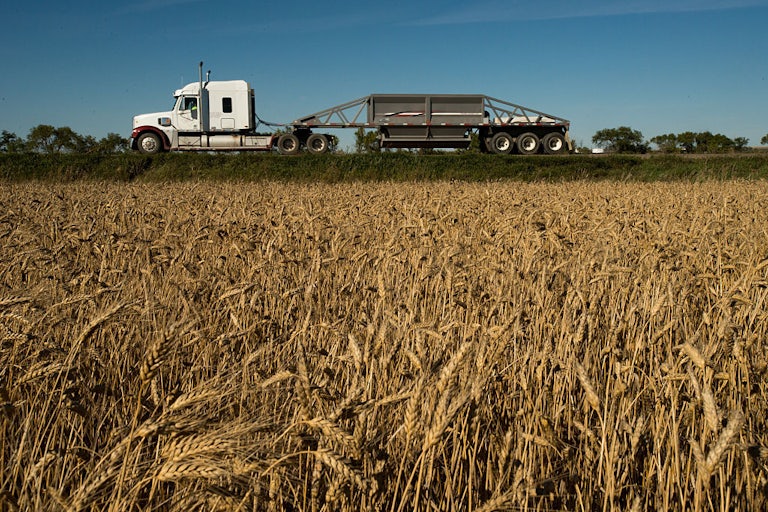
A truck drives past a field of wheat.
Ken Cedeno/Corbis/Getty Images
A wheat field in North Dakota

Spring is here, and seeds are in the ground. But what if, a year from now, all the weather patterns our food system takes for granted were suddenly different? Not just the worsening summers, droughts, and floods of climate change but something faster and more dramatic, and much harder to adapt to?

Last month, researchers from Utrecht University in the Netherlands published a disturbing paper suggesting this might actually happen. Scientists have previously speculated that melting ice sheets dumping vast quantities of freshwater into the ocean could change the currents of the Atlantic Ocean. The new modeling suggested, though, that complete collapse of the Atlantic Ocean’s current system is no longer “theoretical” and could occur much faster and more completely than anticipated. Europe would abruptly get much colder, seasons could fully flip in the Amazon rainforest, and many other places could see big changes in weather patterns.

Can our food systems survive this kind of shock? Food systems are dizzyingly complex, encompassing crops grown in fields and greenhouses, meat and dairy animals elsewhere that consume some of those field crops, wild and farmed fisheries, refrigerated supply chains transporting plant and animal products to processing sites or warehouses, the grocery and restaurant industries, and international trade. When I asked experts about how U.S. food supply might be affected by weather shifts like the one outlined in the new paper, their responses weren’t reassuring. In essence: Both domestic and international food systems are quite vulnerable. But figuring out how vulnerable is hard. Not only is the United States failing to make its food system more resilient, it’s not even gathering enough data to know how to make the food system more resilient.

“We’ve done surprisingly little preparing for these kinds of shocks,” said Roni Neff, a professor at the Johns Hopkins School of Public Health and Center for a Livable Future. When Neff and her colleagues surveyed local governments on food system resilience, “the people that responded were those that were already thinking about this, and of those that responded only 10 percent considered their local jurisdiction to be prepared.”

Nor can local governments rely on the feds. The concern with a large-scale shock is that it could trigger what researchers call “multiple bread basket failures,” according to Michael Puma, director of the Center for Climate Systems Research at Columbia University. “As far as I know there is no very clear governmental strategy—at least that’s unclassified—that clarifies how the U.S. would deal with a major disruption in production.”

While the U.S. Department of Agriculture does have grants and loans for building a more resilient food system, that’s far from being a comprehensive plan for responding to giant climate shocks. “Some of us in academia have been trying to push the governmental agencies to take notice of this,” Puma said, “with little success to date.” Because food system resilience in response to crisis involves a mix of domestic agriculture, international trade, disaster response, and more, there’s no one agency that would be able to address this. “In the 1970s the U.S. government had prepared a report on potential strategies for managing U.S. food reserves, and this was in response to the Soviet grain crisis,” Puma added. “But then it was somewhat abandoned and ignored and not really used moving forward.”

A comprehensive strategy would have to start with good data. “We know what to do in general” when it comes to food system resilience, Neff said, but “there’s really quite scant research on confirming what works and what to prioritize.” Changing that would involve a combination of funding and coordination. “We haven’t seen a major amount of funding available for this type of question and specifically to develop policies or new institutional responses to this type of threat,” said Puma.

“When we’ve been trying to do various projects with modeling, like where is the food, who’s got it, how much food is in the Baltimore area right now if all the roads got cut off,” Neff said, “we don’t know, because a lot of it is in various individual businesses and storehouses and they’re each keeping their own data.” (One such study of New York City in 2016 estimated “the New York City food system holds roughly 4 to 5 days of regular consumption of food stock on average”—not an encouraging figure if one were to imagine incoming supply chains being disrupted.)

Even without better data, though, it’s possible to identify specific vulnerabilities in the U.S. food system and changes that should probably be made. The high efficiency of the current food system has often come at the cost of redundancy—meaning backup plans. “We need to have more diverse places where food is coming from; we need multiple routes, roads, where it’s coming from, multiple storage facilities,” Neff said. And while sudden systemic agricultural reform would both be hard and come with its own risks, Puma argued, there’s “low-hanging fruit” like fighting the increasing “consolidation of farmland,” reducing overreliance on fertilizer and pesticides, and being a little more skeptical of so-called smart agriculture: “If you’re introducing the use of drones into the agricultural system, that’s a new type of risk to take into account.”

Then there are things that can be done quickly, and locally. Communities that “had been doing some of this work before the pandemic hit were better able to adapt” to the 2020 disruptions, Neff said. And “one of the key things was having people in the local food system connected to each other and knowing each other and having those relationships in the first place so people knew who to call and contact and help develop responses.”

You’ll be reading more about food system resilience and agriculture reform at TNR shortly. But in the meantime, if you’re not feeling exactly reassured as you read this, you’re not alone. At the end of these calls, given the lack of preparedness at the governmental level, I asked whether the people who have been socking away hundreds of pounds of rice and beans in their basements might have the right idea, if not exactly an equitable one.

“The preppers definitely do have a point,” Puma said. “I think it’s a multiscale solution, and I think low-hanging fruit is to encourage people to have more food stored at home so that they’re not as vulnerable. You want to have a little buffer capacity as individuals so if there’s no food for a week you’re not scrambling.”

Good News/Bad News

Competition among states for the Climate Pollution Reduction Grants instituted by the Inflation Reduction Act have resulted in a new crop of ambitious climate proposals from Democratic governors, Politico reports.

A new report has officially confirmed that air quality last year in the U.S. was dreadful.

Stat of the Week
0.92–3.23 percentage points

That’s how much climate change could be inflating food costs per year by 2035, according to a new study. By that point, climate change could also be contributing to overall inflation (“headline inflation”) by up to 1.18 percentage points per year. Read Axios’s summary here.

What I’m Reading

You may remember stunning photos circulating last year of Tulare Lake, long ago drained for agricultural use, reappearing in California’s Central Valley thanks to record precipitation. “Scientists and officials predicted the lake could remain for years to come, sparking consternation among the local farmers whose land was now underwater and excitement from others who saw the lake as a fertile nature sanctuary and sacred site,” writes The Guardian’s Dani Anguiano. Perhaps just as remarkable as the lake’s reappearance, however, is the fact that it’s almost entirely gone just a year later:

These days the crowds of eager tourists have waned, and the shoreline is getting harder to find. On a recent drive through the central valley, I decided to try my best to see what was left of it.

On a sunny afternoon in late February, almost a year after its arrival, the road closure signs still in place around the county served as the most visible reminder of the lake. They blocked long stretches of muddy roads leading to agricultural facilities.

The remnants of Tulare Lake are located entirely on private land, far from where the public can see it. It has reduced rapidly in size as local agencies moved water from the lake to nearby farmlands. Evaporation also played a “key role.”

Read Dani Anguiano’s report at The Guardian.

This article first appeared in Life in a Warming World, a weekly TNR newsletter authored by deputy editor Heather Souvaine Horn. Sign up here.

The Bleak Backdrop to the Kate Middleton Frenzy

Much like “covfefe” in 2017, the internet is converging on a story that feels safer than everything else that’s going on.

Newspapers lie on top of one another showing front-page stories about Kate Middleton.
Ming Yeung/Getty Images
U.K. newspaper coverage of Catherine, Princess of Wales, being admitted to the hospital on January 18

Dozens of pieces in legacy media publications, including TNR, have looked for broader meaning in the social media frenzy over Kate Middleton’s “disappearance” since Christmas. (To recap: The princess was supposed to be recovering from planned surgery away from the public eye. But the internet was suspicious, and to quell rumors the palace released an image earlier this month that then proved to be heavily edited, for which Middleton claimed the blame. This did not help.) Some say the public relations mess signals a general crisis for the monarchy, some that it’s a sign of contemporary addiction to conspiracy theories. A professor of media ethics told The New York Times that it’s a symptom of “the darkness that is characterizing our politics.”

To me, the flurry of amateur Kate Middleton sleuthing, memes, and jokes on social media resembles nothing so much as the viral “covfefe” tweet by Donald Trump nearly seven years ago. Just after midnight on May 31, 2017, Trump typed the nonsensical, “Despite the constant negative press covfefe,” and seemingly logged off for the night. Because journalists and other political obsessives had learned to keep an eye on Trump’s account during the witching hour, Twitter promptly lit up with confusion and speculation about what Trump could have meant, or whether he’d been tackled while typing. Some created “covfefe” parody accounts. The entire internet, it seemed, had descended into giddy absurdity.

Like the “covfefe” episode, the Middleton frenzy has the feel of a massive online community blowing off steam. You can’t say it’s “good clean fun,” exactly—the speculation ranges from salacious to downright grim. But it has the classic “covfefe” mixture of jokes and theories edged with faint nervousness about such obvious incompetence in the P.R. apparatuses of powerful institutions. It’s the incredulous but gleeful vibe of kids realizing that the adults who were supposed to have everything under control are tripping over their own shoelaces. “I don’t think u understand how badly you’ve f***ed this,” read one tweet with over 36,000 likes, responding to alleged Kate Middleton photos. “There are now people on the internet who could SHAKE HER HAND and still claim she’s four cats in a wig.”

Also like “covfefe,” the Middleton moment has people nostalgic for a more innocent era: a time when the internet seemed like a place to clown around rather than a place for fascist paramilitary recruitment. A time when people could laugh at the grown-ups screwing up because we retained a shred of belief that the grown-ups basically had things under control the rest of the time.

None of these jokes and memes are actually fun when you zoom out. The “covfefe” episode proved to be a precursor for Trump threatening nuclear war on Twitter, getting banned for inciting an insurrectionist mob, then getting his account restored (along with many other accounts banned for hate speech) after Elon Musk bought the platform. The Middleton frenzy contains more than a hint of the macabre: Speculating wildly about the lives of people recovering from major surgery isn’t nice, and doing so as a distraction from other news stories, while understandable, is bleak.

The grown-ups—meaning the institutions that have inherited massive power in our society—quite evidently do not have things under control. The other stories people have the option of reading about are almost impossibly grim. A genocide is playing out in Gaza, and the nations who joined the “Never Again” refrain after Rwanda are actively supporting the genocidal regime. Trump, who many hoped would fade into chaotic obscurity after losing the 2020 election, seems quite likely to regain the presidency—and The New York Times is running stories about the resistance being tired.

Whether the world can withstand this turn of events is unclear. The earth may be warming even faster than anticipated, and rich nations still haven’t gotten it together to bring emissions down to safe levels. Environmental groups, who have been warning for years that the Biden administration, despite the Inflation Reduction Act, isn’t doing enough to avert catastrophe, find themselves with little choice but to hope that Biden will at least prevail over the alternative.

Of course people are going off about Kate Middleton. But it has nothing to do with Kate Middleton. This story is a fantasy about returning to the 1990s, when people could indulge in celebrity gossip without the feeling of laughing on the brink of the abyss. Almost every other story in the news is too much to take.

Good News/Bad News

The EPA has, at long last, fully banned asbestos.

The new and relatively weak Securities and Exchange Commission rule requiring companies in some situations to disclose their emissions and climate-related risks has already been halted by court order pending a suit from oil and gas companies. Meanwhile, 24 Republican state attorneys general are suing over the Environmental Protection Agency’s new rule to reduce methane emissions from oil and gas industry activities—for example, by monitoring leaks and limiting flaring. The Republican attorneys general say this is an “attack” on the oil and gas industry.

Stat of the Week
$9 billion

That’s how much taxpayer money since 2012 has gone to subsidizing plastic plants. “In the past three years, more than 80 percent of the facilities violated their air pollution control permits,” reports DeSmog.

What I’m Reading

FBI sent several informants to Standing Rock protests, court documents show

Alleen Brown’s report on the extent of federal law enforcement’s actions against the Indigenous demonstrators and their allies protesting the Dakota Access Pipeline beggars belief:

Up to 10 informants managed by the FBI were embedded in anti-pipeline resistance camps near the Standing Rock Sioux Indian Reservation at the height of mass protests against the Dakota Access pipeline in 2016…. The FBI also regularly sent agents wearing civilian clothing into the camps, one former agent told Grist in an interview. Meanwhile, the Bureau of Indian Affairs, or BIA, operated undercover narcotics officers out of the reservation’s Prairie Knights Casino, where many pipeline opponents rented rooms, according to one of the depositions.

The operations were part of a wider surveillance strategy that included drones, social media monitoring, and radio eavesdropping by an array of state, local, and federal agencies, according to attorneys’ interviews with law enforcement.

Read Alleen Brown’s full report at Grist.

This article first appeared in Life in a Warming World, a weekly TNR newsletter authored by deputy editor Heather Souvaine Horn. Sign up here.