Life in a Warming World
A weekly reckoning with our heated planet—and the fight to save it

The Really Grim Part About Gas Stoves

Lower-income people living in smaller spaces are especially affected by the toxic gases these ranges leak.

This image shows two lit burners on a gas stove.
Michael M. Santiago/Getty Images

Industry marketing campaigns have long conditioned Americans to believe that gas stoves are the height of bourgeois suburban sophistication and the discerning choice of the home chef—Anthony Bourdain meets Instagram trad wife, if you will. What they don’t tell us is that gas stoves poison us—particularly the poorer among us.

Researchers have known for a long time that the nitrogen dioxide released by gas stoves contributes to childhood asthma and other respiratory ailments, and have recently been examining the risk from benzene as well. But a new study clarifies that this is especially bad for people living in smaller spaces. Those in residences under 800 square feet, the researchers found, experience over four times the long-term nitrogen dioxide exposure from gas stoves that those in residences of over 3,000 square feet do. This also means, researchers note, that largely due to differences in average residence size, American Indian and Alaska Native households, Latino households, and Black households with gas stoves tend to have higher than average levels of nitrogen dioxide exposure.

This shouldn’t come as a surprise. Research on the dangers of gas stoves goes back to the 1980s. And as TNR columnist Liza Featherstone argued last year, pro-gas politicians’ insistence on portraying these stoves as a consumer choice issue has always been a red herring. Many people can’t afford to replace their gas stoves. Often, it’s not even up to them: They’re renting. In a pilot study that replaced public housing residents’ gas stoves with induction ones, Liza wrote, “households using induction stoves had a 35 percent reduction in daily nitrogen dioxide compared to … households using gas stoves, and the decrease in carbon monoxide was even more dramatic. The participants, several of whom suffered from asthma, noted that since the departure of their gas stoves, their symptoms had disappeared.” And not a single person asked for their gas stove back.

This was not a double-blind randomized controlled trial. But then again, neither are the paeans to gas ranges that the industry has flooded us with for the past hundred years. While over a century of industry marketing in this country has sought to portray gas stoves as a domestic status symbol and the ultimate chef’s tool, many professional chefs now admit that induction is just as good, and maybe better: faster, safer (less opportunity for sleeves to catch fire, totally apart from the asthma and cancer thing), and a pleasanter cooking experience, because it keeps the kitchen cooler.

As investigative outlet DeSmog reported this week, a social media campaign from the nonprofit Gas Leaks Project is now seeking to counter industry messaging, spreading awareness about the substances gas stoves leak even when not in use, and pointing people to “a petition urging the U.S. Consumer Product Safety Commission to put health warning labels on all gas stoves.” California and Illinois are already considering legislation requiring a warning label on the appliances.

Even if these policies get enacted, they probably won’t be very effective. When I asked John Banzhaf, a law professor famous for his work against cigarette companies, about legal and policy approaches to the dangers posed by gas stoves back in 2022, he noted that package warnings are one of the less useful options, “because by the time you’ve bought it you’re not going to send it back ’cause you saw this little note.” Requiring a notice on all “advertising and promotion” would be better— it’s “what we do with smoking,” he added. But it tends to get challenged in court on First Amendment grounds. Labeling also won’t help with the issue of people being unable to replace their stoves. (As I wrote last year, getting a landlord to replace a gas range is hard.)

Then again, it’s better than nothing. As House Republicans consider a slate of bills this week to keep Americans’ energy bills high in the name of consumer choice—the “Hands Off Our Home Appliances,” or “HOOHA,” Act—it may be worth reminding people that this is not actually a political game. It’s an urgent public health problem. Countless Americans are being poisoned every day by their stoves. The only question is whether we’re going to do anything about it.

Good News/Bad News

Inside Climate News has a fascinating report on one of a few possible technologies for long-term energy storage—a crucial complement to wind and solar. This one involves compressed air.

A new survey of hundreds of top climate scientists finds that they expect the world to warm by at least 2.5 degrees Celsius (4.5 degrees Fahrenheit) this century, “blasting past internationally agreed targets and causing catastrophic consequences for humanity and the planet,” The Guardian reports. Meanwhile, the death toll in Brazil is still rising after extreme rainfall caused catastrophic flooding in the state of Rio Grande do Sul. “The extreme weather has been caused by a rare combination of hotter than average temperatures, high humidity and strong winds,” reports the BBC.

Stat of the Week
251%

That’s the potential increase in habitat for the West African gaboon viper, according to a new study about how climate change will shift the geography of venomous snakes, reported by The Guardian. That means, the researchers note, that historical habitat may not be the best guide for figuring out which establishments should stock various antivenoms.

What I’m Reading

Orangutan, Heal Thyself

An orangutan in Sumatra has been observed chewing up medicinal leaves and putting them on his facial wound—further evidence that humans are not the only species to self-medicate:

“Once I heard about it, I got extremely excited,” said Isabelle Laumer, a primatologist with the Max Planck Institute of Animal Behavior in Germany, in part because records of animals medicating themselves are rare—even more so when it comes to treating injuries. She and colleagues detailed the discovery in a study published Thursday in the journal Scientific Reports.

The plant Rakus used, known as akar kuning or yellow root, is also used by people throughout Southeast Asia to treat malaria, diabetes and other conditions. Research shows it has anti-inflammatory and antibacterial properties.

Read Douglas Main’s report at The New York Times.

This article first appeared in Life in a Warming World, a weekly TNR newsletter authored by deputy editor Heather Souvaine Horn. Sign up here.

Companies Legally Use Poison to Make Your Decaf Coffee

And they are fighting every effort to ban it.

A cup of coffee with a heart design in foam
Beata Zawrzel/NurPhoto/Getty Images

Do you drink decaffeinated coffee? Are you aware that it’s often made by applying a chemical so dangerous it was banned for use in paint stripper five years ago? And are you aware that companies think banning this chemical is really, really unfair?

This week the Environmental Protection Agency finalized a rule prohibiting all but “critical” uses of methylene chloride, a highly toxic liquid that is believed to have killed at least 88 people since 1980—mostly workers refinishing bathtubs or doing other home renovations. Methylene chloride can cause liver damage and is linked to multiple cancers, among other health effects. Amazingly, while the EPA banned its sale for paint stripping in 2019 for this reason, it continues to be used for a lot of other purposes. And one of those is decaffeinating coffee, because the Food and Drug Administration decided in the 1980s that the risk to coffee drinkers was low given how the coffee was processed.

The EPA’s ban on noncritical use of methylene chloride is one of many rules the Biden administration has announced or finalized ahead of the Congressional Review Act deadline. (The CRA, essentially, makes it easier for an unfriendly Congress to nix any administrative regulations finalized in the last 60 days of a legislative session.) A lot of the recently announced rules ban or curtail toxic substances that have made their way into everyday life and are poisoning people. The EPA has limited long-lasting chemicals called PFAS in drinking water, requiring water utilities within five years to build treatment systems that remove it. The agency has categorized two types of PFAS as hazardous substances under the Superfund law, requiring manufacturers to monitor whether they’ve been released into the environment and, if so, clean them up. It has also—finally—fully banned asbestos. It’s finalized a rule to further restrict fine particulate pollution in the air, which has been linked to heart disease, heart attacks, asthma, low birth weight, Alzheimer’s, and other forms of dementia. It’s in the process of finalizing a rule reducing lead in drinking water, which would require the replacement of lead pipes throughout the nation.

Banning poison is good politics. As mentioned in last week’s newsletter, while only 47 percent of respondents in a recent CBS News poll supported reentering the Paris climate agreement, 70 percent said they supported reducing toxic chemicals in drinking water. That’s consistent with other polls showing that a majority of people think the federal government is doing too little to protect “lakes, rivers and streams,” and that an overwhelming majority of people—even 68 percent of Republicans—believe the federal government should play some role in “addressing differences across communities in their health risks from pollution and other environmental problems.”

But every single time one of these rules is announced, companies and industry groups respond with the most ridiculous statements. Let’s look at just a few recent examples.

“A group of coffee makers against banning methylene chloride,” Boston radio station WBUR reported in early April, “recently wrote the FDA saying, ‘True coffee aficionados in blind tastings’ prefer coffee decaffeinated with the chemical.” Who knows how this study was done—“True coffee aficionados” are not known for preferring decaf, period, hence a recent P.R. push to improve decaf’s image. Nick Florko, a reporter for health news website Stat, told WBUR that the coffee makers’ letter to the FDA was a “pretty funny claim if you consider the fact that we’re talking about coffee here that’s essentially rinsed in paint thinner.” And this says nothing at all about what happens to workers involved in the decaffeination process. (Methylene chloride has previously been shown to poison even trained workers wearing protective gear.)

National Coffee Association president William Murray said something even weirder, telling CNN via email that banning methylene chloride “would defy science and harm American[s’] health.” His logic appeared to be that since all coffee consumption, including decaf, shows signs of reducing cancer risk overall, it’s not really a problem to decaffeinate coffee using a known carcinogen. That’s loopy even for industry pushback. For one thing, it’s easy to imagine that coffee could be good in general, and less good if you add poison to it. For another, coffee can also be decaffeinated without methylene chloride, using only water.

Now let’s look at PFAS pushback. Knowing the EPA rules were in progress, the U.S. Chamber of Commerce in March launched the “Essential Chemistry for America” initiative, with the goal of “protecting ‘forever chemicals’ it deems ‘critical,’” according to E&E News. “We’re increasingly concerned that overly broad regulatory approaches threaten access to modern fluorochemistries, so we’re taking action to ensure their availability,” chamber vice president Marty Durbin said. Given that “access” language is typically used in a social and environmental justice context, restyling the regulation of poisons as threatening “access to modern fluorochemistries” is gutsy, to say the least.

The private water industry is meanwhile throwing a fit about being asked to filter out PFAS. The rule will “throw public confidence in drinking water into chaos,” Mike McGill, president of water industry communications firm WaterPIO, told the AP. (You’d think the existence of PFAS in the water is what would tank public confidence, not the requirement that it be removed.) Then there’s the common threat from private water utilities—which, remember, turn a profit off providing a substance people can’t live without—that removing PFAS will increase people’s water bills. Robert Powelson, the head of the National Association of Water Companies, said that the costs of the federal regulation “will disproportionately fall on water and wastewater customers,” according to The Washington Post. “Water utilities do not create or produce PFAS chemicals,” Powelson added. “Yet water systems and their customers are on the front lines of paying for the cleanup of this contamination.”

It’s true enough that water utilities are not the ones creating PFAS chemicals. On the other hand, there are lots of water contaminants that water utilities are responsible for filtering out if they want to keep making money from providing people with drinking water. Is there really any reason PFAS shouldn’t be among them?

Saying that the cost of this regulation “will disproportionately fall on water and wastewater customers” shouldn’t be read as an expression of sympathy for disadvantaged households. The burden will fall on customers because the utilities will make sure of it. It’s a threat, and one that doesn’t mention the federal money from the Inflation Reduction Act that is being made available to help shoulder that burden. Those funds may well fall short, but that doesn’t change the fact that they’re paying for-profit entities to transition to removing something they ought to have been filtering out long ago. And even if this federal rule hadn’t been made, companies would probably have to start removing PFAS anyway, because they are facing increasingly expensive lawsuits over not doing so. (The water utilities, in turn, are suing polluters to cover remediation costs—another source of funding.)

It’s worth emphasizing what PFAS chemicals actually do to people, particularly in light of the American Water Works Association’s assertion to the AP that the cost of removing the chemicals “can’t be justified for communities with low levels of PFAS.” Researchers are now pretty sure that PFAS exposure increases the risk of dying from cardiovascular disease. Studying people in northern Italy who drank PFAS-contaminated water, researchers also saw increased rates of kidney and testicular cancer. The Guardian report on this contained this disturbing finding too: Women with multiple children had lower levels of PFAS only because pregnancy transferred PFAS into their children’s bodies instead.

Don’t let that get in the way of a good comms statement from industry groups, though. Remember: Forcing companies even to report their PFAS pollution, or remove PFAS from the water, is unfair.

Good News/Bad News

Twenty-nine-year-old Andrea Vidaurre has won the Goldman Environmental Prize for her work in environmental justice, pushing California to adopt new standards for truck and rail emissions that will curtail the air pollution harming working-class Latino communities in California’s Inland Empire.

The United States has sided with petrostates in opposing production controls on plastic at the negotiations in Ottawa for a U.N. treaty to reduce plastic pollution. (Two weeks ago, I wrote about these negotiations, noting that the number of plastics industry lobbyists attending this session was not yet known. Now it is: 196 lobbyists from the fossil fuel and chemical industries registered for this round, according to the Center for International Environmental Law—a 37 percent increase from the number at the last session.)

Stat of the Week
9.6%

That’s the percentage of the 250 most popular fictional films released between 2013 and 2022 in which climate change exists and a character depicted on screen knows it, according to a new “Climate Reality Check” analysis from Colby University and Good Energy. Read Sammy Roth’s newsletter about why climate change in movies is so important here.

What I’m Reading

Big Oil privately acknowledged efforts to downplay climate crisis, joint committee investigation finds

Congressional Democrats this week released a report confirming what news outlets have previously reported: Companies like Exxon knew about climate change very early on and covered it up. They also found in subpoenaed emails that Exxon tried to discredit reporting of its duplicity, while privately acknowledging that it was true:

The new revelations build on 2015 reporting from Inside Climate News and the Los Angeles Times, which found that Exxon was for decades aware of the dangers of the climate crisis, yet hid that from the public.

At the time, Exxon publicly rejected the journalists’ findings outright, calling them “inaccurate and deliberately misleading.” … But in internal communications, Exxon confirmed the validity of the reporting. In a December 2015 email about a potential public response to the investigative reporting, Exxon communications advisor Pamela Kevelson admitted the company did not “dispute much of what these stories report.” … “It’s true that Inside Climate News originally accused us of working against science but ultimately modified their accusation to working against policies meant to stop climate change,” Alan Jeffers, then a spokesperson for Exxon, wrote in a 2016 email to Kevelson. “I’m OK either way, since they were both true at one time or another.”

Read Dharna Noor’s report in The Guardian.

This article first appeared in Life in a Warming World, a weekly TNR newsletter authored by deputy editor Heather Souvaine Horn. Sign up here.
The Wrong Question to Ask About Climate Change

Saying people support “steps” to address climate change is meaningless unless we specify what those steps are.

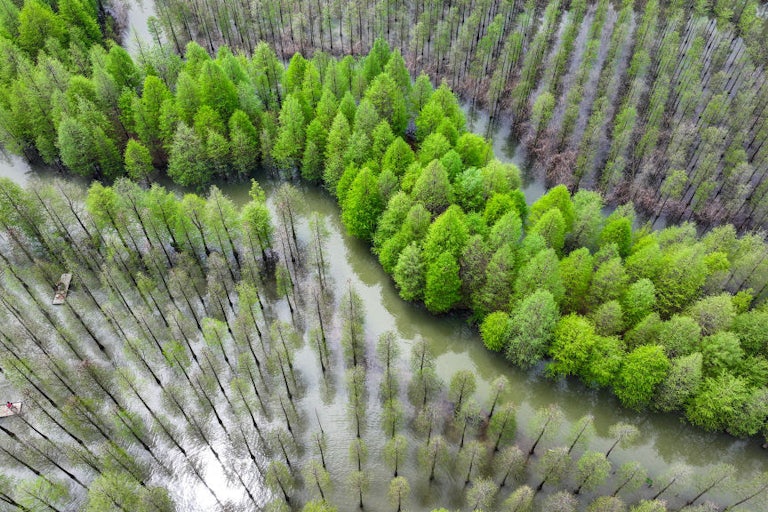
An aerial photo shows trees growing in a wetland in a manmade pattern.
VCG/Getty Images
A man-made metasequoia forest at Sihong Hongze Lake Wetland Scenic Area in China

Remember when people weren’t even sure climate change was real?

According to a new CBS News poll, 70 percent of Americans support the “U.S. taking steps to reduce climate change.” That’s a big number—so big, in fact, that you’d think political action would be guaranteed, and that we’d be well on our way to halting global warming altogether.

Then how come Congress isn’t passing bills to do that right now? There are a lot of possible answers. That 70 percent finding doesn’t say anything about where climate action lies on respondents’ priorities list. It doesn’t shed light on what sort of actions and policies respondents would support. And perhaps most fundamentally, it doesn’t even define what climate change is.

This last part is particularly important, because it’s the only way to make sense of the CBS poll against others in the past year. Last August, Pew Research Center reported that only 46 percent of Americans believe the “Earth’s temperature is getting warmer mostly due to human activity.” Another 26 percent said it was “mostly due to natural patterns,” with “not sure” and “no solid evidence” receiving 14 percent each. That paints a very different picture of political support for climate policy, because if you think global warming is mostly due to natural patterns, you’re probably not going to support immediate curtailment of fossil fuels.

Pew also asked about prioritization. Only 37 percent said that “the president and Congress dealing with climate change should be a top priority.” Another 34 percent said it should “be an important but lower priority”—which roughly adds up to that 70 percent support for climate action in CBS’s poll.

So why isn’t Congress putting the finishing touches on energy efficiency legislation as you read this? Instead, House Republicans seem inclined to declare war on home appliances that use too little energy.

Much like “do you believe in climate change?” before it, “do you support steps to reduce climate change?” or “do you think addressing climate change should be a priority?” may today be questions that have outlived their usefulness, obscuring more than they inform. Without identifying what those steps are, the questions are nearly meaningless. For while there are many policies that could be construed as “addressing climate change,” those that don’t actually result in reduced emissions don’t fix the fundamental problem.

This conundrum is on full display in the conflicting assessments of the U.S.’s biggest climate legislation yet: the Inflation Reduction Act. By many measures, the IRA has been a smashing success, its tax incentives stimulating green investment all over the nation. Yet the law was tremendously difficult to pass, and probably only did so because the final text didn’t include any policies directly reducing, say, the combustion of fossil fuels. Oil and gas production has actually gone up dramatically since then. As TNR’s Kate Aronoff put it:

As a piece of green industrial policy, the principal aim of the IRA is to foster the development of strategic economic sectors so as to make the U.S. economy more competitive. Any emissions reductions it generates en route to that goal are largely incidental… businesses that take advantage of [the tax incentives]—including fossil fuel companies—are largely free to simply add lower-carbon lines of business onto their core, polluting business models.

You can see a similar problem in some “bipartisan” climate solutions being proposed, like one Time magazine published earlier this week for Earth Day: planting trees. It’s not that planting trees is bad. It’s often very good! But “planting a trillion trees,” as former Speaker Kevin McCarthy proposed last year, would only prevent 0.15 degrees Celsius of warming while requiring 900 million hectares of land (land that may already be already storing carbon and supporting diversity in the form of prairies and wetlands, or that may be needed to produce food or renewable energy). And planting trees doesn’t actually transition the economy to more sustainable forms of energy. So it starts to look like a political sleight of hand to avoid the real need: reducing fossil fuel consumption and production (which McCarthy absolutely does not support).

While the CBS report didn’t mention it, its poll did ask people about specific policies: While 63 percent said they supported the Biden administration’s rebates and tax credits for energy efficiency, and 70 percent supported the reduction of toxic chemicals in drinking water, only 47 percent said they supported the administration reentering the U.S. into the Paris Climate Agreement, and 49 percent supported “spending on projects to reduce climate change.” Tellingly, only 14 percent of respondents overall said they’d heard “a lot” about these policies, while 28 percent said “not much” and 22 percent said “nothing at all.”

Climate scientist Katharine Hayhoe has famously argued over the past decade that “the most important thing you can do to fight climate change” is to “talk about it,” which spreads awareness and may build political will for addressing it. But as awareness of climate change spreads, perhaps it’s time to tweak that prescription. The most important thing you can do to fight climate change may be to talk, specifically, about what policies and steps you support.

Good News/Bad News

Tribal leaders are celebrating the release of juvenile salmon by the California Department of Fish and Wildlife into the Klamath River, following dam removals that are expected to increase the salmon’s chances of survival and spawning.

Three offshore wind projects in New York have been canceled, one of a string of developments complicating the state’s progress toward 70 percent renewable energy by 2030. Read TNR’s coverage of this goal here and here, and coverage about the challenges facing offshore wind here.

Stat of the Week
1,700 coal plants

That’s how many coal plants it would take to equal the emissions produced by plastic production if industry growth continues on its current trajectory, according to a new report covered by The Guardian. Read more of TNR’s coverage of the plastics industry here and the UN negotiations for a plastics treaty here.

What I’m Reading

As the climate changes, cities will scramble to find trees that will survive

Trees are struggling to keep up with the warming world, Laura Hautala writes. Varieties that used to do well in certain areas aren’t doing well anymore, and that challenge will only increase with time. That may seem like a problem for forest conservationists, but it also presents a challenge for cities:

Urban arborists say planting for the future is urgently needed and could prevent a decline in leafy cover just when the world needs it most. Trees play a crucial role in keeping cities cool. A study published in 2022 found that a roughly 30 percent increase in the metropolitan canopy could prevent nearly 40 percent of heat-related deaths in Europe. The need is particularly acute in marginalized communities, where residents—often people of color—live among treeless expanses where temperatures can go much higher than in more affluent neighborhoods.… Urban botanists and other experts warn that cities are well behind where they should be to avoid overall tree loss. The full impact of climate change may be decades away, but oaks, maples, and other popular species can take 10 or more years to mature (and show they can tolerate a new climate), making the search for the right varieties for each region a frantic race against time.

Grist | Lauren Hautala

This article first appeared in Life in a Warming World, a weekly TNR newsletter authored by deputy editor Heather Souvaine Horn. Sign up here.

The U.N. Is Running Out of Time to Draft This Plastics Treaty

Meanwhile, it has yet to ban plastics industry lobbyists from the talks.

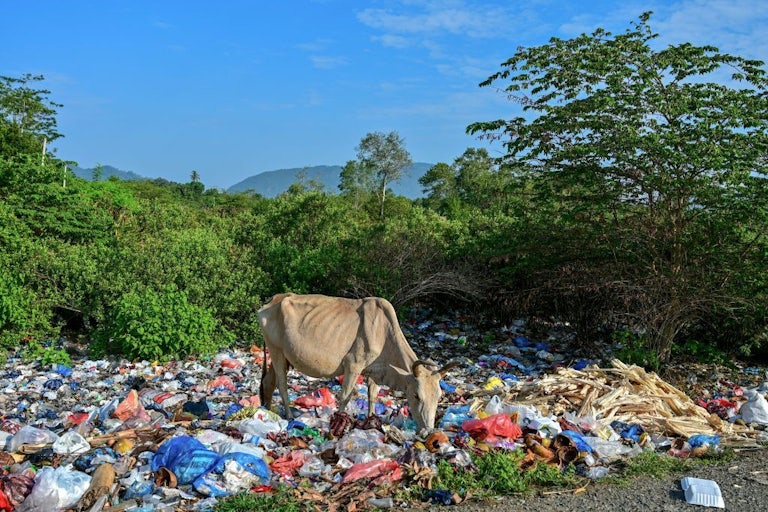
A cow stands in a field of discarded plastic.
Chaideer Mahyuddin/Getty Images
A cow forages amid plastic garbage in Indonesia’s Lhoknga, Aceh province.

In March 2022, U.N. delegates met in Ottawa and struck a historic agreement to produce, by the end of 2024, a legally binding treaty to “end plastic pollution.” “Plastic pollution has grown into an epidemic. With today’s resolution we are officially on track for a cure,” Espen Barth Eide, then Norway’s minister for climate and the environment, said at the time. Now, more than two years later, the mission looks dangerously close to derailing.

Next week, when delegates reconvene in Ottawa, it will be their penultimate chance to achieve their stated goal (the final meeting is in November). “This meeting is, to a degree, make or break,” the International Pollutants Elimination Network’s Björn Beeler told Inside Climate News.

Given the proliferation of plastics alternatives these days, you might think this treaty would be in the shrimp shell–derived sustainable bag, so to speak. Nope. A meeting in Nairobi in November 2023 ended with very little progress. Perhaps relatedly, as this newsletter noted at the time, the Center for International and Environmental Law tallied 143 fossil fuel and petrochemical industry lobbyists registered to attend that meeting. It’s not known yet how many have registered to attend next week’s.

Since last November, several new reports have shed further light on the deception of the plastics industry. In February, the Center for Climate Integrity released a report on what it called a “decades-long campaign of fraud and deception about the recyclability of plastics,” as newly uncovered documents from trade group the Vinyl Institute explicitly acknowledged in the 1980s that “recycling cannot go on indefinitely, and does not solve the solid waste problem.”

Last month, the Environmental Integrity Project announced another finding: that some $9 billion in U.S. taxpayer money has been used, via tax breaks and subsidies, to build plastics manufacturing facilities. Many of those facilities, in turn, have “repeatedly exceeded legal limits on the air pollution they release into surrounding communities, disproportionately affecting people of color,” DeSmog’s Sara Sneath wrote. Volatile organic compounds of the sort released by these plants have been “tied to a broad range of potential health impacts, from nosebleeds to cancer.”

These two reports aren’t the first and won’t be the last to showcase the plastics industry’s bad faith or the catastrophic consequences of public credulity. But taken together, they’re a striking indictment of the position that reportedly tanked the talks in Nairobi in November. The basic problem then was that countries with big petrochemical industries, like the United States, Saudi Arabia, Russia, and China, opposed the idea of “binding provisions” for reducing plastic production, and in some cases explicitly advocated focusing on recycling instead.

In light of these two reports, at least two things may be said about this position. First: Given that the plastics industry has admitted internally for decades that recycling doesn’t work, a recycling-first approach to plastic pollution is basically a pro-pollution stance. And second: While countries may value the wealth produced by their large fossil fuel industries, they also have ample evidence that these industries will not hesitate to take taxpayer money and, in return, poison taxpayers.

Meanwhile, the political systems for addressing this problem are deeply dysfunctional. It’s not uncommon, in U.N. climate talks, for oil industry execs to actually be part of official governmental delegations for some countries. And in the U.S., even if a useful treaty does get drafted this year, a Trump victory in November “would likely impact how such an agreement gets implemented in the U.S. and ratchet up the already long odds that any final accord would be approved by the U.S. Senate,” E&E News reports.

Still, kicking straight-up lobbyists out of the talks shouldn’t be too much to ask. U.N. member nations are well overdue in acknowledging what many credible news outlets have now reported, and what ought to be common sense: that plastics industry representatives are not disinterested parties here. Any sincere attempt to curb the global disaster of plastic pollution isn’t going to come from them.

Good News/Bad News

As experts warn about plummeting biodiversity and California bans salmon fishing for a second year due to dwindling populations, The Guardian reports one small, potentially positive development in Europe: Around 500 barriers (think dams, fords, etc.) were removed from European waterways last year, helping to restore riparian ecosystems and allowing fish to travel upstream to breed.

Researchers are expecting “the most spatially extensive global bleaching event on record” for the world’s coral, National Oceanic and Atmospheric Administration coal expert Derek Manzello tells The New York Times.

Stat of the Week

$150,000 per lease

That’s the new price for drilling on federal lands, up from $10,000. The rule was finalized by the Bureau of Land Management on Friday, part of a big push to finalize environmental rules before President Biden’s term runs out.

What I’m Reading

How Fast Fashion Is Driving Land Grabs and Violence in Brazil

While brands like H&M promote their cotton clothes as particularly sustainable, courtesy of the Better Cotton Initiative, environmental nonprofit Earthsight has cast doubt on that, Sophie Benson reports for Atmos. Earthsight examined two major cotton producers who export to manufacturers that make clothes for H&M and Zara:

SLC and Horita Group stand accused of deforestation on a grand scale.

In 2014, Bahia’s environmental agency Ibama found 25,153 hectares of illegal deforestation on Horita farms at Agronegócio Condomínio Cachoeira do Estrondo, a vast agribusiness estate, the report outlines. In 2020, the same agency stated it could find no permits for 11,700 hectares of deforestation carried out by the company between 2010 and 2018. Between 2002 and 2019, Horita Group’s owners were fined over 20 times for environmental violations, totalling $4.5 million.

Meanwhile, three of SLC’s cotton farms lost at least 40,000 hectares of native Cerrado wilderness in the last 12 years, per Earthsight’s reporting. SLC has also been fined around $250,000 by Ibama since 2008 for environmental infractions in Bahia. Both companies are further alleged to have cleared land which has been legally earmarked for regeneration or preservation.

Read Sophie Benson’s full report at Atmos.Earth.

This article first appeared in Life in a Warming World, a weekly TNR newsletter authored by deputy editor Heather Souvaine Horn. Sign up here.

Fish Are Behaving Erratically and Dying. No One Knows Why.

Endangered smalltooth sawfish are one of many species that have been seen spinning around and beaching themselves off the Florida Keys.

A smalltooth sawfish
Houston Chronicle/Hearst Newspapers/Getty Images
A sawfish in an aquarium

Something strange is happening in the waters off the Florida Keys. For months now, thousand-pound fish with three-foot serrated beaks have been spinning around in seeming distress, beaching themselves, and dying. The news largely escaped national attention until the National Oceanic and Atmospheric Administration announced last week that it would be coordinating an “emergency response effort” to rescue these fish, prompting a string of pieces in major outlets.

It’s not a story that gets less disturbing or strange the more you learn about it. Quite the opposite.

NOAA is mobilizing because the fish in question, the smalltooth sawfish, is an endangered species—one of only five sawfish species in the world, all of which are threatened. “It’s a big ray with a big crazy hedge trimmer on the edge of its head,” says Florida State University marine biologist Dean Grubbs, who’s been on NOAA’s Smalltooth Sawfish Recovery and Implementation Team since 2009. The fish, “which are close to bull sharks in terms of where they are on the food chain,” Grubbs added, have been hit hard by commercial fishing bycatch, trophy hunting, and habitat loss—particularly of the mangroves where young sawfish hide from predators while they grow. They’ve been protected in Florida since 1992 and listed under the Endangered Species Act since 2003. “We were sort of celebrating the twentieth anniversary of the listing,” Grubbs said, because “we were actually seeing some positive signs of recovery”—until this happened.

But sawfish aren’t the only ones behaving strangely. “There have been I think over 40 species of fishes that have been seen doing this weird spinning behavior,” Grubbs said, and it started months ago, as early as November of last year. People simply started noticing it more when they saw the sawfish with their giant rostrums—that’s the big serrated beak-like apparatus—in the shallow water starting in January. “Most residents of the Florida Keys have never seen a sawfish, and that’s why it caught everybody’s eye.”

Fish losing their minds en masse is alarming, although it seems confined to the Keys. “The theory is that it’s something that seems neurotoxicological,” Grubbs said, but the routine water testing isn’t showing anything suspicious. The head of Mote Marine Laboratory, involved in the response, told CBS News, “This seems to be some kind of an agent that is in the water that is negatively impacting just the fish species.”

While many fish may die while awaiting an answer, the sawtooth population is particularly vulnerable. Given that genetic analysis of the smalltooth sawfish population estimates that there could be only around 400 breeding females left, Grubbs said, this sort of unexplained phenomenon is pretty worrisome. Nearly 30 adult sawfish have been confirmed dead, with possibly many more whose carcasses simply haven’t been found, and over 100 live sawfish have been observed exhibiting this odd spinning behavior. That’s a sizable portion of the total population, which doesn’t have a great capacity to bounce back. Researchers think it may take sawfish a decade or more to reach sexual maturity.

The plan to buy the sawtooths time while researchers figure out what’s going on is pretty wild: to capture live sawtooths, take them out of the ocean (so they can’t beach themselves or get any sicker if the problem is being caused by the water), and quarantine them until they recover and researchers have answers. This is not a minor task when talking about an animal 10 to 15 feet long that weighs about as much as a horse and needs to remain submerged. NOAA’s statement last Wednesday listed Ripley’s Aquariums, the research nonprofit Mote Marine Laboratory, and aquarium and pet store supplier Dynasty Marine Associates as three locations where sawfish might be taken for quarantine. To make this work, NOAA also has to find “transport routes,” Grubbs noted. Meanwhile, the testing will continue—of water, of samples from dead sawtooths and other fish, and of samples from healthy fish, which Grubbs and his team helped provide from a recent research trip.

These sorts of mass mortality events, as Marion Renault wrote for TNR last year, are becoming more common. “We’re nowhere close to grasping the repercussions these cascades of death have on ecosystems,” Marion wrote. “One catastrophe makes it more likely that you’ll suffer a second or third,” one zoologist told her. “And every devastation,” Marion wrote, “leaves an ecosystem more vulnerable for the next.”

The mystery of the spinning fish is strange enough, hopefully, to seize the nation’s attention. But it’s just one part of a larger onslaught on Florida’s coastal ecosystems, degraded by runoff and sewage, toxic algal blooms, and soaring temperatures that reduce the amount of oxygen in the water. Those studying sawfish may be particularly anxious, unsure whether the population can rebound. But, said Grubbs, “I think it’s a big environmental concern for all of us.”

Good News/Bad News

There are a growing number of alternatives to plastic when it comes to food packaging, The New York Times reports. But current systems for distributing food, and patterns people have when it comes to buying and consuming food, aren’t going to make eliminating plastic easy.

Landfills are emitting way more methane than previously thought.

Stat of the Week

140%

That’s the increase in incidence of dengue fever in Puerto Rico so far this year compared to this time last year. Read Zoya Teirstein’s report at Grist about the disease’s alarming spread.

What I’m Reading

HOAs are blocking solar panels and native lawns. Here’s how to fight back.

This column from The Washington Post’s “climate coach” tells the story of two people—a software engineer near D.C. and a climate journalist in Lockhart, Texas—who have defied homeowners associations to transform their front lawns into a vegetable garden and a miniature prairie landscape, respectively. It also contains advice for those who want to follow in their footsteps.

Power is shifting back into the hands of property owners after state legislators have begun rolling back decades of escalating HOA restrictions. But many members of HOA boards don’t know these provisions, or ignore them.

“Unfortunately, it sounds cliché, but there are association board members who are on a power trip,” says Luke Carlson, an attorney and founder of LS Carlson Law specializing in HOA disputes. “They will not listen to reason until you notify someone in their camp that what is happening is wrong, and it’s violating the owners’ rights and well-established law. But it takes a little bit of fight to get some traction.”

Read Michael J. Coren’s column at The Washington Post.

This article first appeared in Life in a Warming World, a weekly TNR newsletter authored by deputy editor Heather Souvaine Horn. Sign up here.