Newsletter
Power Mad
A weekly review of the rogues and scoundrels of American politics

The Media’s Demented Policy Illiteracy

The press has been feverishly demanding more and more wonky details about the presidential candidates’ proposals. If only they could understand them!

Donald Trump speaks during a presidential debate Kamala Harris in Philadelphia, Pennsylvania.
Saul Loeb/Getty Images
Donald Trump speaks during the presidential debate with Vice President Kamala Harris in Philadelphia on September 10.

It’s pretty rare for the Columbia Journalism Review and Dallas Mavericks owner Mark Cuban to be dishing on the same topic. But media critics touched a nerve this week with accusations that the political press suffers from a “coherence bias,” particularly as it relates to Donald Trump: the tendency of reporters and editors to take his verbal diarrhea and transform it, through the magic of elision and omission, into statesmanship. TNR contributor Parker Molloy has an even better word for this practice: “sanewashing.”

That this discussion arose in the days leading up to the presidential debate was to the benefit of those tuning in. It likely primed the pump for some of the real-time fact-checking of those moments when Trump seemed to be completely gacked up on whoop chicken, such as his contention that Democrats support “post-birth abortions” and that immigrants in Ohio are stealing and eating pets. But if there’s an agreement to be had on sanewashing, then let it serve as a springboard for a larger and more important conversation: whether the political media’s grasp of policy is truly commensurate with its constant demand for it.

Recent attempts in the mainstream media to understand and explain wonky matters have been embarrassing failures—a dereliction that shares strands of DNA with its tendency to tidy up Trump’s constant barrage of nonsense. A prime example can be found in one of the stories that provoked the sanewashing conversation: the Associated Press’s recap of Trump’s appearance at the Economic Club of New York last week, in which he offered up several paragraphs of word salad in lieu of a discussion of child poverty. The straight story of what happened was a naggingly simple one: Trump dodged a question about child poverty in order to pivot to what he wanted to talk about—tariffs—and shoehorn in his preferred talking points. He did this less artfully than many politicians, but it would have been sufficient to simply say he did not bother to answer the question he was asked.

But the AP didn’t opt for the straight story, and instead constructed a world rivaling George R.R. Martin. In the AP’s version of cloud-cuckoo-land, Trump explicated an innovative idea, in which the proceeds from our trade wars would facilitate bountiful childcare benefits … somehow. It’s bad enough that the AP did all this heavy lifting just to make it appear that Trump used complete English-language sentences in a speech. But considerably more effort was expended here to convert several minutes of sundowner gobbledygook into an allegedly earnest policy proposal. To get there, these reporters had to ignore a vast amount of information and experience, including knowledge of the policies that Republicans have actually supported and the informed opinions of actual experts.

The reality is that what will happen in Trump’s second term looks more like this: These tariffs get applied. American consumers pay more money for goods. The money goes into federal coffers. And the GOP passes (and Trump signs) budget packages that include massive tax cuts for billionaires and corporations, alongside massive cuts to funding for social services.

Could that money have paid for childcare? Sure! It could have gone to baking the world’s largest funnel cake! But in our actual reality, the GOP is adamantly, philosophically opposed to providing government assistance to the people who need relief the most, thus rendering meaningless whatever benefits Trump thinks all of his alleged “big numbers” might provide. This kind of forthright, accurate analysis was available had anyone at the AP understood tariffs at the same level of intellectual heft as the Twitter menswear guy.

This is only the latest example of the vast delta in the political press between acquiring policy information and understanding that information. The signature policy goal of the next Trump administration, to hear reporters tell it, is the facilitation of a massive deportation plan that would evict tens of millions of people from the country. One question that could be asked here (because it’s the first question put to any Democratic policy proposal) would be, “How will you pay for it?” Literally where does the funding to spin up this effort come from? How do you plan to get the United States out of the deep recession that would occur as a result of this population extraction? (If Trump’s answer is, “I’m doing tariffs,” maybe remind him that those proceeds were already earmarked to fix child poverty.)

So it was very weird when—with all these unasked urgent questions—a recent New York Times story portrayed his nigh-on unworkable plan as a linchpin in a proposal to ameliorate the affordable housing crisis: “Harris and Trump both have plans to address America’s affordable housing crisis,” the story originally read. “Hers include tax cuts and a benefit for first-time buyers, and his include deportations and lower interest rates.” (The story was later stealth-edited to massage these sentences out of existence.)

The original contention of the piece was to portray economists as equally skeptical of both candidates’ housing proposals. But here, the entire idea that a mass deportation plan would play a role comes bull-rushing into the discussion without warning and without any explanation of how it would work. Would low-income Americans be literally moved into the domiciles of freshly evicted immigrants? No one knows, and no one can say! (And to be honest, “economists” would probably be even more keen to find out how Trump’s plan to issue massive tax cuts for the wealthy—and the ballooning deficits that would follow—would somehow lead to lower interest rates. The Times just takes it on faith that Trump will somehow magically summon them from the economic wreckage of his grand design.)

That so much falls by the wayside in covering Trump’s policy proposals might be somewhat acceptable if this lackadaisical approach was consistently applied across the board, but this hasn’t been the case. I am sympathetic to journalists, from campaign reporters to The New Republic’s Alex Shephard, who think Kamala Harris ought to put more meat on the bone in terms of policy, but we should be at least as demanding that Trump answer the “How?” and “WTF?” questions that his ideas engender.

What’s very clearly emerged from recent weeks of campaign trail coverage is a rather glaring disparity. On one hand, we have an eminently defensible drive to get Harris to pony up more details of what she wants to do as president, and real scrutiny being paid to how much her policy preferences have shifted in the past five years. On the other hand, we have reporters dutifully filling in Trump’s blanks, excusing his psychopathic edges, and inventing weird cause-and-effect chains that purport to explain how his ideas work. I’m glad that the press is taking Trump both literally and seriously, but no one can look seriously at the literal details of his “proposals” and conclude they make any sense. To pretend otherwise is to write fiction, not journalism.

This article first appeared in Power Mad, a weekly TNR newsletter authored by deputy editor Jason Linkins. Sign up here.
Trump’s Diabolical Plan for the Federal Workforce

Trump’s reelection would mean a radical transformation of the civil service. Democrats need to raise the alarm.

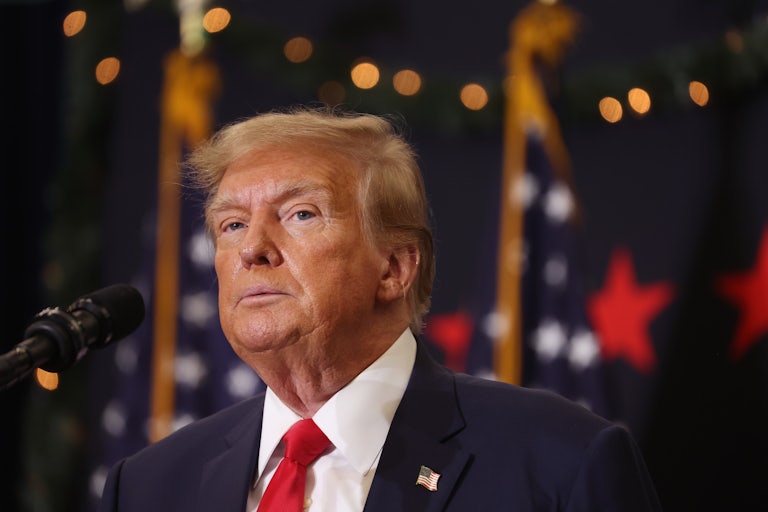
Republican presidential candidate and former U.S. President Donald Trump looks on during a campaign event in Waterloo, Iowa.
Scott Olson/Getty Images
Former President Donald Trump looks on during a campaign event in Waterloo, Iowa.

Just when Donald Trump thought he had put his latest weird controversy behind him, the son of the late Senator John McCain dragged it back into the news. This week, Jimmy McCain, who followed his father into military service, announced that he was all in for Kamala Harris, going so far as to register as a Democrat for the upcoming election. The catalyzing event for McCain was a scandal that made huge news last week: the Trump campaign’s bizarre attempt at a publicity stunt at Arlington National Cemetery on August 26, which ended in an altercation between members of his campaign staff and an official at the cemetery, who attempted to enforce a rule barring cameras in one section of the grounds.

The fracas spurred a weeklong festival of potshots, recriminations, and—as with all things Trump—the specter of political violence, as the official who ran afoul of Trump’s campaign thugs was left fearful of retaliation. It was all too much for McCain fils, who referred to the Trump team’s actions as a “violation.” As true as that may be, the whole hullabaloo is also quintessential Trump—and perhaps the best example of how he will rule in a second term: as a bully, bent on pushing around, publicly maligning, and punishing those who earn their living in public service.

This is no mere supposition on my part. It’s no secret that Trump and his GOP allies plan to radically reconceive the federal workforce into an engine of personal gain and retribution. Indeed, it was a latter-day plan of Trump’s first term that never ended up coming to fruition: In October of 2020, he issued an executive order that would have recategorized a wide swath of the civil service under something called “Schedule F,” giving Trump broad leeway to apply political loyalty tests to executive branch employees and fire those who could not pass them.

Trump was unable to fully implement this design, and President Joe Biden was swift to rescind the order upon taking office. But Trump and his allies—notably the far-right weirdos of the Peter Thiel Extended Universe, which includes vice presidential hopeful J.D. Vance—dream of purging the federal government of anyone who isn’t a true MAGA believer and bringing back a souped-up spoils system that would transform the government into an engine of retribution.

Trump learned during his first term that the federal workforce was often a de facto blockade against his corrupt designs, simply because throughout its ranks are people who follow the rules. And while purging this workforce of its dedicated lifers and replacing them with cronies and trolls won’t make the civil service smarter or more efficient, it will reduce resistance to unlawful orders and create opportunities for corruption. Currently, federal employees are protected if they refuse unlawful orders. Trump wants to change that, so that the massive federal workforce might be transformed into the fist of an authoritarian president.

In particular, attorneys are a big focus of Trump’s plans, because these are the referees who tell government managers and political leaders which potential actions are either illegal or unauthorized. If these civil servants are dispensed with and replaced with flunkies, not only will there be no one left to slow a corrupt administration’s plots and schemes; the American people will lose vital advocates, sworn to uphold the Constitution. These will be replaced by revenge-minded vipers, with loyalty only to Trump, his financial interests, and his lust for revenge.

The potential for mayhem if Trump gets his way with the federal workforce is boundless. As I previously wrote:

Democrats might find their Social Security or veterans’ benefits delayed or denied. They might no longer be able to obtain passports. Emergency disaster aid might flow only to those deemed loyal to the administration. Corporations that refuse to pay tribute might be punished. Transform the civil service from an open hand to a closed fist, and things get very frightening very quickly.

With this in mind, it’s not hard to see how last week’s incident at Arlington National Cemetery might have gone down under a Trump presidency. With Biden in office, rules and norms were respected, and officials at the U.S Army had a free hand to support the woman who tried to stop Trump’s team from filming in a restricted area, saying publicly that “her professionalism was unfairly attacked.” If Trump returns to office, those same officials would be risking their livelihoods for trying to uphold the law against a Trump ally—or be promoted for letting them break the law.

Trump’s plans for the federal bureaucracy have received some mainstream attention, but they’ve not jumped into the public psyche yet, despite—or perhaps because of—the pure comic-book villainy of the scheme. But there’s a lesson for Democrats here: Harris and her allies were successful in popularizing Trump’s association with Project 2025—and his faltering attempts to distance himself from it—through a literal and figurative “billboard-size” campaign. These efforts paid off handsomely.

Can Democrats repeat this success? Trump’s plans to weaponize the government are cut from the same antisocial cloth. Its proponents fit squarely within the “weird” frame that Democrats used throughout the summer. “Schedule F” has a similarly ominous name. And most importantly, these are plans that Trump and his fellow Republicans openly discuss, and which they’ve already tried to implement once. The explosive incident at Arlington Cemetery is a fitting way to illustrate the larger malevolence of Trump’s designs and get people to recognize the same thing that Jimmy McCain saw this week—that it was disqualifying.

This article first appeared in Power Mad, a weekly TNR newsletter authored by deputy editor Jason Linkins. Sign up here.
Where Are Harris’s Policies? Trapped in the Supreme Court

Everyone’s wondering what the Democratic nominee plans to do in office. Not much, without the permission of Chief Justice John Roberts and his cronies.

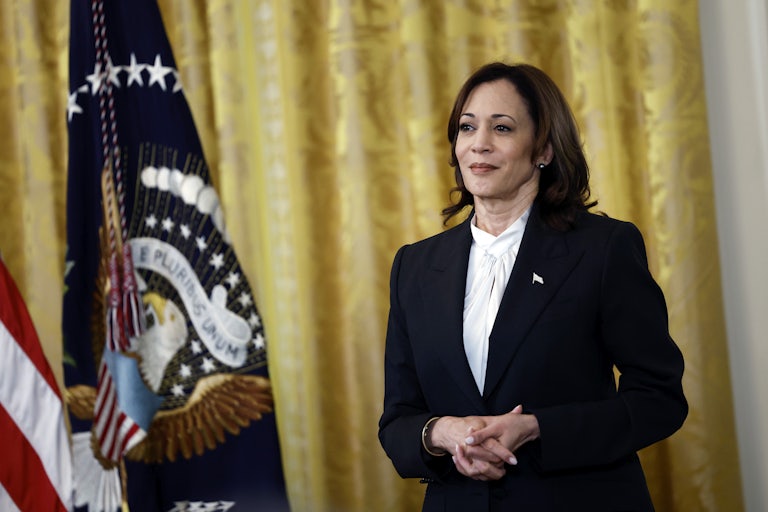
Vice President Kamala Harris listens during a Women’s History Month reception at the White House.
Anna Moneymaker/Getty Images
Vice President Kamala Harris listens during a Women’s History Month reception at the White House on March 18.

With the party vibes at the Democratic National Convention fading, and attention turning to the ragged ten-week sprint to November, the punditocracy seems ready to declare an end to Kamala Harris’s honeymoon. Where, everyone wants to know, are her policy positions? The notion that she has none has been overstated, but this is indeed the moment where a campaign, after all the convention’s frippery, is expected to put some meat on the bone. And given that Harris has lately retreated from bold positions she once took on a range of issues, she will be “expected to … explain the differences between her 2019 primary campaign agenda and her more limited ambitions as the Democratic nominee in 2024,” as Brian Beutler notes in his Off Message newsletter.

I’m curious about this as well—and since I labor at a journal of ideas, I’d certainly prefer the next phase of the conversation to veer in the direction of policy. But if you want to know the biggest difference between 2019 and now, I would urge you to consider the dark shadow that hangs over everything: the Supreme Court’s conservative majority’s decision in Loper Bright Enterprises v. Raimondo.

That ruling, which overturned a doctrine called “Chevron deference,” puts the future of any policy that Harris favors in grave doubt. If you want the Harris campaign to get more detailed on policy, I’m sorry to say that any conversation starts and ends with how they plan to confront a Supreme Court that has torched the separation of powers in the mad game of Calvinball they kicked off during the Trump era.

The gutting of Chevron deference is not something that the smooth-brained masses of the political media adequately understood when it came down. Chevron deference is essentially the doctrine that allows government agencies to respond nimbly to their congressional mandates; hitherto, the judiciary stayed out of the way, allowing executive branch personnel to use their expertise to interpret ambiguous regulations. Imagine, for example, the technological advancements that have occurred since landmark environmental legislation was passed decades ago. The EPA, given free rein to adapt to this changing landscape, can move more fleetly to remediate pollution thanks to Chevron. The Roberts court, instead, imagines a world where they have to return to Congress each time there is an emergency, to get specific guidance.

The best way of describing what the conservative majority did is to say it gave six unelected right-wing politicians who all enjoy a lifetime appointment a line-item veto over anything a Democratic Congress—and by extension Harris—wants to do, unless they can muster the votes to confront each problem they want to solve with an inhuman amount of hyper-specificity. As Vox’s Ian Millhiser has explained, if the executive branch “can’t regulate without getting permission from a Republican judiciary … then conservatives no longer need to worry about Democratic presidents doing much of anything that doesn’t meet the GOP’s approval.”

Judicial malefactors have already cited Loper Bright to challenge President Joe Biden’s policies and pilfer money from the pockets of ordinary people. The way this ruling potentially hamstrings the ability of the federal government to protect ordinary people from a myriad of harms means this is a Supreme Court decision that will come with a running tally of costs to taxpayers—and, most likely, a body count.

The Supreme Court really is the most critical policy issue in this election. The Trump-installed majority is central to what the right plans for a second Trump term. Beyond the fact that the Roberts court’s ruling in Trump v. United States imbues the chief executive with monarchic levels of unaccountability—a dangerous privilege for, frankly, any president to possess—Project 2025, which is best understood as a massive rollback of individual rights, is something that Republicans simply could never contemplate without their super-legislature in black robes.

Here, vaporizing Chevron has an asymmetric impact on the ambitions of the two parties. The GOP, having retreated from any part of the policy realm besides Project 2025’s infernal schemes, the furnishing of tax cuts to plutocrats, and deregulating everything under the sun (also a form of wealth transfer to plutocrats), need not worry about Chevron being in effect anymore.

But what makes Chevron crucial to this campaign is that the sledding for Democrats remains rough even if they prevail in November. Indeed, even if they blow the GOP out of the water electorally, the end of Chevron deference is a fail-safe against Democratic policy, constantly running in the background as long as five of the six conservatives on the Roberts court agree. In this way, Harris and her fellow Democrats are locked out of liberal governance. Since liberal governance will form the cornerstone of anything Harris and Democrats want to do during her time in office, a confrontation with a Supreme Court that’s holding the policymaking apparatus hostage is not a fight they can duck.

All Democrats need to join in this fight, and constantly raise the salience of the Supreme Court and its attendant corruption. It would be a good idea for any policy discussion to note that the Roberts court is the primary antagonist to making things better, easier, safer, and fairer for ordinary Americans; they are despoilers of the land and pilferers of our wealth. Harris should continually remind voters that turning things around will require a Democratic president to be on hand to appoint any replacements that may be needed, and prevent the oldest conservative justices from escaping into retirement, which would allow Trump to replace them with young members of the right’s lunatic lower-court farm system.

Is it time to revisit court-packing? I think the institutionalist case against it completely collapsed by the end of the court’s last term, but I doubt Harris has the stomach to revive the idea over the next several weeks. Nevertheless, the Supreme Court will remain the rock in the road that Democrats must find a way around if they want to improve our lives. Anything you might want an ascendant Democratic administration to do faces the judicial veto of right-wingers who can’t be voted out of office. It’s true that Harris is probably not going to deliver, or even champion, the most ambitious policies that progressives favor. But whether you’re a progressive fan of Medicare for All, or a centrist dedicated to means-tested, watered-down bullshit, you’re all in the same boat, so grab an oar.

This article first appeared in Power Mad, a weekly TNR newsletter authored by deputy editor Jason Linkins. Sign up here.
Don’t Worry, Mike Pence, Trump Will Sign Your Abortion Ban

The former vice president thinks his former boss has betrayed the anti-abortion movement. He is, unfortunately, very wrong about that.

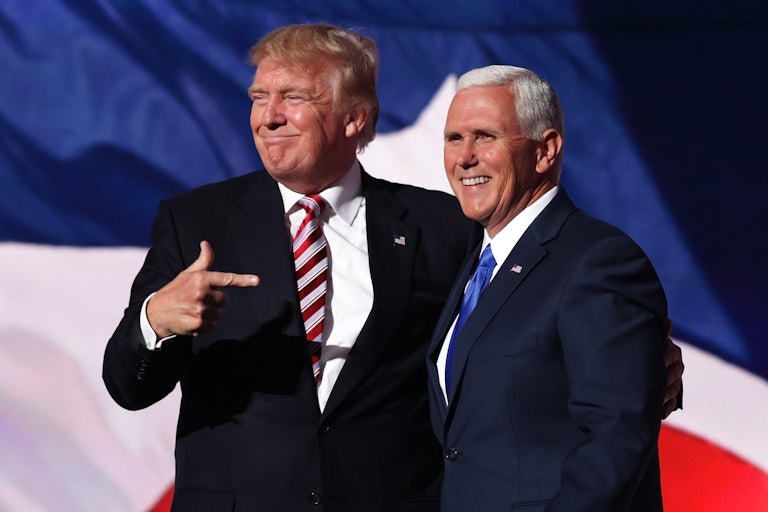
Donald Trump stands with Mike Pence in happier times.
Chip Somodevilla/Getty Images
Donald Trump stands with Mike Pence in happier times.

Has Donald Trump betrayed the anti-abortion movement? It’s a hard case to make against the president who appointed the Supreme Court justices necessary to gut Roe’s protections once and for all, and who’s gone to some lengths to take a victory lap for doing little more than being the warm body who complied with the Federalist Society’s honey-do list. But this does seem to be the position of Trump’s former vice president, Mike Pence, who spent last weekend working himself into a lather over Trump’s weeks-old commentary on the matter, in which he appeared to disavow his support for a national ban on abortion.

The end product of Pence’s considerable vexation is an op-ed in The New York Times, a halting work of high dudgeon in which the former vice president meanders through eight paragraphs before eventually alighting on his complaints about his former boss. Pence says that Trump’s “recent retreat from the pro-life cause” has left him “disheartened.” “I was deeply disappointed,” he says, when the former president “stated that he considered abortion to be a states-only issue and would not sign a bill prohibiting late-term abortions after 15 weeks of pregnancy, even if it came to his desk.”

It’s hard to say who this op-ed is for. Pence doesn’t exactly command any kind of political constituency and he’s now well outside Trump’s circle of influence. And for all of Pence’s melodramatic talk of betrayal, he arrived rather late to this particular party, some weeks after Trump made the statement in question. All that said, I feel duty-bound to tell Pence to cheer up: If Trump is reelected, he will absolutely sign a national abortion ban. I’m really not sure why anyone even doubts this. Take it to the bank.

Perhaps we should go back and actually reflect upon what Trump actually said:

My view is now that we have abortion where everybody wanted it from a legal standpoint, the states will determine by vote or legislation or perhaps both, and whatever they decide must be the law of the land, in this case, the law of the state. Many states will be different. Many will have a different number of weeks, or some will have more conservative than others, and that’s what they will be.

If this is why Pence is so mad, the fault perhaps lies in his cognitive abilities, not Trump’s remarks. As Semafor’s Jordan Weissman noted, “If you actually listen to Trump’s statement on abortion, he doesn’t say ‘should’ be left to the states. He says ‘will’ be left to the [states]. It’s just a statement of what the law is. He leaves unsaid what would happen if a ban crosses his desk.”

Indeed, it wasn’t until days later that Trump actually offered any kind of political commitment, telling a reporter on the airport tarmac in Atlanta that he would not sign a national abortion ban into law. Here, I must offer a reminder that this promise isn’t worth much, as Trump is—and I can’t believe I have to explain this to Mike Pence—an inveterate liar. Even the reporting on Trump’s comment is careful to note that this represents a shift from Trump’s prior position on the matter and alludes to the former president’s possible motivation, to “to make one of his greatest political liabilities disappear.”

As I’ve written before, lies and prevarications are what you should expect from Trump and his fellow Republicans this year as they attempt to regain power in a world where the Dobbs decision has rebounded to their political detriment. It’s been well established that conservatives are planning further rollbacks to abortion rights behind the scenes, even as they endeavor to present themselves as more politically palatable to the public—an effort that involves “rebranding” the pro-life movement in an effort to obfuscate its plans.

Here, conservatives haven’t been doing anything different than what they’ve been doing for decades. Pence, in fact, is prevaricating in this very op-ed when he says, “I believe the time has come to adopt a minimum national standard restricting abortion after 15 weeks in order to end late-term abortions nationwide.” I’m not sure he actually believes this! In 2010, Pence told an Indiana anti-abortion group that “abortion should never be legal”—though he offered some concessions on saving the life of the mother. As recently as last May, Pence vowed his support for a national ban on abortion after six weeks. Perhaps Mike Pence should explain to the pro-life movement why he’s become such a squish on the issue before he tries to fillet his former boss.

If Trump is reelected, the last thing you should expect is this kind of wishy-washiness. As Susan Rinkunas recently reported for Jezebel, leaders on the right are “increasingly discussing the prospect” of using the Comstock Act to “ban abortion nationwide if he wins a second term.” The still-on-the-books law from 1875, which the Christian Right has been hoping to revive, is one of the linchpins of Project 2025, the de facto second-term playbook that the Heritage Foundation has created on Trump’s behalf—which states that “the Dobbs decision is just the beginning.”

As Rinkunas documents, the level of prevarication around the right’s out-in-the-open plan to use Comstock as a reproductive rights bulldozer is sky-high—and ably summed up by an anonymously quoted attorney who explained to The Atlantic’s Elaine Godfrey that Comstock is “obviously a political loser, so just keep your mouth shut. Say you oppose a federal [legislative] ban, and see if that works’ to get elected.” It’s not hard to see this in the subtext of Trump’s own remarks when he talks about the GOP’s “obligation to the salvation of our Nation…TO WIN ELECTIONS.” As Rinkunas notes, Trump is eyeing his own salvation from potential criminal convictions as well.

But why tell the press that you plan to lie to the press about your abortion position? Here we should consider the world-historical awfulness of American political reporting—and how badly they biffed the story when Trump made his abortion remarks. As The Present Age’s Parker Malloy reported, “NBC News, The New York Times, CNN, Axios, CBS News, NPR, ABC News, The Washington Post, The Hill, Forbes, Politico, Financial Times, the Associated Press, and The Wall Street Journal … all botched their reporting of Trump’s statement on abortion policy by inaccurately stating in headlines that he believes abortion rights should be left up to individual states to figure out.”

The media’s track record, to put it mildly, is shit! Sometimes it’s hard to know whether the political press doesn’t realize when they’re getting squid ink sprayed in their faces or if they simply look forward to being abused in that fashion.

It’s honestly hard to discern whether Pence’s op-ed isn’t meant to be more of this same dissembling. Only his near-total irrelevance to the conservative movement exculpates his involvement in their effort to paint Trump and his fellow Republicans as more moderate than they really are. Regardless, Mike Pence should calm down: He’s going to get everything he could possibly want out of a second Trump presidency—except for maybe an apology for that time Trump sent a mob to murder him. Given Pence’s voracious appetite for self-abnegation, though, maybe he doesn’t mind.

This article first appeared in Power Mad, a weekly TNR newsletter authored by deputy editor Jason Linkins. Sign up here.

So, What’s Going on With Clarence Thomas These Days?

It’s never a bad time for Democrats to talk about the possibility of a Supreme Court vacancy.

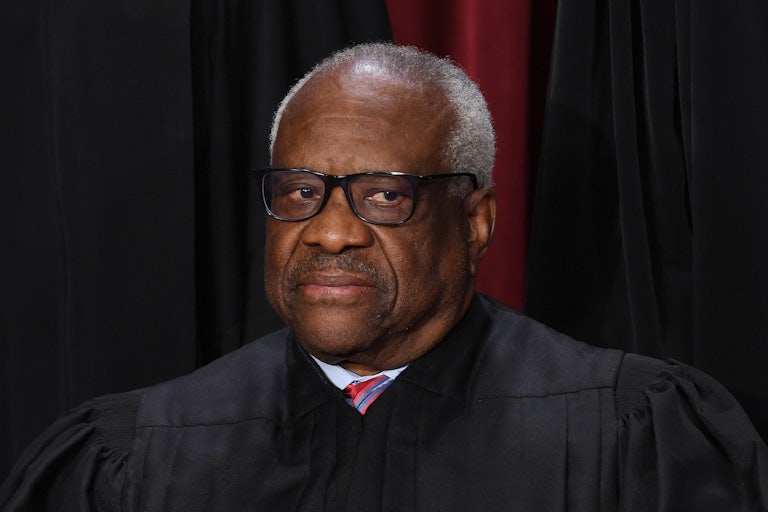
Associate US Supreme Court Justice Clarence Thomas
Olivier Douliery/Getty Images
Associate U.S. Supreme Court Justice Clarence Thomas

Next week marks the last week of oral arguments in this Supreme Court term, leaving little more than a sprint through the remaining decisions left unsettled. As of this writing, some heady matters remain unresolved. The ruling on the abortion pill has yet to be decided; there is a consequential gun rights case on the docket; and as always, the fate of the administrative state hangs in the balance. For many ordinary people, it will be another white-knuckle stretch, as they hope for narrow rulings that might limit the potentially life-altering—and precedent-shattering—damage.

For Democrats, the 6–3 split on the high court is a generational problem. At least, that’s how it’s often framed. In a recent post, my colleague Matt Ford stated the matter pretty starkly: “By some estimates, liberals may not have a chance to appoint a majority of Supreme Court justices until the 2050s. If Barrett stays on the court until she is the same age as Ginsburg, she will serve until at least 2059.” To think about this dilemma in these terms is to resign oneself to the idea that the solution won’t be arriving for several decades. But a lot can happen between now and 2059, and perhaps even sooner, because of another immutable law that holds that “shit happens.”

With that in mind, has anyone noticed that something seems to be up with Justice Clarence Thomas lately?

This past Monday, it was reported that Thomas was absent from the court and not participating remotely in the oral arguments of the day, with Chief Justice John Roberts assuring everyone that Thomas would get the full range of “briefs and transcripts” after the fact, ensuring that he’d be able to participate in the cases. Thomas doesn’t miss many days of work, and unlike a previous instance two years ago in which he missed a number of sessions during a hospital stay, no reason for his most recent absence was offered.

Into this blank space in the story, allow me to remind everyone that Thomas, 75, is the oldest of the justices, the longest-serving member of the court, and while I don’t doubt that Harlan Crow’s Garden of Dictators may be the venue for eldritch incantations of all varieties, there is no reason to believe that Thomas is immortal. In other words, he is still subject to the vagaries of the Universal Law of Shit Happening. (Fun fact: Samuel Alito is only a year younger than Thomas.)

It’s really no one’s fault that the comings and goings of sitting Supreme Court justices can be such a macabre business. Given the opportunity to amend the Founders’ work, I imagine that ending the whole “lifetime appointments for wizened, unaccountable elders in robes with the final say over American life” arrangement would be near the top of the list of improvements. But Democrats are probably too physiologically incapable of stating the potential stakes of the upcoming election to their voters in terms as stark as “Clarence Thomas might not be long for the bench; send Biden back to stem the tide of far-right jurisprudence.”

It’s not as if taking the high road hasn’t led anywhere: As The New Republic contributor Simon Lazarus has pointed out several times, a combination of consistent pressure and high-minded critique from liberals has, over the course of the past few terms, seemed to play a role in the justices taking a more tempered approach to their rulings. This strategy may yet bear more fruit this term, and forestall the kinds of extreme rulings that the conservative bloc’s two elder statesmen might hope to wrangle.

Still it’s weird to watch how some on the left are raising the salience of the justices’ mortality: by urging Democrats to bring Justice Sonia Sotomayor’s career to a premature end, the better to install a younger jurist now while Biden is still president. In that aforementioned article, Ford took a dim view of this way of thinking and suggested instead that Democrats might be better off simply winning elections. Regardless, this is a debate worth moving on from. It’s silly for Democrats to be divided in an election year over anything, let alone Sotomayor’s career, and anyway, no one’s run this plan to pull a late-in-the-day switcheroo past Senators Joe Manchin and Kyrsten Sinema, whose permission is still required for such stunts.

Nevertheless, there is definitely a ruthlessness gap between the parties in this regard. Republicans have had enormous success in dispensing with the polite traditions that govern the high court’s promotions and relegations. That the GOP went to elaborate lengths to prevent Obama from appointing Merrick Garland to the bench was, during that ongoing folderol, evidence of how far they were willing to go to consolidate power. But it is also a reminder that there was once a time when the makeup of the Supreme Court wasn’t in their favor and they were staring down the tunnel of the same kind of generational problem that Democrats now face.

But the right has benefited from the happenstances of the Shit Happens Law, as well. The misfortuned timing of Ruth Bader Ginsburg’s death created the opportunity for the 6–3 split and provided the catalyst for the Democrats’ recent agita over Sotomayor. Still, the lessons of the recent past—combined with all this recent talk of court-vacancy gamesmanship—illuminates a simple idea that Democrats should perhaps find the courage to speak aloud, regardless of the grisly implications: Elections matter, because you never know when the chance to appoint a new justice might arise. There is a clear mission at hand: Don’t let any of the court’s elder conservatives have the opportunity to make their escape through the safe harbor of a Trump presidency.