Newsletter
Power Mad
A weekly review of the rogues and scoundrels of American politics

Americans Really Dislike Trump. But They’re About to Truly Hate Him.

Welcome to the summer of scarcity and the full-blown Trump recession.

Empty shelves are seen at a Dollar Tree store on April 28, 2025 in Alhambra, California.
Frederic J. Brown/Getty Images
Empty shelves at a Dollar Tree store in Alhambra, California, on April 28

Donald Trump’s first 100 days in office may have been the longest, figuratively speaking, of any U.S. president in history. But we can also say definitively that they were the most disastrous, ever. His draconian deportations, destruction of the federal government, and insane tariff Tilt-a-Whirls have driven his approval numbers so low as to be a modern marvel; the last time a president was this disliked after 100 days, we were fighting a world war and the Slinky was the country’s most popular toy. Trump has ended up here for no other reason than that he pursued the very policies he promised to pursue on the campaign trail. That’s the story of his first 100 days: Americans elected a dumb asshole, and natural consequences followed.

Now let’s consider the next 100 days, which look to be even worse for all of us—including the president. As The New Republic’s Alex Shephard wrote this week, there are a lot of good reasons to believe Trump’s standing with the American people hasn’t hit bottom yet, the main one being that the worst is yet to come. The president, Shephard writes, “is still stubbornly clinging to tariffs, which inevitably will cause product shortages and rising costs in the near future—not to mention a potential recession, the odds of which are worryingly high.”

Last weekend, Apollo Global economist Torsten Slok published a preview of coming attractions in the form of a report documenting what he’s calling the imminent “Voluntary Trade Reset Recession.” As Slok documents, Trump’s economy—though quite sluggish—has been boosted by the fact that inventories rose rapidly as firms acted in anticipation of tariffs being imposed. Now that tariffs have arrived, the sugar high is over and collapse is on the way. The most straightforward way of looking at the future is on page 4 of Slok’s report.
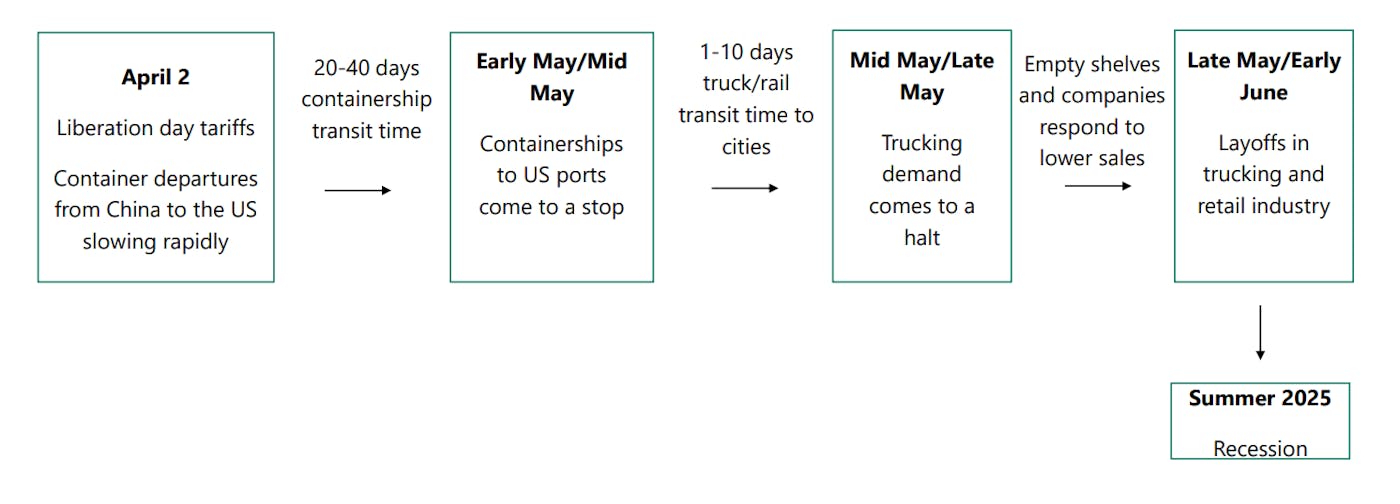
Image depicting a flowchart of the "Voluntary Trade Reset Recession."
Apollo Global Management/Torsten Slok

What we have here is the prelude to the summer of scarcity, coming soon to a retailer near you. We are already well and fully in the stage where activity at our ports falls off a cliff. As TNR’s Tim Noah wrote this week:

This is how it begins. The recession has arrived in Seattle, with cargo shipments down 60 percent. Los Angeles will be next. As recently as November, the Los Angeles Times reported that cargo traffic at the ports of Los Angeles and Long Beach reached record highs. But last week it quoted the port’s executive director, Gene Seroka, predicting that “in two weeks’ time, arrivals will drop by 35 percent.” The reason, Seroka said, was that “essentially all shipments out of China for major retailers and manufacturers have ceased, and cargo coming out of Southeast Asia locations is much softer than normal.”

From here, Tim says, there will be less cargo to ship across the country, and inevitably, fewer people employed to do that work. Already, UPS has laid off 20,000 workers because of “current macro-economic uncertainty” that I really think wasn’t all that uncertain when Trump was reelected. This only highlights another grim reality: Even if Trump called off his tariffs tomorrow, much of the coming mayhem is baked into our future, as it would take a substantial amount of time to restart the global shipping machine. “Expect ships to sit offshore, orders to be canceled, and well-run generational retailers to file for bankruptcy,” says Slok.

The latter half of that prediction may well be the more devastating part. As Marketwatch’s Steve Goldstein highlighted, Slok said that “small businesses that account for more than 80 percent of employment and capital expenditure don’t have the working capital to pay tariffs.” In other words, Trumpnomics will soon be best known for that which is absent: products on the shelves of retailers, and businesses on the streets where you live, now shuttered.

Here is where the Wall Street versus Main Street divide is going to be keenly illuminated as Trump’s tariffs start the economic bloodletting. The White House has rather persistently explained away the turmoil its tariffs have wrought as a harm done only to high-flying financiers, and claimed that the benefits to ordinary people would soon emerge. A day after he got hit with a hundred dreadful evaluations of his first 100 days, Trump was spinning out on Truth Social, promising that the boom was on the wing.

But even as the stock markets have pitched and yawed as investors cling to their naïve beliefs that Trump has a plan (he doesn’t), those plying their trade on Main Street are planning for a different sort of boom. To hear Casey Ames—the founder of Harkla, a small, 10-person firm in Idaho that sells products for special needs children—tell it, Trump’s tariffs have already forced him to make some grim considerations.

Ames told the Idaho Statesman that his company was set to have a banner year. “We had just hired more people, and we were forecasting a really good year, even with the initial Trump tariffs,” he said. Now, however, he’s facing a massive hike in the amount of import taxes he’ll have to pay, from $26,000 to $346,000. With no domestic manufacturer capable of supplying the same goods, and knowing that even modest price hikes could crater sales, Ames is suddenly facing a situation where he may have to lay off employees.

Ames has garnered a lot of attention for sharing his experiences on social media, taking his audience behind the curtain to reveal what small-business owners have to expect as the summer of scarcity begins. Over at The New York Times, where they’ve been doing a long-running bit where Frank Luntz interviews the 14 dumbest voters in America, this fissure recently emerged: Meagan, the focus group’s lone small-business owner, told Luntz that the tariffs were a “very, very scary thing” and that she was, as a result, in “crisis mode.” If reality has started to penetrate Luntz’s Delulu Conclave, we’re all in for a world of hurt.

And that’s probably the most dreadful reckoning, as we mark the 100th day of Trump’s second term. Trump’s collapse in public opinion polling—along with the fact that he’s not likely to reverse many of his worst decisions or repair the things he’s broken—has probably set his presidency on the road to ruin. But if Trump has truly sown the seeds of his own undoing, it will be ordinary Americans who reap the proceeds of that dire harvest first, in the form of lost livelihoods and scuppered wealth. It’s going to be a rough summer—and many seasons thereafter, until one day we finally hit the nadir of Trumpian despair.

This article first appeared in Power Mad, a weekly TNR newsletter authored by deputy editor Jason Linkins. Sign up here. If you’re a small-business owner with a story to tell about how tariffs are impacting your bottom line, contact my colleague Grace Segers.
Editor’s Picks

The Democratic Senator Who Silenced the Centrist Naysayers

Maryland lawmaker Chris Van Hollen is picking the good fight—and fighting the right way.

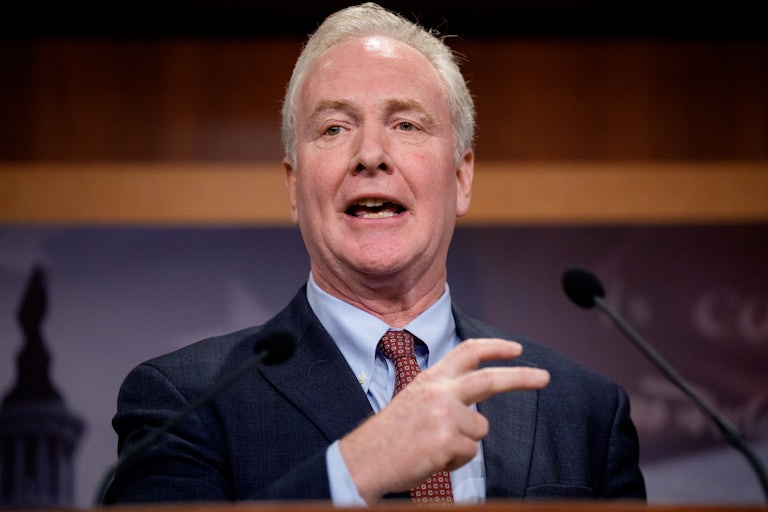
Sen. Chris Van Hollen speaks at a news conference on the Trump Administration's planned cuts to the Social Security Administration.
Andrew Harnik/Getty Images
Maryland Senator Chris Van Hollen

If I’ve said it once, I’ve said it—well, two or three other times, at least: Democrats have found themselves in a content-creation war with the Trumpian right. And this pitched battle isn’t being fought on your grandfather’s media landscape. There’s no more publishing a white paper or a New York Times op-ed and hoping for the best. Today’s information environment favors brawlers, cheap-shot artists, and the commitment to creating conflict and controversy around any issues that can possibly be politicized.

For a party that favors civics over salaciousness, this has been a tough lesson for Democrats to learn. But we’re seeing some of them adapt. The biggest success story of late is Maryland Senator Chris Van Hollen, who took up the cause of Kilmar Abrego Garcia, the Maryland resident who was wrongfully deported and imprisoned in El Salvador. But Van Hollen finds himself in an annoying two-front war: On one side, there is an unrepentant Trump administration; on the other, some of his more sclerotic Democrat colleagues.

Van Hollen made a politically risky commitment to travel to El Salvador last week to meet with Abrego Garcia, and promoted his trip relentlessly. His visit provoked the right into mini-meltdowns, including a try-hard attempt to engineer some fakery involving margaritas, while sending Trump himself into one of his Truth Social tailspins, in which he accused Van Hollen—in a pot-meets-kettle classic—of “grandstanding.”

But it’s 2025, baby. He who grandstands best wins, and in Van Hollen’s case, his efforts earned him a place on every single Sunday show. From pillar to post, this was a stunningly well-executed bit of political theater, proof positive that if you’re willing to give the media what it wants—conflict and controversy—they will reward you with coverage. Best of all, Democrats have ample room to pick big fights on matters that are righteous and substantive, like our rights to due process, and not on weird, off-putting GOP fixations, like the relative fuckability of a cartoon piece of candy.

Sadly, not all Democrats are seeing the light. One of Axios’s recent collections of aggregated bullet points included a comment from an anonymous “centrist” Democrat who called Trump’s rendering of immigrants to foreign prisons a “soup du jour,” insisting that the president was “setting a trap for the Democrats, and like usual we’re falling for it.” And one Democrat who was at least willing to put their name to similar convictions was California Governor Gavin Newsom, who called the fight to secure Abrego Garcia’s rights a “distraction” from arguing about tariffs and the economy.

This is a deeply funny thing to say when you’re a governor who has launched a side hustle as a just sayin’ podcaster. More to the point, there are some staggering misapprehensions at work in these critiques, the first being that Democrats have “walked into a trap.” There seems to be an abiding belief that to stick up for a legally wronged immigrant somehow puts Democrats on the wrong side of the issue, but this is simply not the case. Yes, I’ve seen and lamented some of the public opinion polls in which majorities support deportations, but what Trump is doing is a thing apart—and deeply unpopular. As Alex Shephard wrote last week:

Even polls that show voters broadly favoring Trump’s approach to immigration show that the public is furious about his handling of cases like Garcia’s. Fifty-six percent of respondents to a late March Reuters/Ipsos poll said that the administration should not “keep deporting people despite a court order to stop,” with only 40 percent agreeing it should keep doing so. Nearly every poll tracking the administration’s refusal to obey with court orders stopping deportation shows something similar: Voters really do not like it when Trump ignores court orders. And the issue is bringing down overall support for his approach to immigration.

Between the time Alex wrote that piece and I typed this paragraph, it became official: Public support for Trump’s approach to immigration is tanking. In some surveys, he is underwater. Half of Americans say Trump should bring Abrego Garcia back to the U.S., versus just a quarter who say he should not. Someone sprung a trap all right: Chris Van Hollen.

The second bit of stupidity here is that talking about the curtailment of immigrants’ due process rights is a “distraction.” The notion that Democrats lack the bandwidth to talk about immigration and the economy at the same time really looks ridiculous in light of the fact that Trump ran an entire, successful presidential campaign on talking about immigration and the economy—plus a constant demonization of trans people. Forever defying convention, Trump somehow managed to talk about three whole things! And yet, Democrats can’t dare to talk about just two.

This is simply out-of-touch thinking. We live in a world where ordinary Americans have to contend with a litany of political problems. To tell voters that some of their concerns don’t actually matter is a recipe for disaffection. Beyond that, our information environment requires political parties to be nimble and varied, keeping old conflicts burning while surfacing new controversies. But that doesn’t mean every Democrat has to do it all. There’s nothing wrong with taking up a pet issue and becoming the go-to person on the matter, as Van Hollen has done with Abrego Garcia. Alexandria Ocasio-Cortez seems to be latching onto the issue of congressional stock trading. If Newsom wants to be one of the tariff guys in the party, he’s free to dig in and make himself useful.

The interesting thing about this approach is that it mirrors some of the things that the best journalists do to make their name in this industry: Reporters who can grab a hold of a specific story and work it relentlessly can quickly become a star on a particular beat. Democrats would be well served to treat their organization against Trump the way a roomful of reporters and editors tackle the news each day: Assign people to dig deep into a particular issue, build good sources, surface the stories of victims of Trumpian misrule, and otherwise constantly iterate on the assignment anytime there is fresh material. By thinking like a newsroom, Democrats might actually find themselves more seamlessly jibing with an industry with which they’ve struggled to synchronize.

Suffice it to say, success begins with an acknowledgment that the landscape is shifting—and the rules have changed. Some, like Van Hollen, are getting with the program and easing into a new way of doing things. Other Democrats may find themselves being left behind; but the worse scenario is that the more moribund members of the party might undermine the efforts of their more highly effective peers with their carping and complaining. This is a time for some to lead and some to follow, and for others to get out of the way.

This article first appeared in Power Mad, a weekly TNR newsletter authored by deputy editor Jason Linkins. Sign up here.

Gretchen Whitmer Fell Into Trump’s Tariff Trap

The dumbest thing Democrats could do right now is lend even a scintilla of credence to a bad president’s worst idea.

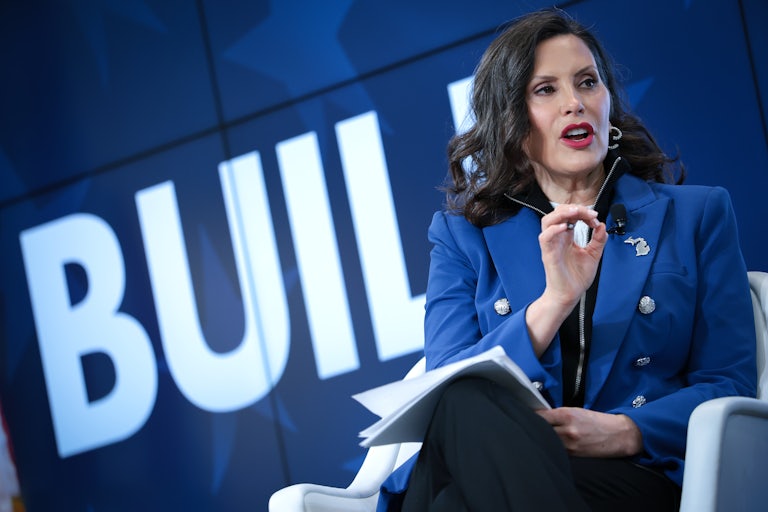
Michigan Gov. Gretchen Whitmer answers questions after speaking on the theme "Build, America, Build!" in Washington, D.C.
Win McNamee/Getty Images
Michigan Governor Gretchen Whitmer answers questions after speaking on the theme “Build, America, Build!” in Washington, D.C.

Gretchen Whitmer came to Washington this week and, in a high-profile appearance, took herself out of the running for the 2028 Democratic Party presidential nomination. Only, she probably doesn’t know she did that. (That’s OK, she just read it here first.)

The exact moment where things went awry for the Michigan governor came when she attempted to defend the very thing that had raised the specter of a recession that will wreck millions of Americans’ livelihoods: Trump’s insane tariffs scheme, which caused such unholy havoc over the last few days that he was forced to issue a partial suspension of hostilities on Wednesday afternoon, pausing the implementation of escalated tariffs on most nations for 90 days (while retaining 10 percent across-the-board tariffs and upping his trade-war ante against China to an insane 125 percent).

It was against this backdrop that Whitmer breezed in from cloud-cuckoo-land to lend Trump a bipartisan shoulder to cry on. “I understand the motivation behind the tariffs, and I can tell you, here’s where President Trump and I do agree. We do need to make more stuff in America—more cars and chips, more steel and ships. We do need fair trade,” she said, in a speech at the Council of Foreign Relations. “We should be able to celebrate good policy no matter where it comes from, and also criticize bad policy no matter where it comes from.” She followed up this performance by allowing herself to get baited into participating in an Oval Office photo op, where she stood by cringing as Donald Trump signed an executive order asking the Justice Department to investigate two former White House aides for treason.

And that’s a wrap on Whitmer 2028.

Am I being unfair here? For sure, Whitmer would probably complain that I’m leaving out the fact that she criticized Trump’s tariffs as a “triple whammy: higher costs, fewer jobs and more uncertainty.” But I’m not leaving that out at all. I am, in fact, including it to better highlight the exact moment she should have stopped talking—because the rest of what she said was opinion-polling poison. Everything Trump touches dies, and tariffs are no different. Serious politicians should not be spending their time trying to co-sign his ideas. Voters will have nothing nice to say about tariffs come election season.

Whitmer is somewhat cross-pressured, admittedly: The labor leaders who have a vested interest in her state’s governance have some unfortunately mixed-to-positive feelings about Trump’s tariffs—even as members of their unions lose their jobs as a result. It’s tough that this is her burden to bear, but I recommend she bear it as the governor of Michigan and not as a Democratic presidential aspirant. And for the sake of those aspirants, she should bear it very quietly, so as not to trouble the news cycle with the kind of talk that might sabotage their chances of winning.

It must be said, though, that much of what Whitmer has to say about tariffs makes me question whether she’s a reliable voice on the topic at all. She claims to understand Trump’s “motivation” (it’s actually more like a “fixation”). But if she did, then she wouldn’t have anything complimentary to say about it. Trump believes that tariffs should replace the income tax, which as Tim Noah demonstrates at length is a notion both ahistorical and innumerate. The Trump administration believes that the federal workforce, as a pool of laborers, would be more productive if they were working for minimum wage at the Triangle Shirtwaist Factory. The only way to “understand Trump’s motivation” is to see the multiple layers of stupidity at work in his seething brain.

Whitmer is right to want more stuff made in America, but she’s wrong to offer Trump—who is driven by mental infirmity and the need to dominate other nations—any kind of concession, especially when his plan won’t work. We’re not going to be commanding the industries of the future by simultaneously imposing recession-inducing tariffs and cutting off the money for research “into new materials for jet engines, propulsion systems, large-scale information networks, robotics, superconductors, and space and satellite communications, as well as cancer” cures, as Trump did this week. This is why you cannot, actually, “celebrate good policy no matter where it comes from”—all of Trump’s policies in combination make the economy worse and the future darker.

There might have been a time when the mastery of technocratic wonkery was effective politics. It was, at least, in vogue for a while. But the nation has been drop-kicked into a new information environment where it is decidedly bad politics to devote yourself to a complicated explanation of how tariffs can create positive sum trade outcomes that might blah blah blah—I feel bored even typing this! In 2025, if you are explaining, you are losing. You should be taking the cheapest of shots at a bad and infirm man wrecking the country, not leading a graduate seminar. If you want to know how it goes when a presidential candidate talks about being “for something before they were against it” and pitches themselves as the person who will take a bad president’s terrible idea and make it work with the right dose of managerial panache, google “John Kerry.”

Look, I know that we’ve employed tariffs from time to time in perfectly sane ways. I know that they should be part of a good steward’s economic tool kit. But Trump’s actions over the past few weeks have indelibly tainted them. In upcoming elections, tariffs are going to poll about as well as feline AIDS or getting punched in the throat. So there’s only one way for Democrats with national aspirations to characterize them for the next few years: as a recipe for economic wreckage that the entire MAGA-pilled Republican Party supports. One day, tariffs may achieve redemption, but it won’t be on the 2028 campaign trail—at least not if you want to stay on it.

This article first appeared in Power Mad, a weekly TNR newsletter authored by deputy editor Jason Linkins. Sign up here.

The Fight for the Post-Trump Future Has Already Begun

How Democrats choose to confront DOGE’s corrupt destruction today will determine whether America recovers—and who will lead that recovery.

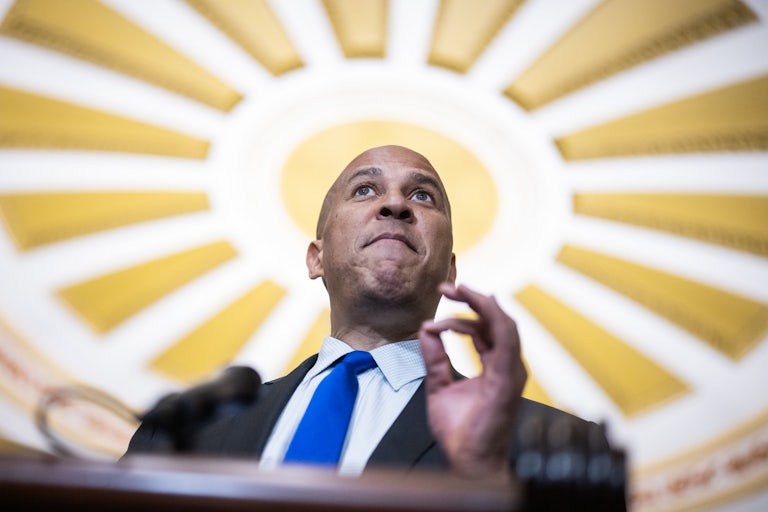
Cory Booker conducts a news conference after the senate luncheons in the U.S. Capitol.
Tom Williams/Getty Images
Senator Cory Booker ignited the news cycle with a marathon speech against the Trump administration this week.

Is it too soon for any of us to start thinking about the post-Trump future? There are many reasons why the obvious answer is yes. The GOP has spent approximately a billion dollars on voter suppression over the past year. The president’s national security adviser is apparently dishing in multiple unsecured group chats. There are a bunch of overlapping antidemocracy forces—from Silicon Valley’s oligarchs to Project 2025’s goons—all trying to immanentize their bespoke eschatons every hour of every day. And now, the president has gutted what was once a roaring economy with nonsensical tariffs. Taken as a whole, it’s not hard to simply file “the future” under “in doubt.”

Nevertheless, the forces of Trumpism are having a very big problem earning the consent of the governed as their all-stick-no-carrot approach to autocracy has only created a suddenly vibrant resistance that’s protesting local Tesla dealerships and storming Republican town halls. So discussions of what might come next are already kicking around, with various Democrats planning on bringing new blood to Congress or slowly shuffling toward a presidential run. In the nation’s capital this week, Senator Cory Booker grabbed and held the media’s attention in a marathon 25-hour speech that was a content-creation victory for his party and a boost to his personal political brand.

Still, a lot of the recent futurecasting has nothing to do with the goings-on in the halls of power. Rather, it’s arisen because of what’s been going down on the book-tour circuit, thanks to the timely publication of a slew of new books—Ezra Klein and Derek Thompson’s Abundance, Yoni Appelbaum’s Stuck, and Mark Dunkelman’s Why Nothing Works—that collectively map out what’s being called “the abundance agenda”: a rather utopian vision that asks our political leaders to tear out all the red tape that holds our biggest ideas back and devote a monomaniacal focus to building stuff.

The New Republic’s Tim Noah has wrestled with these ideas at greater lengths than I can. To my mind, however, I find the timing of the abundance push to be lamentable. It’s pretty clear that these authors essentially anticipated a Democratic win last November. They might have even helped spur one had their ideas made it to market sooner: For all of the abundance agenda’s flaws, theirs is still a laudably optimistic mission that we can all undertake together. Such visionary quests are a mainstay in good campaign messaging, and Kamala Harris could have used something like this to anchor her campaign to a new(ish) idea. Unfortunately, these authors’ ideas have fallen into the unsweetest spot of all: The party of good government is out of power, and the people who are in power are bent on wrecking everything—the civil service, the economy, and the rule of law.

It’s that latter fact of life that really spells doom for the abundance agenda. What we’re learning in real time is that the civil service is one of the country’s most important engines of prosperity: It keeps the country’s gears spinning, all while keeping us safe and spreading wealth to communities. Every government agency that’s torn down to the joists is going to put a huge dent in our productive capacity. Every canceled government grant is a hole torn in the fabric of the future. Every fired federal worker is a post left unattended. Without key agencies like the CDC and the USDA running properly, Americans will simply die sooner and sicken more often, further kneecapping our workforce.

Last week I talked about how important it is for Democrats to bring attention to DOGE’s myriad harms, surface the people who have been hit the hardest by its wanton disregard for the civil service, and keep pumping those stories into the media maw to maximize conflict with the GOP. But there’s an important overarching message that Democrats need to convey, as well. DOGE isn’t about government spending, right-sizing budgets, or the promotion of efficiency. It’s simply about laying waste—burning the government down to its foundations—and it’s every bit as capacious and consuming a vision of the future as anything the abundance bros have come up with.

The GOP has long given up on winning over voters by demonstrating that it knows best how to make the government work for people; as I’ve noted previously, the notion that there are even “Republican lawmakers” anymore is a quaint myth. Republicans are backing DOGE because it’s a once-in-a-lifetime chance to incapacitate the federal government once and for all and forever alter the public’s ability to demand more from their leaders. DOGE’s proponents are making a bet that even if Democrats return to power, they’ll be left with a smoking husk instead of a functional administrative state—and that they’ll lack the willpower to rebuild it.

In this way, going on the warpath against DOGE now is as much about defining the future as it is about defending the present. Some Democrats are already thinking about it in these terms. In a recent interview with Semafor’s Dave Weigel, Minnesota Governor Tim Walz said that Democrats “need to start messaging” on what they intend to do if they get control of the government “right now.” “We need to put our experts on this,” said Walz. “How will we build back next time? I think it’s an opportunity … to create the agencies the way we saw them in the first place, functioning better, without all the barnacles. So, Trump might be doing us a favor. He stripped it down, he blew the motor up. We’re going to put a new motor in it and take off. And I think that’s how we have to start thinking about it.”

Walz has just one vision of this project. Other Democrats may have different opinions of what will need to be rebuilt in a post-Trump future. But no matter what, it will take a lot of political capital, and anytime Democrats gather to fix anything, a swarm of media magpies swoops in to insensately ask, over and over again, “BUT HOW WILL YOU PAY FOR IT? BUT HOW WILL YOU PAY FOR IT?” There is an array of forces standing ready to thwart Democrats’ efforts to build a better world—and as the recent failures of Senate Democrats in the budget battle showed, sometimes they are their own worst enemy.

The best thing elected Democrats can do right now is strike at the heart of DOGE’s predations and start building the public will for rebuilding what’s been torn down. And the best thing we on the left can do is take the full measure of the men and women who might be the party’s future leaders, making sure they have the mettle and the commitment for a complete, post-Trump restoration of the federal government. Anything less simply isn’t serious—not if you want a future of any kind of abundance.

This article first appeared in Power Mad, a weekly TNR newsletter authored by deputy editor Jason Linkins. Sign up here.

Signalgate Can Teach Democrats How to Take Down Elon Musk

A very Trumpian scandal has brought out the best in liberal lawmakers.

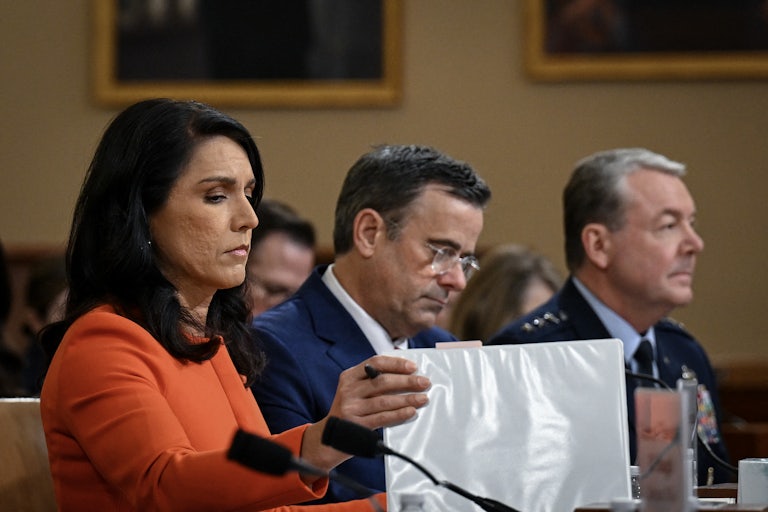
Director of National Intelligence Tulsi Gabbard, CIA Director John Ratcliffe, and Director of the Defense Intelligence Agency Lt. Gen. Jeffrey Kruse testify during a House Permanent Select Committee on Intelligence hearing.
Drew Angerer/Getty Images
Director of National Intelligence Tulsi Gabbard, CIA Director John Ratcliffe, and Director of the Defense Intelligence Agency Lt. Gen. Jeffrey Kruse testify during a House Permanent Select Committee on Intelligence hearing.

The second Trump era is something of an exercise in natural consequences. What happens if you put the most flamboyantly stupid goons in charge of everything? The results will neither surprise nor confound you: It is an absolute omnishambles. Trump’s not nearly through his first 100 days, and we’ve seen markets buffeted by the administration’s trade war whiplashing, allies abandoning us as our foreign policy lapses into nihilism, and everywhere the previously well-calibrated work of the federal government is coming undone—and killing people—as Elon Musk rampages across the city.

In short, mayhem and nonsense are not in short supply, and town halls across the country are filling up with people who are pissed about Trumpian misrule. Despite all this, it wasn’t until this bizarre natsec group chat fiasco—which one social media quipster appropriately named “New phone, Houthis?”—that the Trump administration has been made to bleed in public. It’s worth exploring why that is, and what Democrats can learn from this folderol to confront a far more pressing and destructive problem: the aforementioned pillage of the civil service at the hands of DOGE.

To begin with, it should be obvious that there are some things about this flap that simply aren’t replicable—and I’m not just talking about the part where key figures on the Trump national security team accidentally loop in the editor of a major national magazine on their plans to drop bombs in Yemen. One of the biggest reasons this particular scandal has dominated the news cycle for days is simply the fact that a media organization ended up at the center of it. But after a day of the Trump administration alternating between public prevarication and slagging inadvertent Signal chat participant Jeffrey Goldberg, The Atlantic was forced to take something other than a neutral position by publishing screenshots of the chat to prove—contra the inveterate liars in the White House—that Defense Secretary Pete Hegseth had indeed revealed precise plans for airstrikes on Houthi rebels.

Democrats, by and large, believe that this is how it should always go with the political press: that some sort of civic impulse might stir in the media’s breast, pushing them in the direction of critical thinking and coverage that comes down against irresponsible and immoral actors. This might be the news industry we deserve, but it’s not the one we have, and Democrats will continue to suffer dismay as long as they harbor the illusion that the press will reform itself and align itself with the cause of keeping our civic fabric intact.

That said, this week’s contretemps over the group chat did engender something that can be replicated: Angry Democrats are now in the public eye, eviscerating the GOP. This is one of the big rules in the current information landscape in which we’re forced to live: Conflict creates content. The media beast may be cynical, but it is reliable—and if you feed it enough antagonism, it will hand over the headlines. Given the opportunity to get down to some good old-fashioned battering of Republicans, the outrage of Democrats got, and held, the media’s attention.

Democrats need to scheme up ways to do this kind of thing every day. It shouldn’t be hard: DOGE’s destruction is handing Democrats daily fodder. Now they need to take it and muster the same sort of passion that’s been on display as they torched Trump’s natsec nimrods. That means finding regular opportunities to sound off in front of whatever reporters, television cameras, and microphones are at hand.

It also means thinking unconventionally. One of the most appealing aspects of The New Republic editor Michael Tomasky’s idea of putting together a shadow Cabinet is the way it can be fashioned into a dagger aimed squarely at the heart of Elon Musk’s enterprise, by combining expert argument (here’s where an army of pissed-off federal employees fired by Musk can help a lot) with combat-ready liberal figures. Such an enterprise would pile up the pressure on Trump while taking it off the Democrats’ respective minority leaders in the House and Senate, Hakeem Jeffries and Chuck Schumer, who just aren’t built for political fisticuffs.

That said, there are lots of current operations underway that also provide ammunition for the content creation wars. Bernie Sanders’s “Fighting Oligarchy” tour, as I’ve previously noted, has been an attention-getting boon for the forces of anti-Trumpism. The Democrats are also making great hay staging their own “empty chair” town halls, invading red districts to talk to disaffected voters in places where DOGE cuts hit hardest. And those hits keep on coming: The fact that Elon Musk is damaging the lives of people in places like Osage County, Oklahoma, is opening the doors for Democrats in parts of the country where they’ve had little political luck.

This week, as Democrats grilled the members of the Trump administration who’d perpetuated the group chat flap, they did so with the palpable sense that they enjoyed the taste of blood in their teeth—while uncharacteristically staying on message. While the administration has attempted to wave away criticism, Democrats haven’t budged from the central idea that the group chat was uniquely destructive and disqualifying.

This is exactly how they need to characterize DOGE, because otherwise Musk’s rabid crusade could become cemented in the public eye as a legitimate part of the overall debate about government spending. This is exactly what the GOP is hoping for: Even as public approval of Musk plummets, Republicans like Senate Majority Leader John Thune are trying to pass off DOGE’s sabotage as part of their broader attempt to cut spending (to fund taxes for the rich, of course).

Democratic pushback on DOGE can build on previous successes in fending off the Trump administration’s rapaciousness. When Obamacare was under attack, Democratic unity was key to saving the program from the predations of GOP legislative majorities. Then, it was “Hands off my health care”; now, it’s “Hands off my Social Security” and “Hands off my private data.” These are especially potent rallying cries because they show how every community will be touched by DOGE’s corruption. Suddenly, Democrats have a thousand different ways to reach millions of different voters. That kind of opportunity doesn’t come along all too often.

This article first appeared in Power Mad, a weekly TNR newsletter authored by deputy editor Jason Linkins. Sign up here.