Breaking News
Breaking News
from Washington and beyond

Harvard Names Graduate School After Republican Billionaire Megadonor Who Loves Ron DeSantis

Ron DeSantis is leading an attack on academic freedom. And Ken Griffin is one of his biggest financial backers.

Ken Griffin
David Paul Morris/Bloomberg/Getty Images
Ken Griffin

Harvard’s Graduate School of Arts and Sciences announced Tuesday it will be renamed for a Republican billionaire megadonor who is one of Ron DeSantis’s biggest financial backers.

Hedge fund CEO Ken Griffin graduated from Harvard in 1989. The school praised his $300 million gift, saying it will help it advance its research and expand its ability to provide students with financial aid.

But people were confused by the fanfare over his gift and the decision to give Griffin such a prominent reward. Harvard’s endowment fund is $53.2 billion, the largest academic endowment in the world, so Griffin’s gift is a drop in the bucket for them.

But more than the money, people are pretty mad about Griffin himself. The billionaire is currently the third-biggest individual political donor in the country, having given a total of $71,050,000 to exclusively conservative causes, according to OpenSecrets.

A report published in November by the group Americans for Tax Fairness found that Griffin gave $66.1 million to several Republican super PACs and candidates during the 2022 midterm elections. That election cycle was the most expensive midterms ever, as billionaires rushed to exert influence over the outcomes.

Griffin actually was one of Barack Obama’s biggest fundraisers when he first ran for election in 2008. But by 2012, Griffin had flipped, transferring his vote and his money to then–Republican nominee Mitt Romney.

He alleged the Obama administration had “embraced class warfare as being politically expedient” and argued that wealthy people had “insufficient influence” in politics.

Most recently, Griffin has thrown his weight behind Ron DeSantis. He was the Florida governor’s biggest donor during the 2022 election, giving $5 million to DeSantis’s reelection campaign.

Griffin has repeatedly said he would “love” to see DeSantis run for president in 2024. During a March interview with Bloomberg, Griffin said he disagreed with DeSantis on a few points, such as the governor’s going after Disney for criticizing Florida’s “Don’t Say Gay” law or spreading doubt about Covid-19 vaccines.

To be clear, Griffin didn’t say he disagreed with DeSantis’s motivations. Instead, Griffin said he thought the Disney retaliation was government overreach and the vaccine disinformation was poorly worded and framed.

Meanwhile, DeSantis has come under fire recently for going after educational freedom in Florida. He has promised to defund diversity, equity, and inclusion programs on college campuses; limited what can be taught or read in schools; and even had his allies force out the president of a liberally minded college.

Wisconsin Teacher Who Complained About “Rainbowland” Song Ban Placed on Administrative Leave

A Wisconsin school district seems to be retaliating against one of its own teachers, after she brought attention to overzealous enforcement in the classroom.

Kevin Winter/Getty Images/The Recording Academy
Dolly Parton and Miley Cyrus, the singers of “Rainbowland,” perform onstage.

In March, a first-grade concert in Wisconsin was barred from singing “Rainbowland” by Miley Cyrus and Dolly Parton. Now the school district has placed a teacher who complained about the ban on administrative leave. The district has not clarified when the teacher will be allowed to return or what repercussions she may face next.

Heyer Elementary first-grade teacher Melissa Tempel had been working with other teachers to prepare for a spring music concert. The teachers decided to include Cyrus and Parton’s “Rainbowland” in the set list. But school administrators, including the principal, barred the song’s inclusion, citing a district-wide policy on items “that may be considered political, controversial, or divisive.” Tempel tweeted about the ban, prompting massive public attention on the Waukesha School District.

And then, last week, Tempel was placed on administrative leave. She had come to school like any other day. But unlike any other day, district officials were waiting to stop and remove her from the classroom.

The school board plans to meet Wednesday. The agenda includes items limited to the “executive session” related to “specific personnel problems,” which suggests closed-door discussions about Tempel’s fate. Parents from the district have found this secrecy as well as the uncertainty around Tempel’s leave period or the reason for it in the first place to be indicative of district officials’ broader lack of transparency.

Members of the Alliance for Education in Waukesha, or AEW, a group of parents and community members, are inviting the public to attend a public singalong to “Rainbowland” and the school board meeting to “show support for an inclusive Waukesha.”

“I am deeply concerned that Ms. Tempel was removed from her classroom for standing up for them and what she knows is right,” said a parent from Tempel’s class.

“Melissa is a wonderful teacher, and the fact that the district did not address this issue with her and with the school principal directly, but instead called her out in a communication to the entire district community is not only wrong but juvenile,” said another Heyer elementary parent.

Tempel’s administrative leave is just the latest in what parents and teachers say is a school district’s overzealous enforcement of Board Policy 2240, Controversial Issues in the Classroom, which sets guidelines for when the district would “permit” a so-called “controversial issue” to be introduced in the classroom. The broad policy has gone as far as banning rainbow designs from school decor or teacher lanyards because of the association with the LGBTQ community.

The teachers’ initial planning for the spring concert seemed fairly innocent. After some back and forth, Tempel and her colleagues found Parton and Cyrus’s “Rainbowland” to pair well with other songs in the lineup, like “What a Wonderful World,” “Here Comes the Sun,” and “It’s a Small World.”

“Livin’ in a rainbowland, where everything goes as planned, and I smile, ’cause I know if we try, we could really make a difference in this world,” Parton and Cyrus sing in their chart-leading ballad.

But as the teachers soon discovered, the show would not go on as planned.

The school principal and another school administrator reviewed the song and decided that it “could be deemed controversial” in relation to Board Policy 2240. Waukesha School Board President Dr. Kelly Piacsek and Superintendent Dr. Jim Sebert have insisted that they did not “insert themselves into the song selection.” Rather, they framed the process as decisions made by Heyer Principal Mark Schneider and the school’s music teacher. Piacsek and Sebert claim they only reviewed and upheld decisions made by Heyer’s staff.

But members of AEW argue the officials are blaming school staff for a broader chilling atmosphere in the district that is being conducted, namely through the advancement of policies like 2240.

Curiously, Piascek and Sebert, while insisting they were not involved in the decision to ban the song, took it upon themselves to explain the exact rationale of why it was banned. They explained that the “subject matter addressed by the song’s lyrics” was not in line with the “the age and maturity level of the students.”

The district has not clarified exactly what is inappropriate about Cyrus and Parton’s song, nor have they clearly delineated why Tempel has been placed on forced leave. Attempts were made to reach Superintendent Sebert, Deputy Superintendent Joe Koch, School Board President Piascek, and Heyer Elementary Principal Schneider, but The New Republic did not hear back from any by publication time.

“This Superintendent and Board began the march toward marginalization last year, and it has only served to stoke fear and sow distrust in the  Waukesha Community, which has yielded a pattern of bullying against anyone who calls out the district’s bias and harassment,” the AEW said in a statement Tuesday. “Now Waukesha is a national laughingstock, and the blame for that falls squarely to the feet of the district’s leadership, not those who have the courage to hold them accountable, like Ms. Tempel.”

Tennessee’s Governor Says He Wants a Red Flag Law. Here’s How to Tell Whether He Means It.

If Bill Lee is serious, after the two weeks of chaos in his state, he could actually make it happen.

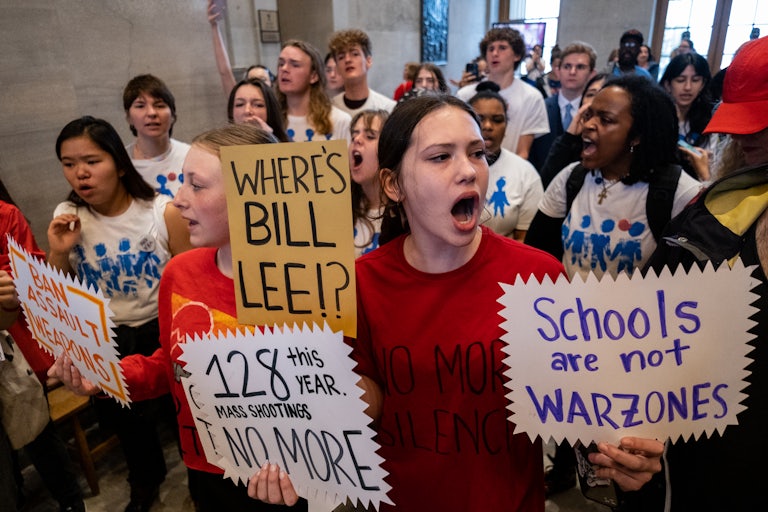
Signs read "Where's Bill Lee?," "Schools are not warzones," "Ban assault weapons," and "128 this year. Mass shootings no more."
Seth Herald/Getty Images
Protesters gather at the Tennessee State Capitol building and demand action on gun control on April 6 in Nashville.

Tennessee’s Republican governor said Tuesday he would support gun reform legislation, pulling an abrupt 180 on gun control legislation as his state still reels from a school shooting.

A shooter opened fire at the Covenant School in Nashville two weeks ago, killing three children and three adults and wounding several others. State Republicans, including Governor Bill Lee, have insisted that there is nothing they could have done or could do differently to prevent such a tragedy. When Democrats agitated for gun reform on the floor of the state House of Representatives, Speaker Cameron Sexton moved to expel two of them from the legislature.

Lee finally struck a different tune Tuesday, during an appearance at the Midtown Hills police precinct, which responded to the Covenant School shooting. “I think everyone—leadership from speakers as well as other leaders—have expressed a desire to do something and move forward,” he said. “I have challenged them to bring forward ideas and subsequently met with those leaders. I do believe we should get it done during this session.”

Lee did not offer any specific suggestions of what those laws, including a red flag law, should entail. Here are some places he could look for ideas: the red flag law that Tennessee failed to pass in 2020 or the package of gun reform measures that state Democrats introduced last week.

One of those bills is for extreme risk protection, another name for a red flag law. The measure would let families and law enforcement intervene when a person poses a significant threat to others or themselves.

The Tennessee Senate Judiciary Committee has said it will not hear any firearm legislation for the rest of the year, but Lee urged the legislature to pass some kind of reform this session.

A few hours after Lee’s speech, Sexton responded by announcing that “the House is willing to work toward bipartisan solutions to protect all children at their schools, in their communities, and inside their homes.” Though he did not specify a red flag law or say the word “guns,” his statement was in response to Lee’s suggestion for this legislation.

Lee’s speech was only his second public appearance since the shooting, and it was markedly different from his first one. In a video message posted on Twitter just days after the attack, Lee said he had lost two close friends in the shooting, but it was not yet time for change.

“I understand that there is pain; I understand the desperation to have answers, to place blame, to argue about a solution that could prevent this horrible tragedy,” he said. “There will come a time to discuss and debate policy. But this is not a time for hate or rage. That will not resolve or heal.”

His pivot comes after two weeks of turmoil in and national scrutiny of the Tennessee state legislature. Thousands of students marched two separate times on the Capitol building demanding gun control. They were joined by three Democratic lawmakers, two of whom were subsequently expelled by their Republican colleagues for allegedly breaking House decorum rules.

One of the expelled lawmakers, Justin Jones of Nashville, was reinstated Monday by his district’s Metro Council. He is now technically a “new member” and can file up to 15 bills. Jones promised Monday night that all 15 bills he files will be on gun control.

What Can the FDA Actually Do About the Abortion Pill Ruling?

As the nation awaits a final decision on the abortion pill, amid dueling legal cases, there is one easy way the FDA could help make sure people still have access.

Paul Ratje/The Washington Post/Getty Images
A doctor prepares doses of mifepristone, the abortion pill, in his clinic in Santa Teresa, New Mexico.

A shocking ruling out of Texas looks like it could take abortion pills off the market, but all hope is not lost. The Food and Drug Administration has a course of action that will let it comply with the court and still maintain access to the drug.

Texas federal Judge Matthew Kacsmaryk ruled Friday that mifepristone, one of the medications used to induce an abortion, had been improperly approved by the FDA and should be yanked from the U.S. market. Another judge has filed a dueling injunction to keep the drug available, and the Department of Justice has appealed the case.

So as the conflicting law proceedings swirl around, what can the FDA do to keep mifepristone available for the people who need it?

Lawmakers, including Democrats Ron Wyden and Alexandria Ocasio-Cortez and even Republican Nancy Mace, have called for the administration to ignore the ruling and keep mifepristone on the market.

“I believe the Food and Drug Administration has the authority to ignore this ruling, which is why I’m again calling on President Biden and the FDA to do just that,” Wyden said Friday.

But law experts warn against urging the government to “ignore” the ruling, which has no legal precedent.

“Ignoring court rulings is a very serious thing that undermines basic principles of law,” David Cohen, a professor at Drexel University’s Kline School of Law, told The New Republic. While he wouldn’t take ignoring Kacsmaryk’s ruling off the table if the situation became extreme enough, he pointed out that there is another, better option.

Enforcement discretion is a decades-old practice established by a 1985 Supreme Court case that determined administrative agencies can decide when to enforce their own rules, based on which offenses are the most important to target. Cohen compared it to police officers not ticketing everyone who drives a few miles over the posted speed limit, focusing instead on people who drive far too fast.

“It’s a normal part of the American justice system,” he explained. “It’s a problematic part, in some ways, because people can use discretion to go after people of color more. But it is a normal part to weigh the pluses and minuses of different offenses and different levels of offenses and go after the ones that you feel you need to use your resources most for.”

The Biden administration has already indicated that it does not intend to ignore the Texas ruling and will wait for the result of the appeal. Business as usual will continue until the end of the week, when Kacsmaryk’s ruling goes into effect, or until the appellate court rules.

But a judge in Washington state has ruled to maintain the status quo, which directly contradicts the Texas ruling.

The only way for the FDA to comply with both rulings, which are both legally binding, is to use enforcement discretion. In doing so, the agency acknowledges that the approval on mifepristone has been suspended. But the FDA also acknowledges that mifepristone is safe for use and that a better use of agency resources is to go after what Cohen describes as “serious offenders,” or other, nonabortion drugs that are unapproved and risky.

Mifepristone was approved for use in 2000. Since then, it has remained categorized as a high-risk drug, even though there have been more than 100 medical studies proving its safety and it is safer than thousands of other FDA-approved drugs, including penicillin and Viagra. Rachel Rebouché, the dean of Temple University’s law school, pointed out that the FDA has “arguably over-regulated mifepristone.”

But this case isn’t just about whether mifepristone is safe or even about the right to an abortion. It’s also about “deference to a federal agency’s expertise.”

The FDA’s authority has been undermined by the [Texas] suit and reaffirmed by the [Washington] suit,” Rebouché told TNR. “To take seriously that it ignored risks, risks unsupported by any credible evidence, suggests questions as to what federal courts might decide about other federal agencies’ decisions.”

Even if the appellate court upholds the Texas ruling, enforcement discretion gives both Biden and the FDA the ability to keep mifepristone on the market while still complying with the judicial system. Cohen, Rebouché, and Pitt University law professor Greer Donley were some of the first to raise this option back in February, noting in a Slate article that even if mifepristone loses its approval, things aren’t necessarily as bad as they seem.

“People have been very quick to make this judge have more authority than we should be giving him,” Cohen said of Kacsmaryk.

There’s been a lot of hand-wringing over the lawsuit, well before Kacsmaryk ruled. People are rightly concerned: More than half of all abortions in the United States are done via medication, a two-step process that consists of taking a dose of mifepristone and then a dose of misoprostol.

These drugs can be ordered online and delivered via mail, making them a key resource for people who live in states that have cracked down on abortion access since Roe v. Wade was overturned last summer.

So the thought that one man could take that away is understandably frightening. By raising the alarm, people brought national attention to the issue. The governments of both Washington state and Massachusetts announced plans to stock up on mifepristone in case residents need it. The widespread outrage could also be used to raise donations for abortion rights groups.

But some of the concern also stems from a lack of general understanding about the legal nuances and complexities of the case.

As Cohen, Rebouché, and Donley say in their Slate piece, Kacsmaryk “is not all-powerful.” The FDA still retains the ability to keep mifepristone on the market, and it should flex that power now.

But “to just throw up their hands in the air and say, ‘Nothing we can do, the drug is now banned,’ (a) that’s not a correct reading of the order,” said Cohen. “And (b) that’s giving up.”

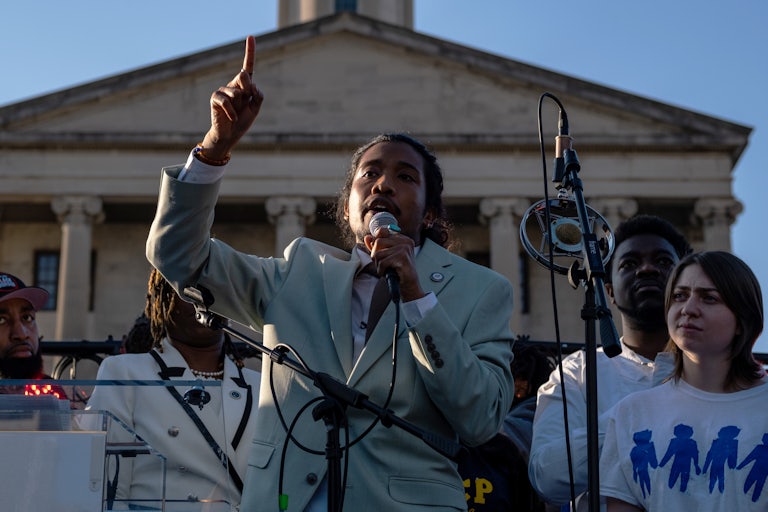
Reinstated Tennessee Lawmaker Promises Every New Bill He Files Will Be on Guns

Justin Jones is back in his seat after Republicans expelled him. And he’s advancing the fight that got him kicked out in the first place.

Seth Herald/Getty Images
State Representative Justin Jones of Nashville speaks outside the Capitol on April 10.

Tennessee state Representative Justin Jones is back in the seat Republicans expelled him from after the Democrat stood in solidarity with thousands protesting gun violence. And now, he promises that every single bill he introduces as a “new member” will be focused on advancing the fight that prompted his expulsion: stopping gun violence.

“They told me today I can file 15 bills because I’m now technically a new member. Every one of those bills is going to have to do with commonsense gun laws,” Jones told CNN on Monday. “Every single one of those bills is going to have to do with that because that’s what these young people are begging us to do. And so when I come tomorrow, I’m going to work on that legislation, get it to the speaker’s office, and let’s take action before we adjourn from session.”

Jones was expelled from the Tennessee state legislature last week, before the Nashville Metro Council unanimously voted Jones right back on Monday night. He and colleague Justin Pearson, who are both Black, were expelled by Republicans after standing in solidarity with thousands of Tennesseans protesting gun violence in the aftermath of the Nashville mass shooting that left three children and three adults dead. Their colleague Gloria Johnson, who is white, joined them in the protests but survived an expulsion proceeding by one vote.

Jones and Pearson, if reelected as expected, will be interim representatives until special elections are held for both districts.

Republicans, in their anti-democratic efforts to remove members inconvenient to their ideology, have in effect lost on all counts. By so blatantly disregarding public concern after a horrifying mass shooting, they’ve awakened and mobilized thousands of Tennesseans who may have previously been apolitical, unmotivated, or even conservative. They’ve brought nationwide attention to their misdoings—not just the expulsion of members who stood in solidarity with parents, teachers, and students but also the way they have used their supermajority to make up their own rules, filing bills with no notice to the public and killing other bills on no coherent basis other than their own personal preferences.

Finally, they’ve brought millions of people’s attention and support to Jones, Pearson, and Johnson. And with Jones returning, and Pearson perhaps not far behind, the expulsion is not martyrdom but the start of a new battle against the Republican Party.

Millions of people are now monitoring Republicans’ every single move—and what they choose to do with every one of the 15 gun control bills Jones has promised to file. Any further inaction is all the more blatant in the aftermath of yet another mass shooting in neighboring Louisville, Kentucky. Republicans’ time of lazily waving away bills or making up their own rules has come to an end.

And it was all their own doing.