Breaking News
Breaking News
from Washington and beyond

Three Children Dead After Mass Shooting at Nashville Christian Elementary School

The attack marks the 129th mass shooting of the year.

Metropolitan Nashville Police Department/Twitter

At least three children and three adults were killed, and several others wounded, after a shooter opened fire at a private Christian grade school in Nashville, Tennessee, on Monday morning.

The shooting occurred at the Covenant School, a Presbyterian school that hosts about 200 students from preschool to sixth grade. The school had reportedly run an active shooter training program as recently as last year, according to local outlet WTVF.

“The shooter was engaged by M.N.P.D. and is dead,” the Metropolitan Nashville Police Department said on Twitter. Police have since said the shooter was a 28-year-old Nashville woman armed with at least two assault rifles and a handgun. Police said she had entered the school through a side door, and was apprehended on the second floor.

Police also said they believe the woman was a former student of the school herself.

The attack marks the 129th mass shooting of the year, according to the Gun Violence Archive. It’s the 86th day of 2023.

The conditions of other potential victims are not yet clear.
A reunification area has been established by the Nashville Fire Department at nearby Woodmont Baptist Church.

This post has been updated.
Florida School Bans Ruby Bridges Movie After Complaint From a Single Parent

The movie, which is shown in the district every Black History Month, is about the first Black student to integrate her elementary school in New Orleans.

Bettmann/Getty Images
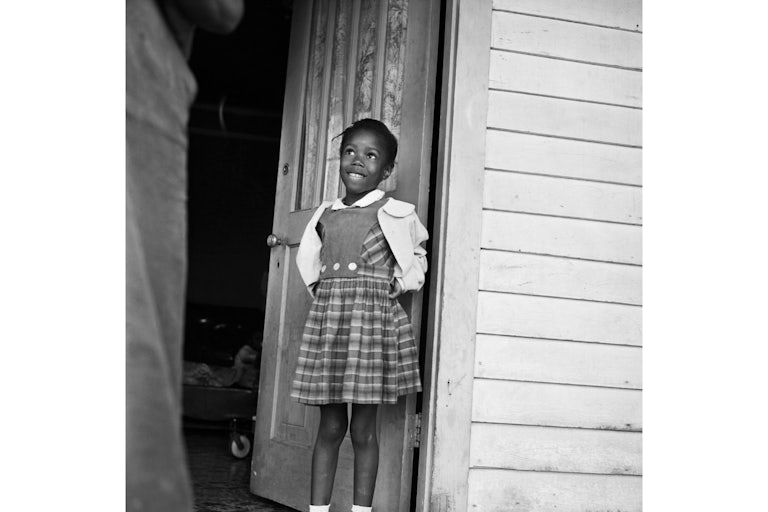
Ruby Nell Bridges, at age 6, was the first African American child to attend William Franz Elementary School in New Orleans after federal courts ordered the desegregation of public schools.

A Florida elementary school has banned the film Ruby Bridges after just one parent complained she didn’t like how it depicted race relations in 1960s America.

The 1998 Disney film is about the true story of Ruby Bridges, who at age 6 became the first Black student to integrate her elementary school in New Orleans. White opposition to her attending was so intense that federal marshals had to escort her in and out of the school every day. 

The movie has been a staple in the Pinellas County Black History Month curriculum for years. But in a complaint from March 6, a mother at North Shore Elementary said she felt that “the use of racial slurs and scenes of white people threatening Ruby as she entered a school might result in students learning that white people hate Black people,” the Tampa Bay Times reported.

The school district responded by banning the film at North Shore Elementary “until a review committee can assess it.” Many advocates for the film pointed out that it seems ridiculous and dangerous that it only takes one parent complaining to get material banned. It’s also counterintuitive to ban a movie about race relations during a month dedicated to Black history.

“Many from historically marginalized communities are asking whether this so-called integrated education system in Pinellas County can even serve the diverse community fairly and equitably,” Ric Davis, president of the Concerned Organization for Quality Education for Black Students, wrote in an open letter.

He pointed out, as the Tampa Bay Times said, “that the truth will not change because someone doesn’t like it.”

Davis argued that one person, no matter their race, should not prompt such a drastic reaction from district officials.

Florida is increasingly restricting what can be taught in schools at all levels. Governor Ron DeSantis has declared war on “wokeism” and has promised to defund diversity, equity, and inclusion programs on college campuses. He has backed the Stop Woke Act, which restricts teaching about race in colleges, and announced plans to mandate Western civilization courses. His administration was also in close contact with the College Board as it gutted the A.P. African American Studies course.

In public schools, one school district has banned 23 different books from school libraries. Teachers in other school districts have been told to hide their classroom book collections until all the books have been vetted and approved. But the vetting process is opaque, and there is no policy clarifying how long a complaint review process should take. As a result, books and films are withheld from students for months on end.

The Ruby Bridges fiasco comes about after Pinellas County school officials earlier this year banned high school students from reading The Bluest Eye by Toni Morrison—again after just one parent complained.

Former St. Petersburg police chief and deputy mayor Goliath Davis condemned the film’s banning. “Black history, Native-American history and Hispanic history, though not always glamorous, are American history and cannot be denied. Additionally, it should not be discarded because a governor and his constituents allege its teaching adversely impacts white students,” he wrote in an op-ed in The Weekly Challenger.

“Why is it permissible to teach white scholars Black folks were enslaved but not permissible to teach them about African American contributions to America and the world and the struggles they encountered and continue to experience as citizens of the United States of America, where the creed is ‘liberty and justice for all’?”

The Israeli Protests Show the Political Power of Unions

A historic strike from unions across the country made the Israel prime minister delay his plan to overhaul the country’s judiciary system.

Ilia Yefimovich/Picture Alliance/Getty Images
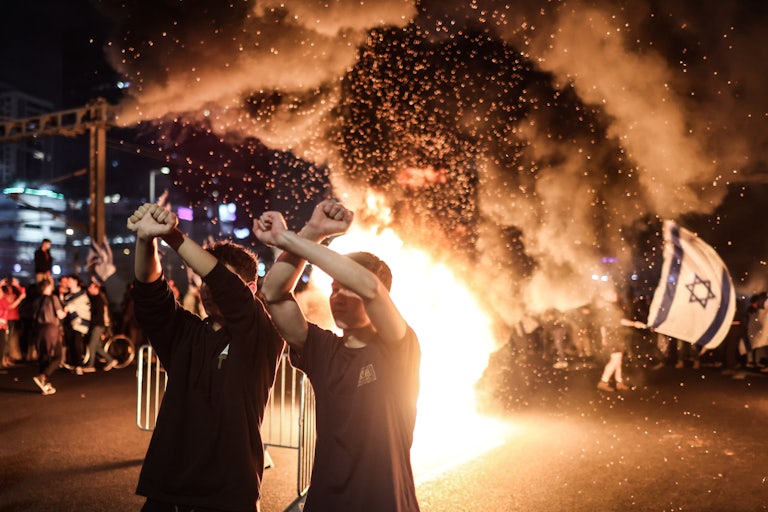
Israeli protesters take to the streets after Prime minister Benjamin Netanyahu announced the dismissal of Defence Minister Yoav Galant, March 26.

Israel’s Prime Minister Benjamin Netanyahu is relenting, for now, on his planned judicial overhaul. After months of mass protest culminating in a general strike on Monday, the far-right plans to seize the nation’s judicial system will be tabled until the next legislative session. In an unlikely collaboration between big business and labor, Israel’s people have shown the power of protest—and the potential for what more they could accomplish, if they so chose to.

Hundreds of thousands of people had already been protesting for weeks against what has become an even more authoritarian Israeli government. The opposition has centered around Netanyahu’s push to give the Knesset (the Israeli Parliament) more power over the judiciary. Such changes would grant the ruling party the power to influence how judges are appointed and even overturn court decisions. Netanyahu himself may be aiming to use such powers to weasel out of his own corruption charges. One poll suggests nearly 1.5 million people may have participated in the ongoing protests against Netanyahu’s attempts to seize and cripple the judiciary.

The tensions came to a new peak on Sunday, after Netanyahu fired Defense Minister Yoav Gallant, who, one day earlier, called for the government to stop its plan to overhaul the judicial system. Gallant argued that the plan had begun to create rifts in society and within the Israel Defense Forces that could risk Israel’s stability and national security. He was the first member of Netanyahu’s Cabinet to oppose the judicial overhaul.

After his firing, the already active protests ballooned into one of the largest mass actions in Israel’s history. Massive, spontaneous protests took place throughout Tel Aviv on Sunday evening, with people blocking the main highway as well as several streets and bridges. And in unprecedented fashion, Israel’s unions, in accordance with the business community, launched a general strike on Monday. The strike was initiated by a massive umbrella group that represents over 700,000 workers in health care, transit, and banking. An array of universities—not just students but the schools themselves—joined the call as well.

Israeli embassies from Dublin to Washington, D.C., shuttered their doors on Monday in tandem with government workers protesting within Israel. Israel’s consul general in New York, Asaf Zamir, also resigned. Zamir called Netanyahu’s firing of Gallant a “dangerous decision” in his resignation letter, adding that he had “become increasingly concerned with the policies of the new government.”

The protests have become so ubiquitous that even Israeli President Isaac Herzog has called on Netanyahu to suspend the judicial overhaul. “The eyes of all the people of Israel are on you. The eyes of all the Jewish people are on you,” Herzog said in a Facebook post Monday. “The eyes of the whole world are on you. For the sake of the unity of Israelis, for the sake of committed responsibility I call on you to halt the legislative procedure immediately.”

Of course, as the snowballing protests are part of a larger movement that has stood for weeks and months against Netanyahu’s increasingly extremist governance, they also serve as a reminder that calls for “protecting democracy” have not been as loud when it has come to the occupation of Palestine. What’s unfortunate about this otherwise exciting popular rise against extremism is that the movement would do well to actively include Palestinian participation in standing against not just Netanyahu but the apartheid system that has led to such a moment. But some Israeli activists have not been allowed to bring even a Palestinian flag to demonstrations. Some officials involved in the increasingly large protest coalition have also refused to appear on stage alongside people sympathetic to the Palestinian cause.

So while Israeli officials frame this mass protest as an effort to preserve Israel’s democracy, it would be prudent to note how short it still is from actually being one, even if the masses can stop Netanyahu; just as well, how readily they could become a true democracy, if they really want to.

Free Speech Absolutist Elon Musk Gets Shown Up by a Free Speech Enthusiast

An internet user named "FreeSpeechEnthusiast" leaked parts of Twitter’s closely guarded source code online.

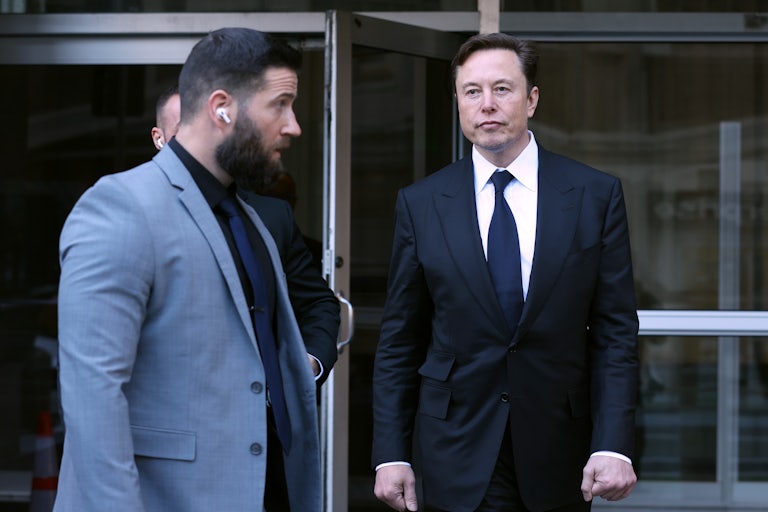
Elon Musk walks out of a building, as a bodyguard stands nearby
Justin Sullivan/Getty Images

Self-described “free speech absolutist” Elon Musk has been shown up by an internet user named FreeSpeechEnthusiast, who leaked some of Twitter’s closely guarded source code online.

Parts of Twitter’s source code, the computer code that runs the platform, had been leaked on the online software developer collaboration platform GitHub. It’s unclear how long the code was up, but The New York Times said it appeared to have been publicly available for at least several months. GitHub complied Friday with a request from Twitter to take the code down.

Musk appeared unbothered on Twitter as the leaked code debacle went down, alternating between sharing pseudo-intellectual musings and weird memes, and begging people to sign up for Twitter Blue, the platform’s paid subscription plan. But internally, he admitted there are serious issues. In an email sent to Twitter employees on Friday, Musk said the company is now worth $20 billion, less than half of what he paid for it in October.

Companies guard their source code jealously to prevent potential hackers or competitors from getting insight into how a platform operates. According to the Times, Twitter has begun investigating who might have leaked the code and suspect it was someone who left the company last year, citing two people familiar with the probe.

Even though the code has been removed from GitHub, it isn’t really gone. Remember when your parents told you that what you put on the internet stays there forever?  Well, “once this is leaked, it cannot be put back in the bottle entirely,” cybersecurity researcher and consultant Lukasz Olejnik told The Washington Post, pointing out it’s impossible to know how many people accessed the code before it was taken down.

“Whether an exploitable vulnerability can be spotted and utilized is difficult to gauge immediately.”

The code was shared by a user named FreeSpeechEnthusiast, who joined GitHub on January 3. That same day, FreeSpeechEnthusiast made their only contribution to the platform (presumably Twitter’s code). Their username is an obvious and excellent troll of Musk, who has described himself as a “free speech absolutist”—which apparently means letting Nazis and the Taliban run rampant on Twitter.

Ironically, Musk had announced plans earlier this month to make parts of Twitter’s code public. The goal was to essentially make it open for peer review, so people could check for and report flaws. Clearly, FreeSpeechEnthusiast beat him to the punch.

Since taking the reins, Musk has embarked on a ruthless cost-cutting mission, firing almost 75 percent of Twitter’s staff, auctioning off everything in the company’s San Francisco headquarters, and just not paying rent. But with advertisers leaving the platform in droves due to his lax content moderation policies, it’s clearly not enough.

Workers of Color Made Up 100% of Union Growth in 2022

Another reminder that “kitchen table issues” and “social” issues are one and the same.

ROBYN BECK/AFP/Getty Images
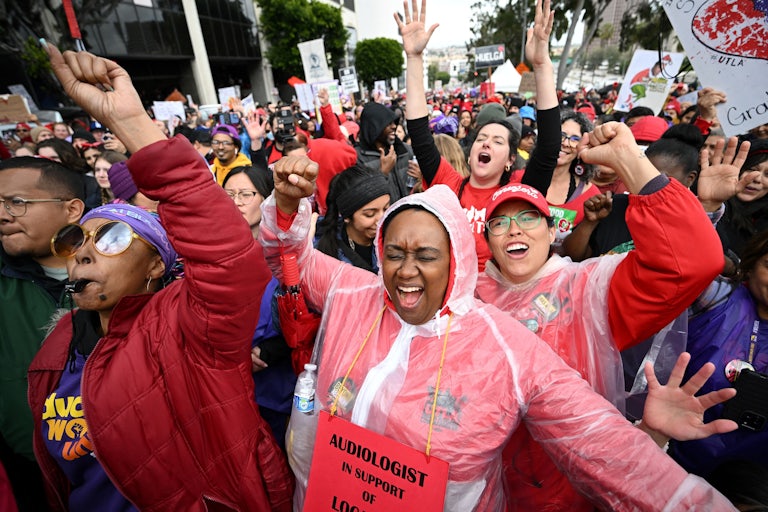
Los Angeles public school support staff, teachers, and supporters rally outside of the school district headquarters on the first day of a three-day strike on March 21.

As thousands of workers went on strike this week, evidence continues to build that the labor movement is back on an upswing in America. But how we engage with the details of this development will determine whether the swing remains a momentary uptick, or becomes part of something larger.

Recent data from the Bureau of Labor Statistics shows that the number of unionized workers in the United States increased by 200,000 from 2021 to 2022. And that growth came entirely from workers of color. There was an increase in 231,000 unionized workers of color last year, while white unionized workers actually decreased by 31,000. Further, of all racial and ethnic groups, Black workers have continued leading unionization rates, at 12.8 percent, higher than the figure of total unionized workers.

While the total share of workers represented by a union still floats at just above 11 percent—much less than where things stood decades ago—union election petitions last year increased by 53 percent, the highest amount since 2016.

According to BLS data, industries that saw the largest increases in unionization were state government; durable goods manufacturing; arts, entertainment, and recreation; and transportation and warehousing. And states with the largest increases in unionization? California, Texas, Ohio, Maryland, and Alabama.

All this to say, monolithic conventions on who constitutes the “working class” need a final upending.

Indeed, the diversity in the movement can be seen in the nature of labor action these past few months. This week, workers at over 100 Starbucks locations nationwide went on strike to protest the company’s alleged union-busting schemes. Another union representing 30,000 Los Angeles school staff workers—including custodians, cafeteria workers, bus drivers, special education assistants, and more—conducted a three-day strike, and the 35,000-strong United Teachers Los Angeles union joined in solidarity. At the beginning of the year, 7,000 nurses went on strike in New York City, protesting poor pay and working conditions brought on by chronic understaffing. All this does not include the some 100,000 rail workers nationwide who almost went on strike last year, until the government itself imposed a contract upon them.

Conservatives—both Republican and Democrat alike—often opine on the need to focus on “kitchen table issues” instead of getting wrapped up in “social” ones. The latter, of course, being another way to say issues surrounding identity and race (much like the term “woke,” but perhaps less likely to incite outrage). But the union data reveals once more that issues of identity and workers’ rights are deeply intertwined. After all, unionization and labor struggles are direct mechanisms to better accomplish racial and social equality; the ability for people to afford to live happy and dignified lives is inherently tied to their ability to enjoy fundamental social and civil rights within those lives, too.

On moral grounds, every politician and journalist should recognize these facts. And for any politico concerned solely with electability, the good news is the results follow the morals anyhow.

In November, several Democrats who refused to pin the economic against the social, even in battleground states, went on to win. That includes people like Governor Josh Shapiro and Senator John Fetterman in Pennsylvania, Senator Raphael Warnock in Georgia, and Governor Gretchen Whitmer in Michigan. And for examples of how these political successes turn to policy successes, look no further than the sacred and often pontificated on Midwest.

In 2018, Governor Whitmer promised to repeal the anti-worker “right-to-work” law. And after voters re-elected her with wide margins—and delivered her majorities in both state chambers for the first time in decades—she delivered on Friday, signing a bill to repeal the anti-union legislation. Just a week earlier, Minnesota Governor Tim Walz signed a bill that guaranteed free breakfast and lunch for all public school students, geared especially for food insecure families, many of whom are marginalized and people of color (perhaps a more direct connection between social and so-called “kitchen table” issues).

As more people become better acquainted with the contradictions of capitalism—from noxious train derailments, to immediately aided collapsing financial institutions (all of which is borne from corporate-bought deregulation)—we may be at another moment in the long history of labor for which a resurgence is possible. But such a moment will not be helped by a media and political apparatus that seeks to flatten the labor movement, rather than embrace it for the vast and diverse coalition it actually is.