Breaking News
Breaking News
from Washington and beyond

Tennessee Republicans’ Power Grab Has Been in the Works for a Long Time

Even before they expelled two Black Democratic lawmakers, Republicans were using their supermajority to undermine democracy.

Seth Herald/Getty Images
Democratic Representatives Justin Pearson of Memphis and Justin Jones of Nashville at the State Capitol Building on April 6, before they were expelled from the state legislature.

Last week, Tennessee Republicans expelled two Black Democratic lawmakers, Justin Jones and Justin Pearson, for standing in solidarity with the thousands of people demanding gun reform after the Nashville school shooting that left three children and three adults dead. What many have rightfully derided as an anti-democratic action seems to be more of a symptom of a broadly poisoned state legislature, in which Republicans are using their supermajority to make their own rules at whim.

An investigation conducted before last week’s drama from Nashville-based NewsChannel5 revealed how Tennessee Republicans have introduced legislation with no notice to the public, denied roll call votes on bills, and killed bills on the basis that their side apparently sounded louder in voice votes.

In so doing, they’ve shut down even the most inoffensive Democratic-led bills, like one that would direct schools to inform high schools seniors how to register to vote, or another that would study whether college ID cards could be used for voting.

“You have committee chairs single-handedly deciding whether bills live or die. Is that democracy?” NewsChannel 5’s Phill Williams asked Republican House Speaker Cameron Sexton, who responded by insisting that there’s no problem.

Yet a problem there is.

On the college student ID bill, pushed by the now-expelled Representative Jones, Republican Elections and Campaign Finance Subcommittee chair Tim Rudd gavelled the vote as a “No” before the voice vote was even finished. Such brazenness certainly cuts against the already condescending charges made by some Republicans last week that members like Jones and Pearson were complainers and not legislation pursuers.

NewsChannel5 gave Rudd the opportunity to explain why he killed the bill before even hearing the vote. “I don’t know what you’re talking about,” Rudd said twice, with not an ounce of shame of what was clearly seen on camera.

Another bill, advanced by local students, that would’ve directed high schools to guide students on how they could register to vote, was denied a roll call vote by Republican Local Government chair John Crawford on the basis that the committee had already voted on an amendment to the bill.

House rules explicitly state that “a roll call vote shall be taken at the request of the sponsor of the bill or resolution under consideration.”

On the voice vote, it sounded to many in the room like the “Aye’s” had won. Crawford, however, deemed that the “No’s had it.”

“Democracy is dead here in Tennessee as it stands right now,” said House Democratic Caucus Chair Vincent Dixie, who sponsored the bill.

Tori Venable, from the libertarian group Americans for Prosperity, told NewsChannel5 how, with the House voice votes, a vote having “sounded one way, [can go] another way,” all by the unchecked discretion of the Republican majority.

On the student voter registration bill, Dixie had also attempted to file an amendment clarifying some language, but Crawford deemed it “untimely” and unacceptable. When NewsChannel5 asked about the rationale, Crawford talked himself in circles, first claiming that if someone makes a motion and gets a second, then he wouldn’t have a choice but to take it to a vote. When the local reporter pointed out that Dixie had received a second on his motion and Crawford had still denied the motion, Crawford then justified himself by saying, “Well, I said, We don’t take up any untimely filed amendments.’ We hadn’t taken any up to that point all year long.”

Two weeks later, House Speaker Sexton filed a last second amendment to a bill that no one else had seen. In this “untimely” scenario, Crawford gladly gavelled it through.

Contrary to Crawford’s claims, NewsChannel5 noted that their investigation found numerous other cases in which Republican chairs readily accepted late filed amendments the public had never seen.

“This is not democracy as far as I’m concerned,” said Democratic Representative Gloria Johnson, who survived her own Republican-led expulsion threat last week by just one vote.

Kentucky Made It Easier to Evade Federal Gun Laws Days Before Louisville Shooting

Kentucky declared itself a “Second Amendment sanctuary state” and rolled back gun control restrictions.

Luke Sharrett/Getty Images
Law enforcement officers respond to an active shooter at the Old National Bank building on April 10 in Louisville, Kentucky. According to reports, there are multiple fatalities and casualties.

Less than two weeks before Monday’s mass shooting at a bank in downtown Louisville, the state of Kentucky banned local law enforcement agencies from enforcing federal firearm laws.

The bill makes Kentucky a so-called “Second Amendment sanctuary” and prohibits local, state, or campus authorities from enforcing federal bans or regulations related to firearms, ammunition, or firearm accessories. It applies to any laws or regulations enacted since January 1, 2021.

On March 28, the bill became law after the Republican-led House and Senate overwhelmingly pushed it through, and Democratic Governor Andy Beshear neither signed nor vetoed the legislation, allowing the bill to become law.

And on Monday, at least five people were killed and another eight injured in a mass shooting.*

Kentucky’s law could counter regulations in the Bipartisan Safer Communities Act, passed in the aftermath of the Buffalo supermarket and Uvalde elementary school shootings. Some of the regulations in that law include: banning people from buying guns if they had committed a disqualifying crime while under the age of 18; banning anyone from buying guns if they were found guilty of a domestic violence charge in a romantic relationship (regardless of marital status); and banning people from buying guns on behalf of criminals, terrorists, drug dealers, or people who are prohibited by law from receiving a gun.

Kentucky’s new law could be weaponized to stop such federal regulations on firearms, as well as any future gun control legislation or executive orders from the Biden administration.

Kentucky Republican Representative Savannah Maddox called the bill blocking even modest federal gun regulation “a step in the right direction” but added that “there is more work that needs to be done by our Republican Supermajority.”

So-called Second Amendment sanctuary laws have been deemed unconstitutional by numerous courts, most recently by a federal judge who struck down a similar policy in Missouri.

Meanwhile, the Kentucky legislature has been considering a slew of other pro-gun bills.

House Bill 542, also pushed by Representative Maddox, seeks to prevent colleges from passing any policies that ban people 21 years and older from carrying a concealed weapon on campuses. The bill would have overturned standing policy at every public college in Kentucky. Maddox had quietly tried to sneak the proposal into what was originally a bill about “workforce development.” Maddox has conceded the bill likely does not have enough votes for now to advance further, but it may gain future momentum after a similar bill succeeded and became law in West Virginia.

Another bill Maddox helped introduce in January would lower the age requirement for carrying a concealed gun from 21 to 18. And yet another she co-signed seeks to allow people to carry concealed weapons in schools.

Kentucky is not an anomaly. In Tennessee, a mass shooting occurred amid a concerted effort by state Republicans to loosen gun laws. Before a mass shooting left three children and three adults dead at a Nashville school, state Republicans passed a bill allowing people 21 and older to openly carry handguns without permits. Republicans there are now pushing to allow 18- and 19-year-old residents to carry any firearm—including weapons like AR-15s and shotguns—without permits.

The exact motives of the Louisville shooter are not yet clear. But in a society ravaged daily by mass shootings, in every possible segment of the public square, one would hope that there would be at least some movement toward lessening those incidents: making weapons of killing harder, not easier, to obtain; meaningfully increasing mental health and well-being support; creating a society where community and care, not isolation and individualism, are the norm.

But no, even while Monday’s shooting in Louisville marks the 146th mass shooting in 2023, Republicans seem to be rolling full-speed ahead on running those numbers up.

* This article has been updated with the latest statistics in the Louisville shooting.

Republicans Suddenly Don’t Want to Talk About Abortion After Texas Judge’s Ruling

Abortion was all Republicans would talk about before. Their silence now speaks volumes.

MOISES AVILA/AFP/Getty Images

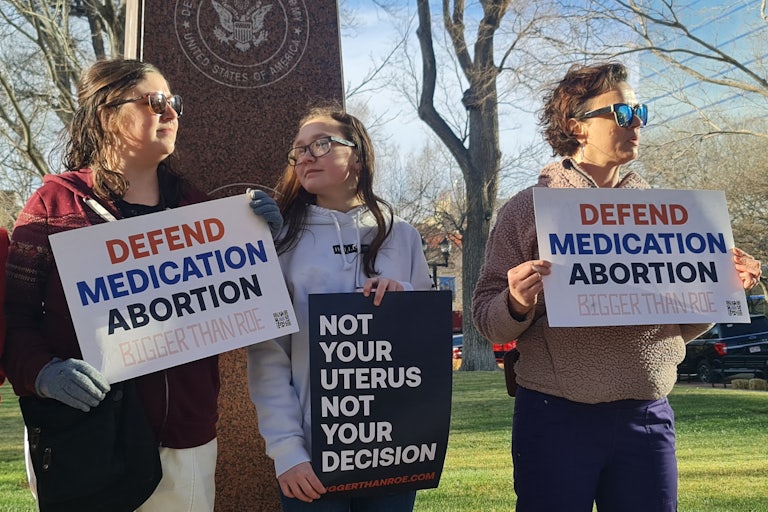
Since the bombshell ruling that could potentially take abortion medication off the market, only a handful of Republicans have commented on it—and some not even directly.

Texas federal Judge Matthew Kacsmaryk ruled Friday that mifepristone, one of the medications used to induce an abortion, had been improperly approved by the FDA and should be yanked from the U.S. market. Another judge has already filed a dueling injunction to keep the drug available.*

Republicans typically like to talk about abortion, with many hailing the reversal of Roe v. Wade last summer. In January, the Republican National Committee passed a resolution instructing GOP lawmakers to “go on offense” against abortion access.

But since Friday, there has been barely a peep out of the Republicans on Capitol Hill. As of Monday, countless Democrats have decried the loss of human rights, with Senator Ron Wyden and Representative Alexandria Ocasio-Cortez calling on the FDA to ignore the ruling. But only a handful of Republicans have addressed the ruling.

Senator Cindy Hyde-Smith was one of the first to react. On Friday, she called the ruling “a victory for pregnant mothers & their unborn children” and accused the FDA of “recklessly violating the law & jeopardizing patient safety.” More than 100 scientific studies show that mifepristone is safe.

Susan Collins, the only Republican senator who voted against Kacsmaryk’s confirmation, said Monday she “strongly” disagreed with the ruling.

Representative Tony Gonzalez told CNN on Sunday it was important to have “real discussions on women’s health care, and get off the abortion conversation,” despite the fact that Republican-backed abortion bans have actually created more problems for their health care. Five women are currently suing the state of Texas, saying the state’s abortion restrictions put their lives at risk.

Senators John Cornyn and Ted Cruz didn’t address the ruling directly, but both slammed Wyden and Ocasio-Cortez for urging the FDA to ignore Kacsmaryk’s decision. Cruz said Democrats “don’t care about undermining the rule of law,” which is rich coming from a guy who tried to overturn the 2020 election results.

Surprisingly, Republican Representative Nancy Mace said she also thinks the FDA should ignore the ruling. “This is an FDA-approved drug. Whether you agree with its usage or not, that’s not your decision. That is the FDA’s decision,” she told CNN Monday.

Mace, however, has a record of trying to have it both ways on abortion. Despite repeatedly urging her Republican colleagues to adopt a more “centrist” approach on the issue, she has also consistently voted for abortion restrictions at the federal level.

* This story was updated to clarify the dueling injunction.

A Completely Bogus Study Is at the Heart of the Ruling to Ban the Abortion Pill

The far-right Texas judge who cited the study in his ruling apparently didn’t care about where it came from.

A person looks at an Abortion Pill (RU-486) for unintended pregnancy from Mifepristone displayed on a computer.
OLIVIER DOULIERY/AFP/Getty Images

The bombshell ruling that could take abortion pills off the national market was based in part on a “study” of anonymous posts on an anti-abortion website.

Texas federal Judge Matthew Kacsmaryk ruled Friday that mifepristone, one of the medications used to induce an abortion, had been improperly approved and should be yanked from the U.S. market. Another judge has already filed a dueling injunction to keep the drug available.*

The lawsuit was filed in November by a coalition of anti-abortion groups and individuals, who specifically chose Kacsmaryk for his history of anti-abortion decisions, arguing that the Food and Drug Administration had improperly approved mifepristone for widespread use more than 20 years ago. More than 100 scientific studies show that mifepristone is safe.

In his ruling, Kacsmaryk cites a study that posits “fourteen percent of women and girls reported having received insufficient information” about the side effects of having an abortion. The study also says that “eighty-three percent of women report that chemical abortion ‘changed’ them—and seventy-seven percent of those women reported a negative change.”

That study analyzed anonymous posts on an anti-abortion website called “Abortion Changes You,” which runs a blog with stories from people who regret having abortions. The sample size is 98 blog posts, but the study authors only analyzed 54 posts and then just cherry-picked quotes from the rest.

“Perhaps this sample might not be reflective of the entire universe of women who have abortions?” suggested legal expert Adam Unikowsky, who clerked for Supreme Court Justice Antonin Scalia, in his Substack “Adam’s Legal Newsletter.”

“This is roughly like reporting a statistic that ‘83% of people are fans of Judge Kacsmaryk’ without mentioning that the entire sample consisted of posters on JudgeKacsmarykFanClub.com.”

What’s even more dangerous is the fact that both the website and the Institute of Reproductive Grief Care, the organization that runs the site, couch themselves in reasonable-sounding language. Founder Michaelene Fredenburg talks repeatedly about the need for a better support system for the men and women grieving pregnancy loss.

This is true. An abortion is a deeply personal choice, and it does not come without an emotional toll. There still seems to be a social taboo about discussing abortions and miscarriages, and people who experience them are often left without a network to support them.

But it should still be a choice. And one man has used a biased study to try to take that away.

* This story was updated to clarify the dueling injunction.

5 Dead, 8 Wounded After Mass Shooting in Louisville, Kentucky

This comes as the nation is still reeling from another mass shooting in Nashville, Tennessee.

Luke Sharrett/Getty Images
Crime scene tape cordons off a street as law enforcement officers respond to an active shooter near the Old National Bank building in Louisville, Kentucky, on April 10.

A shooting at a bank in downtown Louisville, Kentucky, has left at least five people dead and eight wounded.

Calls of shots fired at Old National Bank were reported at around 8:30 a.m. Monday morning. At 10:16 a.m., the Louisville Metro Police Department said there was no longer a threat and that the shooter was “neutralized.”

Police have said that five people have died and another six are injured and have been taken to the hospital; among the injured are reportedly two LMPD officers. The death toll of five people includes the shooter.

Kentucky Governor Andy Beshear has said he is on his way to Louisville.

The shooting comes weeks after a school shooting in nearby Nashville, Tennessee, left three children and three adults dead, prompting massive protests at the state Capitol and nationwide. Two Tennessee Democrats, Justin Jones and Justin Pearson, were expelled from the state House after interrupting House proceedings in solidarity with the protesters.

This post has been updated.