Breaking News
Breaking News
from Washington and beyond

Tennessee Gov. Says He Lost Two Friends in the Nashville Shooting, but Now Is Not the Time to Be Angry

Reminder that Bill Lee helped loosen gun laws in his state.

Dylan Hollingsworth/Bloomberg/Getty Images

Bill Lee doesn’t have plans to change Tennessee’s gun laws anytime soon, despite the fact that earlier this week, a shooter killed three children and three adults, including some of the governor’s family friends.

A shooter opened fire at the Covenant School on Monday, killing at least three children and three adults and wounding several others. Two of the adults killed were close friends of Lee and his wife, the governor said in a video posted on Twitter Tuesday. One of them had planned to go to the Lees’ house for dinner that night.

But Lee insisted that now is not the time for change. “I understand that there is pain; I understand the desperation to have answers, to place blame, to argue about a solution that could prevent this horrible tragedy.… There will come a time to discuss and debate policy. But this is not a time for hate or rage. That will not resolve or heal,” he said

He praised school and law enforcement policies that help prepare students and staff for mass shootings—but did not point out that he helped Tennessee loosen its gun laws in the past few years, making it easier for mass shootings to happen in the first place.

Lee concluded by paraphrasing a Bible passage: “The battle is not against flesh and blood. It’s not against people. The struggle is against evil itself,” he said.

Except, he left something out. As Kentucky youth pastor Steven Levebvre noted, Lee skipped over that the battle is also against “the rulers, against the authorities, against the powers of this dark world.”

Lee and other Tennessee Republicans are burying their heads in the sand, insisting there was nothing they could have done to stop the shooting and that there is little they can do to prevent another one. In fact, they are skating around their own culpability in helping create the circumstances that allowed the shooting to happen.

Lawmakers failed two years ago to pass a red flag law that would have prevented Monday’s shooter from legally acquiring seven guns, three of which were used in the attack. In the past few years, they loosened gun restrictions and focused their energy on attacking LGBTQ rights.

Lee lost two friends, whom he said he has known for decades, in the shooting—and he still doesn’t feel spurred to action.
GOP Rep. Byron Donalds Tells People to Stop Being Emotional After Nashville Mass Shooting

The Florida representative apparently does not think the aftermath of a mass shooting is the proper time to talk about gun control.

Anna Moneymaker/Getty Images
Representative Byron Donalds

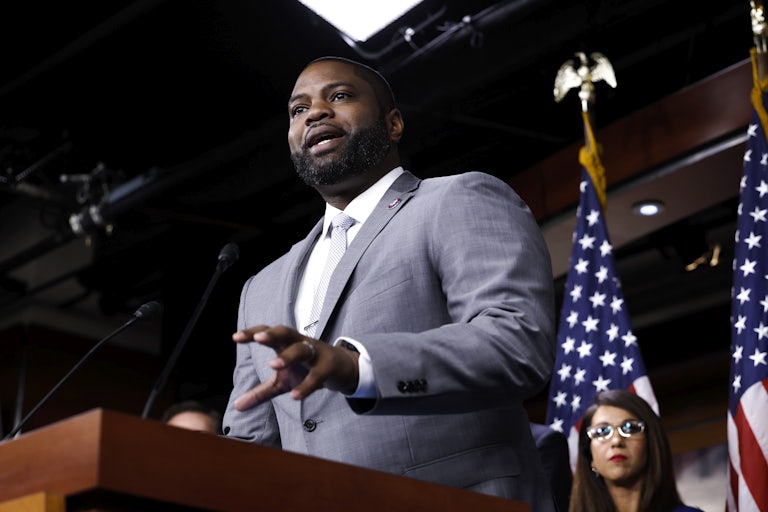
Republican Representative Byron Donalds—the far right’s momentary preferred House speaker choice and onetime candidate for GOP conference chair—believes discussing gun control after yet another mass shooting is getting too “into emotion.”

Donalds made the claim after a school shooting in Nashville, Tennessee, in which three children and three adults were senselessly killed.

“Let’s not get into emotion, because emotion feels good, but emotion doesn’t solve problems,” Donalds told CNN’s Manu Raju.

Volumes could be written about an elected member of Congress chiding people for getting too emotional about six people being shot to death at a school (and the deep impacts that will last for the school, community, and victims’ families and friends).

“People are allowed to possess firearms. Need is in the eye of the beholder,” Donalds said. “I don’t question why you need a blue suit, but you got one. And I know we’re talking about something very, very different, but the Second Amendment allows American citizens to possess firearms,” Donalds continued, advancing the ludicrous analogy anyway.

Note, of course, on the basic level of what one chooses to wear, nudity and public decency laws still place reasonable regulations on how people dress in public. Even in Donalds’s wild analogy, the logic doesn’t hold; and if you were to take into account the levels of scale between apparel choice and possession of machines meant for killing, one would imagine that proportional regulation would severely limit firearm use.

Raju picked up on Donalds’s curious logic, asking the Republican why he wouldn’t support at least limiting access to weapons like the AR-15.

“If you’re gonna talk about the AR-15, you’re talking politics now,” Donalds responded.

It is unclear where the line between “political” and “not political” is in Donalds’s head. Moreover, it’s simply bizarre to make the distinction at all—everything a politician does is definitionally political. Donalds choosing to have no answer about how to stop kids from being shot in schools is just as “political” as him having even the ounce of integrity needed to admit there’s a problem at all.

This leads to the most fundamental point: that politics itself is in fact a good thing. Politics is the exercise of channeling popular will and enacting policy with respect to it. The reason that conservatives so often decry “politics” as a bad thing is because they do not operate in accordance with the democratic will. From seeking to overturn an election in which their preferred candidate lost by seven million popular votes—an effort Donalds was involved in, by the way—to not enacting gun laws supported by upward of 80 percent of Americans, Republicans are not shy about their disdain for doing anything that most people in this country want to happen.

In any other job, such behavior would get you fired; it’s beyond time the same standard is applied here.

Tennessee Shut Down a Red Flag Law That Could Have Stopped the Nashville School Shooting

Law enforcement said there are no laws in the state that would’ve allowed police to take weapons away from the shooter.

BRENDAN SMIALOWSKI/AFP/Getty Images
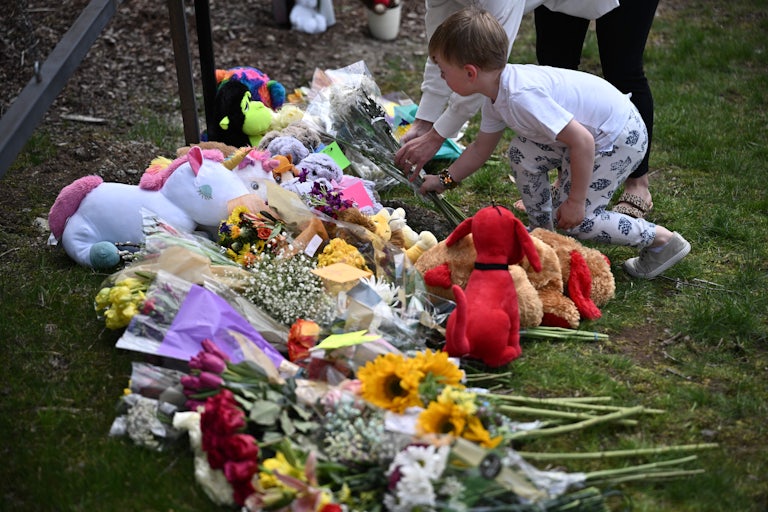
A child leaves flowers at a makeshift memorial for victims by the Covenant School building at the Covenant Presbyterian Church following a shooting in Nashville, Tennessee.

Tennessee lawmakers failed two years ago to pass a red flag gun law that could have stopped the shooter who attacked a grade school in Nashville.

A shooter opened fire at the Covenant School on Monday, killing at least three children and three adults and wounding several others. Police have identified the attacker as Audrey Hale, whom they said was under a doctor’s care for an undisclosed emotional disorder.

Hale was known to be suicidal and had reached out to a former classmate, Averianna Patton, with a suicide note before the attack. Patton tried to contact the police and was told to call the nonemergency number. By the time she got through, it was too late.

Hale also owned seven guns, all purchased legally before the attack, police Chief John Drake said. Three of those guns were used in the school shooting on Monday.

“There’s not a law for” reporting cases like Hale, Drake told a press conference. Had the police known about Hale, “then we would have tried to get those weapons. But as it stands, we had absolutely no idea who this person was or if (Hale) even existed.”

But there could have been a law: A Democratic state senator introduced what’s known as a red flag law in January 2020. The bill would have let family members, household members, intimate partners, or law enforcement officers petition a court to ban an individual who “poses an imminent risk of harm to the person or others” from possessing firearms.

If a judge granted the petition and issued an emergency order, the individual would have 48 hours to hand over any guns they already owned, and they would be prohibited from purchasing more until the order is terminated. But first, they would have to prove in a hearing they are no longer a threat to themselves or others.

Republicans held a supermajority in both the state House and Senate at the time (as they do now), and the bill never made it out of committees. In the years since, they have focused more on trying to curb LGBTQ rights than gun safety.

Following Monday’s tragedy, Tennessee Republicans have decided that there’s simply nothing they could have done differently to prevent the attack.

Josh Hawley, Only Senator to Vote Against Anti-Hate Crimes Bill, Wants to Call Nashville Shooting Hate Crime

Stunning hypocrisy from the Missouri senator.

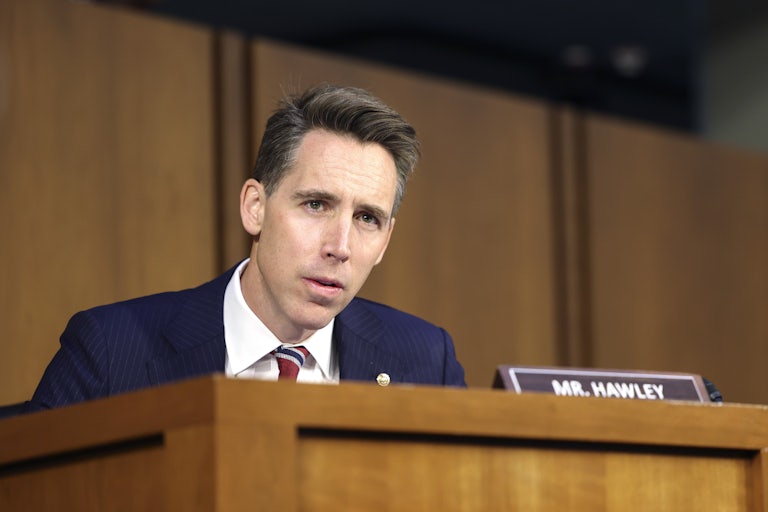
Senator Josh Hawley speaks in a hearing (his nameplate is before him)
Kevin Dietsch/Getty Images
Senator Josh Hawley

In the spring of 2021, Congress passed a bill to support hate crime victims and better prevent and investigate hate crimes. It passed the Senate 94–1; Josh Hawley was the only senator to vote no. Now, he wants to investigate the Nashville mass shooting as a hate crime.

Hawley on Tuesday called the Nashville school shooting a “hate crime” on the basis that it “specifically targeted … the members of this Christian community.” Hawley cited federal law that “prohibits the targeting of violence against any American on the basis of religious affiliation or religious practice or religious belief.”

In other words, Hawley referred to the kind of hate crime guidance that he stood proudly alone in voting against just two years ago.

The difference, of course, is that the 2021 hate crimes bill Hawley voted against focused on the rise in anti-Asian hate since the Covid-19 pandemic. Hawley has similarly not seemed interested in hate crimes when it comes to other communities.  He did not, for instance, make similar calls for hate crime investigations after the May 2022 shooting in Buffalo, New York. That attack was carried out by a white 18-year-old who left behind a manifesto that explicitly laid out the motivations behind his decision to kill 10 Black people at a grocery store.

In the manifesto, the shooter described himself as an ethno-nationalist and white supremacist, voicing support for the vicious “Great Replacement” conspiracy theory that peddles nonsense about a “white genocide.”

After the Buffalo shooting, members of Congress began pushing for a Domestic Terrorism Prevention Act, which sought to establish offices to focus on neo-Nazi and white supremacist terror threats. Hawley stood in full opposition to the bill, calling it the “Patriot Act for American citizens.” (The Patriot Act, a vestige of 9/11, already was policing American citizens, but perhaps Hawley didn’t reflexively think of them as such since they were largely brown men.) And while it’s fair to be hesitant about increasing American policing power, Hawley did not offer any meaningful alternatives to confront white supremacy (nor has he been a critic of law enforcement overreach when it comes to marginalized people anyhow).

No mass shooting should happen, no matter the perpetrator. But instead of aiming to address actual causes of such tragedies, Hawley is, in full view, showing how troublingly inconsistent he is on the issue of hate crimes and violence.

Federal Judge Orders Mike Pence to Testify on January 6 Conversations He Had With Donald Trump

Pence will have to testify in the special counsel case.

Mike Pence
Dia Dipasupil/Getty Images

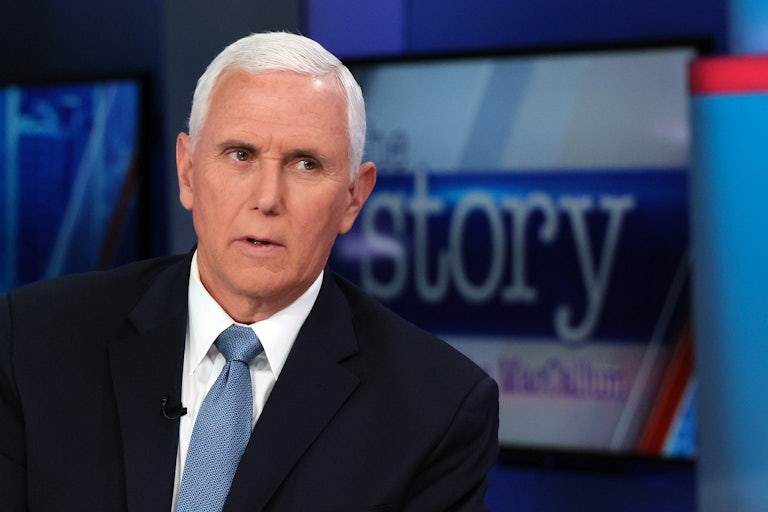
A federal judge has ordered former Vice President Mike Pence to testify in the special counsel investigation into Donald Trump.

Jack Smith was appointed in November as the special counsel to investigate Trump’s role in the January 6 attack and his keeping hundreds of classified documents at his Mar-a-Lago estate. Trump has repeatedly denied any wrongdoing.

Pence, who has previously said he will refuse to testify, can decline to answer questions about his actions during the January 6 insurrection, NBC news reported. He can also appeal the ruling.

The judge’s order, which is still sealed, is a major win for Smith, who has been slowly closing in on Trump and the former president’s inner circle. Smith subpoenaed Pence in early February, which makes sense considering Pence is a key witness to both the events of January 6, 2021, and Trump’s state leading up to them.

But Pence argued that he is protected from testifying by the Constitution’s “speech or debate clause.” That clause’s purpose is to protect members of Congress from having things they say during legislative activities be used against them in lawsuits. Judge James Boasberg of the U.S. District Court in Washington, D.C., ruled Pence does have some limited protections but is not immune from testifying.

Pence has yet to indicate whether he will cooperate with the judge’s order, but he has repeatedly refused to testify in previous January 6 investigations—despite the fact that the rioters wanted to hang him, which Trump reportedly felt was deserved.

The former vice president is reportedly considering running for the top job in 2024, so he has been hesitant to alienate Trump’s base. Testifying against Trump would surely do so.

Trump has also claimed executive privilege in the investigation, but so far, his efforts to shield himself have not been going well.

This story has been updated.