Breaking News
Breaking News
from Washington and beyond

Florida GOP-Controlled Legislature Passes Six-Week Abortion Ban

Florida is one of the last abortion havens in the South. Now a near-total abortion ban is headed to the governor’s desk.

John Parra/Getty Images for MoveOn
An abortion rights activist holds a sign at a protest in support of abortion access on July 13, 2022, in Fort Lauderdale, Florida.

Florida’s House of Representatives passed a bill Thursday banning abortion after six weeks, a measure that will have massive consequences for swathes of the southern United States.

The bill passed by a vote of 70–40, mainly along party lines. It now goes to the desk of Governor Ron DeSantis, who is expected to sign it into law. The measure prohibits abortion after six weeks, before many people even know they are pregnant. It makes exceptions for rape, incest, fetal abnormalities, or to save the life of the pregnant person. However, two doctors have to agree the abortion was “necessary,” and the patient “must provide a copy of a restraining order, police report, medical record, or other court order or documentation proving” they were the victim of rape or incest.

Florida previously allowed abortion up to 15 weeks, making it a major hub for people traveling out of their home state for the procedure. If the bill becomes law, it will cut off abortion access for a majority of the southeastern states.

Several Democrats shared stories of people who had miscarried or been harmed when they were denied an abortion.

“Hearing these stories, it just really brings home how the decisions that we make have an impact,” said Hillary Cassel. “These are the exact scenarios where we are reminded that abortion is health care. That women, as a result of these obstacles being created … are going to die. Women are going to be rendered unable to be have wanted pregnancies in the future.”

House Democrats had proposed nearly 50 amendments aimed at trying to lessen the negative effects of the bill, including striking down the ban entirely, banning state funds from going to clinics run by religious organizations that try to convince people not to get an abortion, and making it easier to prove someone qualifies for an abortion. All of the amendments were voted down.

The bill will also lower the amount of money that the state Department of Health is required to spend on pregnancy and parental support services to 85 percent, down from 90 percent. These services include pregnancy testing, counseling, prenatal classes, adoption education, and material aid such as diapers and formula. Abortion rights advocates regularly point out that states with some of the toughest abortion laws often fail to set up social welfare systems to support children after they are born. People can currently receive such support for up to a year after the child is born. The bill removes that element.

The measure removes the clause that specifically states abortion regulations “may not impose an unconstitutional burden on a woman’s freedom to decide whether to terminate her pregnancy,” specifically stripping away people’s autonomy.

The debate was temporarily delayed when protesters began shouting in the gallery. The House took a 10-minute recess, during which security cleared the gallery and closed doors to spectators. Protesters gathered outside the chamber and were joined by Democratic lawmakers in chanting and singing.

If it becomes law, as it is expected to, the bill will have a significant negative effect across the rest of the South. Florida has become an abortion haven in the region, as many neighboring states have imposed harsher restrictions on the procedure since Roe v. Wade was overturned.

Earlier this month, North Carolina Representative Tricia Cotham changed affiliation to Republican from Democratic, giving the GOP a supermajority in the state, and said she was open to new abortion restrictions. State Republicans introduced a bill in March that defines life as beginning at fertilization and makes it a felony to perform an abortion. Though Cotham hasn’t commented on that specific bill, Republican leaders seem confident they have the votes to pass new anti-abortion legislation. North Carolina is currently another Southern abortion haven. If that bill becomes law, then abortion access will be nearly wiped out for the entire southeastern U.S.
Clarence Thomas Hid Real Estate Deal With Republican Billionaire Megadonor

The Supreme Court justice did not disclose the sales, according to a new report.

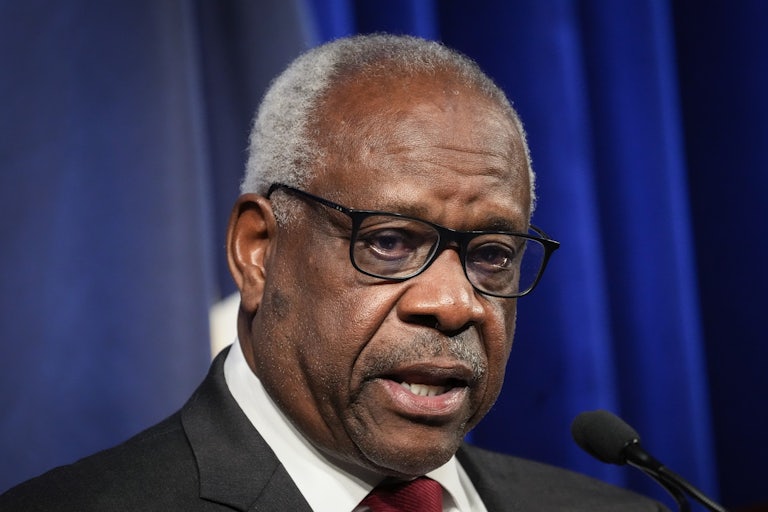
Supreme Court Justice Clarence Thomas
Drew Angerer/Getty Images

Last week, ProPublica revealed that billionaire Republican megadonor Harlan Crow has been secretly showering Supreme Court Justice Clarence Thomas with lavish gifts like island-hopping excursions on massive yachts and on-demand private jet rides—for decades.

Now, the outlet has revealed that Thomas also covertly sold property to the billionaire, including his childhood home where Thomas’s mother continued living as Crow spent tens of thousands in renovations.

In 2014, Crow bought a single-story home and two vacant lots co-owned by Thomas, his mother, and the family of Thomas’s late brother for $133,363. It is not clear whether Crow paid fair market value, but ProPublica noted that Crow had bought a vacant lot and small house on the same block the previous year for a total of $40,000.

Regardless of whether Crow paid extra or not, Thomas did not disclose the sale of any of it. Such a failure appears in clear violation of a federal disclosure law passed after Watergate requiring the disclosure of most real estate sales exceeding $1,000 in value, according to several ethics experts who spoke with ProPublica. This is similar to Thomas’s violation of disclosure laws when it came to the lavish gifts Crow has been giving the Supreme Court justice for decades.

Neighbors told ProPublica Thomas’s mother continues living in the home now owned by Crow. Since his purchase, Crow carried out an array of renovations on the home, including repairing the roof, building a new carport, and adding a new fence and gates.

Crow told ProPublica that he had bought the house in hopes of historical preservation (similar justification, it seems, for the billionaire’s signed copy of Mein Kampf).

“My intention is to one day create a public museum at the Thomas home dedicated to telling the story of our nation’s second black Supreme Court Justice,” Crow said. “I approached the Thomas family about my desire to maintain this historic site so future generations could learn about the inspiring life of one of our greatest Americans.”

ProPublica’s reports last week indicated an appalling financial entanglement between one of the nine most powerful jurists in the country and one of the wealthiest and most politically entrenched individuals in the country. The new report of the undisclosed sale of property shows just how far their entanglements ran.

Florida is Underwater. Where’s Ron DeSantis?

Hint: He is not in Florida.

Chris duMond/Getty Images

Parts of Florida are experiencing the heaviest rainfall in history, and Governor Ron DeSantis is on the scene to help his constituents.

Not really. He’s on a book tour in Ohio.

Fort Lauderdale, in southern Florida, had the rainiest day in its history Wednesday, sparking a flash flood emergency in Broward County, where the city is located. The region got more than a foot of rainfall, but Fort Lauderdale alone got about 26 inches of rain in a 24-hour period. A meteorologist for the National Weather Service described the rainfall as a “1-in-1,000 year event, or greater.”

During a press conference on Thursday, Fort Lauderdale Mayor Dean Trantalis was asked if DeSantis had been in touch with him about the flooding.

“Governor DeSantis has not yet called,” Trantalis said. “I’m not sure what’s going on, but I’m sure he’s very interested in what’s going on here, and we’re happy to work with his office.”

Trantalis said that state agencies were in contact to help with rescue and repair after the flooding.

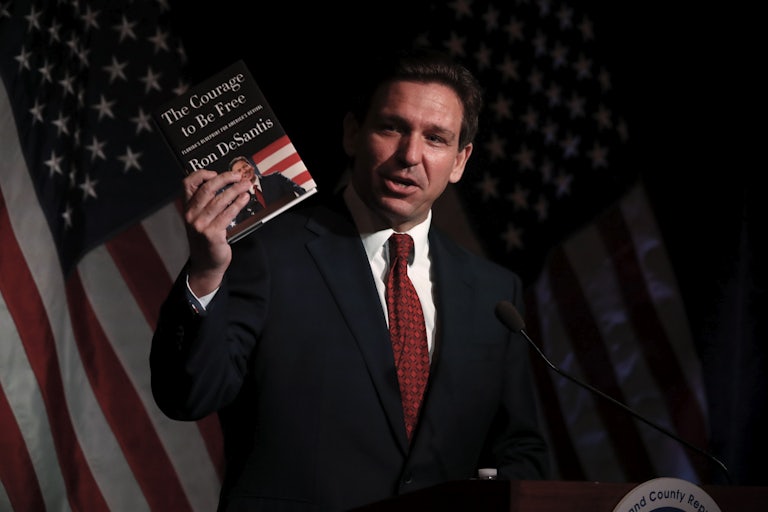
DeSantis, however, is in Ohio. He is the keynote speaker at the Butler County Republican Party’s annual Lincoln Day Dinner Thursday evening, where guests who purchased tables will receive a copy of his new book about how Florida policies can serve as a blueprint for the rest of America.

The Florida governor is expected to announce that he’s running for president in 2024. DeSantis has been stepping up his appearances out of state, and he reportedly has called members of his state’s congressional delegation to ask them to stop endorsing Donald Trump.

The Weird Online Profile of the National Guardsman Arrested for Allegedly Leaking Intelligence Docs

Here’s what we know about the suspected leaker.

DANIEL SLIM/AFP/Getty Images
The Pentagon

Federal investigators on Thursday arrested an air national guardsman suspected of leaking classified intelligence documents about the war in Ukraine.

The man, a 21-year-old named Jack Teixeira, is a member of the Massachusetts Air National Guard’s intelligence wing. He is believed to have shared the documents on a Discord server in early March.

The documents were confirmed to be real, although some were doctored before being posted online. They include information on Russian and Ukrainian strategies and issues in the ongoing war, as well as intelligence on Canada, China, Israel, South Korea, the Indo-Pacific military theater, and the Middle East.

Teixeira shared the documents to a group he led. The other members, about 20-30 of them in total, were mostly young men and teenagers who had bonded during the height of the Covid-19 pandemic over their shared interest in guns, racist memes, and video games.

Four members of the group spoke to The New York Times and insisted that Teixeira, whom they didn’t name, wasn’t a whistleblower. He shared the documents to inform his friends. The leak only gained attention when other members of the group posted some of the documents to a public forum.

The leak is unusual in that it is not as broad in scope as previous ones, such as WikiLeaks or the one orchestrated by Edward Snowden. But the information in the documents is much more timely, which has concerned White House and defense officials.

Some of the documents are less than two months old, and they contain previously unknown details about the state of Ukraine’s army as it tries to fend off the Russian invasion. The documents also revealed new information about how the U.S. gathers intelligence on adversaries and allies alike.

It’s unclear how Teixeira was able to access such highly classified intelligence. A U.S. official, speaking anonymously to The Washington Post, explained that National Guard units sometimes perform support services for active-duty units, including intelligence support for the Joint Staff. If Teixeira performed such support service, he could have been able to get ahold of the documents.

This post has been updated.

Arkansas’s New Law to Save Kids From Social Media Doesn’t Apply to Most Social Media

The law technically makes it illegal for minors to use social media without parental consent, but there are a few big exceptions.

Al Drago/Bloomberg/Getty Images
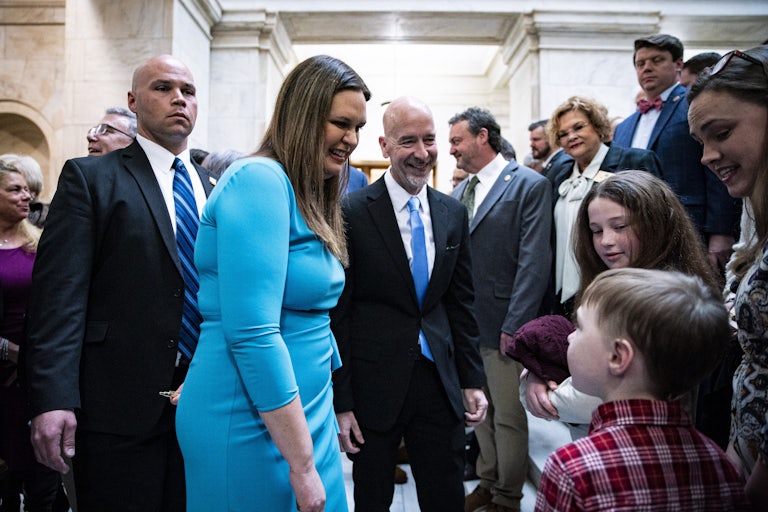
Arizona Governor Sarah Huckabee Sanders

Sarah Huckabee Sanders just made it illegal for anyone in Arkansas under the age of 18 to use social media without consent from their parents. Except, it seems a lot of apps, like TikTok and Snapchat, are exempt.

The Arkansas governor signed the so-called Social Media Safety Act on Wednesday, amid her larger push to “save the children,” marked, for instance, by her bill making child labor easier.

“A social media company shall not permit an Arkansas user who is a minor to be an account holder on the social media company’s social media platform unless the minor has the express consent of a parent or legal guardian,” the bill reads.

Under the bill, which takes effect in September,  all users of a social media app must verify their age by submitting a “digitized” form of identification, like a driver’s license, to the company. If they are proven to be a minor, the company must confirm that the minor has a guardian’s consent.

If the company in question fails to perform proper age verification processes, they would be liable to a $2,500 fee per violation, plus any court costs or attorney’s fees and damages brought by the user and their family if they chose to pursue legal action.

It’s tough talk for a bill that doesn’t actually hold many companies to account, or seek to meaningfully improve young people’s relationship with the online world. Because while it’s difficult to imagine how exactly the bill would be enforced, what’s more difficult is to understand which companies will even be impacted.

The bill has numerous carve outs. Companies that offer “subscription content in which users follow or subscribe unilaterally” or “interacting gaming, virtual gaming, or an online service” (like Twitch or OnlyFans) are excluded. Companies that allow “a user to generate short video clips of dancing, voice overs, or other acts of entertainment” (like TikTok) are excluded. Companies that consist mainly of direct exchanges of messages, photos, or videos (like Snapchat) are exempted. And companies that offer services for K-12 schools or career development services to individuals (like LinkedIn) are excluded.

Moreover, the bill excludes companies that have generated less than $100 million, which would include any number of smaller websites, including far-right platforms like Parler and Truth Social.

Instagram, Facebook, and Twitter appear to be the most prominent websites seemingly not touched by the various exclusions. How exactly the state will work with these companies on an individual basis to set an identity verification process in motion is unclear.

There should be a concerted effort and intentional conversation surrounding the online world and our engagement with it—especially among young people. But Arkansas’s bill is mainly concerned with dictating what websites people under 18 can use without parental consent; there is little attempt to better people’s relationships with the internet more broadly.

In this way, the bill is almost a perfect embodiment of conservative governance: purporting to “empower” personal choice of children and families by instead limiting civil liberties—and then offering no material support to help either with, or after, that “personal choice.”