Breaking News
Breaking News
from Washington and beyond

South Carolina Abortion Bill Loses Co-Sponsors After Death Penalty Backlash

Palmetto State women may soon be free of the fear of execution, as a treat.

Sean Rayford/Getty Images
An abortion rights demonstrator holds a placard expressing her opinion outside the South Carolina Statehouse.

South Carolina Republican lawmakers are backpedaling away as fast as possible from a bill that would make abortion punishable by the death penalty, one of the strictest anti-abortion measures that has been proposed since the Supreme Court issued its ruling in Dobbs v. Jackson Women’s Health Organization last year.

The South Carolina Prenatal Equal Protection Act, which was introduced in mid-February, would have established that human life begins at fertilization. It further held that an abortion could be considered a homicide. In South Carolina, a person convicted of murder is subject to the death penalty or a minimum of 30 years in prison.

But the bill has become too hot for even some of its supporters to handle. Of the bill’s 24 original co-sponsors, nine have yanked their support in the past few weeks, following a massive outcry on social media. Several explained they did not want to criminalize people who get abortions. One, Representative Brandon Guffey, claimed he had not read the bill thoroughly before signing on.

“I did not read into the bill far enough to be aware that it included death penalty,” he said in a Facebook post. “I read through it, but I did not click on the code that it linked to stating that a woman should get the death penalty.”

Guffey pulled his name from the list of sponsors on Thursday. In his Facebook post, he explained he is “pro life but that includes the life of the mother.” He also said he supports other bills that restrict abortion access in South Carolina.

The Prenatal Equal Protection Act has yet to be considered by a committee, but one representative told NBC News that party leadership had made clear the measure was “dead on arrival” and would never make it to the House floor. Republican Senator Shane Massey, the Senate majority leader, also tweeted last week the bill had “zero chance of passing.”

South Carolina currently allows abortion up to 20 weeks; Republicans in the state have tried repeatedly since Roe v. Wade was overturned to cut back access to the procedure. The state Senate passed a bill in February that banned abortion after six weeks, before many people even know they are pregnant, but included exceptions for rape, incest, fatal fetal anomalies, and the pregnant person’s life—up to a generous 12 weeks.

Republican-led states have been rushing to restrict abortion access since the Supreme Court rolled back the nationwide right to the procedure. Some states seem to be competing for who can pass the strictest measures, while others are trying to actively circumvent the will of the people in banning abortion.

That this draconian South Carolina bill is shuddering slowly to a halt is a welcome development, but it’s also a pretty grim reminder of how low the bar has become that “not sentencing people to death for getting a normal medical procedure” is good news.
California Will Cut Insulin Costs by 90 Percent, Capping Price at $30

“People should not be forced to go into debt to get lifesaving prescriptions,” said Governor Gavin Newsom.

Francine Orr/Getty Images
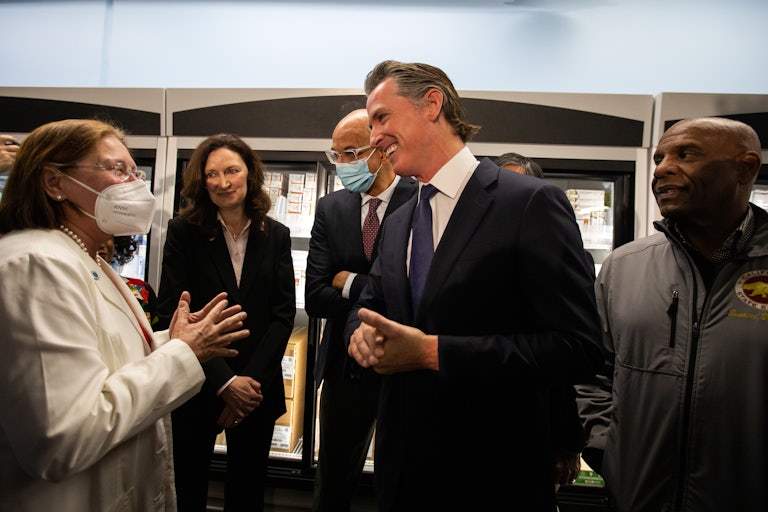
Dr. Tanya Spirtos, president-elect of the California Medical Association, speaks with Governor Gavin Newsom following a press conference. Newsom just announced that the state has landed a contract with a company to produce insulin.

California will cap costs for insulin at $30, and it will begin manufacturing Naloxone, a nasal spray that helps reverse opioid overdoses.

Governor Gavin Newsom broke the news on Saturday, announcing that the state struck a contract with manufacturer CIVICA to make 10 milliliter vials of insulin that can cost up to $300 available to California residents at $30.

“People should not be forced to go into debt to get lifesaving prescriptions. Through CalRx, Californians will have access to some of the most inexpensive insulin available, helping them save thousands each year,” said Newsom.

CIVICA, a nonprofit generic drugmaker, aims to combat drug shortages and price spikes by producing generic medicines that are more affordable and accessible. The company is backed by various insurers, philanthropies, and—as in its deal with California—state partnerships.

Coupled with his insulin announcement, Newsom detailed his Naloxone policy as part of a broader “master plan” to tackle the fentanyl and opioid crisis, which includes a “crackdown” on drug trafficking and efforts to “raise awareness.” Newsom’s proposed 2023 budget includes $79 million to further distribute Naloxone and another $4 million to make fentanyl test strips more widely available. These millions don’t include Newsom’s plans to begin manufacturing the Naloxone nasal spray in-state. California’s Health and Human Services Agency is working with CIVICA to find a suitable manufacturing facility, according to a release.

Newsom’s moves follow news that pharmaceutical company Eli Lilly will cap its insulin costs to $35 per month. Naturally, these are consequential changes for many people who rely on this drug. But insulin does not, in fact, cost enough to be priced at $300 in the first place—or perhaps even at $35. As Charlotte Kilpatrick noted in these pages, it is peculiar that the fates of millions of patients’ lives and bank accounts are up to the whims of pharmaceutical companies at all—especially in America, where people pay an average of 256 percent more for medication than people in 32 other Organization for Economic Co-operation and Development countries.

Moreover, if Newsom could move beyond a partnership to a fully state-owned manufacturing apparatus, he could guarantee a roughly $10 cost for insulin. At the moment, however, this is an important measure of relief coming for thousands of Californians—and Newsom’s decision may spark further rethinking about how much insulin, as well as health care more generally, should cost in this country.

Biden Vetoes Anti-ESG Bill, Accomplishing the Barest of Minimums for Climate Change

The president nixes GOP legislation that would have thrown a barrier between investors and their money managers.

Anna Moneymaker/Getty Images

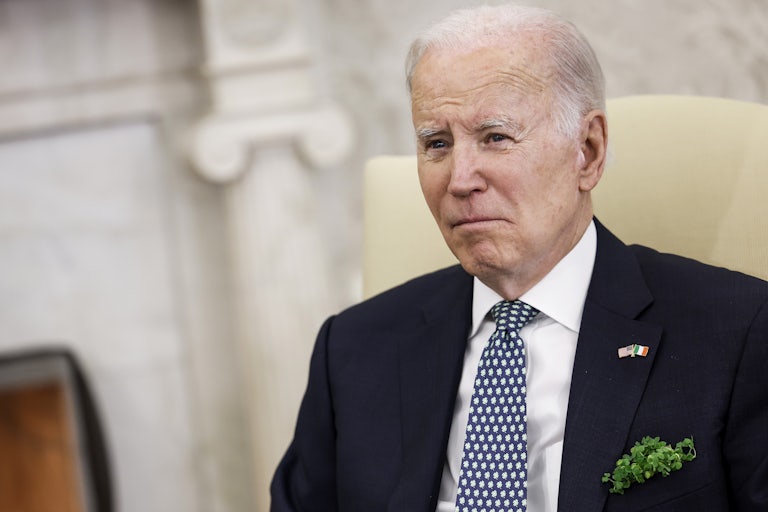
On Monday, Biden issued his first veto since taking office, shutting down a narrowly passed Republican bill that would have stopped the administration from simply encouraging money managers to consider climate change when making investment decisions for their clients.

Biden’s Department of Labor issued a rule toward money managers, stating they could weigh climate change and other environmental, social, and governance, or ESG, factors as they handled retirement investment portfolios. Biden’s rule overturned a rule made under Trump that limited the ability of managers to consider such factors; Biden’s rule, while encouraging managers to consider ESG, still mandates that managers operate in the best interest of clients. So the rule at its core was just a suggestion—a directive that the government welcomes even the appearance of capital being directed toward more ethical destinations so long as fiduciary obligations to investors are met.

Republicans, buttressed by their cause to include everything that remotely seems related to racial, social, or environmental justice in their broader war on “wokeness,” have since attached ESG to their broader onslaught on what they oxymoronically refer to as “woke capitalism.” The House voted 216–204 to roll back the rule, and Democrats Joe Manchin and Jon Tester subsequently joined Senate Republicans to pass the adjoined Senate resolution to overturn the rule.

Biden’s veto comes on the same day that the United Nations Intergovernmental Panel on Climate Change, or IPCC, released its report issuing a warning about the world being on the final brink of a point of no return in locking in a too-high global temperature increase. One of the myriad solutions the IPCC noted was a redirection of capital from fossil fuels to climate mitigation and environmental protection.

At the same time, it’s worth noting that “sustainable investing” is not even close to what’s needed to address climate catastrophe. The practice, at best, redirects funds that would’ve gone to fossil fuel firms and the like, potentially paving the way for consequential innovation that might help green the economy. It is perhaps more realistic to refer to the practice as a marketing tool—a flimsy label companies can use to greenwash their practices. So while the Republican onslaught against ESG could be seen as conservatives not even wanting the bare minimum in taking on climate change, their actions can also be viewed as a means of hyperfixating on a relatively inconsequential solution to climate change in order to distract from the deeper debates over climate mitigation, as well as the tougher policy choices that need to be made.

Missouri Becomes Latest State to Attempt a Ban on Gender-Affirming Care

The state’s attorney general pulled the trigger on an emergency order despite the fact that the legislature is currently debating a bill.

Valerie Plesch/Getty Images
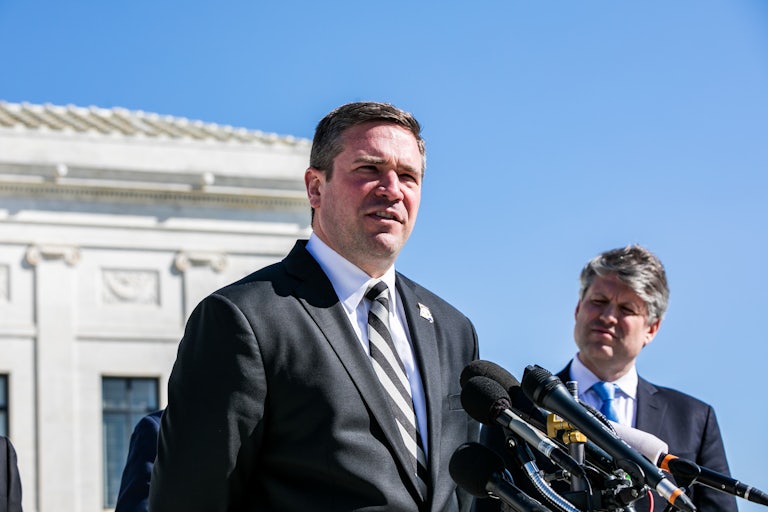
Missouri Attorney General Andrew Bailey

The Attorney General of Missouri issued an emergency regulation Monday banning gender-affirming care for minors, skipping over the legislative process in a massive power grab.

The Missouri state legislature is already considering a bill that would ban certain medical procedures, including puberty blockers and hormone therapy, for transgender Missourians under the age of 18. Monday’s emergency regulation by Attorney General Andrew Bailey would effectively ban such care until the bill passes or fails.

The regulation claims that “because gender transition interventions are experimental, they are covered by existing Missouri law governing unfair, deceptive, and unconscionable business practices, including in administering healthcare services.”

The measure requires an 18-month waiting period before starting care, during which potential patients must be screened for “mental health comorbidities” and autism. The text also describes questions about gender identity as a “social contagion,” the idea being that young people are only questioning their identities because they see other people do it, not because they might have an authentic reason to do so.

“As Attorney General, I will protect children and enforce the laws as written,” Bailey said in a statement. “I am dedicated to using every legal tool at my disposal to stand in the gap and protect children from being subject to inhumane science experiments.”

The cruel irony, of course, is that providing gender-affirming care to trans and nonbinary teenagers decreases the amount of depression and anxiety they feel. It also makes them less likely to consider suicide. Moreover, targeting LGBTQ people through legislation, as many Republicans are doing across the country, only demonizes the community and puts them at an increased risk of violence.

Reporter and trans rights activist Erin Reed slammed Bailey’s measure as a “power grab,” and pointed out that many mental health issues could be solved simply by providing gender-affirming care.

Howard Schultz Will Step Down From Starbucks to Spend Less Time Getting Owned by Union Organizers

His decision to end his third stint running the coffee chain comes days before he is expected to testify before a Senate committee.

Melina Mara/Getty Images
Starbucks CEO Howard Schultz drinks an espresso.

Turns out the third time is not the charm for Starbucks CEO Howard Schultz, who announced Monday that he was stepping down two weeks early from the helm of the coffee chain.

Schultz began serving his third term as Starbucks chief last April and was due to finish on April 1, 2023. He had served as the company’s CEO twice before, from 1986 to 2000 and again from 2008 until 2017. He briefly flirted with the idea of running for president before returning to Starbucks for what he said would be his last time.

Schultz spent the majority of his most recent tenure trying to thwart Starbucks’s nascent union organizing drive and attempting to pivot to non-fungible tokens several months after everybody else. His announcement also comes a little more than a week before he was due to appear in front of a key Senate labor committee.

“As I turn Starbucks over to you now, know that you have my utmost confidence, trust and love. You are all the future of Starbucks,” Schultz said in an open letter to the company’s other leaders.

“The world needs Starbucks—and Starbucks needs all of you,” he added, which is an objectively weird thing to say about a coffee company.

Schultz had come under intense scrutiny during his third stint as CEO for alleged union-busting tactics. At least 420 Starbucks locations nationwide have launched unionization efforts, 285 of which were successful. Another 40 elections are ongoing.

Over the past year, Starbucks has shuttered multiple locations, some of which were either unionized or reportedly forming a union. The company fired more than 100 union leaders, some of whom were reinstated only after a federal judge ordered Starbucks to do so. And when Starbucks representatives finally met with union members in October, after months of delays, they walked out after just a few minutes because they disliked that some union members had called in over Zoom.

Senator Bernie Sanders called earlier this month for the chamber’s Health, Education, Labor and Pensions Committee, which he chairs, to vote to subpoena Schultz over the union-busting allegations.

“The National Labor Relations Board (NLRB) has filed over 75 complaints against Starbucks for violating federal labor law and there have been over 500 unfair labor practice charges lodged against his company,” Sanders said in a statement at the time.

“A multi-billion dollar corporation like Starbucks cannot continue to break federal labor law with impunity.”

Schultz agreed to testify less than a week later, before the vote was held. He will still have to appear in front of the committee, even though he is no longer Starbucks’s CEO.