Breaking News
Breaking News
from Washington and beyond

Mike Pence Announces 2024 Bid, With No Mention of Man Who Wanted Him Hanged

Pence is attempting to win the Republican nomination without talking about Donald Trump, apparently.

George Frey/Getty Images

Mike Pence is running to become the presidential candidate for the party that almost led to his execution.

The former vice president made it all official Wednesday with a video announcement that did not once mention Donald Trump or January 6.

Instead, he warned about the Biden administration and the dangers of the “radical left.”

It’s hard to pin down exactly why so many Republicans think they can win this primary, but the more Republicans who run, the more Trump can coast through a divided primary. As with Ron DeSantis, or Chris Christie, or Vivek Ramaswamy, or Tim Scott, or Nikki Haley, or Insert Former Trump Fan Afraid to Criticize Here, it’s difficult to understand the case for most of the candidates. And Pence is really no exception.

Pence is not exactly the most charismatic type; like DeSantis, Pence has had his robotic moments. His big plan to overcome this, and to win the election, is to reportedly put together a “Reagan coalition” consisting of the Christian right, fiscal conservatives, and national security hawks. How those numbers can grow to any substance is hard to say.

The Christian right, if they are to be distinguished at all by one issue alone, may very well vote for the president who has already stacked a court that banned abortion. Fiscal conservatives, if their only real concern is cutting taxes for the wealthy, will have their pick of Republican candidates. And the same goes for national security hawks, who have a whole roster of candidates ready to make them feel warm inside about selling more bombs and destabilizing more of the world.

The math just doesn’t math.

If there is a story for Pence to embrace, at least to potentially rise above the slew of candidates who will likely remain at 5 percent or lower, it’s of actively resisting Trump’s efforts to subvert democracy. But if his campaign announcement Wednesday is any indication, that isn’t in the cards.

Pence hasn’t completely shied away from condemning Trump for his role in inciting the January 6 attacks on the Capitol in the past. “President Trump was wrong; I had no right to overturn the election. And his reckless words endangered my family and everyone at the Capitol that day. And I know that history will hold Donald Trump accountable,” he said in March.

In his memoir released last year, Pence attacked Trump for his handling of the 2017 neo-Nazi march in Charlottesville, the investigations into Russian election interference, and both impeachments he faced.

Still, Pence also wrote of a heartwarming moment in which he told Trump he was “never gonna stop praying” for him. Trump, Pence wrote, smiled back, saying, “That’s right—don’t ever change.” And it seems that nonconfrontational strategy is the one Pence is choosing to lead his campaign with.

Pence’s trepidation about fully committing to going full-steam on a man he is actively trying to beat in an election won’t hold for much longer. There are two roads ahead: one where Pence will certainly lose if he sticks to being wishy-washy on Trump (e.g., by calling his indictment “political persecution”) or one in which he will probably lose, by claiming his own lane as the man who actually stood up to Trump when it counted. Few, if any, candidates in the race can say that.

Give it a go, Mike! One might suggest you have nothing to lose but your pride, but pretty much every Republican running for president has already lost that too!

Democratic Congresswoman Rips Anti-Trans GOP Witness: “Do You Actually Believe This Garbage?”

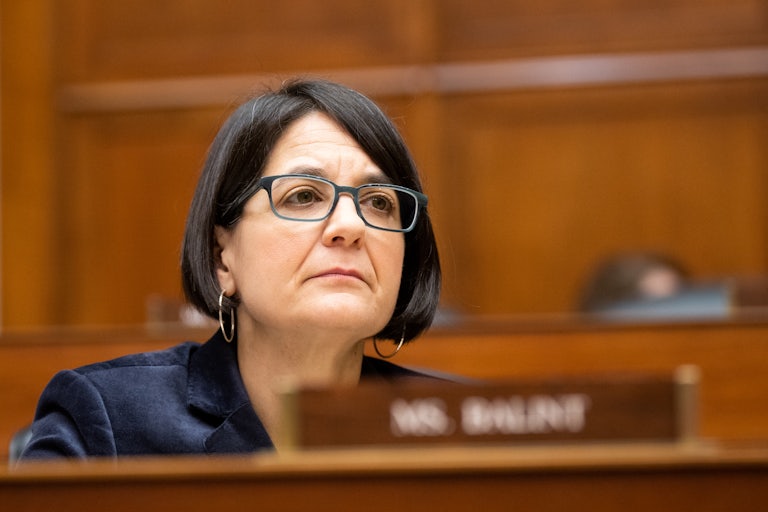
Becca Balint is tired.

Bill Clark/CQ-Roll Call, Inc/Getty Images
Congresswoman Becca Balint

Vermont Representative Becca Balint absolutely destroyed a witness for unnecessarily bringing up transgender rights during a House Oversight Committee hearing on Tuesday.

The committee held a hearing on the effects of environmental, social, and corporate governance, or ESG, one of Republicans’ latest manufactured culture wars. ESG is a framework that helps investors understand how an organization manages risks and opportunities regarding sustainability issues, including environmental protection, impact on society, and aligning corporate and stakeholder goals.

At one point, Balint asked witness Mandy Gunasekara about her claim that ESG promotes forced gender transition for children. “I want to know, do you really believe that garbage?” asked Balint, who is the first woman and openly LGBTQ lawmaker to represent Vermont.

Gunasekara, who served in the Environmental Protection Agency under Donald Trump, insisted that her claim was “fact” and accused people who support gender-affirming care of “beating up on children.”

Balint hit back, saying that not 30 minutes prior, she had heard from parents of trans children who live in states that have banned gender-affirming care for minors. “They literally said, ‘When you leave this room, could you please—the next time you’re in a room with someone bringing up, yet again, our children and our families as some kind of bogeyman, that you actually stand up for us?’” Balint said. “I didn’t know I would have such an opportunity!”

“It feels like every single hearing that I am in, whether it is in Oversight, or whether it is in Budget, or whether it is in a subcommittee, somehow the witnesses find a way to bring in trans children into whatever conversation we’re trying to have here.”

While trans health care and ESG have nothing to do with each other, both are important policies that have become unnecessarily politicized. ESG is beneficial for both the environment and corporations, and gender-affirming care is proven to help reduce levels of anxiety, depression, and suicidal thoughts in LGBTQ people.

House Conservatives Cut Off GOP Bill to Spite Their Own Speaker

A symbolic bill on gas stoves flamed out because of conservative anger at McCarthy over the debt ceiling deal.

Tom Williams/CQ-Roll Call, Inc/Getty Images
Representative Matt Gaetz

A crew of conservative Republicans, still stewing over debt ceiling legislation negotiated by Speaker Kevin McCarthy and President Joe Biden, demonstrated their ire on Tuesday by blocking a Republican bill from a full House vote.

“We warned them not to cut that deal without coming down and sitting down to talk to us,” Representative Chip Roy told reporters after the vote. “So this is all about restoring a process that will fundamentally change things back to what was working.”

Twelve Republicans voted against the rule that would have established the terms of the floor debate for a bill to prevent gas stoves from being banned, joining all Democrats in voting against it. The House cannot consider a bill without first adopting a rule, which establishes the terms of the floor debate, including how long it will transpire and whether and how the bill being considered can be amended. House rules are generally party-line votes (the rule for the debt ceiling bill was a rare exception), meaning that with such a narrow GOP majority, a few recalcitrant Republicans could gum up the works. The last rule vote that failed occurred in 2002. (The good news for gas stoves’ would-be defenders is that leadership may bring up a motion to reconsider the rule to allow floor debate and a vote on the bill.)

The conservative dissenters griped that Republican leadership backtracked on bringing up an unrelated bill by Representative Andrew Clyde, a Freedom Caucus member, which would repeal an administration regulation on pistol braces. (Clyde himself did not vote against the rule, and told Politico that he believed his bill would come to the floor next week.) But while their frustration over the apparent snub to Clyde may have been the precipitating factor, the conservative anger with McCarthy and Republican leadership traces to their debt limit deal opposition.

“We’re concerned that the fundamental commitments that allowed Kevin McCarthy to assume the speakership have been violated as a consequence of the debt limit deal,” Representative Matt Gaetz, who voted against the rule, told reporters.

Conservatives insist that McCarthy violated promises he made when courting them to become speaker in January, when he underwent 15 grueling votes to earn the position. “I need him to abide by the promises he made when he was first elected speaker,” Representative Ken Buck said. Buck said that while McCarthy had promised to cut government spending to fiscal year 2022 numbers, the debt ceiling agreement capped it to fiscal year 2023 numbers. Although that bill has been signed into law, Buck insisted that spending cuts should be addressed in upcoming appropriations legislation.

It was initially unclear whether conservatives will block future rules. Representative Dan Bishop said that he didn’t see any “particular pattern” going forward. “There’s no decision about rules [yet], but the problem that has been precipitated entirely by the speaker’s approach to the debt ceiling package is going to have to be dealt with,” Bishop said.

The debt ceiling deal’s success last week, including conservatives backing down from a threat to try to topple McCarthy, appeared to indicate that the speaker had a firm grip on his conference. The rule failure, however, demonstrates that there are still ways for hard-liners to make trouble for McCarthy. He may not lose his position, but his inability to control the fate of a slam-dunk GOP messaging bill is a loss in itself.

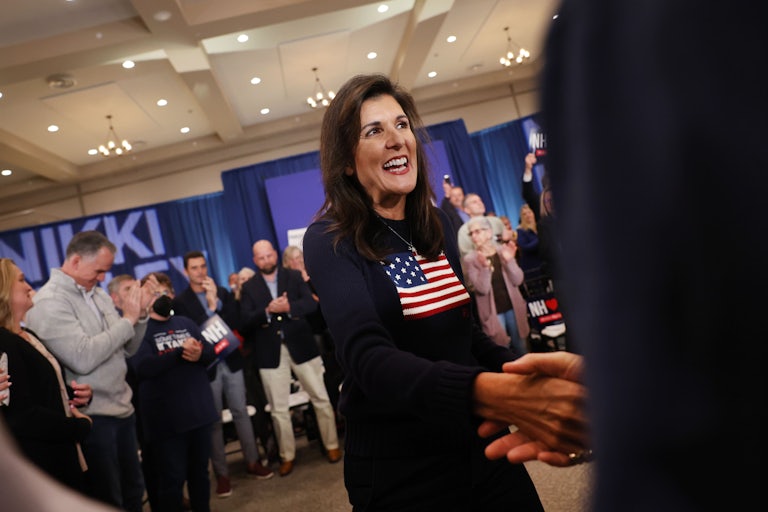
No One Watched Nikki Haley’s CNN Town Hall

The ratings are in, and they’re embarrassing for someone who says she’s a strong contender to Trump.

Spencer Platt/Getty Images

CNN continues to let Republicans come on the air and push extreme views and falsehoods. And people continue not to watch.

The network hosted presidential hopeful Nikki Haley for a town hall on Sunday. During the 90-minute event, she advocated for the use of “bulletproof tape” to tackle gun violence, said women who get abortions shouldn’t be executed, and called transgender girls playing girls’ sports “the women’s issue of our time.”

But no one was interested in what she had to say. Just 562,000 people tuned in to watch Haley. In comparison, when CNN had a town hall with Donald Trump—whom Haley says Americans are tired of—nearly six times as many people watched, for a total of 3.3 million viewers.

And that audience size pales in comparison to what Trump could bring in at his peak. Almost 71.5 million people watched him win the 2016 election. In 2020, an average of 21.6 million viewers watched the Republican National Convention—far fewer than the previous election, but still miles away from his CNN event.

It’s an embarrassingly low number for Haley, who is trying to position herself as a new direction for the Republican Party, away from Trump. But it would seem that people are still more interested in him than they are in her.

Of course, neither of them could beat the viewership record at CNN. The network hosted a town hall with President Joe Biden in 2020, which brought in 3.47 million viewers—the most for a single-candidate town hall to date.

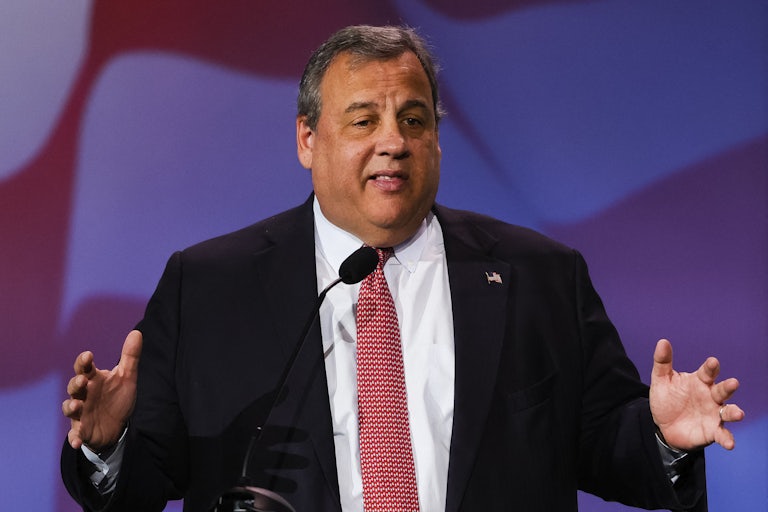
Chris Christie Launches 2024 Run in Bridge to Nowhere

The former New Jersey governor seems to think he can be president.

WADE VANDERVORT/AFP/Getty Images

Former New Jersey Governor Chris Christie on Tuesday formally filed paperwork for his presidential run, hoping that he can bridge the gaping political divide in the United States.

Unfortunately, we’ve been here before, and it’s unlikely that Americans are going to want to go any further down this bridge to nowhere.

Christie ran for president in 2016 but flamed out spectacularly in the New Hampshire primary. He had taken multiple attacks from Donald Trump up until that point, but apparently it was all water under the bridge, as Christie threw whatever clout he had behind Trump.

Christie worked fairly closely with Trump throughout his presidency and on his failed 2020 reelection campaign. He finally broke with Trump when the former president refused to accept the election results, which was apparently a bridge too far. Christie has since been vocal in opposing Trump and may make that criticism a central tenet of his campaign, though it remains to be seen.

During his two terms as New Jersey governor, Christie seemed to take nothing but political beatings. The trouble began in 2012, when fellow Republicans accused him of getting too close to then-President Barack Obama during the aftermath of Hurricane Sandy.

The following year, two of the three lanes of the George Washington Bridge connecting New York and New Jersey were shut down for several days. Christie was accused of ordering the lane closure, which came to be known as Bridgegate, to create traffic jams and punish a local Democratic mayor who didn’t support him.

All of these scandals took a real toll on Christie’s popularity. By 2016, he had the lowest approval rating of any Garden State governor in 20 years. That wasn’t helped when, the following year, New Jersey suffered a government shutdown. State parks and beaches were closed as a result of the shutdown, but Christie took his family to the beach for July 4, an outing that came to be known as Beachgate.

And of course, there is Christie’s bizarre and unrequited fanboy love for Bruce Springsteen, who called out Christie for his financial policies and for Bridgegate, and reportedly said Christie was not allowed to use any Springsteen songs on his campaigns.

Christie is, to his credit, one of the few Republican lawmakers actually willing to call Trump out for his actions. But it’s unclear whether Christie actually has enough political pull to do some damage during the race. You could say let’s cross that bridge when we get there, but a Monmouth University poll published at the end of May found that only 21 percent of voters have a favorable view of him, while 47 percent view him negatively.