Breaking News
Breaking News
from Washington and beyond

Watch Mike Pence Get Black Woman’s Name Wrong and Mechanically Reboot

This right here is 2024 material, folks!

John Lamparski/Getty Images

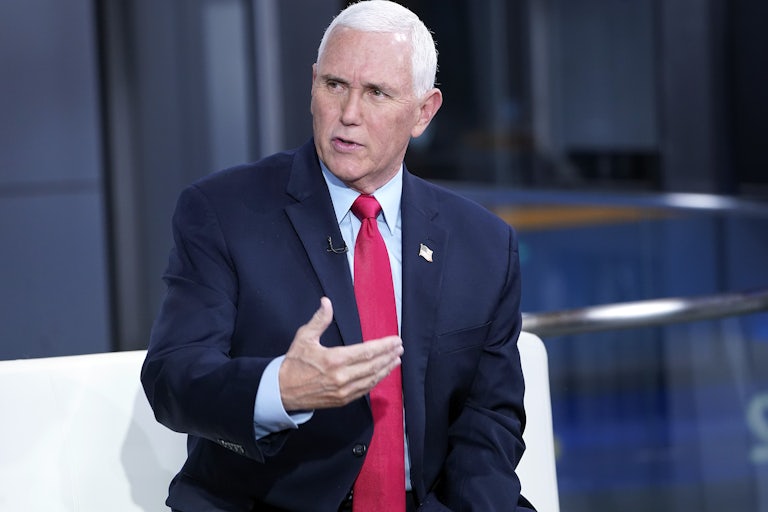
Former Vice President Mike Pence appeared at a CNN town hall on Wednesday night to discuss a lot of things—like his new book, his opinions on Donald Trump’s 2024 bid, the January 6 attack on our democracy.

But one clip caught the attention of the internet.

In a repeat of flygate—an uncomfortable two minutes of Pence seemingly unaware of a fly nesting on his head during a vice presidential debate—we have received even more evidence of Pence’s robotic nature.

At the town hall, a Black woman named Andrea Barber-Dansby asked Pence a question.

“Barbara, thank you. I represented Madison County in Congress for many years,” Pence starts with a grin.

“Andrea,” Barber-Dansby interjects with an admirably patient smile.

“It’s nice to see you,” Pence responds, as if he’s starting an entirely different conversation. He then takes a shockingly long pause, not unlike an automaton rebooting:

Pence’s town hall came amid his ongoing effort to both express disapproval for Trump yet still maintain favor with the GOP, while he sets the ground for his own potential 2024 candidacy.

We don’t know for sure whether Pence is even running. But robotically malfunctioning and struggling to remember someone’s name (and not even apologizing for it!) on live television is maybe not the best soft launch for a campaign. Rest assured, if Pence does proceed to run, we’ll likely see many more instances showcasing the kind of charisma and presence only a real human could display.
Mike Pence: January 6 Was “Most Difficult Day” of My Life, and Also I Won’t Testify

Pence admitted his family was in danger that day thanks to Trump, but he still won’t cooperate with the January 6 committee.

John Lamparski/Getty Images

Mike Pence has made his stance clear: January 6 was one of the most harrowing days of his life, and also he will not cooperate with investigations of the attack.

Speaking in a CNN town hall Wednesday night, Pence told Jake Tapper that the January 6 riot was “the most difficult day of my public life.”

He explained he certified the votes for President Joe Biden—against the wishes of former President Donald Trump, who continues to falsely insist the 2020 election was rigged against him—because his main loyalties are to his God and the U.S. Constitution.

Pence also condemned Trump’s actions that day, although he stopped short of explicitly placing the blame for the riot with his former boss. “The president’s words and tweet that day were reckless,” Pence said. “They endangered my family and all the people at the Capitol.”

But, somewhat bafflingly, Pence also said he will not testify before the House January 6 committee. He argued that a congressional committee summoning a vice president would violate the separation of powers, and besides, Congress has “no right” to his testimony.

He expanded on that in an interview with CBS, explaining, “I must say … the partisan nature of the January 6 committee has been a disappointment to me.”

The committee hit back at Pence, accusing him of trying to drum up press for his forthcoming memoir. “It is disappointing that he is misrepresenting the nature of our investigation while giving interviews to promote his new book,” committee Chair Bennie Thompson and Vice Chair Liz Cheney said in a statement.

Representative Adam Kinzinger, also a committee member, took particular offense with Pence’s comments, accusing him of waffling on his duty.

Pence’s interviews come just a few days after Trump announced a third run for president, but Pence is reportedly considering making a bid for himself.

If so, then his wishy-washy stance makes sense: In both the interviews and his new book, he sought to distance himself from Trump—a bid to moderates and independents—but stopped short of agreeing to actively work against the former leader, risking alienating Trump’s rabidly loyal fan base.

Latest on the House: Here Are the Democrats’ Remaining Best Shots

Republicans have a narrow majority in the House, but there are still a few races left in this election.

Anna Moneymaker/Getty Images

Republicans finally clinched control of the House of Representatives, more than a week after Election Day, but it does not necessarily signal the end for Democrats.

The GOP reached the 218-seat threshold for a majority Wednesday night, but it is still a fight to the finish for the remaining six seats. Democrats hold 211 seats, and The New York Times predicts they will easily take two more with Mary Peltola in Alaska and Katie Porter in California.

Republicans are likely to get two more seats in California, and the last two seats are still too close to call, even with more than 90 percent of the votes counted. One of those races is Colorado Representative Lauren Boebert, a Trump-backed election denier who was initially expected to easily win her race.

Either way, the GOP’s majority will be only a handful of seats—a far cry from the overwhelming “red wave” they had predicted before the midterms.

The question for Republicans now is whether they can stay unified in order to advance their agenda, namely blocking President Joe Biden’s agenda and launching a slew of rather petty investigations into policies they don’t like.

But it’s unclear if Representative Kevin McCarthy, who was nominated the party’s House leader, will be able to pull that off. He faced multiple opponents to his nomination and did not have a unanimous vote in his favor.

Democrats, meanwhile, have kept control of the Senate, and they might still have a chance of passing measures in the House if they are willing to deal with more moderate Republicans.

Nebraska Republican Representative Don Bacon warned CNN, “I perceive that there’s a small group that is trying to put us in gridlock.” He has already said he is willing to work with Democrats to avoid a deadlocked House and even find someone more centrist (than McCarthy) for speaker.

At Least 32 Trans People Have Been Killed So Far This Year

The real number is likely far higher, according to a new report from the Human Rights Campaign.

Vuk Valcic/SOPA Images/LightRocket/Getty Images

At least 32 transgender and gender-nonconforming people have been killed this year, the Human Rights Campaign said in a report published Wednesday, a few days before Transgender Day of Remembrance.

The HRC said that the toll could well be higher because anti-trans violence is often misreported or unreported altogether. Almost all the victims listed in the report are people of color.

While the details of these cases differ, it is clear that fatal violence disproportionately affects transgender women of color—particularly Black transgender women,” the report said.

The data does not include people who died by suicide.

The toll is lower than the year before, which saw at least 57 trans and nonbinary people killed. But it comes amid a raft of anti-trans legislation throughout the United States.

State governments, particularly in Republican-led areas, have passed legislation seeking to ban trans girls from playing on girls’ sports teams and prevent gender-affirming care in hospitals.

Virginia Governor Glenn Youngkin unveiled a policy in September that requires trans and nonbinary students to get permission from their parents to use their correct pronouns or gendered bathrooms. Even if parents grant that permission, school faculty and staff can still refuse to honor a student’s gender.

Ohio’s House passed a bill in the spring prohibiting trans women and girls from playing alongside cisgender women and girls. The bill had originally included a horrifying measure that would require anyone suspected of being trans to undergo a genital inspection.

That portion was eventually removed from the bill, which could go before the state legislature for a final vote before the end of the year.

And Florida passed a law in March, nicknamed the “Don’t Say Gay” law, that banned discussing sexual orientation or gender identity in the classroom.

Congress Just Passed a Bill to Limit Sexual Harassment NDAs. 109 Republicans Voted Against It.

The Speak Out Act had already passed unanimously in the Senate.

Anna Moneymaker/Getty Images

On Wednesday, the House passed the Speak Out Act, legislation that prohibits the use of nondisclosure agreements, or NDAs, in cases of workplace sexual harassment or sexual assault. In other words, the bill empowers victims to speak out, share their stories, and seek justice without fear of retaliation for breaking previously signed NDAs.

The House passed the act 315–109—a decent showing of bipartisanship, yet a glaring mark on the 109 Republicans who voted against it. Over half the House Republican caucus voted against the bill, while the Senate passed it with unanimous consent in late September.

Thwarting the use of NDAs is important, as they have been weaponized to bind victims from speaking out against abusive employers or workplace superiors. That prevents victims from stopping potential future harm from being inflicted upon colleagues. Gretchen Carlson and Julie Rognisky, former Fox News employees and advocates for the bill, are familiar with this dynamic. Both bound by NDAs, the pair filed lawsuits against late Fox executive Roger Ailes, alleging sexual assault.

“The goal of the silencing mechanisms is to isolate you, to make you feel like you’re the only one that this is happening to, to protect predators by ensuring that nobody will know,” Roginsky told The 19th. “What survivors go through is something that has driven countless women out of the workforce because they have to choose between staying in an untenable situation silently or leaving their chosen careers.”

The Speak Out Act follows a related bill, signed by President Joe Biden in March, that prohibits companies from “resolving” claims of sexual assault and sexual harassment through arbitration. Such resolution processes allowed superiors to discreetly deal with cases away from public scrutiny, enabling them to get away with abusing employees at will.

Such bills are straightforwardly to the public’s benefit. They protect victims of sexual assault and harassment. They empower workers who are exploited by their employers. And they support the public’s interest: Job applicants become aware of the culture they could be joining; consumers of a company know what kind of culture they could be supporting.

And still, 109 Republicans found a way to vote against it.