Breaking News
Breaking News
from Washington and beyond

No Labels Could Hand the 2024 Election to Donald Trump

The self-described “nonpartisan” and “centrist” group is doing Donald Trump and the GOP a huge favor.

Photo by Jeff Swensen/Getty Images

The self-described “nonpartisan” group No Labels is hell-bent on running a third presidential candidate for 2024—and in doing so could hand the election to Donald Trump.

No Labels claims its goal is to create a space for centrists who are fed up with partisan politics and want solutions that appeal to both the right and the left. In reality, it has taken money from Republican billionaire megadonor Harlan Crow—best known for the lavish gifts and vacations he has given to Clarence Thomas—and backed the immensely unpopular former North Carolina Governor Pat McCrory. Even the group’s former allies say No Labels is “dangerous.”

The group insists that voters want someone other than Trump or Joe Biden, so it’s preparing for a third-party campaign—despite enormous pushback from political strategists.

“It is a spectacular combination of hubris and irresponsibility at a level that I have trouble even believing,” Rick Wilson, co-founder of the anti-Trump group the Lincoln Project, told The Wall Street Journal. “They’ve made a financial and personal decision to destroy Joe Biden.” (Wilson should be pretty familiar with this: The Lincoln Project is another group with lofty goals but questionable follow-through.)

If No Labels persists, it could end up giving Trump an easy win. Historically, third-party candidates have performed poorly in presidential elections, typically receiving (at best) a sliver of the electorate. The exceptions (Theodore Roosevelt in 1912; Ross Perot in 1992) prove the rule. But a third-party candidate could peel critical votes away from Biden while Trump cruises to victory on the support of his energized fans.

Another outcome could be that a third candidate prevents anyone from getting 270 electoral votes, meaning that state delegations in the House of Representatives pick the winner. Since the House is currently in Republican hands, it would almost certainly swing for Trump.

No Labels has pledged to back out if Trump does not get the GOP nomination. The current runner-up is Florida Governor Ron DeSantis, who has signed some of the most extreme laws in the country, targeting women, people of color, and LGBTQ people. DeSantis also criticized the debt ceiling deal, which No Labels praised.
Elon Musk Finally Broke Twitter

Over the weekend, the social network began limiting how many posts its users could see.

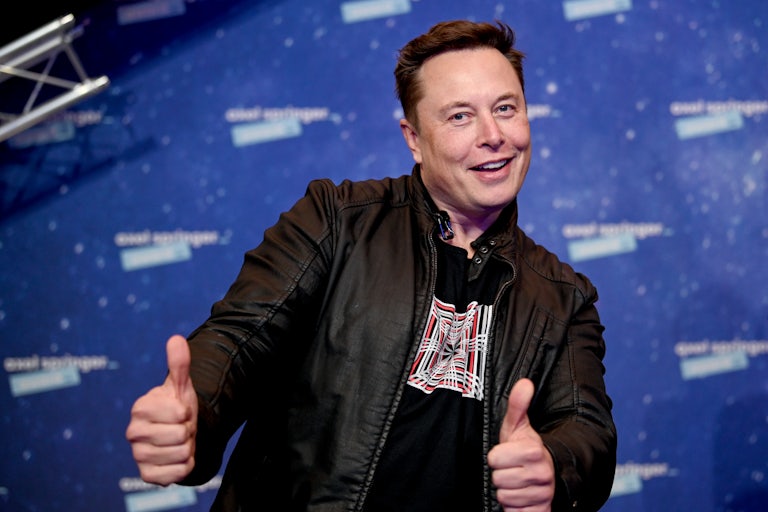
Photo by Britta Pedersen/Pool/Getty Images

Rumors of Twitter’s demise have been swirling since last last year, when changes—specifically layoffs, firings, and other cuts made by Elon Musk after he purchased the company for $44 billion—began to intermittently break the site. Still, despite being clearly held together with wire and string and staffed by a skeleton crew, the social network managed to hold on for months. Twitter was worse in many ways—less reliable, with more spam, fake news, and stupid replies thanks to Musk’s new “verified” system—but it was still Twitter, more or less.

Over the weekend, Twitter stopped being Twitter. Musk was, it practically goes without saying at this point, the culprit. Early Saturday morning, users began to report that the app was restricting the number of posts they could view. For unverified users, the number was incredibly low—600, later raised to 800—which rendered the social network unusable after users hit the cap. Twitter, like all social networks, is attention-based: Its ostensible goal is for people to use it as much as possible. This is, at the moment, of existential importance given the vast amount of money the company is losing. Its new CEO, Linda Yaccarino, was brought on in part to raise money from advertising, which is dependent on view counts. Her job was already difficult, given Musk’s penchant for posting like a pimply teenage edgelord. It just got even harder.

It’s not entirely clear why Musk introduced rate limits. He has insisted that it was an effort to stop unauthorized scraping by third parties, like ChatGPT, of the site’s data. Others have speculated that the limits were imposed as a result of Twitter not paying its Amazon Web Services bill or as a desperate ploy to get more people to pay for Twitter Blue, where subscribers are able to view more posts (though still not, for unexplained reasons, an infinite number). Bluesky, the nascent competitor started by Twitter founder Jack Dorsey, saw sign-ups skyrocket over the weekend and seems, for the first time, like it could become a viable alternative. Meta, the company formerly known as Facebook, is expected to launch its own Twitter clone sometime this summer.

Given the substantial financial and technological challenges it faces, Musk’s Twitter has seemed destined to crash and burn more or less since he purchased it. Over the weekend, he hastened its decline.

Is This the Weirdest Ad in American Political History?

Struggling in the polls, Ron DeSantis is leaning in to homophobia.

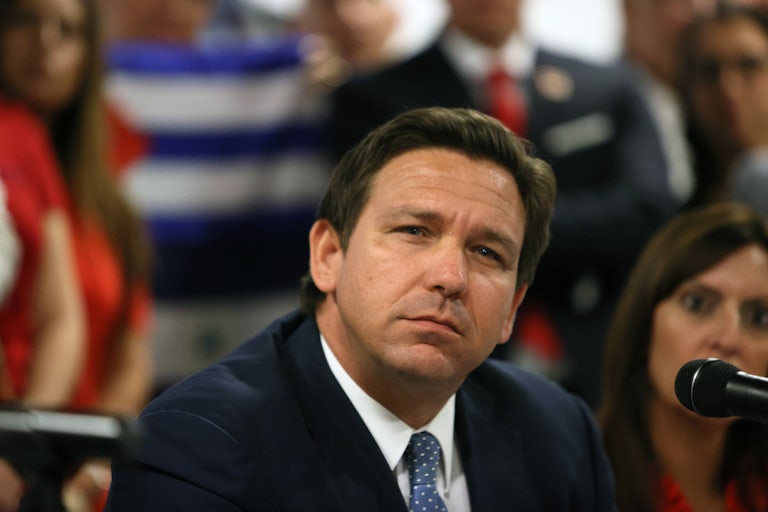
Photo by Joe Raedle/Getty Images

Over the weekend, Ron DeSantis’s rapid response team shared a video railing against twice-impeached and twice-indicted former President Donald Trump for previous expressions of support for the LGBTQ community, proudly contrasting it with DeSantis’s outward crusade against America’s LGBTQ population.

The video begins by focusing on Trump’s remarks following the Pulse nightclub shooting, which left 49 people dead in DeSantis’s state. “I will do everything in my power to protect our LGBTQ citizens,” Trump is heard saying. The video then touches on a few instances of Trump expressing support for Caitlyn Jenner being able to use whatever bathroom she wanted and for transgender women being able to compete in Miss Universe.

After the opening, the video shared by DeSantis’s campaign nails its transition with Tyler the Creator—who once called himself “gay as fuck”—yelling “PSYCHE,” to begin the contrast between Trump’s apparently woke record to DeSantis’s hard-line stances. And the rest of the video is somehow even more insane.

The remainder of the video is set to a music track straight out of the coldest and most socially disconnected corners of YouTube and TikTok (the Andrew Tate cinematic universe). It highlights headlines about DeSantis’s relentless attack on gay people and phrases like “DeSantis is public enemy No. 1,” or “DeSantis is evil,” aimed at showing the left’s hatred of the Florida governor.

The ad is also a strange pop-culture pastiche and relies heavily on images from films and television. There’s Christian Bale as American Psycho’s Patrick Bateman (an elite Wall Street mover and shaker, fan of Donald Trump, prep school and Harvard alum, and also, serial killer, rapist, and cannibal). There’s Brad Pitt starring in Troy as the Greek hero Achilles (who, in the Iliad, has been interpreted to have gone on a vengeful rampage after the death of his gay lover, Patroclus). There’s Cilian Murphy as Thomas Shelby in Peaky Blinders (a show that depicted the rise of fascism and nationalism, as well as the literal and psychological ravages of war and violence). And, finally, there’s Leonardo DeCaprio as Jordan Belfort in The Wolf of Wall Street, in which the actor portrayed a coked-up Wall Street fraudster who celebrates greed and fraud. (Tyler the Creator also once said he “one hundred percent would go gay for ’96 Leo.”)

The Florida governor has been portrayed by some as a potential moderate alternative to Trump. Some conservative groups, like Log Cabin Republicans, a national organization for “L.G.B.T conservatives and allies,” have denounced the video as “divisive and desperate,” though DeSantis’s rivals for the nomination have remained mum. Transportation Secretary Pete Buttigieg offered a succinct rebuttal to DeSantis on Sunday:

States Enact New Laws on Controversial Issues Such as Abortion

New rules on education, transgender issues, and marijuana are among the hundreds of new measures in effect in July.

Michael M. Santiago/Getty Images
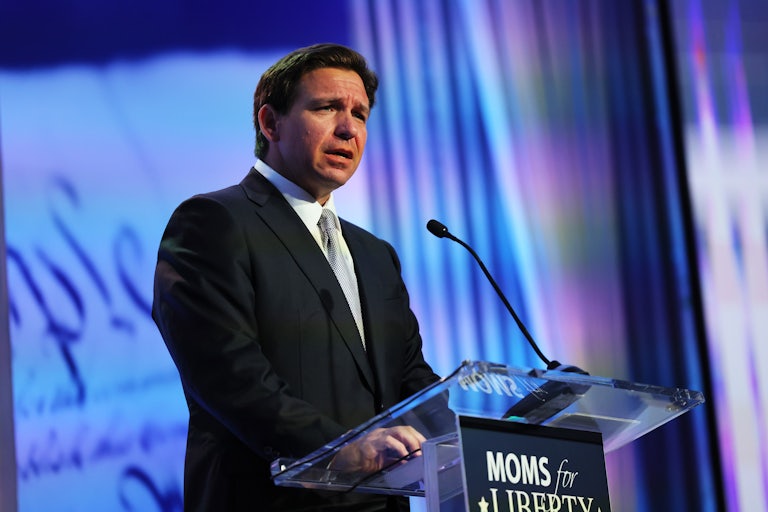
Florida Governor Ron DeSantis

Hundreds of new state laws went into effect on July 1, with red and blue states flexing their ideological muscles on issues such as marijuana, gender-affirming care, book bans, and abortion. Here’s a rundown of some of the critical new measures now in effect:

Abortion

North Carolina’s new 12-week abortion ban went into effect on Saturday, after several last-minute revisions by the state legislature.

A bill banning abortion after six weeks was supposed to go into effect in Florida on July 1, but has been delayed pending court action on the state’s current 15-week ban.

A ban on medication abortion was set to go into effect in Wyoming on Saturday, but a judge blocked it.

Transgender rights

A new law in Georgia bans gender-affirming care for minors, with medical professionals at risk of losing their licenses if they provide hormone therapy or gender-transition surgery to anyone under 18. A similar law also went into effect in South Dakota.

A federal judge temporarily blocked part of Tennessee’s law banning gender-affirming care for minors, preventing the state from enforcing a ban on hormone therapies and puberty blockers for minors. However, the portion of the law barring gender-transition surgery for individuals under 18 went into effect on Saturday.

The Kansas legislature recently overrode Governor Laura Kelly’s veto of legislation barring transgender individuals from using restrooms, locker rooms, domestic violence shelters, and rape crisis centers in accordance with their gender identities. That law went into effect on Saturday.

Education

Several of Governor Ron DeSantis’s priorities are now the law of the land in Florida, just in time for him to campaign on the new laws in his presidential stump speech. The state’s “Don’t Say Period” bill went into effect on Saturday, banning instruction on menstruation, sexually transmitted infections, and sexuality before sixth grade. Instructors teaching sex education must also focus on abstinence outside of marriage and teach the “benefits of monogamous heterosexual marriage.” Moreover, teachers will no longer be able to ask a student’s preferred pronouns or refer to a student by their preferred pronouns.

School libraries in Iowa will need to remove books with “sex acts,” according to a new state law that also bans instruction related to sexuality and gender identity until sixth grade.

A new law in North Carolina also allows individuals to carry concealed firearms on school grounds.

Criminal justice

A near-complete ban on no-knock warrants went into effect in Minnesota on Saturday, after a SWAT officer shot and killed a man during a raid with such a warrant last year.

California now permits former criminal offenders to seal their records if they have not committed another felony four years after finishing their sentences.

Maryland became the twenty-first state to legalize recreational marijuana on July 1, and Connecticut residents 21 and older can now grow up to six cannabis plants.

Other notable laws

A law banning TikTok on state-owned devices went into effect in Georgia on Saturday. Indiana repealed a law banning throwing stars, which are once again legal except for use on school properties. Nevada increased its penalties on drunk driving, Iowa now allows teenagers to work longer hours, and Mississippi formally designated the blueberry as its state fruit.

Donald Trump’s One Weird Trick to Win the GOP Primary

It’s getting indicted. Twice.

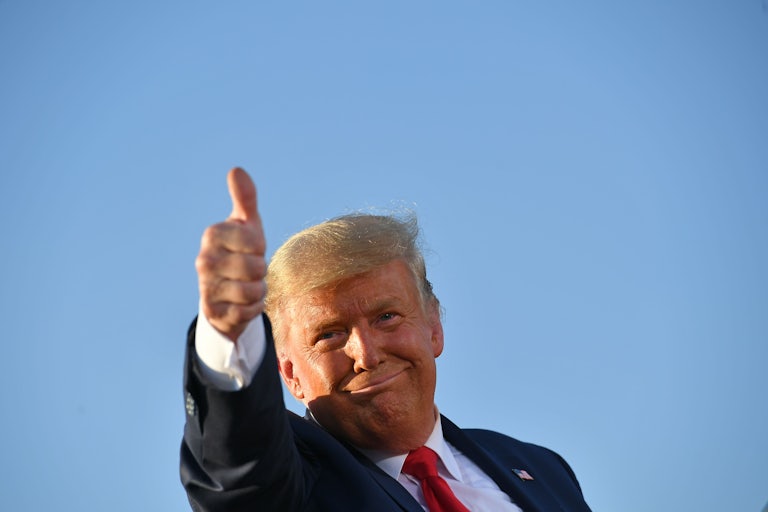
Trump gives a thumbs up sign as he leaves a rally.
MANDEL NGAN/AFP/Getty Images
Donald Trump in 2020

Donald Trump has been indicted twice this year: once in April for hush-money payments sent during the 2016 election and again in June for mishandling of classified documents. Rather than make him a political pariah, the charges could send him straight to the Republican presidential nomination.

Republican consultants and activists believe that the indictments have energized Trump’s supporters, and even people who had until now been undecided, The Messenger reported Monday. The outlet looked specifically at Iowa, which is anticipated to set the stage for the rest of the Republican race.

Previously, many Iowans had backed Florida Governor Ron DeSantis or South Carolina Senator Tim Scott. But since the indictments, voters have rallied around Trump.

“The majority of Republicans here are for Trump after this frickin’ legal lynching. That’s all it is,” state resident Merle Miller told The Messenger. “People here take the indictment personally.”

Trump has capitalized on the indictments, using them to stoke outrage—and rake in donations. His campaign announced in mid-June that it had raised $6.6 million in the week after his second indictment, in which the Department of Justice alleged that he had stored highly sensitive documents relating to national security in a bathroom. He raised more than double that in the days after he was indicted in April.

The former president has also surged in the polls since the second indictment. An NBC poll released on June 25 found that Trump had 51 percent support, a substantial lead over DeSantis, the current runner-up.

It is, of course, still nearly a year until the Iowa caucuses. Any number of things could change by then. But it’s safe to say that Trump has not been hurt by the indictments nearly as much as some expected.

More on Trump's (Second) Indictment