Life in a Warming World
A weekly reckoning with our heated planet—and the fight to save it

How the Supreme Court Could Destroy Environmental Justice Efforts

Last week’s rulings have real ramifications for how the government could help vulnerable communities moving forward.

A photo of the front of the Supreme Court building with a few people walking by the steps.
Anna Moneymaker/Getty Images
The Supreme Court building.

Since President Biden took office, his administration has put environmental justice front and center in its strategies to combat climate change. Last year, the Inflation Reduction Act made billions of dollars available to environmental justice–related initiatives; in April, the president signed an executive order mandating that environmental justice principles be worked into the mission of every federal agency, not just the ones dealing directly with the environment. It’s a long-overdue effort to correct the systemic inequities that Black and brown people face when it comes to climate change and other environmental factors.

Unfortunately, advocates and federal workers may have to grapple with the Supreme Court to make some of these changes a reality. None of the Supreme Court decisions that made headlines last week dealt directly with environmental issues, but the rulings have real ramifications for how the government could help vulnerable communities moving forward.

As E&E News reporter Pamela King reported this week, the Supreme Court’s decision in Students for Fair Admissions v. Harvard, which dealt with affirmative action on college campuses, could have serious implications for government attempts to prioritize racial equity, including on environmental matters. Last week’s historic ruling, which effectively banned race-based admissions policies, “does not mean that race-conscious environmental justice efforts are doomed—but the court clearly signaled that the strict-scrutiny test has very sharp teeth,” Emily Hammond, a professor and vice provost for faculty affairs at George Washington University Law School, told King. “Federal, state and local governments will need to tightly craft their environmental justice policies to meet this standard.”

The court is already looming large in how the administration deals with potential oncoming legal challenges from conservative states. Last Tuesday, the Environmental Protection Agency announced that it would drop an investigation into whether Black communities living in an industry-heavy stretch of coastline in Louisiana suffered disproportionate cancer risks thanks to the state’s failure to regulate chemical plants there.

For decades, residents of the region, commonly referred to as “Cancer Alley,” have complained of health problems from petrochemical and oil facilities. According to the NAACP Legal Fund, one school district that sits half a mile from a chemical facility has a 25 percent higher incidence rate of all types of cancers compared to the rest of the state. The area has been the subject of countless media investigations over the past few decades, and Biden mentioned the region by name when signing a major environmental executive order at the start of his term.

The administration’s adoption of the case last year was seen as a substantial win for the environmental justice movement and a long-awaited chance to bring changes to Cancer Alley residents. But the EPA said last week, just two days before the affirmative action ruling was announced, that it had taken sufficient enforcement against Louisiana’s Departments of Health and Environmental Quality based on the deficiencies it found, and would not be pursuing a Civil Rights Act investigation.

The Biden administration has centered much of its environmental justice investigation and enforcement around Title VI of the Civil Rights Act, which prohibits racial discrimination in programs and entities receiving federal funds. Title VI has historically been used in areas like housing, education, and transportation, but the Biden administration has taken the idea for a new spin with regard to climate and health.

It’s seen some success with this strategy. Earlier this year, the Justice Department reached an agreement with the Alabama Department of Public Health, finding that the state had violated Title VI in neglecting to address sanitation conditions in the majority-Black Lowndes County. Residents have for decades complained about open sewage pits in their yards, high rates of disease, and a lack of help from the local government.

But in late May, Louisiana Attorney General Jeff Landry—who is also running for governor—filed suit against the EPA and the Biden administration. While the suit doesn’t specifically name the agency’s investigation into conditions in Cancer Alley, it claims that the EPA’s attempted use of Title VI in enforcement procedures oversteps its authority. The EPA has “lost sight of the agency’s actual environmental mission, and instead decided to moonlight as […] social justice warriors fixated on race,” Landry wrote.

The majority opinion in the Harvard case last week focused mostly on the constitutionality of race-based admissions rather than specific issues with Title VI. But in a concurring opinion, Justice Neil Gorsuch echoed some of Landry’s specific allegations about the use of Title VI. In the suit, Landry also raised the “major questions” doctrine, a conservative legal interpretation that aims to limit how much government agencies can do without explicit permission from Congress; the doctrine formed the bedrock of the court’s decision last year in West Virginia vs. EPA, which constrained the agency’s ability to regulate emissions from power plants. The doctrine was also brought up last week in the Biden v. Nebraska student loan ruling, suggesting that the question around what Congress explicitly allows specific agencies to do will be a continual theme in decisions to come.

Legal experts told the AP that it’s likely the EPA dropped the investigation in Louisiana in order to avoid the risk of this suit being brought before the right-wing court. But that raises questions of how the administration can otherwise help vulnerable communities—and it doesn’t mean anything to the residents of Cancer Alley, who have been living in environmentally dangerous conditions for years.

“I would never support the government abandoning their obligation,” Robert Taylor, a resident of St. John the Baptist Parish and founder and executive director of the Concerned Citizens of St. John, told The Washington Post. “It will not help the residents here. They know that we are the targets of these industries.… We have the least protection. And now the federal government can’t provide protection.”

Good News

Wind and solar are pulling more than their fair share in Texas, where a sustained heat wave and increased air conditioner use have made energy demand skyrocket. The state set a record for renewable energy generation last week, and renewables provided up to 40 percent of Texas’s energy mix during peak use times.

Bad News

It’s not just you—this July 4 was really, really, really hot. The global average temperature on July 4 reached 62.92 degrees Fahrenheit, making it the hottest day on record, according to data from the U.S. National Centers for Environmental Prediction.

Stat of the Week

4.5%

That’s the rate at which incidences of domestic violence against women in South Asian countries increase as the ambient temperature rises by one degree Celsius, a new study published last week in the journal JAMA Psychiatry has found.

Elsewhere in the Ecosystem

Climate change could swamp this island. Home sales are surging.

An island in Maryland threatened by sea level rise is experiencing a surge in real estate sales, The Washington Post reports:

More homes have sold on Smith Island in the last three years than in the previous 11 combined, according to sales data. Locals see a story of hope. Their efforts to rescue a 400-year-old way of life tied to tide and season are beginning to bear fruit. Many question the doomsday predictions for the island or hope they can find a way to ride out rising waters.

Environmentalists see a dangerous kind of denialism. They say Smith Island’s long-term survival is doubtful, so the only rational path is retreat. They see the recent interest in the island as part of an unsettling national trend—studies show more Americans are moving into climate danger zones.

Read Justin Jouvenal’s full report at The Washington Post.

This article first appeared in Life in a Warming World, a weekly TNR newsletter authored by contributing deputy editor Molly Taft. Sign up here.

The Right-Wing Groups Behind the War on ESG

A new report sheds light on state-level legislative attacks on the right’s newfound obsession.

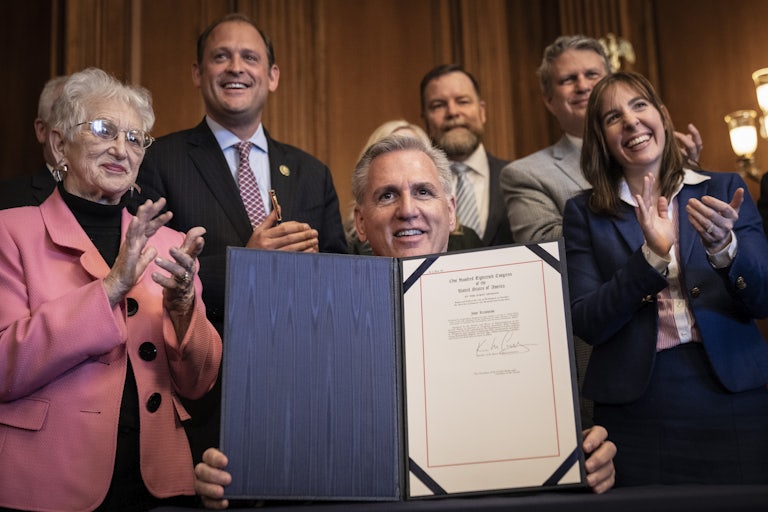
Speaker Kevin McCarthy signs an anti-ESG resolution
Drew Angerer/Getty Images
House Speaker Kevin McCarthy signed an anti-ESG resolution in March.

If you’d have told me a couple years ago that ESG—an acronym for environmental, social, and governance principles—would be a major talking point of the 2024 Republican presidential primary, I would have laughed in your face. ESG began to gain popularity over the past decade in the financial sector amid shareholder pressure on corporations to incorporate environmental and social risks into investments as well as customer demand for Wall Street firms to provide more responsible investment options. What ESG definitely wasn’t was a Greta Thunberg–level Marxist revolution. BlackRock, of all companies, is on board with ESG.

Try telling that to the GOP. Over the past year, the right has turned viciously against this once boring investing principle, devoting chyrons on Fox News to the threat of “woke capitalism” and holding full House hearings to rage against the “cabal of global elites” supposedly behind the ideal. But anti-ESG sentiment on the right isn’t just a cable news talking point. A new report reveals the full scope of state-level legislative attacks on ESG, showing that they’re in fact part of a highly coordinated, national Republican offensive.

The report, released last week from research firm Pleiades Strategy, found that by the middle of 2023, Republican lawmakers in 37 states had introduced at least 165 bills and nine resolutions designed to target and/or eliminate ESG in state-level investment strategies and contracts. Most of these proposals were inspired by a handful of draft bills created by GOP dark-money powerhouses like the American Legislative Exchange Council, the Heartland Institute, the Heritage Foundation, and the Texas Public Policy Foundation. Many of these organizations are members of the State Policy Network, a conservative group of think tanks that push so-called model legislation at the state level and have ties to the oil and gas industry and histories of pushing climate denial.

This state-level war on ESG isn’t going very well—not legislatively, anyway. Only 31 of those 165 bills and resolutions ended up passing, the report found; several of the successful ones only made it through legislatures after significant changes that effectively kneecapped many of their limits on financial entities. Meanwhile, 83 of the bills—just about half—failed to pass altogether or were vetoed by governors. (Of the other half of those 165, around a dozen are still active or have not had committee hearings, while 42 bills did not pass this session but will be readopted in future.)

This isn’t terribly surprising given that the targets of these anti-ESG bills are banks, businesses, and pension funds. In at least 17 states, the report finds, anti-ESG legislation met substantial opposition from business lobbyists. State-level chambers of commerce and bankers’ associations in various states have spoken out against the proposed laws. Many opponents of the bills also conducted state-level analyses that showed that they would do substantial financial damage to constituents if they passed.

Many have noted the irony that the party that professes to worship the free market now wants to tell private and public companies alike that they can’t manage their money however they please. But Republicans aren’t backing down in their anti-ESG fight, despite pushback from the business community.

“We used to be able to go to [lawmakers] and say, ‘Hey, this is going to hurt free markets and have a negative regulatory effect,’” Steven Killian, director of government relations for the Arizona Bankers Association, told The Washington Post. “They just don’t want to hear it anymore. They’re more interested in the political fight.”

And what’s the goal of that fight? A lot has changed since Senator James Inhofe tossed a snowball on the floor of Congress to disprove that the world was warming; even oil companies have net-zero pledges now, and “climate denier” is a much dirtier word than it used to be. Lawmakers can no longer simply stick their head in the sand and pretend nothing is happening. Instead, they’re trying to make ESG seem “woke,” in the hopes of attacking climate policy without seeming like they’re out of touch with the science or refusing to acknowledge how the world is changing. It’s all part of Republicans’ long game of delaying climate action while it gets hotter and hotter outside.

And despite the legislative failures laid out in the Pleiades Strategy report, the state-level ESG fight isn’t over. More than three dozen of the 165 bills will be readopted in the next legislative sessions, the report says, while one GOP presidential contender, Vivek Ramaswamy, has built his entire campaign around defeating ESG. Sounds like we’re going to be hearing a lot more about ESG in the months to come—until Fox News moves on to its next “woke” obsession, that is.

Good News

A county in Oregon filed a lawsuit last week against more than a dozen fossil fuel companies and lobbying groups, including ExxonMobil, Shell, Peabody Energy, and the American Petroleum Institute, alleging that the 2021 heat wave that killed hundreds in the Pacific Northwest was a “direct and foreseeable consequence” of these companies’ decisions to sell oil, gas, and coal while obscuring what they knew about climate change.

Bad News

There are more mosquitoes in everyone’s future. The number of “mosquito days”—days with high temperatures and humidity that are ideal for the bugs to thrive—have increased in more than 70 percent of the United States since 1979, a new report from Climate Central has found. (This week, the Centers for Disease Control and Prevention issued an alert that malaria cases had been reported in the U.S. for the first time in two decades.)

Stat of the Week

$10.3 billion

That’s the amount of the settlement chemical giant 3M reached last Thursday with hundreds of cities and towns across the U.S. The money, which will be paid out over 13 years, is in response to thousands of lawsuits alleging pollution from PFAS, a.k.a. “forever chemicals,” in municipal water supplies.

Elsewhere in the Ecosystem

The Hidden Cost of Gasoline: Gas stations caused a $20 billion toxic mess—and it’s not going away.

Oil sold at gas stations doesn’t just destroy the environment once it gets into your car. Underground storage tanks can also be hugely damaging to soil and water, a joint investigation from Grist and Crosscut has found:

Much of this pollution has been stagnant for decades. Forty years ago, steel storage tanks began corroding, setting off a slow-motion environmental disaster all over the United States. Leaks often weren’t discovered until long after petroleum had poisoned the groundwater, when neighbors of gas stations began complaining that the water from their taps smelled like gasoline. In 1983, the EPA declared leaking tanks a serious threat to groundwater, and Congress soon stepped in with new regulations. One of the largest spills was in Brooklyn, where a 17 million-gallon pool of oil gradually collected beneath a Mobil gas station—a larger spill than the Exxon Valdez disaster in 1989, when a tanker ran aground in Alaska and poured oil into Prince William Sound.

Fast-forward to today, and more than half a million leaks have been confirmed around the country. The Government Accountability Office estimated in 2007 that the total bill for cleanups would top $22 billion. Those old, decrepit storage tanks have left a legacy: overgrown, empty lots that real-estate developers don’t want to touch. Of the roughly 450,000 brownfields in the country, nearly half are contaminated by petroleum, much of it coming from old gas stations.

Read Kate Yoder’s full report at Grist.

This article first appeared in Life in a Warming World, a weekly TNR newsletter authored by contributing deputy editor Molly Taft. Sign up here.

Confessions of a Frequent Flier

Why is the airline industry so hard to decarbonize—and can we ever expect to fly guilt-free?

A person sits in a chair at an airport window, with a view of a plane on the runway.
Brandon Bell/Getty Images
A passenger waits near a Delta Air lines terminal in the Austin-Bergstrom International Airport.

This year, I became an Airport Person—an awkward position to be in as a climate journalist. Before, I tried to limit my regular travel to buses and trains where possible. But over the winter, I started a relationship with someone who lives on the West Coast, and now I find myself haunting JFK Airport every few months on jaunts to go see her. (I even bought one of those dorky neck pillows—all in the name of love.)

It’s awkward because long-haul flights are among the most atmosphere-damaging actions you can take as an individual. A one-way flight from London to New York can generate more carbon dioxide per passenger than the average person in 56 different countries emits in a year.

All that time dragging my suitcase around terminals and crammed into impossibly tiny seats in economy class has given me a lot of opportunity to think about the ethical conundrum I’ve found myself in. Not all fliers are created equal: People who travel by plane regularly are responsible for an outsize chunk of global airline emissions. The various airlines I fly on, I’ve noticed, have offered me some small consolations for my climate betrayal, from promises about more efficient aircraft design to assurances that they’re using “eco-friendly” packaging for in-flight snacks.

The whole thing feels like one of those impossible modern climate catch-22s. Am I really supposed to choose between not destroying the planet and seeing my girlfriend? Why is this industry so hard to decarbonize? And how are we supposed to trust that airlines are actually doing what their green P.R. says they are?

I’m far from the only one asking these questions. Late last month, Delta got hit with a class-action lawsuit claiming that it erroneously represented its green credentials. The lawsuit states that plaintiff Mayanna Berrin, a California resident, was led to buy tickets thanks to the airline’s advertising claims around its carbon neutrality, “due to her belief that by flying Delta she engaged in more ecologically conscious air travel and participated in a global transition away from carbon emissions.”

Delta had made a bold pronouncement in early 2020. “Starting March 1, Delta Airlines will become the first airline to go fully carbon-neutral on a global basis,” CEO Ed Bastian told CNBC’s Squawk Box in an interview. As the lawsuit details, the airline followed this announcement with similar claims on social media and in advertising—including on in-flight napkins—which led Berrin to feel better about buying so many flights.

Carbon credits were a key part of Delta’s sustainability strategy at the time: paying for a project somewhere in the world that theoretically pulls carbon out of the atmosphere—like planting trees or restoring carbon sinks—to offset the emissions damage done by flying. Dan Rutherford, a program director at the International Council on Clean Transportation, told me that Delta’s tactic was a pretty standard move for the industry at the time. “The focus was very much on, OK, the aviation sector is very hard to change,” he said. “Let’s not worry about the planes themselves and the fuels they burn. Let’s offset their emissions.”

Unfortunately, buying offsets doesn’t wave a magic wand to make all the emissions from a major airline go away. We published a great piece last week illustrating problems with offsets, but the offset market is, in sum, rife with problems—and, in many cases, can enable polluters to release even more emissions into the atmosphere. These issues are a cornerstone of Berrin’s lawsuit, which claims that Delta led consumers into thinking it emitted no CO2 after March 2020, even as it was continuing to do (mostly) business as usual.

Regardless of the outcome of the lawsuit, sustainability claims may change substantially for the industry moving forward. Over the past year, Rutherford told me, airlines have shifted their carbon-reducing strategies away from offsets to focusing more on sustainable aviation fuels—an umbrella term for different types not derived from fossil fuels, including some made with biomass feedstocks. While they have much lower carbon emissions, these fuels tend to be very pricey, costing several times more on average than traditional ones—a nonstarter for an industry that operates on razor-thin margins and tries to squeeze every last penny out of customers.

As part of its massive package of climate investments, the Inflation Reduction Act added an additional tax credit on sustainable aviation fuels that, Rutherford said, airlines can stack on top of other existing incentives to get a steep discount.

“We’re throwing a lot of money … very randomly at fuels,” he said. “And we’re throwing a lot of money at some technologies that have already matured and we don’t expect the cost to come down much more. Which is not great public policy.”

Still, Rutherford said he thinks there’s potential for flying to change. The industry has set a benchmark of totally decarbonizing by 2050; Rutherford said that by 2035, a combination of sustainable fuels, developing technologies like hydrogen and lighter batteries, and increased customer tools, like more detailed breakdowns of emissions by itineraries, should get us to a point where we’ll know if we’re heading toward that goal or not. That’s way longer than I hope my girlfriend and I will be living on separate coasts but seems promising given the huge scope of the problem.

Rutherford said he’s especially “bullish” on consumers being nudged to change their behavior. I’ve been using Google Flights to find lower-emissions options, but I wonder how many other consumers—most of whom don’t think about climate change for a living—do the same. And even if everyone sought out lower-emissions flights, would that make enough of a dent? Or do we simply need people to fly less?

The answer to that last question is, basically, yes. It’s an uncomfortable part of the conversation, Rutherford admits—especially given that most of the world’s policymakers are themselves super-fliers. “This fits into the big debate over collective action versus personal responsibility,” he said. “Long term, it’s a societal problem.”

Good News

Massachusetts announced last week that it was creating the country’s first green bank for affordable housing. The Massachusetts Community Climate Bank, created with an initial seed of $50 million from the federal government, will offer people living in low-income housing retrofits that help both decarbonize buildings and lower energy bills.

Bad News

The world just keeps getting hotter and hotter. Global air temperatures briefly breached 1.5 degrees Celsius (2.7 degrees Fahrenheit) above preindustrial levels—the bottom warming limit set by the Paris Agreement—in June.

Stat of the Week

103.3°F

That’s the temperature reached in early June in Baevo, Russia, where summer temperatures usually only get up to the high 70s or low 80s. Siberia is experiencing a record-breaking heat wave this month, and several places across the region have seen all-time highs.

Elsewhere in the Ecosystem

Out of Balance: How the World Bank Group Is Enabling the Deaths of Endangered Chimps

Carbon offsets aren’t the only problem. Biodiversity offsets—a practice where corporations can pay for damaging flora and fauna in one region by funding conservation elsewhere—can have unintended and devastating consequences. ProPublica reports on how one mining company’s offsets in Guinea are leading to the mass death of chimpanzees and putting residents in a nearby village in danger:

Offsets are “mainly an instrument to sanction perpetual destruction,” said Jutta Kill, a researcher and environmental advocate who’s studied conservation programs in the Global South.

While biodiversity offsets have been used by governments, banks and industries at least 13,000 times across 37 countries, these arrangements have been subjected to far less scrutiny than carbon offsets, which my investigations have found to be profoundly flawed.

I reviewed the literature on the tiny sliver of biodiversity offsets that have been studied and found that, at best, their records are spotty or unproven. At worst, they function as greenwashing for destructive industries.

Those associated with the World Bank Group are among the most controversial, because unlike most others, some enable companies to write off the lives of critically endangered species.

Read Lisa Song’s full report at ProPublica.

This article first appeared in Life in a Warming World, a weekly TNR newsletter authored by contributing deputy editor Molly Taft. Sign up here.

The Fossil Fuel Industry Veterans Who Regulate Your Electricity

A closer look at the people in power who control your power

Eric Thayer/Bloomberg/Getty Images
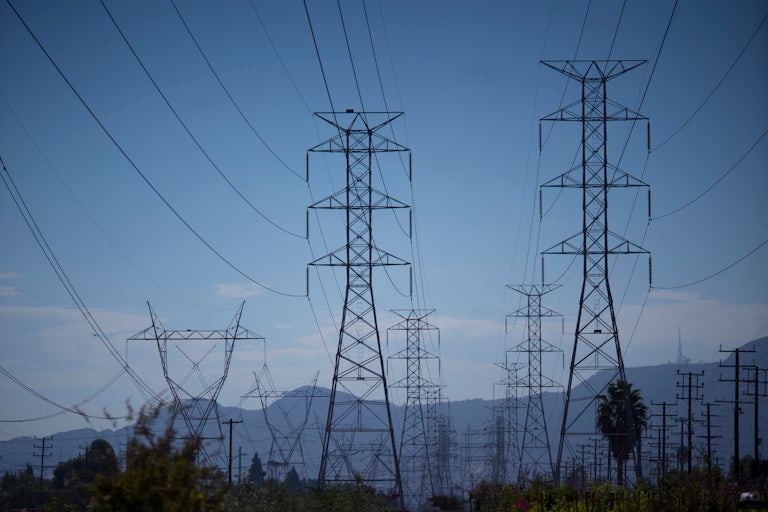
Power lines in North Hollywood, California

When you think about your electric bill, what comes to mind? For most of us, it probably goes no further than annoyance at how high it gets when your spouse or roommate cranks the A.C. all summer. It’s safe to say that the average American doesn’t think too much about the people making decisions about electricity that both dictate the rates we pay and the amount of progress the country achieves on climate change.

But a new study of the professional background of these people ought to make us sit up and take notice, because many of them walked right through the revolving door from the fossil fuel industry.

First, some context: The nation’s 168 investor-owned utilities serve almost three-quarters of Americans. Because of the regulatory structure of how we provide electricity, these utilities can only turn a profit when they build new infrastructure—which incentivizes them to prioritize certain projects over others. The state bodies that regulate these utilities (and other services like water and telecommunications) are usually referred to as “public utility commissions,” and PUCs are staffed by commissioners who are either elected by voters or appointed by elected officials, depending on the state.

“PUCs are charged with ensuring reliable service to customers, at the lowest possible rates, while still allowing a ‘reasonable’ return on the investments that utilities make to run the electrical power system,” Jared Heern, a postdoctoral researcher at Brown University, told me. “The way it usually works is that utilities spend money on something or want to spend money on something, so they go to the PUC that rules whether it is a reasonable and needed expense or not, and then they set the electric rates that customers pay so utilities can recoup that money plus a profit on top.”

Research conducted by Heern and published in the July issue of the journal Energy Research & Social Science looked at the bios of more than 800 commissioners serving in all 50 states between 2000 and 2021 and found that 25 percent of the commissioners surveyed had worked in the fossil fuel or utility industries, compared to 19 percent with a background in environmental regulation.

This isn’t necessarily shocking. Having industry knowledge in a complicated field like electricity generation is, naturally, a good fit for many regulators. But this experience could also bias commissioners toward decisions that might be profitable for a utility while not necessarily helping customers or the environment. The commissioners’ experience working on PUCs is also potentially profitable for themselves: Heern tracked what half of the surveyed commissioners did after leaving the PUC, and a whopping 50 percent of them went back to work for the utilities they had just been regulating.

“Decarbonizing and decentralizing the electrical power system is a critical part of addressing climate change and will become even more important as we electrify other sectors like transportation and building heating,” Heern said. “Yet there are only about 200 public utility commissioners at a given time spread across all 50 states that are making these crucial regulatory decisions on what utilities can, cannot, and should do with the electrical power system.”

Utilities are, pardon the pun, real power players in state and national politics—Southern Company, one of the nation’s biggest utilities, spent more than $9.2 million on lobbying last year—while wealthy utility CEOs can also make significant financial contributions in local and state races. In many states, public utility commissioners are appointed directly by governors or legislatures, which can open up serious potential conflicts of interest when considering how personal interest and financial ties come into play.

Heern’s research found that both Democratic and Republican utility commissioners tended to have backgrounds working in the services they were then appointed to regulate. Partisanship, however, played a key role in one area: Some 30 percent of Democratic utility commissioners had a background in environmental regulation, whereas only 10 percent of Republican commissioners did.

Amid all the tangles of conflicts of interests, Heern’s work points to some encouraging news on climate. The number of commissioners with environmental experience soared from 12 percent in 2000 to 29 percent in 2020, as the energy transition kicks into gear—a change Heern says “seems positive for the necessary policy steps to be taken in addressing climate change.”

Heern told me that he hopes his work kick-starts more research and focus on these crucially understudied groups. “PUCs need more attention from researchers and journalists, but also from members of the public,” he said.

Good News

For the first time, wind and solar outpaced coal in America’s mix of energy generation consistently for the first five months of the year, according to an E&E News analysis of preliminary federal energy data. “From a coal perspective, it has been a disaster,” Andy Blumenfeld, an energy analyst, told E&E. “The decline is happening faster than anyone anticipated.”

Bad News

The Pakistani government said Tuesday it is planning to evacuate more than 80,000 people ahead of Cyclone Biparjoy’s landfall on Thursday. This week, the storm reached 105 mph wind speeds over the Indian Ocean, classifying it as a “very severe” cyclonic storm. High tides and strong winds from Biparjoy killed several people in India ahead of the storm’s landfall.

Stat of the Week

172%

That’s how much more land has burned in California’s wildfires since 1971 thanks to climate change, a new study has found. Wildfires in the state have increased fivefold over the past 50 years.

Elsewhere in the Ecosystem

Alarm at rightwing push to reverse clean-energy success in Texas and beyond

Last week, Texas Republicans scrambled to pass a bill that would have imposed significant punishments for new wind and solar facilities. Portions of that bill were directly drafted and edited by the Texas Public Policy Foundation, ot TPPF, a powerful conservative think tank in the state with a history of lobbying against climate policies in Texas and beyond, The Guardian reports:

The burgeoning influence of TPPF, an organization substantially funded by fossil fuel interests and publicly lauded by Greg Abbott, Texas’s Republican governor, is the catalyst to a rightwing attempt to crimp the stunning progress of renewable energy in the state, which now produces more than a quarter of all wind-powered electricity in the US.

The group’s agenda is now extending far beyond Texas, bankrolling efforts to halt offshore wind turbines in Massachusetts and to prop up coal power on native American land in Arizona while spearheading efforts to crack down on sustainable finance in energy-producing states like West Virginia.

“We are very influential, we are meeting with policymakers to share recommendations and we’re having success around the country,” said Jason Isaac, a former state representative and now director of TPPF’s energy initiatives. Isaac said that TPFF regularly helped craft “certain aspects” of bills in Texas related to the state’s electricity grid or environmental, social, and corporate governance (or ESG) issues.

Read Oliver Milman and Dharna Noor’s full report at The Guardian

This article first appeared in Apocalypse Soon, a weekly TNR newsletter authored by contributing deputy editor Molly Taft. Sign up here.

My Personal Gas Stove Saga

Improving indoor air quality is harder than it sounds.

A close-up of a lit gas stovetop.
Michael M. Santiago/Getty Images

Confession: When TNR began covering the most recent wave of gas stove news, I was still cooking on a gas range.

At first, replacing it didn’t feel like a realistic option: The stove came with our rental. And while I wasn’t wild about the well-established link to respiratory illnesses, I figured there were a lot of risks out there in every aspect of life. I also appreciated how quickly the range heated up, how responsive it was to adjustments during the cooking process, and how screaming hot I could crank the oven for homemade pizzas—in short, all the reasons people say they like gas stoves. And there was no chance any landlord would shell out for induction.

So as I interviewed people about new research showing gas ranges leak carcinogenic benzene, and reported their suggested policy solutions, I was compartmentalizing. I was even a little startled when my husband, reviewing the coverage, insisted that we had to do something about this too—and do it now, not merely prioritize electric when we eventually moved out. When he bought new filters for a long-unused air purifier and set it up in the kitchen, along with an air quality monitor, I suggested this might be overkill. (Caveat: Home air quality measuring devices are not very accurate, but you can watch the “volatile organic compounds”—which include benzene—spike when you turn the stove on, which has a way of making the theoretical risk feel a little more immediate. Great panic fodder for masochists.)

Without his insistence, though, I’d never have appreciated how hard it is to mitigate the effects of gas stoves with the tips many “service” journalism pieces offer.

One Slate piece last October suggested people cut their risk by using the exhaust hood. And that’s what our landlord suggested when we first contacted him asking whether he’d consider replacing the gas stove. The exhaust hood doesn’t do much, though, when it’s simply venting to a spot six inches above where it takes in air, rather than to the outdoors. Although this air is allegedly filtered before being dumped back into the kitchen, a lot of filters don’t work on benzene, and our filter was old and the vent cover even broke off shortly after this experiment began. The landlord said there was no way to vent to the outdoors given the kitchen’s setup.

Our main option was to open the window while cooking. As fall turned into winter, doing this every time we cooked got really flipping cold.

In January, all hell broke loose. U.S. Consumer Product Safety Commissioner Richard Trumka Jr. told Bloomberg that “any option is on the table” regarding gas stove regulation and “products that can’t be made safe can be banned.” Conservatives went haywire, yelling about freedom and chaining themselves to their ranges, while liberals pointed out that no one was going to actually rip existing ranges from the walls and a full nationwide ban on gas stoves almost certainly wasn’t in the offing anyway.

But here’s the thing about people like Trumka using their pulpit: It may trigger the wingnuts, but it also raises public awareness. I can’t prove the connection, but when we emailed the landlord three days after this national debate kicked off, this time he said yes—that this issue had been on his mind—and offered a deal of replacing the gas stove in exchange for our signing a longer-term lease.

The physical act of replacing a stove still takes work: The gas range, it turned out, had no electrical hookup behind it, so that had to be installed. The technician who dropped off the new range for installation gave me a lecture about how his wife had demanded the opposite switch—that he put in a gas range rather than electric. Were we really sure about this, he asked, or was the rental management agency forcing us to take a substandard stove swap? I mentioned the research on gas stoves. He remained unconvinced.

I’m happier than I thought I’d be with the new range—it’s not induction, but regular glass-top electric stoves have gotten better since I last used them: They heat up faster and can reach higher temperatures. The heat in the electric oven seems a little steadier and more uniform than in our gas one (this is consistent with what others say, although I’m not aware of good data), so it’s a little better for cakes and more delicate stuff—and it gets very, very hot with enough time, so pizza and bread still work.

And here’s the thing: Not having to worry about what’s leaking out isn’t nothing. It feels better than you might think. Aside from the concern about respiratory problems and cancer—our basement gas line sprang an unrelated leak midway through this process, resulting in multiple emergency technician visits—it’s kind of nice to know that there’s one less way for the house to blow up.

Anyway, that’s one story of a gas-to-electric switch.

Now, some news: I’ll be going on tiny-human leave for a few months as of the end of this week (one of the reasons we pushed through this stove saga—kids are particularly affected by gas range emissions). I couldn’t be more delighted to introduce Molly Taft, who will be taking over this newsletter and the TNR climate desk in the interim. Molly was most recently a staff writer at Earther, Gizmodo’s climate site, and has also written for The Intercept, Vice, The Outline, and in fact The New Republic!

Simultaneously, we’ll soon be renaming this newsletter from its original launch title of “Apocalypse Soon” to “Life in a Warming World,” to better reflect the wide-ranging nature of topics covered. It’s going to be an exciting next couple of months—stay tuned!

Good News

Well, medium news: Chemical companies Chemours, DuPont, and Corteva have announced a preliminary settlement agreement in lawsuits over damages from PFAS (or “forever chemicals,” linked to many adverse health outcomes, so named because they are slow to break down) contaminating drinking water. The agreement involves setting up a $1.19 billion fund for removing PFAS. (Chemical company 3M also appears ready to settle on similar claims.) The good part of this is that it means money will go toward cleanup. The bad part is that it may not be enough, and it probably doesn’t hold these companies fully accountable for decades of misleading the public about the dangers from these substances.

Bad News

Both Allstate and State Farm have stopped writing new home insurance policies in California, due to climate risks and repair costs.

Stat of the Week

50%

That’s the increase in the amount of carbon dioxide in the atmosphere, comparing this year’s measurements to the preindustrial era, according to a new report.

Elsewhere in the Ecosystem

The Grand Canyon, a Cathedral to Time, Is Losing Its River

The great Western water crisis will have many casualties. The Times’ photo-intensive feature on the Grand Canyon takes one of them and uses it as a poetic stand-in for the greater Colorado River catastrophe:

The Colorado flows so far beneath the Grand Canyon’s rim that many of the four million people who visit the national park each year see it only as a faint thread, glinting in the distance. But the river’s fate matters profoundly for the 280-mile-long canyon and the way future generations will experience it. Our subjugation of the Colorado has already set in motion sweeping shifts to the canyon’s ecosystems and landscapes—shifts that a group of scientists and graduate students from the University of California, Davis, recently set out to see by raft: a slow trip through deep time, at a moment when Earth’s clock seems to be speeding up.

John Weisheit, who helps lead the conservation group Living Rivers, has been rafting on the Colorado for over four decades. Seeing how much the canyon has changed, just in his lifetime, makes him “hugely depressed,” he said. “You know how you feel like when you go to the cemetery? That’s how I feel.”

Read Raymond Zhong’s full report at The New York Times.

This article first appeared in Apocalypse Soon, a weekly TNR newsletter authored by deputy editor Heather Souvaine Horn. Sign up here.