Breaking News
Breaking News
from Washington and beyond

Far-Right Republicans Pledge to Shut Down Government Over “Cancerous Woke Policies”

The GOP’s Freedom Caucus will do anything to hurt Biden—even destroy the U.S. economy.

Rep. Jim Jordan
Drew Angerer/Getty Images
Representative Jim Jordan is vice chair of the House Freedom Caucus.

The House Freedom Caucus announced Monday that it will block attempts to pass a government funding bill unless its chosen policies are included.

Congress has not passed all the necessary appropriations bills, and it is unlikely to do so by its September 30 deadline. Party leaders on both sides have suggested passing a continuing resolution to keep funds flowing until all the bills have passed. If Congress fails to pass the stopgap measure, the government is at risk of a shutdown.

But the Freedom Caucus, a group of far-right House Republicans, said it would not support a stopgap. “We refuse to support any such measure that continues Democrats’ bloated COVID-era spending and simultaneously fails to force the Biden Administration to follow the law and fulfill its most basic responsibilities,” the caucus said in a statement.

The group demanded that any funding measures include policies to rein in immigration at the southern border “address the unprecedented weaponization of the Justice Department and FBI” and “end the Left’s cancerous woke policies in the Pentagon undermining our military’s core warfighting mission.”

The latter two points refer, respectively, to the indictments against former President Donald Trump and a Defense Department policy of refunding travel costs for service members who have to travel for an abortion. The caucus also said they would oppose short-term funding extensions and a “blank check” for Ukraine aid.

The Freedom Caucus has made similar demands before, such as when they tried to block the debt ceiling deal. That didn’t work out as planned. A deal was struck, and House Speaker Kevin McCarthy—whom the caucus keeps trying to undermine—somehow came out looking fine.

It’s possible, though, that the caucus has a different goal: tanking the economy. The government shutdown in 2018 cost the United States $11 billion, including $3 billion in economic activity that will never be recovered, the Congressional Budget Office said at the start of the following year.

With a presidential election on the horizon, the Freedom Caucus could be looking for ways to undermine Biden any way it can. Destroying the economy he’s helping to recover would do just that.
Report: Elon Musk Has Been Chatting Up Putin While Aiding Ukraine

Reporting for The New Yorker, Ronan Farrow finds a concerned Pentagon at the center of the terminally online mogul and the battlefield resources under his control.

Nathan Laine/Getty Images

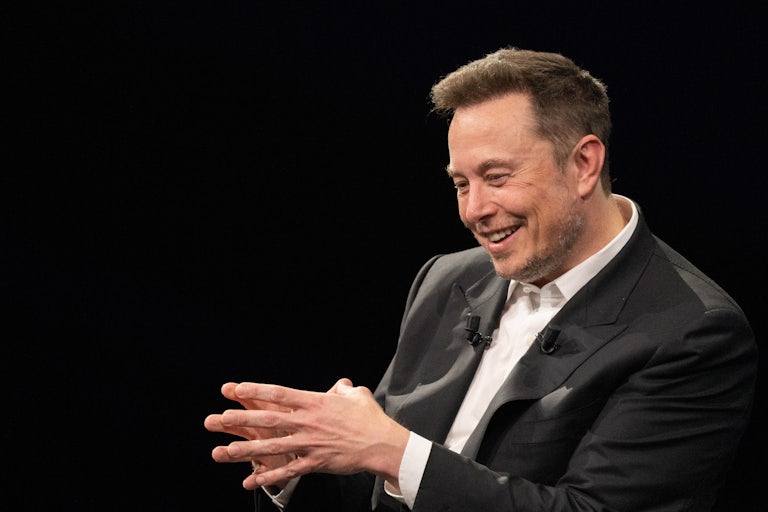
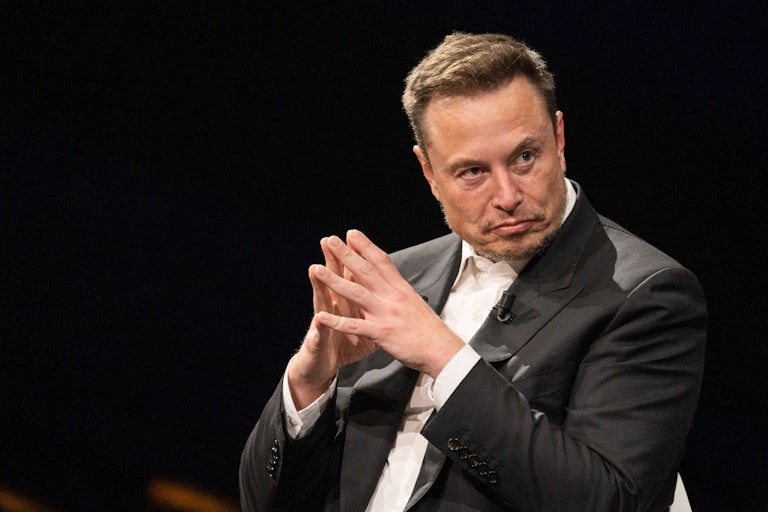
Elon Musk has made himself a major player in the Ukraine war by providing the Ukrainian military with internet service. But his help comes at a cost.

Musk became involved with the war shortly after Russia invaded in February 2022. But according to a new profile from Ronan Farrow published Monday in The New Yorker, he repeatedly threatens to cut off Ukraine’s access to a tool that has become crucial to its military’s success. He also has mentioned several times that he is in contact with Russian President Vladimir Putin, and many of Musk’s moves seem geared toward the benefit of Moscow.

“Elon desperately wants the world to be saved. But only if he can be the one to save it,” OpenAI CEO Sam Altman told Farrow, perfectly—and perhaps inadvertently—capturing Musk’s narcissistic savior complex.

Musk agreed to set up a nationwide network of mobile internet terminals, called Starlink, throughout Ukraine. This would help protect against Russian cyberattacks and allow the Ukrainian military to maintain constant contact while on the battlefield. Nobody thought twice about the fact that Musk could also turn off access anytime he felt like it.

At first, Musk’s company SpaceX provided Starlink for free. But as the war dragged on, Musk began to press the Pentagon to start paying for the internet service. Around the same time, he began to express increasing support for Putin’s position.

He advocated for the United States to negotiate with the Russian leader and tweeted a “peace plan” he claimed to have invented. That plan involved ceding swathes of Ukraine to Russian control. Reid Hoffman, who co-founded PayPal with Musk, said his former colleague seemed to have “bought what Putin was selling, hook, line, and sinker.”

Meanwhile, in Ukraine, soldiers began losing connection on the battlefield, forcing battalions to retreat or commanders to drive into battle just to be in radio range. U.S. and Ukrainian officials told The New Yorker they believed SpaceX had cut off the internet terminals in certain areas, including major battlefields—including Zaporizhzhia, Kharkiv, and Donetsk.

During a call in October 2022 with Colin Kahl, at the time the under-secretary of defense for policy at the Pentagon, Musk said he could see the “entire war unfolding” through Starlink activity. “This was, like, three minutes before he said, ‘Well, I had this great conversation with Putin.’” Kahl told The New Yorker. “And we were, like, ‘Oh, dear, this is not good.’”

Musk eventually agreed to keep Starlink going for free, and in June, the Defense Department announced it had reached a deal with SpaceX. Although Musk has repeatedly said his ultimate goal is peace, his actions belie that claim. It seems instead that he wants to be the center of attention, and maybe make a few bucks along the way.

Trump’s Sickening Plans for an All-Out War on Immigrants

If you thought his first term was bad, wait until you see what he’s plotting for round two.

Trump at the Trump National Golf Club
Rich Graessle/Icon Sportswire/Getty Images
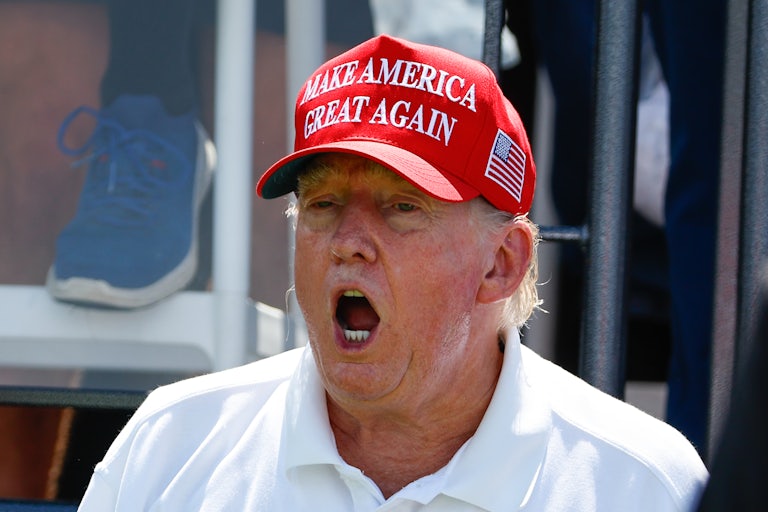
Trump at the Trump National Golf Club in Bedminster, New Jersey, last week

Donald Trump is reportedly planning an immigration crackdown that would make his first stint in the White House look tame.

Axios reports that Trump, if elected in 2024, is planning to increase ideological screenings of immigrants to prevent “Marxists” from entering, to designate drug cartels as “unlawful enemy combatants,” and to expand the “Muslim ban” to more countries.

“For those passionate about securing our immigration system ... the first 100 days of the Trump administration will be pure bliss—followed by another four years of the most hard-hitting action conceivable,” Stephen Miller, the anti-immigrant architect of Trump’s first term, told Axios.

Designating drug cartels as “unlawful enemy combatants” would provide a legal justification for the United States military to target them in Mexico—or so Trump imagines. It would also significantly raise tensions between the U.S. and Mexico, to say the least.

Trump also plans to complete his precious border wall, grow the dangerous floating barriers in the Rio Grande, deploy the Coast Guard and Navy to create a sea blockade to stop drug smugglers, and end “birthright citizenship” for children born in the U.S. to undocumented immigrants. These ideas and more stand a better chance of surviving court challenges given that the Supreme Court has become even more conservative since Trump’s first term.

Trump hopes to use the Alien Enemies Act—a long-forgotten section of the Alien and Sedition Acts of 1798—to quickly deport gang members, smugglers, and criminals by claiming a border “invasion” and designating people from certain countries as “alien enemies.” He also wants to make it easier to deport people and would use the FBI, DEA, and perhaps even the National Guard to find undocumented immigrants.

Trump’s plan would rush “people through the system, stripping due process protections from them, eliminating any access to legal services, and really transforming this into an assembly line deportation machine,” the American Immigration Council’s Aaron Reichlin-Melnick told Axios.

Mike Pence and Mark Meadows Just Ruined Trump’s Defense in Classified Docs Case

The former president appears to be caught in a huge lie.

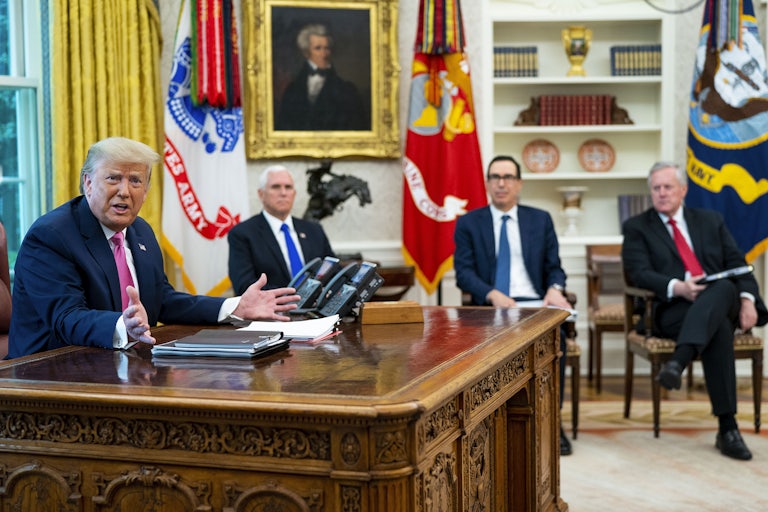
Trump in the Oval Office with (l-r) Mike Pence, Steven Mnuchin, and Mark Meadows
Doug Mills/Pool/Getty Images
Trump in the Oval Office with Mike Pence, Steven Mnuchin, and Mark Meadows on July 20, 2020

Former Vice President Mike Pence and former White House Chief of Staff Mark Meadows said on Sunday that they had no knowledge of then-President Donald Trump declassifying a large number of documents, completely undermining the former president’s main defense in the Mar-a-Lago case.

Special counsel Jack Smith indicted Trump for allegedly mishandling classified documents at his Mar-a-Lago estate. Trump’s main argument for his innocence is that as president, he could declassify whatever material he wanted. His allies had previously argued that he had a standing declassification order that would immediately declassify any document removed from the Oval Office. Trump himself claimed he could declassify things “just by thinking about it.”

But Pence and Meadows, two of Trump’s closest advisers in the White House, say differently. “I was never made aware of any broad-based effort to declassify documents,” Pence told ABC on Sunday.

Pence was quick to add it’s possible a sweeping declassification did happen without his knowledge. But his comments match Meadows’s testimony to Smith. Meadows told Smith’s investigators that he does not remember Trump ever ordering or even discussing declassifying huge swathes of classified documents, ABC reported Sunday, citing anonymous sources. Meadows also said he was unaware of any “standing order” to automatically declassify documents taken out of the Oval Office.

ABC also saw an early draft of the prologue to Meadows’s memoir about serving as Trump’s chief of staff. Meadows mentions a meeting Trump had at his Bedminster, New Jersey, club with Meadows’s ghostwriter and publicist, but not Meadows. The prologue mentions Trump had a classified war plan on the couch in his office, in plain view. Meadows later removed that detail because he knew it would be “problematic,” according to ABC.

This is the same meeting where Trump himself admitted he knew all his talk about automatic declassification was bunk. In an audio recording of the July 2021 meeting, Trump admits he had classified material and could not declassify it because he no longer holds office.

In the recording, Trump claims he has a big pile of papers that undermine previous reports that Chairman of the Joint Chiefs of Staff Mark Milley had convinced Trump not to attack Iran near the end of his presidency. Trump refers to one document as if he has it in front of him, and at one point there is the sound of paper rustling as if he was showing off the document.

According to the recording transcript, Trump says, “This totally wins my case, you know. Except it is, like, highly confidential. Secret. This is secret information.”

“As president, I could have declassified, but now I can’t,” he admits.

In addition to Pence and Meadows, 18 other former administration officials have said they knew of no standing declassification order. These officials include former Chiefs of Staff John Kelly and Mick Mulvaney. Notably, Trump’s lawyers do not mention a standing order in court documents because they could be penalized for making false statements.

Twitter Could Be Erased From App Stores If Elon Really Scraps Block Feature

This may be one of Elon Musk’s worst ideas yet.

Nathan Laine/Bloomberg/Getty Images

Elon Musk on Friday declared he wants to remove the block feature on X, the social media site formerly known as Twitter—despite frequently using the block button himself.

There’s also one other big problem: Musk’s desire to limit this blocking feature could also cost X its spot in various app stores.

The Tesla CEO said he wants to remove the block option, in response to discourse surrounding the difference between blocking versus muting users on the app.

“It makes no sense,” he wrote. “Block is going to be deleted as a ‘feature’, except for DMs.”

Muting allows you to remove another user’s posts from your feed without unfollowing them, but blocking allows you to remove that user’s posts from your feed while also restricting contact and their ability to see your posts.

If Musk goes through with his promise, X may be removed from Apple’s App Store. The current guidelines state that apps with user-generated content must provide features such as blocking to protect users from abusive users on apps.

Google’s Google Play enforces similar user-generated content safety protocol.

“Apps that contain or feature UGC, including apps which are specialized browsers or clients to direct users to a UGC platform, must implement robust, effective, and ongoing UGC moderation that ... provides an in-app system for blocking UGC and users,” according to Google’s policy center.

If the block feature is only allowed for private messaging on X, users will also likely be at a higher risk of experiencing harassment or viewing harmful content on their timeline.

Musk has a history of using the block feature and even banning users from the app. Although Musk claims to be an advocate of free speech, he has banned numerous journalists from X. Earlier this week, a Washington Post report found that X has throttled traffic for social media competitors such as Threads and Substack, as well as news sites Musk simply doesn’t like.

This article has been updated.