Newsletter
Power Mad
A weekly review of the rogues and scoundrels of American politics

Democrats Are Wasting Tens of Millions of Dollars in California’s Senate Race

The primary campaign for Dianne Feinstein’s seat has become a donor sinkhole. That money is better spent elsewhere.

Justin Sullivan/Getty Images
California Governor Gavin Newsom

There’s a new senator in Washington, D.C., this week: Laphonza Butler, a former president of Emily’s List, was tapped by California Governor Gavin Newsom to fill out the term of the late Dianne Feinstein. Butler’s path to the Senate—where she will be the lone Black woman in the upper body and the first to call that chamber home since Vice President Kamala Harris—was partly due to a set of baroque promises Newsom made in advance of Feinstein’s death: to select a Black woman for the post and to not select any of the Democrats already running for the seat in 2024, so as to not play favorites.

It is perhaps in furtherance of that latter pledge that Newsom roamed rather far afield to tap Butler, who resides in Maryland as opposed to California. But his apparent intention to pick a placeholder seems not to have been made clear to Butler herself, as she has not ruled out running to retain the seat.

So that’s something of a whoopsie! But it’s not the main reason that Newsom perhaps should have put his finger on the scale: The California primary for U.S. Senate has become a black hole of Democratic donor money, to the exclusion of what could be more consequential races.

Opportunities to become California’s senator have been in short supply in recent years, so it’s not a surprise that this race, in a state known for pricey political contests, was expected to become the most expensive Senate race in history. But now, as a result of Feinstein’s death, there will be not just the usual primary and general election next year but also special elections—meaning that donors normally constrained by maximum allowances will be permitted to double-dip for their favored candidates.

California Representative Adam Schiff already has raised what I would charitably call an unreasonable—perhaps even unspendable—amount of money. Axios reported in July that Schiff had almost $30 million in hand—“more than any other federal candidate, including for president.” After that figure ticked up slightly in the most recent fundraising quarter, Aaron Kleinman, the director of research at the States Project, made a canny observation: “In other words he has more cash on hand for a race Democrats are guaranteed to win than every single Democrat running for the Virginia House (which either party could control after November) has combined.”

The importance of the Virginia elections is clear: Democrats could stop the political career of Virginia Governor Glenn Youngkin—who is term-limited in the Old Dominion and said to be weighing a presidential run based on how Virginia Republicans fare in November—in its tracks. Democrats also have a generally daunting Senate map in 2024, and a highly competitive gubernatorial contest in Kentucky on the wing.

This is not to say that the California primary isn’t worth Democrats’ attention. People have some passionate, principled, and well-informed opinions of who among that field—which Schiff has largely led over Katie Porter and Barbara Lee, according to the scant polling that’s been done—should be Feinstein’s successor. I’ve no doubt that I could develop my own ideas on the matter if I took as much time as those with a vested interest. That doesn’t really change the fact that Democrats are going to retain this seat and that the differences between these candidates will largely fade into the grayscale once a winner is seated.

Which is why I wish Newsom, who seems to harbor ambition about becoming a national leader of his party, had taken a stab at ending this primary himself. He could have given the nod to Schiff and called a halt to the implacable donor arms race. Barring that, he could have just fully honored his commitment to upping the representation of Black women in the Senate by tapping Lee, who was already running. That might not have sent a strong enough signal to turn off the money spigot, but it would have sent a worthy message to the backbone of the Democratic Party.

Realistically, Newsom is too calculated to have seriously considered doing all that. His pledge to stay out of the fray was probably less about keeping the spirit of fair competition alive than about not wanting to stick his neck out, only to have California voters chop it off. But those who are, or aspire to be, Democratic standard-bearers ought to be thinking about the party’s needs across the country, and that means not encouraging a donor sinkhole in their own backyard. There are more critical elections and bigger prizes on which that boodle is better spent.

Democrats have, in recent years, demonstrated the tendency to dream a little too big and pile untold sums of campaign cash in the coffers of a litany of no-hopers. That’s not what’s going on here. But if Democrats are not careful, they could screw up from the opposite direction, denying critical resources to winnable races in the service of a seat they’re destined to get anyway. It’s time to stop emptying your wallets on this Senate primary and let these wannabe senators from California fend for themselves.
This article first appeared in Power Mad, a weekly TNR newsletter authored by deputy editor Jason Linkins. Sign up here.

The Looming Government Shutdown Is Not the Fault of Dysfunction

There’s only one culprit for the chaos gripping Capitol Hill—the Republican Party.

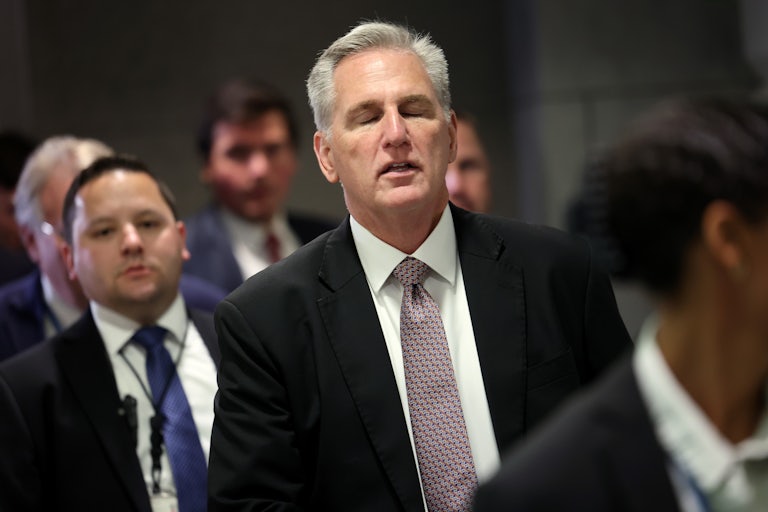
House Speaker Kevin McCarthy grimaces as he walks to another meeting with the House Republican caucus.
Kevin Dietsch/Getty Images
House Speaker Kevin McCarthy grimaces as he walks to another meeting with the House Republican caucus.

Former House Speaker Nancy Pelosi tends to get a lot of grief whenever she offers her opinion about how the country needs a “strong Republican Party,” but I think that what’s currently happening on the GOP side of the House of Representatives is probably what she had in mind. There, the scene has devolved over the past week into the parliamentary equivalent of a Superfund site. It’s become rivetingly clear that Kevin McCarthy’s charges are hurtling toward a spectacular self-own—and a government shutdown. A slew of inconveniences and vaporized economic activity are about to land, hard, on ordinary Americans.

If history is any guide, it also means that political woe is on the way for the GOP. As Senate Minority Leader Mitch McConnell told reporters this week, shutdowns have “always been a loser for Republicans—politically.” But McConnell, who is clearly still capable of dispensing effective strategic advice in between his harrowing health episodes, is likely to go unheeded.

What help can be offered to a party that can’t help itself? Democrats partially powered their 2020 presidential campaign on the notion that Joe Biden cast a long, collegial shadow over Washington and was just the figure to help a wayward Republican Party break the fever that had engulfed it during the Trump years. But as Biden became more familiar with the Republicans he’d be working with, his opinions on the matter shifted rather dramatically. He ended up helping to author a successful midterm message that captured the GOP as they are: autocratic and beyond redemption. As McCarthy’s untamed hooligans steer the ship of state toward the chop, Democrats would be wise to stick with this instinct. They’re already doing the best thing they can do in this situation—nothing at all.

If there’s anything that Democrats should emphasize about the looming government shutdown, it’s the essential Republican-ness of it all. This shutdown is the pure product of the modern GOP, packed with antisocial weirdos and redolent of their inability to govern themselves or anyone else. Here, Democrats may have to joust with a media that vastly prefers to pin this kind of dysfunction on mushy concepts like polarization, or point the finger of blame—more nebulously—at “Congress,” as The New York Times did in a limp headline last week. More recent reporting has, happily, hit the ball more squarely, properly identifying “Republican infighting” as the proximate cause of the impending calamity.

To say that the GOP has lost the plot is perhaps an understatement. As The American Prospect’s David Dayen pointed out this week, the debate that Republicans are having with themselves has lapsed into pure abstraction, in which members of the party are now “arguing with each other over how much funding to cut in a one-month stopgap continuing resolution—not the budget itself.” Meanwhile, every sentient life-form knows that cuts of any kind make it a nonstarter with Democrats in the Senate, and the Oval Office.

But the prospect of Republicans troubling Democrats with some fruit of their legislative labors is a long way off, as their blockheaded negotiations have yet to yield anything that’s not a nonstarter with one another. Here, the GOP has flopped in operatic fashion: a Freedom Caucus–wrought deal immediately got spiked this week as a “giveaway to Joe Biden” by other members of the Freedom Caucus. How, exactly, is a budget proposal that Biden would veto instantly a “giveaway” to him? Don’t worry: No one in the GOP knows the answer to that question!

This entire exercise in self-torture really has little to do with line items on a budget spreadsheet. This is all just a primate dominance ritual: a steroidal sequel to the government shutdowns of the Obama era, in which Republicans convinced themselves that bringing Washington to a crashing halt could break the White House’s will. The only new twist on this old formula is that I’m pretty sure that, as far as the Republicans driving us into a ditch are concerned, Joe Biden is a secondary concern, if not an afterthought. Republicans are well and truly into their Lord of the Flies era, fully engulfed in the internecine purity-test battles I predicted were on their way. But not even McCarthy promising an impeachment inquiry was able to buy him enough goodwill to simply keep the government running.

It’s hard to see how any of this ends. Republicans seem bent on playing stupid games for the privilege of winning stupid prizes, with the most stupid prize of all being the poisoned chalice of the House speakership. Yes, Kevin McCarthy may finally be forced out of what has become the worst job in all of Washington—and the biggest problem that those threatening to knock McCarthy from his perch face is that one of them will have to take his place.

What Democrats should do now is simple: Do not interrupt this. There’s no need to get involved. What Republicans are enduring can’t be solved by rational people appealing to better natures that don’t exist. The only way out is for the GOP to eat shit, every day, until their bellies are full. Yeah, it’s possible that some dumb pundit will come along, afflicted with a terminal case of what Dayen calls “Washington brain,” to try to convince Democrats to “blink and offer concessions to avoid a shutdown.” The only thing Democrats should throw Republicans’ way is the old military acronym, KMAGYOYOKiss my ass, guys, you’re on your own.

This article first appeared in Power Mad, a weekly TNR newsletter authored by deputy editor Jason Linkins. Sign up here.

Good Luck With Your Pro-Life “Rebranding,” Dummies!

The anti-abortion movement has grown too radical to be tamed by a bunch of Washington elites playacting as marketing consultants.

Allison Shelley/Getty Images

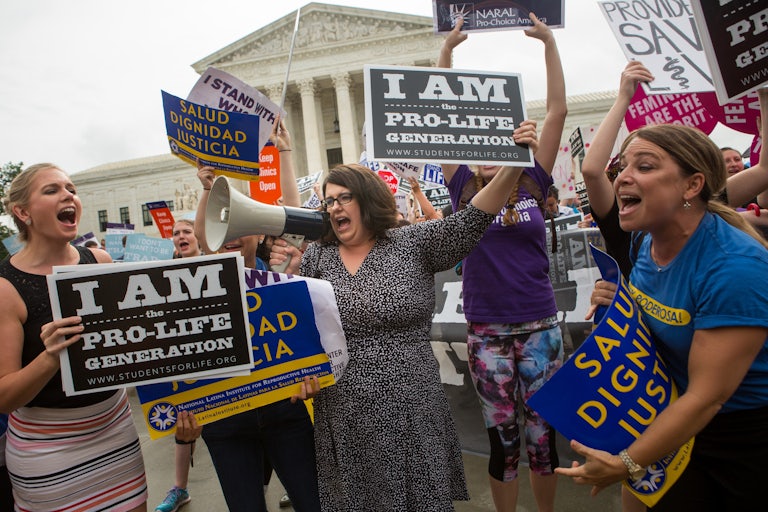
It would appear that anti-abortion conservatives are starting to come around to the realization that when the Supreme Court gutted Roe in its 2022 decision in Dobbs v. Jackson Women’s Health Organization, the Republican Party became the protagonist in the classic tale of “The Dog That Caught the Car.” As The Hill contributor B.J. Rudell put it, the pro-life movement had it pretty good for about 50 years, residing “in a self-made and self-contained cocoon, operating with equal parts political savvy and practical ignorance.” As long as its great dispute was a live issue—a political Schrödinger’s box that would remain a potent electoral motivator so long as it stayed closed—the movement could reap the benefits of its unrealized vision.

But once Samuel Alito and his fellow travelers peeled the box open, the world got a good long stare at the dead cat inside. The post-Dobbs landscape has been a regularly scheduled litany of dystopian one-offs—here’s a woman forced to travel 1,400 miles to deliver a skull-less fetus; there’s a woman who nearly died because she could not obtain a medically necessary abortion—peppering the steady, ambient worsening of the world: the obstetrics positions going unfilled, the measurable rise in health inequity, the “ominous health trends” that rose up, spawned in the wake of the Supreme Court’s decision to undo the modern world.

And did I mention that on top of all of this, the Dobbs decision is implicated in the consistent way that Republicans keep getting rinsed at the polls? It’s no wonder that elite conservatives have recently decided that the real problem here is the need to rebrand the term “pro-life,” not the myriad horrors that have been unleashed since the movement that sallied forth under that banner 50 years ago finally got all the things it wanted.

Right now, this “rebranding” effort is at the stage where various Republicans say staggeringly obvious things with the absolute wonder of a wee child. “What intrigued me the most,” said North Dakota Republican Senator Kevin Cramer, “was that ‘pro-choice’ and ‘pro-life’ means something different now; that people see being ‘pro-life’ as being against all abortions … at all levels.” Wow, no shit—that truly is a remarkable state of affairs! His Senate colleague Josh Hawley choked out some similarly incredulous words in a recent interview: “Most voters think [‘pro-life’] means you’re for no exceptions in favor of abortion ever, ever, and ‘pro-choice’ now can mean any number of things,” he said, adding, “So if you’re going to talk about the issue, you need to be specific.”

But as TNR’s Tori Otten pointed out, we can actually be excruciatingly specific about what Republicans want, and it’s pretty much entirely indistinguishable from “no abortion, ever, ever,” and not so much something that a few hasty marketing summits among GOP bigwigs is going to be able to obscure. “Since Roe was overturned,” Otten reported, “Republicans have banned abortion completely in 14 states. In many other states, Republicans have limited abortion access with cruel laws to the point that the procedure is effectively banned anyway.” The would-be rebranders are lagging badly behind the curve: Across the country it didn’t take long for the right to push hard for draconian bans after Dobbs was handed down. The plain truth is that when the next Republican trifecta hits Washington, many of them will be pushing hard to pass a nationwide abortion ban.

This is the biggest problem that those who are so desperate to “rebrand ‘pro-life’” face right now: This is a movement that’s largely defined by the zealots in its ranks. You’re not going to be able to exert control over a nation of anti-abortion radicals with a Central Committee to Temper Our Excesses and Lessen the Completely Foreseeable Consequences of Our Actions. Wherever those fanatics hold a little bit of untrammeled power, they’re doing headline-grabbing things to get attention and advertise exactly what they want the post-Roe landscape to look like.

Take, for example, the extremists who’ve brought so-called “abortion trafficking” laws to several counties in Texas. As TNR’s Melissa Gira Grant recently reported, political leaders in these jurisdictions have breathed new life into laws over a century old, in the service of incentivizing vigilantes to patrol Texas highways, looking for women who might be seeking to leave the state to receive abortions, in order to detain them for cash rewards. Or take the “pro-lifers” in Oregon who, far from getting their cues from Washington elites urging circumspection for the sake of winning elections, are plowing ahead to the next frontier and looking to ban contraceptives next—just as one could have predicted (and did).

Josh Hawley, Kevin Cramer, and the rest of the people trying to slap a new name on “pro-life” are simply not going to cow this movement into submission with a PowerPoint presentation on the value of adopting a more palatable brand identity—not after they’ve already spent a wild-eyed half-century howling for an unpopular set of draconian policies to be imposed on the country. And so the Republican Party will continue to be defined by its militants, not its marketers. Yes, this could contribute greatly to future Democratic wins at the polls, as an agitated public sends more protectors of abortion rights to office. But this should give us pause nonetheless—because wherever the pro-life dead-enders can hold on to even a little bit of political power, they will continue to advance their tyrannical vision, inch by inch, and in their wake damage the lives of a yet-to-be-counted number of ordinary Americans—leaving a trail of ruin that no rebranding can redeem.

This article first appeared in Power Mad, a weekly TNR newsletter authored by deputy editor Jason Linkins. Sign up here.

How Badly Will the Media Botch the Trump Trials?

There’s a good chance the political press will create a circus out of the former president’s legal entanglements and then blame the people trying to hold him accountable.

Steven Hirsch/Getty Images

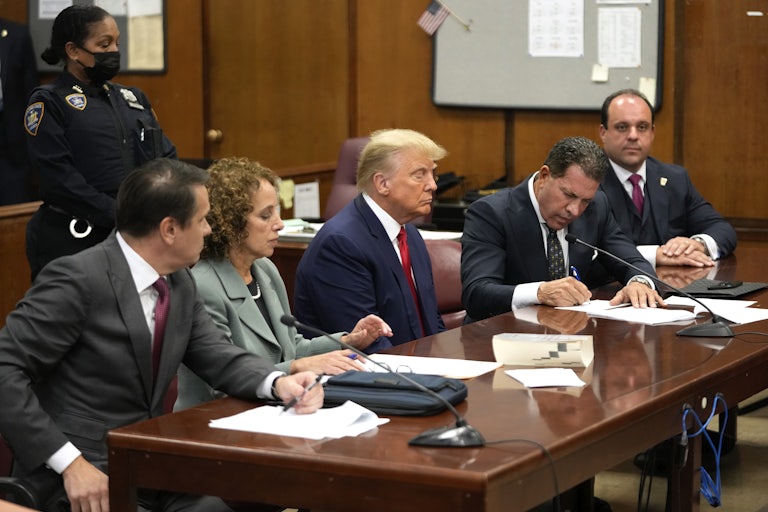
Donald Trump may have spent the past year creaming his wan Republican competition in the polls, but the news has not been all wine and roses for the former president—at least not in America’s legal venues. He has collected a scavenger hunt’s worth of indictments and faces a formidable calendar of dates as a professional defendant. What Trump is about to endure has few historical precedents—limp comparisons to Eugene V. Debs notwithstanding. This is shaping up to be a strange campaign, fought on large patches of undiscovered country.

But even as we fantasize about the consequences catching up with Trump, it must be said that once again he has us right where he wants us: at the center of a newshole that he is dominating. The Man Who Ate the Discourse is back, devouring whole news cycles, his attendant Gorpmans and Bleemers hopping in and out of the headlines. And with the news that the Georgia trial will be televised—for months on end—the potential for a feeding frenzy seems likely. But should this become a demented spectacle, remember: It’s not the fault of those who are seeking to hold the former president to account.

It’s not out of the realm of possibility that the media will either catastrophize the effort to hold Trump accountable or turn the justice-seekers into the villains of the story. The campaign trail is long and dull, and this time out it will wind through numerous courtrooms, in which Trump will be arrayed against a constantly shifting cast of “opponents.” Ever on the hunt for the mythical “balance” that they believe defines pure, mountain-grown political coverage, the press may well endeavor to cover these trials neutrally, as opposed to fairly—that is to say, to locate some imaginary middle ground between a criminal and his victims to defend, instead of considering the substance of the matter.

In a recent piece for The Wall Street Journal, Peter Funt convincingly argues that the transparency gained from televising the trials offsets whatever media circus is created. But along the way, he identifies a litany of concerns that we might soon hear spilling out of the hyped-up mouths of the hand-wringers on your local cable news panel—that the substance of the cases against Trump will be lost amid the grandstanding, cheapening the whole affair and thus contributing to an overall erosion of faith in the judiciary.

As Funt reminds, some fairly dubious theories about Trump have already been marshaled to argue that this moveable media feast will prove disastrous, such as the belief that the former president is some kind of inimitable maestro of the televisual arts and the idea that all of these indictments are a secret boon to his campaign. I am sorry to use this particularly overused term, but these notions are all just vibes. None of it is tethered to a quantifiable reality. It is clearly preferable to not get indicted, four times over, if you want to run for president. And Trump’s reputation for being some kind of teevee trickster all stems from the fact that he has benefited immensely from promiscuous cable news coverage.

Trump’s also already benefiting from some early carping about the media circus that’s lying over the horizon. Last week, New York Times columnist Ross Douthat complained about the logistics of Trump’s federal trial—the one in which he’ll face charges for conspiring to overturn the 2016 election. At issue was Judge Tanya S. Chutkan’s decision to begin proceedings on March 6 of next year, the day before Super Tuesday. This, to Douthat’s mind, was an “extremely suboptimal convergence.”

“If you take the judicial process seriously,” he wrote, “then clearly under ideal circumstances the trial of a major presidential contender would be completed before voters begin passing judgments of their own.” Well, sure? But what is Judge Chutkan supposed to do about this? As writer Tom Scocca pointed out in his newsletter, Chutkan had to fit her obligations into a calendar already crowded with Trump trials: “The only way to keep one or another of Trump’s trials from happening during a sensitive part of the primary season is by pushing things back into a sensitive part of the general election season.”

Yes, it’s true, these are suboptimal choices, all the way down. Court dates are mashing up against court dates, which in turn are abutting important dates on the primary calendar. I think one thing that maybe every party involved in these matters can agree on is that none of this is ideal. But who, then, should fill the blank space that Scocca locates in Douthat’s argument, the person to whom the “blame, formless and insinuating,” should attach?

Here’s a thought: Maybe it’s Trump’s fault! Trump’s allies keep darkly muttering, “If they can do this to Trump, they can do it to you too.” And my response is: “Well yes, that’s the whole point!” My one neat trick for avoiding indictments charging me with trying to overturn an election is to not try to overturn an election. And in the parallel universe where Trump had offered a dignified concession, no one’s worried about whether his federal trial is too close to Super Tuesday. It was a failure of accountability that gave rise to the media circus that’s coming down the pike. Maybe a strong dose of it will actually end this spectacle once and for all.

This article first appeared in Power Mad, a weekly TNR newsletter authored by deputy editor Jason Linkins. Sign up here.

The Real Crime Isn’t Shoplifting—It’s Wage Theft

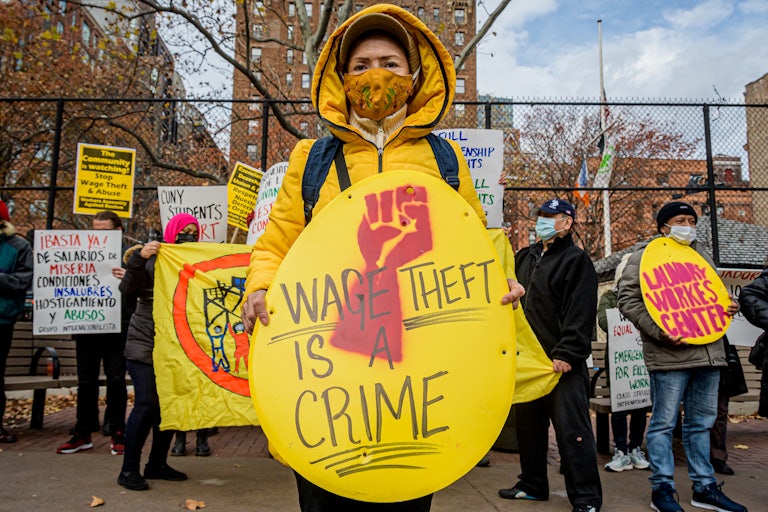
Why has the media gone all in on small time scofflaws when organized financial crime is robbing people straight from their paychecks?

Erik McGregor/Getty Images

Last weekend, I stumbled across a viral tweet thread that provided a rather thorough debunking of one of my big bugbears: the insipid shoplifting panic that’s been coursing through the media the past two years. Over several posts, WBAI radio host Rafael Shimunov punctures what’s become a classic “too good to check” story and discovered that many of the foundational ideas behind what’s been sold as a bona fide crisis were falsehoods—and not particularly well-constructed ones at that.

Once the evidence was sorted and the numbers run, Shimunov estimated that the total cost of our shoplifting horror show amounted to “seven cents per 100 dollars in losses.” The real “shoplifting crisis,” in fact, may be simply the way this nonstory has become so indelibly imprinted in the zeitgeist: Shimunov, after all, was pulling his evidence largely from a Los Angeles Times article from 2021, one of many pieces that explored these claims and found a hoax at the center instead. What will it take, then, to dislodge this falsehood from the public consciousness? Perhaps what we need here is a better enemy—and if the public wants a pound of flesh from a gang of conniving thieves, I’ve got one: corporate America’s runaway wage theft.

Unlike shoplifting, this is not a penny-ante crime, and it’s carried out every day with the ruthless efficiency of the boardroom. An L.A. Times column of a more recent vintage, courtesy of Michael Hiltzik, tells a fuller story. He enumerates many ways in which employers pull their own coordinated smash-and-grab jobs on their employees’ paychecks: “They may pay workers less than the legal minimum wage, fail to pay overtime, deny workers legal meal breaks or rest periods, divert workers’ tips, or require them to work off-the-clock to prepare for their shifts or to perform duties after their shifts have ended.”

And those are some decidedly old-school techniques. The “one neat trick” to screwing workers in today’s gig economy is simply to misclassify them as independent contractors, “thus sticking the workers with expenses that would be covered for employees.” All in all, the true cost of wage theft amounts to something substantially north of chump change: A 2014 study from the Economic Policy Institute “a nationwide epidemic that costs American workers as much as $50 billion a year.”*

Moreover, a 2021 study from the Center for Public Integrity found that while firms that “hire child care workers, gas station clerks, restaurant servers and security guards are among the businesses most likely to get caught cheating their employees,” wage theft is a way of life at “many major U.S. corporations.” One such scofflaw that gets top billing in Hiltzik’s column is Home Depot, which in June settled a class-action lawsuit over wage theft to the tune of $72.5 million. That the firm’s former CEO Bob Nardelli was recently on Fox Business hyping up the threat of shoplifting is enough to make a cynic wonder: Is he fomenting public fear over an urban legend to distract from the real thieving?

Fortunately, in some quarters, wage theft is being treated with the seriousness it deserves. Just this week, ProPublica produced a blockbuster report on wage theft in New York City, finding that from 2017 to 2021, “more than $203 million in wages had been stolen from about 127,000 workers in New York.” And Documented, which partnered with ProPublica to produce the piece, this week launched its Wage Theft Monitor, which allows anyone to dig down into the data of who got ripped off and who did the stealing.

Under Biden, the Labor Department—whose acting secretary, Julie Su, made her name helping workers keep their hard-earned money from being pilfered by their bosses—has been frisky in the fight against wage theft. Last October, the agency reversed a Trump-era rule that permitted gig-economy employers to misclassify their workforce. A month later, an agency investigation led to Krispy Kreme paying $1.2 million in damages and back wages to more than 500 workers who’d been denied overtime. And this week, the department extended overtime protections to 3.6 million workers, the estimated equivalent of an additional “$1.2 billion in employees’ pockets, both in the form of more overtime pay and also salary increases by employers to ensure their white-collar workers will be exempt from the new rules,” according to the L.A. Times.

Naturally, we’ve a ways to go before all of the money that corporations have absconded with is back with whom it belongs. Perhaps the biggest policy change we could make in support of that effort, as TNR contributing editor Osita Nwanevu has written in the past, is to pave the way for worker ownership of firms. In the meantime, however, whenever you hear about a shoplifting crisis, remember that the actual theft isn’t occurring in the aisles of your nearby chain stores; it’s occurring in their boardrooms.

* This article originally linked to the wrong EPI study.

This article first appeared in Power Mad, a weekly TNR newsletter authored by deputy editor Jason Linkins. Sign up here.