Newsletter
Power Mad
A weekly review of the rogues and scoundrels of American politics

Biden’s Democracy Argument Worked

The pundits thought the Democratic Party’s closing argument for the midterms was going to end in certain disaster. Swing and a miss!

Alex Wong/Getty Images

In the last two weeks of the election cycle, as the news seemed to be getting worse and worse for Democrats hoping to avoid a historic midterm election shellacking, party leaders opted to go all in on one particular theme—that democracy itself was on the ballot. Here, voters had a historic choice to make: Vote to save the republic, or squander it. Across the aisle, the GOP had marshaled an army of candidates behind election denialism and a vision of an illiberal United States. In his final campaign speech, President Joe Biden told the crowd assembled at Bowie State University in Maryland that the country was at “an inflection point.”

“We know in our bones that our democracy is at risk, and we know that this is your moment to defend it, preserve or protect it, choose it,” he said.

It was a tall order. And let’s face it, it was a little bit belated. As we’ve chronicled on these pages, Democrats haven’t always spent the past two years as democracy’s most ardent defenders. Too many senators preferred to keep the filibuster rather than get rid of it to pass the laws necessary to confront a well-organized and well-funded effort among Republicans to curb voting rights across the country. Even the Biden administration seemed dismissive at one point, referring to voting rights as just one more niche issue among many.

But when Democrats finally put the defense of democracy front and center in their midterm messaging, the wave of skepticism from the media wasn’t rooted in any past failures or prior fecklessness. Rather, it was spawned by the pundit class’s disbelief that demonstrating fealty to the ideals of our Founders was the correct thing to do to win an election.

CNN’s Chris Cillizza called Biden’s defense of democracy oration a “head-scratchingspeech and “a strategic blunder given what we know about the electorate and its priorities.” Meanwhile, Politico’s Playbook called it “important” but “puzzling” and gave a wide array of voices the freedom to criticize the decision on various grounds, from the fact that the president had already given a widely reported speech on the same subject some weeks before to the concerns of Democratic strategists like David Axelrod, who thought that “as a matter of practical politics, I doubt many Ds in marginal races are eager for [Biden] to be on TV tonight”—the idea being that his poor approval ratings made him a dubious messenger in any event.

In truth, you wouldn’t be thought entirely daft if you fretted that Democrats were, at the very least, talking over the heads of the electorate. Polls ahead of the midterms consistently showed that matters such as the January 6 attacks weren’t foremost on people’s minds; democracy defense seemed like a bad bet. But the exit polls told a different story. Per Axios: “National polling showed abortion and democracy turned out to be big issues with voters. Coverage in the run-up to midterms had focused heavily on pocketbook issues.” In other words, the Democrats’ plan worked, and the media whiffed badly in their read of the electorate’s mood.

For all the anxiety over Biden’s approval ratings, no one seemed to have considered whether the vision of the future of democracy that the GOP spent the year articulating wasn’t even more toxic. This is a party that’s embraced book bans and LGBTQ discrimination, bomb threats at children’s hospitals, and Proud Boys terrorizing drag performers. They’ve discarded the legal roots of the right to an abortion and are eyeing doing the same thing to contraception and marriage equality. Republicans have embraced violent QAnon adherents and become Viktor Orbán fanboys. Does any of this sound like the stuff normie America wants?

And if you want to talk about polarization, let’s talk about how polarizing young voters found the GOP’s message. According to exit polls, voters between the ages of 18 and 29 broke for Democrats by a margin of 63 to 35. This makes sense: Every conservative denunciation of “wokeness” is, at bottom, a proclamation that Republicans shall not allow the youngest Americans to live the lives they want; their massive effort to suppress the vote is, in the end, just a plan to deny the youngest Americans their right to shape the nation they’re inheriting just as they’re becoming regular voters.

Still, I think a lot could have gone wrong with the way Democrats messaged around a defense of democracy. When Biden trotted out “ultra MAGA” some months ago, I worried he was more likely to energize the opposition than rally his own troops. But more recently, I heard one of Pennsylvania Governor-elect Josh Shapiro’s final campaign speeches, and I realized just how much power this closing argument could marshal.

I’m not letting Doug Mastriano take away your vote.… That is not how things work in this commonwealth or in this country. That’s not how our democracy works, and that’s not what freedom is all about.

This guy loves to talk a good game about “freedom” all the time. Right? We’ve heard that. Let me tell you something: It’s not freedom to tell women what they’re allowed to do with their bodies. Right? That’s not freedom. It’s not freedom to tell our schoolchildren what books they’re allowed to read. That’s not freedom. It’s not freedom to tell workers they can work a 40-hour workweek but they can’t be a member of a union. That’s not freedom. And it sure as hell isn’t freedom to say, you can go vote, but he’s gonna pick the winner. That’s not freedom. That’s not how we do things here in Pennsylvania.

This is the way to talk about democracy: not as something that only started mattering because Donald Trump came along to piss on it but as the great provider of the gifts of the good life—prosperity, stability, and dignity. Democracy is also something that has enemies, who should be cheerfully and confidently named and shamed.

Obviously the fight is far from over; lots of illiberal Republicans won this week. And now that democracy is “off the ballot,” Democrats need to help everyone who cast a vote to preserve democracy find new and creative ways to tend to it in all the days that come between elections. But we can put any skepticism about the “message” to bed. The fight for democracy is a good fight, and it’s good that the right people found a way, while facing long odds, to draw a line in the sand and punch the bullies in the mouth. More of this, please!

An earlier version of this article first appeared in Power Mad, a weekly TNR newsletter authored by deputy editor Jason Linkins. Sign up here.
Will Elon Musk Ruin Twitter? That’s the Wrong Question.

The Tesla mogul has taken up ownership of a company that may not have much of a future with or without him.

Twitter account of Elon Musk/Getty Images
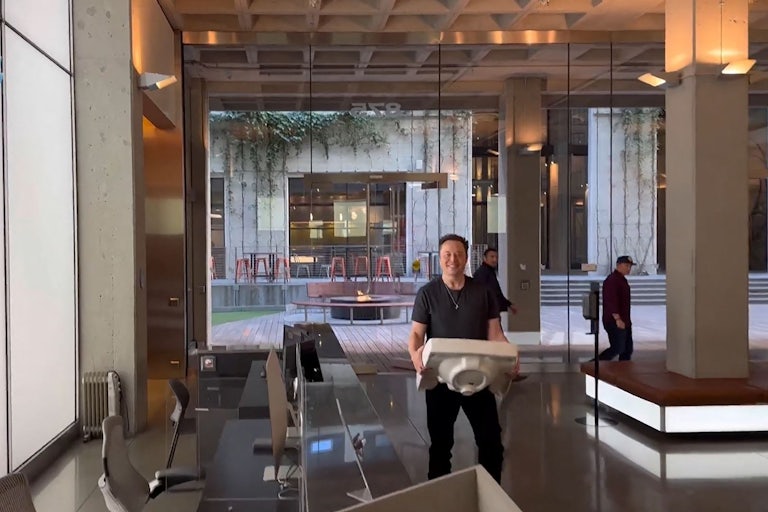
Elon Musk visits Twitter’s San Francisco headquarters.

Tesla founder and professional online griefer Elon Musk paid a visit Wednesday to Twitter’s San Francisco headquarters, carrying a sink to execute a visual pun I won’t condescend to explain here. This was the beginning of a significant week in the life of Musk and the company. The headline-making deal that has left the venerable social media firm in his hands has, after fits and starts, come to fruition. Employees were invited to say hello to Musk as he swanned about the building—a dicey proposition given that Musk had announced that he’ll be shedding three-quarters of the firm’s workers as one of his opening moves.

As Musk neared the completion of a transaction that he may end up regretting, there was a lot of “last week of Twitter” talk circulating. The fears are not entirely unfounded: If Musk carries out his planned purge, people more deeply invested in knowing how Twitter works predict that the move will likely have a “major impact” on the company’s “ability to control harmful content and prevent data security crises.” Of course, for all anyone knows, Musk won’t gut the workforce in this fashion—in fact, while he immediately made a series of splashy firings, he already appears to be walking back this threat. This is typical Musk: His favorite commodity to manufacture, after all, is bravado, which is probably why he wants to be the “chief twit” at the internet’s biggest hot-take mill. It’s very possible to overstate Musk’s malevolence. But as I listen to the doomsaying, I’m reminded that it’s equally possible to overstate Twitter’s importance.

What does it actually mean for Twitter to “end”? Is it going to be like when Friendster ended? Is it going to be like when we all stopped using manual typewriters? If and when Twitter meets its final demise, it stands to reason that we’ll not easily replace it. As Garbage Day’s Ryan Broderick notes, there aren’t “any platforms well-established enough to collect Twitter refugees all at once,” and there’s no guarantee that one will. Twitter has, over time, accreted a bunch of different functions that make sense in its skin but aren’t necessarily worth another company replicating. “Historically,” Broderick argues, “the exact features of a dead platform never really come back.”

But it’s one thing to feel wistful about the platform that allowed us all to gasp together when Will Smith smacked Chris Rock in the face; another thing entirely to feel anxious about the possibility that this one may fall into crapulence. I think that most of these fears are based on a misapprehension that Twitter is some kind of manifestation of “the public square”—something that Musk himself still seems to believe as well (though his vision for this public square is less content moderation and more advertising, two ideas he does not understand are in tension with each other).

Here’s the good news, however: Twitter isn’t a “public square.” I don’t mean to downplay the way this platform can and sometimes does have uplifting effects on people’s lives and careers. But you can’t have a public square without the public, and the public has proven itself to be very resistant to Twitter’s charms. A study by Pew Research found that fewer than one-quarter of U.S. adults use Twitter at all. Of this sliver of the population, an even tinier cohort is responsible for the vast majority of tweets: “The top 25% of users by tweet volume produce 97% of all tweets, while the bottom 75% of users produce just 3%.”  

As it turns out, Twitter really is just a weird bubble of self-selecting outlier freaks; we’re disproportionately elite but largely unfollowed by the masses. We’re loud and we’re persistent and we’re representative of nothing in particular. And if what we were doing on Twitter was some kind of threat to the powers that be, well, there would probably already be a well-funded campaign to stop us from tweeting, the way there is a well-funded campaign to strip Democrats of their voting rights.

Besides, there’s another way of thinking about Musk’s acquisition of Twitter. It may be that the very reason it’s happening is precisely because Twitter is already well on its way to becoming a distressed asset without Musk’s influence and thus ripe for the plucking. According to the firm’s own research, Twitter is struggling to maintain the engagement of its most active users, and an overall shift in user interest—from news, sports, and entertainment to cryptocurrency and “not safe for work” content—stands to “make the platform less attractive to advertisers.” 

The picture being painted is of a site struggling to stay relevant and influential, to which Musk is going to tether himself like a subprime mortgage in a doomed effort to refurbish a property that can’t be saved. Even in this regard, we should consider whether more tidal forces are at work. Meta, formerly known as Facebook, is also having epochal problems as its “metaverse” play founders and the company (and its founder) shed market value. Maybe what’s happening right now is simple evolution: Social media’s neolithic age is simply giving way to the next era, and the old dinosaurs are sinking in tar.

At any rate, if you’re in need of an actual public square, there’s always the real thing: public and civic life, political organizing, and citizenship. And more and more, we need more reasonable and sane people in that space. We need more people out in the world to outnumber antisemitic thugs who preach hate on highway overpasses and to show up in greater numbers in rooms where monstrous idiots are bullying children to tears because of their insane belief that the mural they painted is “satanic.” Liberals need to be working, in numbers, at polling places on this Election Day and the next. We can all live with Twitter rotting out from the inside, but we can’t allow the same thing to happen to democracy. If these are the last days of Twitter, let’s embrace the fact that we’ll all have more time to do the things that really matter.

An earlier version of this article first appeared in Power Mad, a weekly TNR newsletter authored by deputy editor Jason Linkins. Sign up here.

The January 6 Committee Can’t Win an Election

The congressional investigation into the Capitol Riot accomplished much, but it was never a good vehicle to deliver the midterms to the Democrats.

Drew Angerer/Getty Images

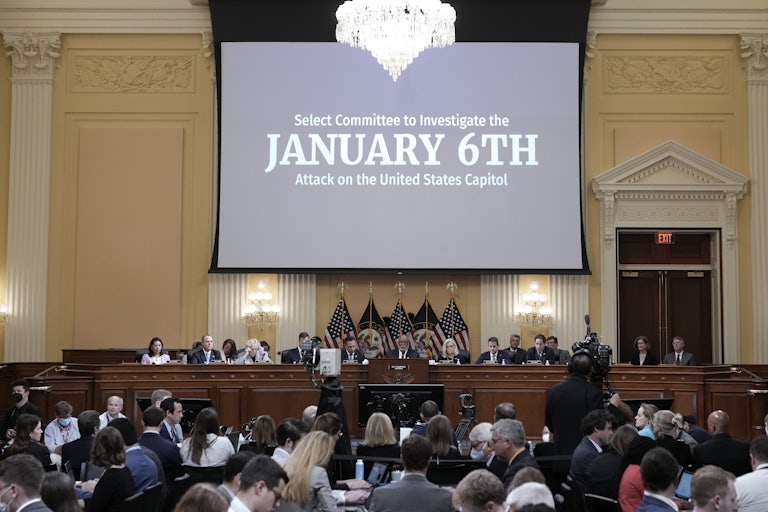
With the January 6 committee’s work having concluded on the cliff-hanger of former President Trump getting subpoenaed, the postmortems have been rolling in—and some of them are primarily concerned with the impact of the group’s work on the upcoming midterm elections. The Washington Post’s Dan Balz fretted that while the committee provided “a valuable reminder of what is at stake in November,” it wasn’t immediately clear how that would translate into voters acting on the January 6 revelations, if they acted at all.

As if to reply, his Post colleague Aaron Blake laid out some hard truths: Democrats had not made January 6 “an overarching focus of their campaign messaging,” and while the committee’s work was well publicized, recent polling suggested that “Democrats haven’t really driven the argument home.” Perhaps most dispiriting, there’s evidence that the largely Democratic committee didn’t even sway its own supporters: “If you dig a little deeper, you’ll see that isn’t the full story: It’s also the case that many Democratic voters haven’t been convinced that the problem goes beyond Trump.”

That the January 6 committee hasn’t had much of an effect on the way midterm voters think about Republican threats to democracy isn’t a new insight. At the beginning of August, a Monmouth University survey found that the hearings’ impact on public opinion was negligible at best. Flash forward to today, and you’ll find that January 6 remains a low priority for voters: The most recent Harvard/Harris poll found that only 7 percent of voters thought of January 6 as their most pressing issue.

But rather than indict the committee for these failings, it’s worth considering whether the point of its work was to confer some sort of partisan electoral advantage to Democrats. Throughout its proceedings, it has focused on institutional, not electoral, interests. If anything, it really seems that the committee mightily endeavored to avoid cheapening its work by mixing it up with histrionic election-year politics. Perhaps the responsibility for articulating that “the problem goes beyond Trump”—that it, in fact, connected to everything the GOP is currently about—was never in its purview. Rather, that responsibility belonged to the Democratic Party itself.

President Biden has recently shown that it’s eminently possible to use campaign rhetoric to connect the events of January 6 to the midterm elections. He rather clearly and provocatively articulated this message in a fiery oration last month in Philadelphia, in which he cited the right’s turn toward authoritarianism and the GOP’s well-funded open war against the right to vote as threats to democracy.

The speech had one flaw, however: Biden’s sudden urgency about these threats is a stark contrast with his previously casual assessment of the idea that democracy was under attack. Many of his specific warnings of late, from the GOP’s turn toward “semi-fascism” to the fact that the party was “working right now … in state after state to give power to decide elections in America to partisans and cronies, empowering election deniers to undermine democracy itself,” were matters that he and his fellow Democrats largely failed to either address legislatively or warn about earlier. In fact, the Biden White House had previously dismissed worries about voting rights as a boutique concern, telling The Atlantic’s Peter Nicholas, “Every constituency has their issue.… If you ask immigration folks, they’ll tell you their issue is a life-or-death issue too.”

Democrats largely followed Biden’s lead, treating voting rights as an issue that Republicans could be convinced to support. And so multiple voting rights bills met a predictable demise in the Senate, where too many Democrats believed that preserving the upper chamber’s filibuster tradition was more important than ensuring their own constituents would continue to be able to cast a vote freely.

Even with polls indicating that inflation and jobs are top of voters’ minds, there’s a good argument for foregrounding the threat of Republican illiberalism in the political conversation: The GOP’s anti-democratic tilt ties right back to matters of the economy. For the avowed economic platform of the GOP is every bit as extreme as an insurrection. The Republicans plan to use debt-limit brinkmanship to impose painful austerity upon the American people. They not only lack a plan of their own to alleviate inflationary pressures, but intend to lay further siege to ordinary Americans by forcing Biden to choose between gutting earned-benefit programs like Social Security and Medicare and destroying the economy by defaulting on the government’s debt.

In a perfect world, perhaps the January 6 committee might have penetrated the consciousness of voters to the extent that it shifted voter opinion. Alas, it didn’t, because it was never within its purview to paint this broader picture. But the fact that so many observers bemoan this failure suggests that the vacuum the January 6 hearing failed to fill should have been filled by others. The committee’s work exceeded expectations, but it turns out that it was never a great substitute for just doing politics.

This article first appeared in Power Mad, a weekly TNR newsletter authored by deputy editor Jason Linkins. Sign up here.
The Industry Devouring the American Dream

Private equity’s tentacles reach nearly every aspect of our lives, and it’s making everything worse.

Scott Olson/Getty Images

Do newspaper endorsements matter? It’s a question that’s been kicked around a lot in recent years. Some editors laud the tradition; others think it’s time for them to end. I’ve always felt that these sledgehammerings from on high, purporting to help voters pick and choose, are no substitute for the woven tapestry of journalism that creates a well-informed public. But that doesn’t mean that I’m cheering the news that one major publisher has announced that it is dispensing with them altogether. And that’s because this particular decision is being handed down by a firm called Alden Global Capital, best known for being at the vanguard of a recent trend: private equity devouring the world.

The New York Timesreport on the matter offers only Alden’s point of view, which sounds innocuous enough at first blush. In a forthcoming editorial set to run in Alden’s publications, the firm says its decision to spike endorsements was done in the spirit of “advanc[ing] a healthy and productive discourse” and reducing “acrimony.” The “common ground,” it writes, “has become a no-man’s land between the clashing forces of the culture wars.”

But as The Nation’s Washington correspondent (and TNR’s former editor) Chris Lehmann notes at length, red flags abound. “The ‘no man’s land’ rhetoric here is especially risible,” he writes, “given that Alden has laid siege to local news markets on its relentless binge of media acquisition.” Indeed, Alden isn’t so much known for advancing the discourse as it is for gutting it; the “no-man’s land” it speaks of has become more of a “no-newspapers land” under its watch, as it lays off employees and closes newsrooms across the country, leaving the aforementioned tapestry of journalism in tatters. But this is just the damage that one private equity firm is doing to one industry.

The tale the private equity industry tells about itself is a virtuous one: They’re savvy investors rescuing ailing firms and making them profitable. Naturally, popular culture has provided an alternative story: that of leveraged buyouts and hostile takeovers. But as Mother Jones’s Hannah Levintova explained, yesteryear’s mythmaking doesn’t really capture how much the industry has evolved. It’s no longer the case that private equity firms mainly hunt down dying businesses to pluck profit like carrion from their bones. Now, she writes, “the bulk of the work done by modern-day private equity firms is not to finish off sick companies, but rather to stalk and gut the healthy ones.”

Consequently, there is almost no aspect of American life that hasn’t been financialized; there is always fresh meat at the private equity smorgasbord. As The Financial Times reported in June 2021, the private equity industry’s assets amounted to more than $3 trillion. And its acquisitions run the gamut: As Levintova notes, the industry acquired numerous for-profit colleges, “enveloped the health care sector,” and gobbled up nursing homes, with the end result being lower graduation rates, increased student debt, higher medical costs, and a rise in the mortality of nursing home patients. Elsewhere, we learn that these firms have devoured trailer parks, neighborhood grocers, and big retail chains. (One thing private equity consistently fails to do is make things better. As TNR contributor Jon Skolnik recently noted, “In the retail sector alone, the industry is estimated to have killed at least 1.3 million jobs since 2009.”)

Beyond the staggering array of assets that private equity firms are absorbing, there is also the broad impact of their rapaciousness to consider. The industry bears some responsibility for climate change and surprise medical bills. It even somehow got its mitts on billions of dollars’ worth of forgivable bailout loans from the Paycheck Protection Program, even though the industry was excluded from those proceeds. Private equity was such a bedevilment to Taylor Swift that it’s surprising she’s not yet penned an “All Too Well (Taylor’s Version)”–style ballad about her experiences.

So private equity is hoovering up every piece of the American dream it can. And in recent years, it’s been targeting one of the most essential parts of the lives we all hope to build for ourselves: where we live. As ProPublica reported in February, private equity–backed companies have “stormed into the multifamily apartment market, snapping up rentals by the thousands and becoming major landlords in American cities,” raising rents and chewing up tenants in their profit-squeezing schemes. And Marketwatch reported in July that the industry has upped its stake in the available stock of single-family homes, competing against ordinary home buyers in a mad dash to snatch up available housing stock and shift it onto the rental market.

That ordinary American families now have to outbid Jeff Bezos for their dream home is a grim and dystopian fact of life. Fortunately, there is some pushback: U.S. Representative Adam Smith, who represents Washington state’s 9th district, has introduced the Saving Homes From Acquisition by Private Equity Act, which, if enacted, would “create a significant federal real estate transfer tax on institutional investors and private equity firms who purchase single-family homes on the open market,” raising revenue that states can then use to build or maintain affordable housing and “slow the consolidation of single-family home ownership among the investor class.”

Democrats should climb aboard this bandwagon; defending ordinary Americans from clear and obvious plutocratic predators is what the Good Life agenda is all about. But the party needs to get to it quickly: Before long, there might not be enough newspapers left to endorse the defenders of the American dream.

This article first appeared in Power Mad, a weekly TNR newsletter authored by deputy editor Jason Linkins. Sign up here.

The United States of Plutocracy

As if dodgy oligarchs and shifty tax cheats didn’t have enough help hiding their ill-gotten gains, your state government may have stepped up to join the con.

Graphica Artis/Getty Images

What do you think of when you think of tax havens? For many, the idea evokes Swiss banks or Caribbean islands—far-flung locales where shell companies stack high and shady enablers in fine suits ooze around every street corner. The truth, however, is that havens for illicit and ill-gotten boodle aren’t nearly as exotic as the Robert Ludlum novel in your mind. If there’s one thing that we’ve learned from recent disclosures—such as the Pandora Papers—on the lengths that the rich and powerful will go to stash their wealth, it’s that the most innovative and disruptive tax havens in the world are the ones right next door.

The U.S. is growing in stature as one of the premier locations for oligarchs of all stripes to safely stash their cash. As TNR contributor Casey Michel has noted, the top grifters in the kleptocracy extended universe aren’t just parking their loot in popular Western capitals, they’re buying up real estate in Cleveland—where Ukrainian kleptocrat Ihor Kolomoisky was, at one point, “the largest commercial real estate holder” in the city. There’s a sizable amount of corrupt money flowing through America’s think tanks as well. And the Pandora Papers revealed that there is a small army of stateside lawyers ready to come to the aid of those who need to keep their filthy lucre hidden.

But it’s underappreciated how one of the biggest enablers of this whole corrupt regime might be your state government. According to a new report from the Institute for Policy Studies, or IPS, a growing number of states have become havens for illicit wealth due to the systematic degradation of regulations governing trusts. These instruments, which are probably best known for their utility in allowing affluent parents to sock away money for their children, are being used more and more by bad actors who want to obscure their fortunes or simply avoid paying taxes on them.

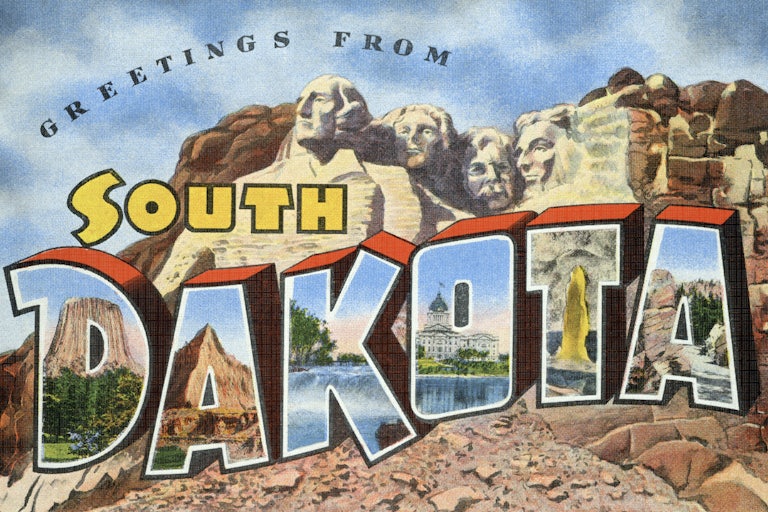
As Tim Noah wrote a year ago, the release of the Pandora Papers shone a light on the state that also gets top billing for the IPS: South Dakota, which pioneered the undoing of trusts by repealing what’s known as the “rule against perpetuities,” the backbone regulation that limits the amount of time money can be held in trust. The IPS’s new study reveals the extent to which South Dakota has touched off a race to the bottom among states who want to deregulate the industry further: More than half of U.S. states have repealed the rule against perpetuities.

But that’s just a start—13 states have gone further to enable these stateside tax havens. The upshot is that tax dodgers and kleptocrats suddenly have a lot of options: They can now effectively stash their wealth in perpetuity if they want. Many states even permit the person who establishes the trust to be the beneficiary of that trust as well—an arrangement that practically legalizes tax dodging.

And as the IPS’s Kalena Thomhave and Chuck Collins note at length, the deterioration of the laws governing trusts have many ill effects on ordinary people, from the way “investments by anonymous trusts in real estate” help to “push up the cost of housing for locals” to the democracy-debasing effect of permitting foreign oligarchs and like-minded thieves to stash their plunder here in the U.S.

This corrupted regulatory state impacts our lives in numerous ways. As Thomhave and Collins report, ordinary people don’t derive any material benefit from their states transforming themselves into safe-deposit boxes for oligarchs. They also note that there “is a significant correlation between regressive state taxation systems, which hurt the poorest residents, and trust-subservient state laws.” But the worst effect by far is the way this misrule further entrenches inequality of all stripes:

The wealthy deploy their power to further shape the rules, news, and culture of society, including trust law. They block popular reforms by capturing the political system and ensuring dysfunctional gridlock. This leads to further consolidation of wealth dynasties, impervious to taxation and accountability. It also leads to more social breakdown and polarization as our collective capacity to solve big problems—like responding to a pandemic or ecological disruption—is rendered inoperative.

At The New Republic, we’ve found ourselves asking more and more: Are states OK? A recent book by Jacob M. Grumbach, Laboratories Against Democracy: How National Parties Transformed State Politics, argues that the states have become “the wrecking ball” of democracy, subverting the desires of their citizens and throwing roadblocks in the way of their right to seek redress with their vote. Now this IPS report shows just how many states are signing up to be the haven of illicit money and harbor the ultrawealthy from paying their taxes. Should state governments serve plutocratic elites or their own citizens? A growing number are making the wrong choice.

This article first appeared in Power Mad, a weekly TNR newsletter authored by deputy editor Jason Linkins. Sign up here.