Newsletter
Power Mad
A weekly review of the rogues and scoundrels of American politics

The GOP’s Brand Is Chaos

The Republicans have spent years perfecting their dysfunction.

Win McNamee/Getty Images
Ohio Rep. Jim Jordan

By the time you read this, the House of Representatives may have a new speaker. It also might not have a new speaker. I can’t say for certain what world you’ll be living in, sorry.

The new speaker won’t be Ohio Congressman Jim Jordan, whose gangly effort to crowbar his way into the role was sunk after multiple efforts to secure enough votes from his own caucus this week. It’s probably a safe bet that former Speaker Kevin McCarthy won’t be making an all-is-forgiven return to the role—though it can’t be completely ruled out. It could be that North Carolina congressman and current fill-in Speaker Patrick McHenry will end up the anointed one, but that’s looking less likely as well. For that to happen, however, McHenry would have to be formally and further empowered, as the speaker pro tempore position he’s currently holding has very limited constitutional authority, owing to the fact that no one really imagined a temporary speaker doing much more than presiding over the chamber as it selected an actual speaker. Republicans will take another shot at doing this next week; Tom Emmer, who may or may not be a maniac, is considered the frontrunner.

Alas, not for the first time, we must observe that among the many things the Framers could not have foreseen is the state of today’s Republican Party: devoid of any respect for institutions and hell-bent on writing blank checks to the biggest extremists in its midst. That the GOP has made a farce of such a basic task as electing a leader should really come as no surprise to anyone. It’s been quite some time since Republicans have shown any kind of interest in performing the basic functions of a majority party in the legislature.

Forget their weird lust for government shutdowns and debt ceiling breaches; this gang of freaks can go months without putting their majority to any productive purpose at all. So let’s be realistic about their current struggles. The Republicans’ basic problem isn’t that they broke the House of Representatives—the problem is that they’ve finally perfected their approach to (not) running the joint.

That so many of the people who claim to cover politics seem surprised at the way Beltway Republicans have ended up here only demonstrates what short memories they have. Anyone who was paying attention during the Obama era knew that the brine that the GOP of today soaks in was already well into its fermentation stage then. And long before McCarthy’s pale eminence seized the gavel, an older version of his antagonists was doing then-Speaker John Boehner dirty. As Ryan Lizza wrote for The New Yorker, way way back when Ryan Lizza was on staff at The New Yorker:

[Boehner’s] tenure was marked by an increasingly futile effort to control a group of conservatives that Devin Nunes, a Republican from California and an ally of Boehner’s, once described as “lemmings with suicide vests.” In 2013, to the bafflement of some colleagues, Boehner supported the shutdown, in the hope that the public backlash would expose the group as hopelessly radical. It didn’t work. The group continued to defy Boehner. He tried to regain control as speaker by marginalizing its members, and they decided that he must be forced out.
Savor the memory of Devin Nunes being lumped on the reasonable side of the GOP, because it didn’t last! He and Boehner alike were among the casualties of the Republican Party’s long-running project to indulge and empower the fringiest members in their midst. With the aid of their brightest think tank minds and the deepest-pocketed donors, the Tea Party movement helped numerous far-right ideologues make their way to Washington, which in turn begat the Freedom Caucus—and all of the showdowns, shutdowns, and near misses on the way to a debt ceiling apocalypse that became their stock-in-trade. This miasma of extremism and dysfunction ultimately crescendoed with the advent of Trumpism and the full flower of that authoritarian project.


Jim Jordan, whom Boehner once assailed as a “
legislative terrorist,” is as pure a product of this political project as you can find anywhere—a 180-proof distillation of the GOP’s turn toward nihilism and unhinged self-regard. (It’s little wonder that his attempt to ascend has come with the threat of political violence toward his opponents that has become so au courant in the Trump era.) Despite his stated belief that “America wants him” to be speaker, Jordan owes his existence in Congress entirely to the fact that he can’t be held accountable by Americans: He’s stuffed into a ridiculously gerrymandered district and hasn’t had to deploy any kind of political skill to retain his seat in years. For all intents and purposes, he’s the electoral equivalent of a welfare queen.

The Ohio congressman brings little more to the table than utterly lycanthropic rhetoric, an extreme lack of legislative prowess, and a gaping void where an interest in governing should be. I’ve written previously on his only accomplishment of note: his creation of a perverse House subcommittee that’s entirely dedicated to backfilling the Fox News Extended Universe of weird culture-war lore with something that resembles a threadbare factual basis. (A task at which, I might add, he has failed spectacularly.)

I have found it darkly hilarious to hear so many Republicans whine about their struggle to elect a speaker, given that this episode is just a big demonstration that their rickety-ass, claptrap version of “governing” is going exactly the way they designed it to work. It’s the exact same feeling I get watching so-called “Never Trump” Republicans express extreme disaffection with the state of their party, as if they didn’t have a strong hand in the creation and cultivation of the shitty and cynical political project that’s now firing on all cylinders.

So many Republicans are scuttling around the news cycle, full of worry that their failure to emerge from the speaker chaos will result in a slew of bad outcomes. Nothing might get done legislatively. There’s a strong possibility of a government shutdown. The longer the House can’t function, the greater the chance that the economy gets wrecked or the United States loses standing around the world with our allies and partners. Well, let me give Republican lawmakers some much-needed succor: Their party is going to accomplish all of these things whether they elect a speaker or not.

This article was adapted from Thursday afternoon’s edition of Power Mad, a weekly TNR newsletter authored by deputy editor Jason Linkins. Sign up here.

Hey, Democrats—Here’s a Winning 2024 Message on a Silver Platter

Why the party should go big on protecting consumers from corporate crooks

Alex Wong/Getty Images
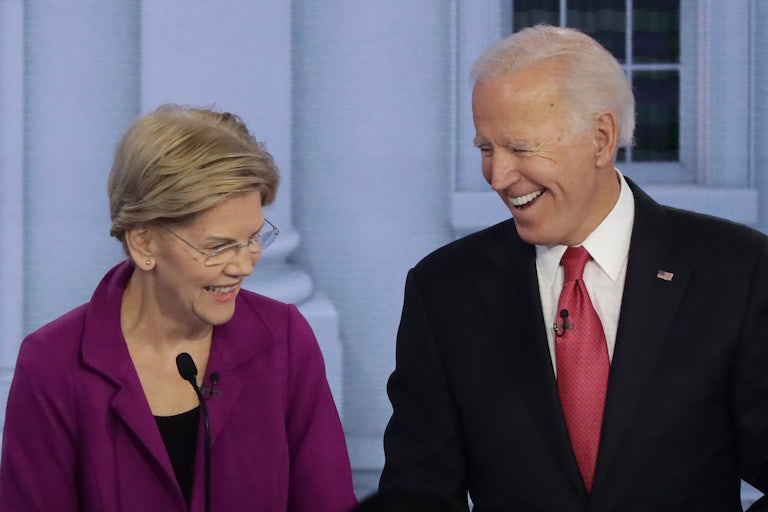
Senator Elizabeth Warren and President Joe Biden during a debate in 2019

I’m not the sort of person to wager money on Supreme Court rulings based on the tenor of oral arguments, but TNR contributor Matt Ford was one of many high court observers who thought there was reason to believe the Consumer Financial Protection Bureau—which has served as an advocate for ordinary Americans against a slew of fast-fingered corporate crooks—may just survive its day in court. Should the CFPB prevail, it will buck some significant trends: one being the recent Supreme Court’s antipathy toward Democratic governance and the administrative state in general, the other being the longer-running winning streak that corporate interests have enjoyed at the high court for as long as anyone can remember.

But whether we’re poised to celebrate the CFPB’s unlikely survival or soon to mourn its demise, it’s worth reflecting on the agency’s mission and urging Democrats not just to continue it but to make the idea of protecting ordinary people from corporate thieves and cheats even more central to the party’s identity. Obviously, that work will only be more difficult if the CFPB goes down—should the Roberts court do the deed, liberals must add its demise to the larger portfolio of complaints that have driven public esteem of the court to new lows. But even if it emerges unscathed, a passion for protecting the little guy from a universe of crooks should be fomented and channeled with renewed vigor, as should a commitment to making consumer protection a vital avenue of the party’s policymaking zeal and its political fury.

As the Public Interest Research Group recently recounted, the CFPB has some hefty accomplishments to its name. The agency, which is often referred to as Elizabeth Warren’s brainchild, has recouped $17.5 billion worth of consumer money. This year alone, it’s prevailed against a slew of foes, from big banks to shady data brokers, and offered guidance to help ordinary people avoid pitfalls and hang onto their hard-earned money. These are victories that Democrats should savor and tout, in the same way cops do when they force scofflaws to do a public perp walk, their seized assets left on a table as Instagrammable trophies.

There’s a simple idea here: It should be politically toxic to rip people off. One suspects that everyone who opposes the CFPB’s mission is aware of how it looks to throw in with plutocratic con men, which is probably why Big Business has confronted the agency in crab-walk fashion, sidling up to the supposed cracks in its constitutional edifice rather than challenge it frontally by going to bat for every unreliable fiduciary and financial scam artist in Christendom.

It’s somewhat significant that in this most recent case, it’s the ultimate financial bottom-feeders serving as plaintiffs: payday lenders, who I once described as being fit for only two purposes—“to encircle the working poor in inescapable cycles of crushing debt, and to continually generate plausible-sounding reasons for why a civilized society should continue to allow [them] to exist.” I suppose you can add “front-running for the entire financial services sector against the country’s consumer watchdog” to that brief—an advantage seized from having a toilet reputation in the first place.

Democrats, of course, haven’t always walked the right side of the street where consumer protection is concerned. Scofflaws of all varieties, from payday lenders to big banks, have found allies on the left side of the aisle far too often. This needs to change: The CFPB is an important part of the Democratic Party’s legacy. The taxpayers who ponied up billions of dollars to bail out the banking industry after the 2008 financial crisis got little thanks and almost nothing in return for their generosity. The CFPB is the only monument to their sacrifice; the only gift they got in return.

This is a ripe time to renew this past promise. Democrats will go into the 2024 election seeking once again to define Trump as an illiberal force bent on soiling our civic fabric, thus building on the pro-democracy message of the 2022 midterms—which pundits pooh-poohed but voters embraced. Democrats will also likely make hay out of the GOP’s antipathy to abortion rights and the post-Roe dystopia it engendered and is now trying to avoid talking about. But there’s room for Democrats to diversify their portfolio of enemies, and consumer protection allows them to take on targets that are less partisan but just as political—adding some “right versus wrong” to a message that’s already full of “left versus right.”

Moreover, consumer protection is a cause that provides ample opportunity to freeze Republicans in disadvantageous positions: It’s pretty effective politics to campaign against the crooks who are plundering everyone’s American dream one dime at a time. If Democrats invite Republicans to weigh in on whoever ends up in the consumer protection crosshairs, they can either agree and help Democrats forge bipartisan consensus or they can disagree and get implicated as enablers. Democrats can tether their consumer protection zeal to their pro-democracy arguments as well: Certainly the clear consequences of a Trump win will be an executive branch that’s not just hostile to consumer interests but likely to pervert the cause of consumer protection as a weapon against its political enemies.

As former TNR contributor Brian Beutler noted, in a recent edition of his Off Message newsletter, Democrats have recently struggled to recover the “confidence and combative energy they’d developed by the end of George W. Bush’s second term,” their “fighting spirit” replaced by a data-driven, poll-tested “spirit of timidity.” Well, the quickest way to get back in the ring is to start naming foes and picking fights. President Joe Biden has seeded the terrain by making the purveyors of junk fees one of his administration’s enemies. But this is a fun fight everyone should join.

This article first appeared in Power Mad, a weekly TNR newsletter authored by deputy editor Jason Linkins. Sign up here.
Democrats Are Wasting Tens of Millions of Dollars in California’s Senate Race

The primary campaign for Dianne Feinstein’s seat has become a donor sinkhole. That money is better spent elsewhere.

Justin Sullivan/Getty Images
California Governor Gavin Newsom

There’s a new senator in Washington, D.C., this week: Laphonza Butler, a former president of Emily’s List, was tapped by California Governor Gavin Newsom to fill out the term of the late Dianne Feinstein. Butler’s path to the Senate—where she will be the lone Black woman in the upper body and the first to call that chamber home since Vice President Kamala Harris—was partly due to a set of baroque promises Newsom made in advance of Feinstein’s death: to select a Black woman for the post and to not select any of the Democrats already running for the seat in 2024, so as to not play favorites.

It is perhaps in furtherance of that latter pledge that Newsom roamed rather far afield to tap Butler, who resides in Maryland as opposed to California. But his apparent intention to pick a placeholder seems not to have been made clear to Butler herself, as she has not ruled out running to retain the seat.

So that’s something of a whoopsie! But it’s not the main reason that Newsom perhaps should have put his finger on the scale: The California primary for U.S. Senate has become a black hole of Democratic donor money, to the exclusion of what could be more consequential races.

Opportunities to become California’s senator have been in short supply in recent years, so it’s not a surprise that this race, in a state known for pricey political contests, was expected to become the most expensive Senate race in history. But now, as a result of Feinstein’s death, there will be not just the usual primary and general election next year but also special elections—meaning that donors normally constrained by maximum allowances will be permitted to double-dip for their favored candidates.

California Representative Adam Schiff already has raised what I would charitably call an unreasonable—perhaps even unspendable—amount of money. Axios reported in July that Schiff had almost $30 million in hand—“more than any other federal candidate, including for president.” After that figure ticked up slightly in the most recent fundraising quarter, Aaron Kleinman, the director of research at the States Project, made a canny observation: “In other words he has more cash on hand for a race Democrats are guaranteed to win than every single Democrat running for the Virginia House (which either party could control after November) has combined.”

The importance of the Virginia elections is clear: Democrats could stop the political career of Virginia Governor Glenn Youngkin—who is term-limited in the Old Dominion and said to be weighing a presidential run based on how Virginia Republicans fare in November—in its tracks. Democrats also have a generally daunting Senate map in 2024, and a highly competitive gubernatorial contest in Kentucky on the wing.

This is not to say that the California primary isn’t worth Democrats’ attention. People have some passionate, principled, and well-informed opinions of who among that field—which Schiff has largely led over Katie Porter and Barbara Lee, according to the scant polling that’s been done—should be Feinstein’s successor. I’ve no doubt that I could develop my own ideas on the matter if I took as much time as those with a vested interest. That doesn’t really change the fact that Democrats are going to retain this seat and that the differences between these candidates will largely fade into the grayscale once a winner is seated.

Which is why I wish Newsom, who seems to harbor ambition about becoming a national leader of his party, had taken a stab at ending this primary himself. He could have given the nod to Schiff and called a halt to the implacable donor arms race. Barring that, he could have just fully honored his commitment to upping the representation of Black women in the Senate by tapping Lee, who was already running. That might not have sent a strong enough signal to turn off the money spigot, but it would have sent a worthy message to the backbone of the Democratic Party.

Realistically, Newsom is too calculated to have seriously considered doing all that. His pledge to stay out of the fray was probably less about keeping the spirit of fair competition alive than about not wanting to stick his neck out, only to have California voters chop it off. But those who are, or aspire to be, Democratic standard-bearers ought to be thinking about the party’s needs across the country, and that means not encouraging a donor sinkhole in their own backyard. There are more critical elections and bigger prizes on which that boodle is better spent.

Democrats have, in recent years, demonstrated the tendency to dream a little too big and pile untold sums of campaign cash in the coffers of a litany of no-hopers. That’s not what’s going on here. But if Democrats are not careful, they could screw up from the opposite direction, denying critical resources to winnable races in the service of a seat they’re destined to get anyway. It’s time to stop emptying your wallets on this Senate primary and let these wannabe senators from California fend for themselves.

This article first appeared in Power Mad, a weekly TNR newsletter authored by deputy editor Jason Linkins. Sign up here.
The Looming Government Shutdown Is Not the Fault of Dysfunction

There’s only one culprit for the chaos gripping Capitol Hill—the Republican Party.

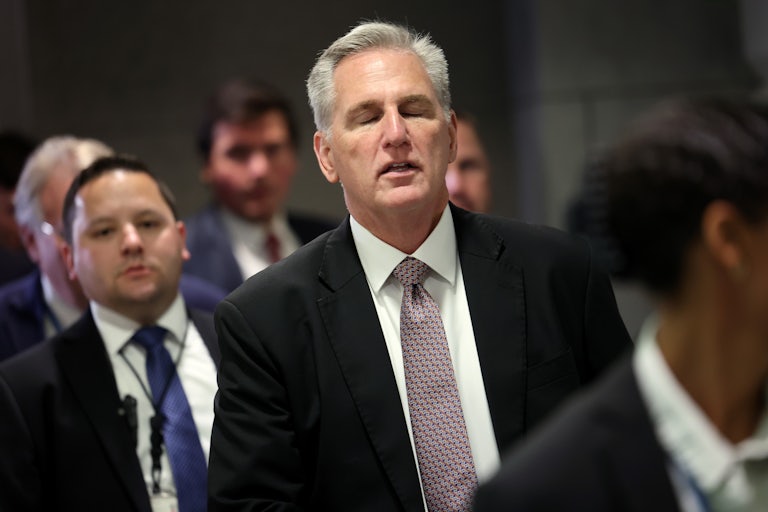
House Speaker Kevin McCarthy grimaces as he walks to another meeting with the House Republican caucus.
Kevin Dietsch/Getty Images
House Speaker Kevin McCarthy grimaces as he walks to another meeting with the House Republican caucus.

Former House Speaker Nancy Pelosi tends to get a lot of grief whenever she offers her opinion about how the country needs a “strong Republican Party,” but I think that what’s currently happening on the GOP side of the House of Representatives is probably what she had in mind. There, the scene has devolved over the past week into the parliamentary equivalent of a Superfund site. It’s become rivetingly clear that Kevin McCarthy’s charges are hurtling toward a spectacular self-own—and a government shutdown. A slew of inconveniences and vaporized economic activity are about to land, hard, on ordinary Americans.

If history is any guide, it also means that political woe is on the way for the GOP. As Senate Minority Leader Mitch McConnell told reporters this week, shutdowns have “always been a loser for Republicans—politically.” But McConnell, who is clearly still capable of dispensing effective strategic advice in between his harrowing health episodes, is likely to go unheeded.

What help can be offered to a party that can’t help itself? Democrats partially powered their 2020 presidential campaign on the notion that Joe Biden cast a long, collegial shadow over Washington and was just the figure to help a wayward Republican Party break the fever that had engulfed it during the Trump years. But as Biden became more familiar with the Republicans he’d be working with, his opinions on the matter shifted rather dramatically. He ended up helping to author a successful midterm message that captured the GOP as they are: autocratic and beyond redemption. As McCarthy’s untamed hooligans steer the ship of state toward the chop, Democrats would be wise to stick with this instinct. They’re already doing the best thing they can do in this situation—nothing at all.

If there’s anything that Democrats should emphasize about the looming government shutdown, it’s the essential Republican-ness of it all. This shutdown is the pure product of the modern GOP, packed with antisocial weirdos and redolent of their inability to govern themselves or anyone else. Here, Democrats may have to joust with a media that vastly prefers to pin this kind of dysfunction on mushy concepts like polarization, or point the finger of blame—more nebulously—at “Congress,” as The New York Times did in a limp headline last week. More recent reporting has, happily, hit the ball more squarely, properly identifying “Republican infighting” as the proximate cause of the impending calamity.

To say that the GOP has lost the plot is perhaps an understatement. As The American Prospect’s David Dayen pointed out this week, the debate that Republicans are having with themselves has lapsed into pure abstraction, in which members of the party are now “arguing with each other over how much funding to cut in a one-month stopgap continuing resolution—not the budget itself.” Meanwhile, every sentient life-form knows that cuts of any kind make it a nonstarter with Democrats in the Senate, and the Oval Office.

But the prospect of Republicans troubling Democrats with some fruit of their legislative labors is a long way off, as their blockheaded negotiations have yet to yield anything that’s not a nonstarter with one another. Here, the GOP has flopped in operatic fashion: a Freedom Caucus–wrought deal immediately got spiked this week as a “giveaway to Joe Biden” by other members of the Freedom Caucus. How, exactly, is a budget proposal that Biden would veto instantly a “giveaway” to him? Don’t worry: No one in the GOP knows the answer to that question!

This entire exercise in self-torture really has little to do with line items on a budget spreadsheet. This is all just a primate dominance ritual: a steroidal sequel to the government shutdowns of the Obama era, in which Republicans convinced themselves that bringing Washington to a crashing halt could break the White House’s will. The only new twist on this old formula is that I’m pretty sure that, as far as the Republicans driving us into a ditch are concerned, Joe Biden is a secondary concern, if not an afterthought. Republicans are well and truly into their Lord of the Flies era, fully engulfed in the internecine purity-test battles I predicted were on their way. But not even McCarthy promising an impeachment inquiry was able to buy him enough goodwill to simply keep the government running.

It’s hard to see how any of this ends. Republicans seem bent on playing stupid games for the privilege of winning stupid prizes, with the most stupid prize of all being the poisoned chalice of the House speakership. Yes, Kevin McCarthy may finally be forced out of what has become the worst job in all of Washington—and the biggest problem that those threatening to knock McCarthy from his perch face is that one of them will have to take his place.

What Democrats should do now is simple: Do not interrupt this. There’s no need to get involved. What Republicans are enduring can’t be solved by rational people appealing to better natures that don’t exist. The only way out is for the GOP to eat shit, every day, until their bellies are full. Yeah, it’s possible that some dumb pundit will come along, afflicted with a terminal case of what Dayen calls “Washington brain,” to try to convince Democrats to “blink and offer concessions to avoid a shutdown.” The only thing Democrats should throw Republicans’ way is the old military acronym, KMAGYOYOKiss my ass, guys, you’re on your own.

This article first appeared in Power Mad, a weekly TNR newsletter authored by deputy editor Jason Linkins. Sign up here.

Good Luck With Your Pro-Life “Rebranding,” Dummies!

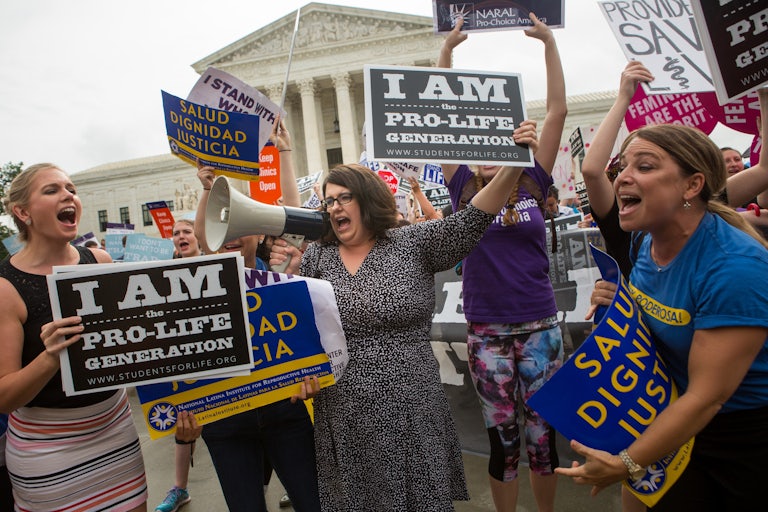
The anti-abortion movement has grown too radical to be tamed by a bunch of Washington elites playacting as marketing consultants.

Allison Shelley/Getty Images

It would appear that anti-abortion conservatives are starting to come around to the realization that when the Supreme Court gutted Roe in its 2022 decision in Dobbs v. Jackson Women’s Health Organization, the Republican Party became the protagonist in the classic tale of “The Dog That Caught the Car.” As The Hill contributor B.J. Rudell put it, the pro-life movement had it pretty good for about 50 years, residing “in a self-made and self-contained cocoon, operating with equal parts political savvy and practical ignorance.” As long as its great dispute was a live issue—a political Schrödinger’s box that would remain a potent electoral motivator so long as it stayed closed—the movement could reap the benefits of its unrealized vision.

But once Samuel Alito and his fellow travelers peeled the box open, the world got a good long stare at the dead cat inside. The post-Dobbs landscape has been a regularly scheduled litany of dystopian one-offs—here’s a woman forced to travel 1,400 miles to deliver a skull-less fetus; there’s a woman who nearly died because she could not obtain a medically necessary abortion—peppering the steady, ambient worsening of the world: the obstetrics positions going unfilled, the measurable rise in health inequity, the “ominous health trends” that rose up, spawned in the wake of the Supreme Court’s decision to undo the modern world.

And did I mention that on top of all of this, the Dobbs decision is implicated in the consistent way that Republicans keep getting rinsed at the polls? It’s no wonder that elite conservatives have recently decided that the real problem here is the need to rebrand the term “pro-life,” not the myriad horrors that have been unleashed since the movement that sallied forth under that banner 50 years ago finally got all the things it wanted.

Right now, this “rebranding” effort is at the stage where various Republicans say staggeringly obvious things with the absolute wonder of a wee child. “What intrigued me the most,” said North Dakota Republican Senator Kevin Cramer, “was that ‘pro-choice’ and ‘pro-life’ means something different now; that people see being ‘pro-life’ as being against all abortions … at all levels.” Wow, no shit—that truly is a remarkable state of affairs! His Senate colleague Josh Hawley choked out some similarly incredulous words in a recent interview: “Most voters think [‘pro-life’] means you’re for no exceptions in favor of abortion ever, ever, and ‘pro-choice’ now can mean any number of things,” he said, adding, “So if you’re going to talk about the issue, you need to be specific.”

But as TNR’s Tori Otten pointed out, we can actually be excruciatingly specific about what Republicans want, and it’s pretty much entirely indistinguishable from “no abortion, ever, ever,” and not so much something that a few hasty marketing summits among GOP bigwigs is going to be able to obscure. “Since Roe was overturned,” Otten reported, “Republicans have banned abortion completely in 14 states. In many other states, Republicans have limited abortion access with cruel laws to the point that the procedure is effectively banned anyway.” The would-be rebranders are lagging badly behind the curve: Across the country it didn’t take long for the right to push hard for draconian bans after Dobbs was handed down. The plain truth is that when the next Republican trifecta hits Washington, many of them will be pushing hard to pass a nationwide abortion ban.

This is the biggest problem that those who are so desperate to “rebrand ‘pro-life’” face right now: This is a movement that’s largely defined by the zealots in its ranks. You’re not going to be able to exert control over a nation of anti-abortion radicals with a Central Committee to Temper Our Excesses and Lessen the Completely Foreseeable Consequences of Our Actions. Wherever those fanatics hold a little bit of untrammeled power, they’re doing headline-grabbing things to get attention and advertise exactly what they want the post-Roe landscape to look like.

Take, for example, the extremists who’ve brought so-called “abortion trafficking” laws to several counties in Texas. As TNR’s Melissa Gira Grant recently reported, political leaders in these jurisdictions have breathed new life into laws over a century old, in the service of incentivizing vigilantes to patrol Texas highways, looking for women who might be seeking to leave the state to receive abortions, in order to detain them for cash rewards. Or take the “pro-lifers” in Oregon who, far from getting their cues from Washington elites urging circumspection for the sake of winning elections, are plowing ahead to the next frontier and looking to ban contraceptives next—just as one could have predicted (and did).

Josh Hawley, Kevin Cramer, and the rest of the people trying to slap a new name on “pro-life” are simply not going to cow this movement into submission with a PowerPoint presentation on the value of adopting a more palatable brand identity—not after they’ve already spent a wild-eyed half-century howling for an unpopular set of draconian policies to be imposed on the country. And so the Republican Party will continue to be defined by its militants, not its marketers. Yes, this could contribute greatly to future Democratic wins at the polls, as an agitated public sends more protectors of abortion rights to office. But this should give us pause nonetheless—because wherever the pro-life dead-enders can hold on to even a little bit of political power, they will continue to advance their tyrannical vision, inch by inch, and in their wake damage the lives of a yet-to-be-counted number of ordinary Americans—leaving a trail of ruin that no rebranding can redeem.

This article first appeared in Power Mad, a weekly TNR newsletter authored by deputy editor Jason Linkins. Sign up here.