Breaking News
Breaking News
from Washington and beyond

Trump Is Already Reaping the Benefit of His Election Victory

Donald Trump’s election win has turbo-charged his and his allies’ crypto assets.

Donald Trump gestures while speaking at the Bitcoin conference
Brett Carlsen/Bloomberg/Getty Images

After Donald Trump made it his goal to make America “the crypto capital of the planet,” the Republican winner, Silicon Valley, and his crypto army may be able to cash in on Tuesday’s victory.

The “upcoming deregulation wave will create an economic sonic boom,” wrote one CEO Tuesday night, encapsulating the feelings of many investors looking to make a buck off the Election Day results and its ripple effects.

As of Wednesday morning, traders, crypto enthusiasts, and of course, Trump himself find themselves victorious. The stock market jumped overall Wednesday morning, buoyed by the so-called “Trade trade,” as investors scramble to buy stock expected to perform well under a second Trump term.

Perhaps the person cashing in the most is Trump himself, whose shares of Trump Media & Technology Group skyrocketed following his win. Shares of TMTG, which runs his Truth Social platform, rose more than 30 percent in premarket trading. Trump owns a roughly 57 percent stake in Trump Media.

He added nearly $300 million to his fortune overnight.

Meanwhile, bitcoin is also at a record high after Trump’s win, again boosting his own earnings. And the Republican has the crypto industry to thank.

“Being anti-crypto is simply bad politics,” wrote Coinbase CEO Brian Armstrong just after midnight, attaching a photo of the Ohio Senate race. The cryptocurrency super PAC Defend American Jobs spent more than $40 million to help Republican Bernie Moreno win his race to flip the Senate seat.

The industry raised more than $200 million to affect House and Senate elections and punish anti-crypto candidates. And it looks like, for the most part, their work paid off. Coinbase’s political offshoot Stand With Crypto’s own numbers indicate that “pro-crypto” candidates won 270 seats.

As The New Republic reported earlier this fall, crypto companies spent more than $130 million to determine the election, breaking records. Since the Citizens United ruling in 2010, the fossil fuel industry has collectively only spent $176 million over 14 years of election cycles.

“It’s time to build. 🇺🇸” wrote Marc Andreessen, the “techno-optimist” billionaire who gave millions to Trump, in celebration of the win.
Elon Musk Is Already Making Bank off Trump’s Win

The world’s richest man just got even richer.

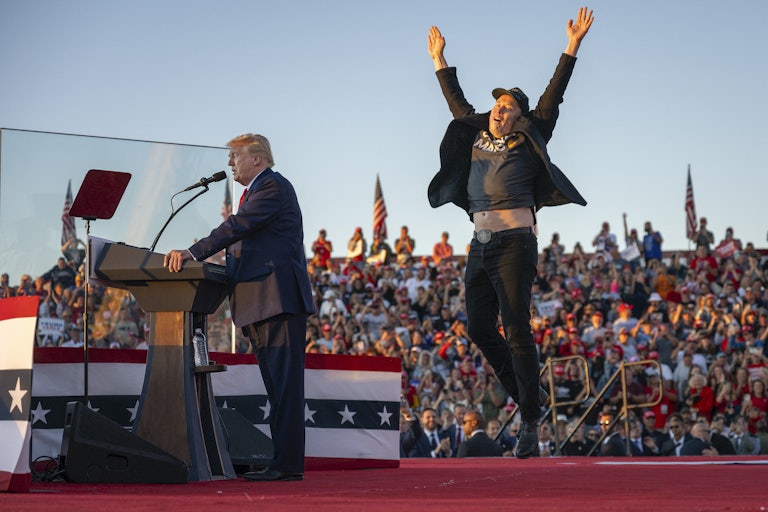
Donald Trump speaks at a campaign rally while Elon Musk jumps behind him
JIM WATSON/AFP/Getty Images

The richest man in the world just got richer off our presidential election.

Billionaire CEO and Trump hype man Elon Musk saw stock for his Tesla company go through the roof, mere hours after Donald Trump defeated Kamala Harris in the presidential election. The electric vehicle company saw an 11 percent increase in its stock Wednesday morning.

Investors believe that Tesla will be positively impacted by another Trump presidency, as he has promised to enact tariffs on Chinese imports, which could be particularly beneficial for the electric vehicle maker. 

Musk was Trump’s second-largest funder this election, even handing out $1 million a day to voters in swing states (many in Pennsylvania) if they signed his petition in support of Trump and the Constitution. He became a close confidant to the former president and now president-elect as a result. Musk dutifully followed Trump from campaign stop to campaign stop, jumping awkwardly for joy and outlining his plan to cripple the federal government with massive cuts to the budget.

“Elon will likely be rewarded with some efficiency czar position, which could accelerate adoption of a single autonomous driving standard instead of 50 different state regulations,” shareholder Gary Black said Wednesday on social media.

Musk has already agreed to head what he and Trump call the Department of Government Efficiency, or “DOGE.” Musk has promised to cut $2 trillion from the government budget and to launch a “complete financial and performance audit of the entire federal government.”

There are dark days ahead for the rest of us, but at least Musk can continue to line his pockets with no issues.

Are We Just Ignoring How Russia Openly Helped Trump on Election Night?

Multiple polling locations in Democratic areas of battleground states received hoax bomb threats.

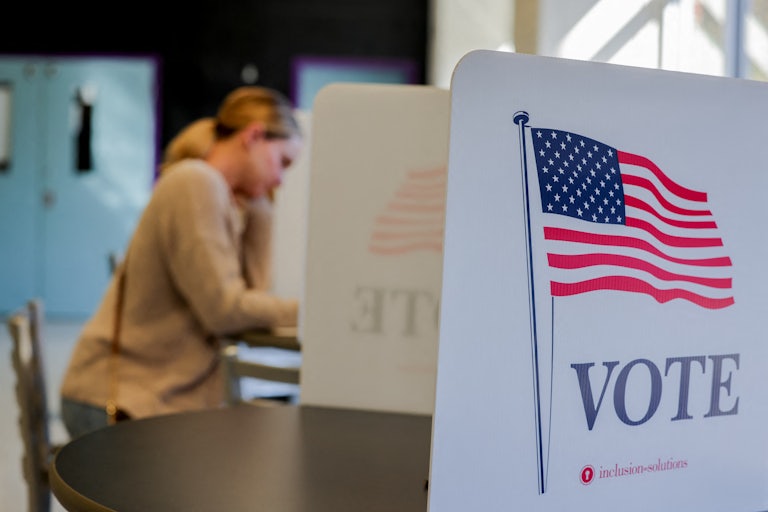
A person votes at a polling station
Ali Khaligh/Middle East Images/AFP/Getty Images

Polling locations in Democratic strongholds across several key battleground states received a slew of phony bomb threats on Election Day, and while the FBI deemed that none of the threats were credible, they still represent a disturbing feature of U.S. elections: alleged interference from Russia. 

The FBI released a statement Tuesday saying that it was “aware of bomb threats to polling locations in several states, many of which appear to originate from Russian email domains.”  While the FBI underscored that none of the threats had been found to be credible, their purpose was undoubtedly to sow chaos and fear as Americans attempted to cast their ballots. 

Many of those threats were directed at sites in Fulton County, Georgia, the state’s most populous Democratic stronghold. Law enforcement officials received at least five threats toward two Union City voting sites, and two polling places were evacuated for 30 minutes each after receiving threats. 

Georgia’s Secretary of State Brad Raffensperger said in a statement that the non-credible threats affected “five to seven different precincts” in the key swing state.

He also said that the bomb threats had been linked to one particular “foreign state actor.”

“We identified the source, and it was from Russia,” Raffensperger said. “They’re up to mischief, it seems, and they don’t want us to have a smooth, fair, and accurate election.

“Anything that can get us to fight amongst ourselves—they can count that as a victory.”

In Wisconsin, two polling places in the state capitol of Madison received threats according to Ann Jacobs, who leads the Wisconsin Elections Commission. Those threats also seemingly originated from Russian email domains, according to the FBI’s office in Milwaukee. 

In Arizona, election officials received fake bomb threats at four polling stations. Arizona Secretary of State Adrian Fontes said that the threats came from an email address ending in .ru, but emphasized that he could not confirm if the threats were actually from the Russian government. 

There were also dozens of bomb threats that have not been linked to the alleged Russian email campaign. 

Pennsylvania, a critical battleground state, also received a slate of hoax bomb threats. At least 10 polling locations received threats in Philadelphia alone. One location was shut down for 23 minutes but later received a court order extending its hours to make up the lost time.

The threats in Pennsylvania were not just limited to locations in Philadelphia County. Officials in Bucks, Centre, Chester, Clearfield, Delaware, Luzerne, Perry, and York Counties also reported receiving bomb threats. Investigators in Pennsylvania have yet to specifically link any of these phony threats to Russia.

In Michigan, there were reports of bomb threats at several polling locations, but none were credible, according to a spokesperson for Michigan’s Secretary of State Jocelyn Benson.

Russia’s diplomatic mission in the United States dismissed any allegations of Russian interference as “malicious slander.”

“We would like to emphasize that Russia has not interfered and does not interfere in the internal affairs of other countries, including the United States,” the Russian Embassy said in a statement. “As President Vladimir Putin has repeatedly stressed, we respect the will of the American people.”

Voters Defy Republicans to Overwhelmingly Protect Abortion Rights

Ten states voted on whether to protect abortion access. Only three failed to do so.

People hold up pro-abortion rights signs
Valerie Plesch/Bloomberg/Getty Images

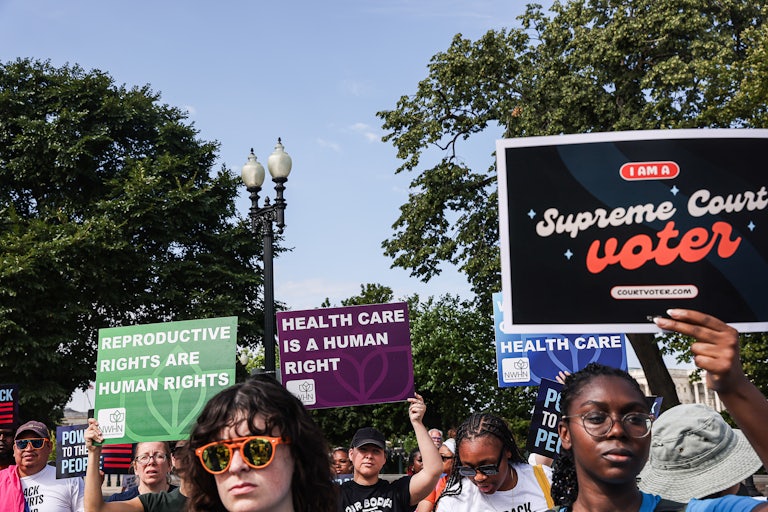
Nearly every state that placed abortion on the ballot this year successfully enshrined the procedure in their state constitutions.

A record-breaking 10 states placed abortion access in the hands of the popular vote on Tuesday, handing citizens—not elected representatives—the ability to decide whether or not their state should meddle in an individual’s reproductive rights.

Arizona, Colorado, Maryland, Missouri, Montana, Nevada, and New York all passed constitutional amendments codifying the right to abortion. Meanwhile, Florida, Nebraska, and South Dakota—a small handful of states with already draconian abortion restrictions—failed to pass their respective measures to protect the medical procedure.

The majority of the initiatives sought to protect abortion access up until the point of fetal viability, which typically occurs during the second trimester between 23 and 24 weeks of pregnancy.

More than 61 percent of Arizona voters chose to codify abortion access in the state constitution. The Arizona Abortion Access Act will also enshrine the right to an abortion to protect the life and health of pregnant people.

The amendment to the Arizona Constitution offers every Arizonan the “fundamental right” to an abortion, and makes illegal any policy or program that restricts or interferes with an eligible abortion, or penalizes any person or group for aiding or assisting in an abortion within state bounds. It’s a seismic shift from the state’s current law, which restricts abortion access 15 weeks after a person’s last menstrual period.

Maryland, Missouri, Montana, and Nevada also had similar efforts on the ballot. They voted in favor of protecting the procedure up until the point of fetal viability, some by double-digit margins. Maryland had the strongest turnout of the group, with 74 percent of the vote going toward protecting an individual’s right to make their own reproductive decisions regarding abortion. Missouri passed its ballot measure by more than 51 percent, becoming the first state to overturn a total abortion ban.

Meanwhile, Montana passed its measure by 57 percent, and Nevada by 63 percent.

Colorado, which already has no gestational limit on the right to an abortion, put an amendment to a vote that sought to formally recognize the right to an abortion. Approximately 61 percent of the state voted in favor of the initiative, simultaneously stripping a conflicting constitutional amendment that prohibited the use of state funds for abortion care.

New York, which protects abortion up until the point of fetal viability under current law, put a vote to anti-discrimination efforts around access to the procedure as well as to more general reproductive health care. Sixty-two percent of voting New Yorkers sided in favor of the amendment. Advocates described it as a sideways effort that could thwart future constitutional attacks on abortion access by the state legislature, but the initiative drew criticism from voters across the board—including those in favor of it—who claimed that the proposition’s vague language failed to convey its connection to reproductive rights.

South Dakota, where abortion is completely banned, sought to prevent the state from interfering with a person’s right to choose before the second trimester. But just 40 percent of voting South Dakotans actually sided in favor of the constitutional amendment, flouting efforts that would have prohibited that state government from regulating a pregnant person’s decision to access an abortion.

The Mount Rushmore State’s ballot initiative would have protected abortion during the first trimester, or the first 13 weeks of pregnancy. It also baked in protections during emergency circumstances, including in the event that a third-trimester pregnancy poses a risk to the life of a pregnant person. The measure would have restricted the regulations capable of being imposed on second-trimester pregnancies, specifying that the government could only intervene in a way “reasonably related to the physical health of the pregnant woman.”

Nebraska had two simultaneous abortion-related measures on their ballot, one for and one against. In the early hours of Wednesday, the Associated Press called the race in favor of the ban, reporting that state denizens voted in favor of an amendment prohibiting abortion after the first three months of pregnancy—effectively affirming state law—while shooting down a proposition that would have guaranteed the right to an abortion until viability.

The trio of states that failed to pass abortion initiatives on Tuesday hint at a small shift toward an increasingly conservative outlook across the nation. In the two years since the Supreme Court overturned Roe v. Wade, abortion efforts have won in every state where the issue has appeared on the ballot. But Florida’s effort, in particular, faced dire odds: In order to be amended into the state constitution, it needed 60 percent of the vote in order to succeed.

More than six million Floridians voted in favor of Amendment 4—approximately 57.1 percent—with more than 96 percent of the expected votes in, according to a projection by NBC News. But despite the overwhelming majority of the state supporting the measure, it fell short of that 60 percent threshold.

The Amendment to Limit Government Interference With Abortion sought to protect an individual’s right to an abortion up to the point of viability, which typically occurs between 23 and 24 weeks of pregnancy. The measure also would have safeguarded the right to an abortion in the event that the procedure is deemed medically necessary in order to preserve a pregnant person’s health.

As it stands on the books, Florida’s law restricts abortion access after just six weeks. That law, signed by Governor Ron DeSantis during his campaign for president, went into effect in May. DeSantis’s decision was viewed as a strategic move that could have proved popular with some voters in swing states such as Iowa, but that bid fell apart when DeSantis announced in January that he would be withdrawing from the race—leaving Floridians holding the bag.

Florida’s law prohibits abortions well before a lot of people even realize they’re pregnant, and just one week before drugstore pregnancy tests can detect pregnancy hormones in their earliest, and least reliable, window. It has also forced some patients in need of the procedure to seek treatment outside the state—such as in North Carolina, where abortion is banned after 12 weeks—or even further afield.

Dana White Reveals Dark MAGA Future at Trump Victory Speech

Donald Trump’s election night speech was chaotic for more reasons than one.

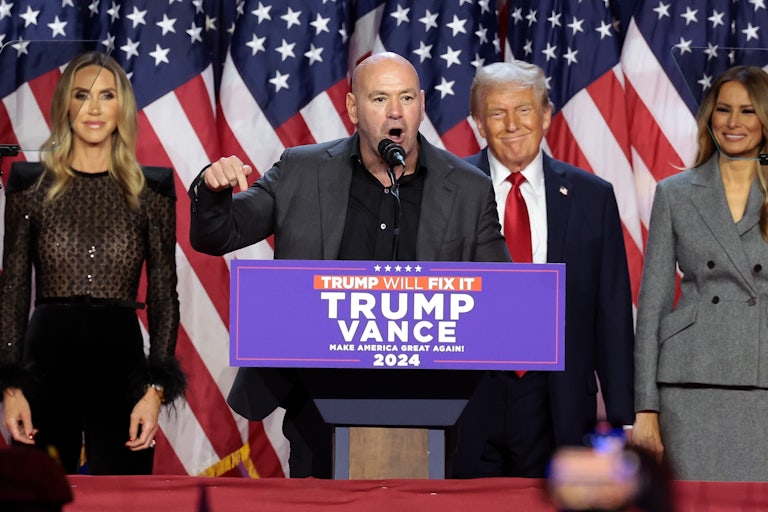
Dana Bash speaks at Trump's victory rally as he looks on and smiles
Win McNamee/Getty Images

On an election night as bleak as it was long, Ultimate Fighting Championship CEO and hardcore Trump supporter Dana White used his stage time at the Trump victory rally to paint an especially grim vision of the future.

There was a palpable joy at the Trump headquarters in the early hours of Wednesday morning as polls nationwide all but guaranteed a Trump victory. Trump brought what looked like his entire team onstage during his nearly 3 a.m. victory speech, even giving White the floor for an outlandish speech in which he heaped praise on Trump.

“This is what happens when the machine comes after you. What you’ve seen over the last several years, this is what it looks like,” said White. “Couldn’t stop him, he keeps going forward, he doesn’t quit, he’s the most resilient, hardworking man I’ve ever met in my life.… This is karma, he deserves this.”

White went on to shout out major manosphere influencers, many of whom are thought to have had a direct impact on the men who voted for Trump.

“I want to thank the Nelk Boys, Adin Ross, Theo Von, Bussin’ With the Boys, and last but not least, the mighty and powerful Joe Rogan.”

Adin Ross’s streams have been a safe place for sexism and general, lowbrow bigotry for some time now. The 24-year-old has been banned from Twitch eight separate times for using a homophobic slur and for “hateful conduct.” Earlier this year, Trump joined Ross’s livestream, per Barron Trump’s suggestion, and was gifted a Rolex live on stream. The Nelk Boys have similarly used their podcast to platform right-wing demagogues like Tucker Carlson to young men. Theo Von and Bussin’ With the Boys are slightly tamer versions of these acts. And the infamous Joe Rogan is the forefather of them all.

This strange lineup of famous podcasters with dubious ties to the alt-right is just a sign of how dangerous and unserious a future Trump Cabinet could be.