Breaking News
Breaking News
from Washington and beyond

California Is Not “Done” With Walgreens After All

Governor Gavin Newsom’s plan to stop doing business with the pharmacy chain has crashed into a legal wall.

California Governor Gavin Newsom
Mario Tama/Getty Images
California Governor Gavin Newsom

As it turns out, California cannot cut ties with pharmacy chain Walgreens.

Governor Gavin Newsom announced last month that his state would cease to do business with Walgreens because the pharmacy chain decided not to dispense abortion pills in nearly half of U.S. states following pressure from Republican attorneys general. Medication abortions make up more than half of all abortions in the United States and are considered a crucial tool in maintaining access to the procedure since Roe v. Wade was overturned.

But California legally has to maintain ties with Walgreens because of the state’s Medicaid program, Kaiser Health News reported Thursday, citing health law experts.

Medi-Cal provides health coverage for about 15 million people. Federal law states that patients can get their Medicaid-covered prescriptions at any approved pharmacy. Had California abruptly stopped covering Medi-Cal prescriptions filled at Walgreens locations, it would have broken federal law. This also would also have contradicted a key part of Newsom’s platform: to expand Medi-Cal as much as possible.

The Newsom administration said it will “continue to comply” with federal law by keeping its partnership with Walgreens. Gubernatorial spokesperson Anthony York said Newsom will not “take any action that hurts people who need access to care.”

Walgreens had said in January that it would offer mifepristone, one of the medications used to induce an abortion. The Food and Drug Administration changed its rules to allow pharmacies in states that still allow abortion to dispense the drug. Pharmacies would need to get certified to do so because the FDA currently classifies mifepristone as a high-risk drug, despite the fact that there is no data backing that decision up.

Walgreens and CVS, two of the biggest U.S. pharmacy chains, said they would seek certification. But in March, following intense pressure from Republican attorneys general in 20 states, Walgreens announced it wouldn’t dispense mifepristone in those states—and threw Kansas in there for good measure, too.

The chain has said it will dispense mifepristone “in any jurisdiction where it is legally permissible to do so.” Abortion is still legal in more than half of the states where Walgreens will no longer offer the drug, but the company said in a statement to TNR that some of those states don’t allow pharmacists to dispense mifepristone. “Failure to follow these state laws could result in individual pharmacists facing very real and serious legal risk, including criminal charges that could lead to jail time, steep fines and the loss of their license by state boards of pharmacy,” the company said.

In February, Newsom slammed Walgreens for its decision and said the chain “cowers to extremists and puts women’s lives at risk.” He said California was “done” with Walgreens but did not clarify what he meant. It now appears that was never an option.

This article has been updated to clarify Walgreens’ position.

North Dakota Senate Votes to Increase Its Own Meal Budget After Rejecting Free School Lunch Bill

Meanwhile, state Republicans are busy banning pretty much everything except hypocrisy.

Matt Stone/MediaNews Group/Boston Herald/Getty Images

Just over a week ago, North Dakota lawmakers voted to prevent giving free school lunches to low-income students. Then, on Thursday, they voted to increase the amount of money they get to spend on their own lunch.

On March 27, the Senate narrowly rejected a bill, which had passed the House, guaranteeing free school lunches to K-12 students in families at or below 200 percent of the federal poverty level.

On Thursday, the Senate voted 26–21 to pass a bill to raise per diem meal reimbursements for state employees traveling within the state, from $35 to $45.

Republican Assistant Majority Leader Jerry Klein told local outlet InForum that state employees should be getting a higher sum because inflation costs have made meals more expensive. Klein voted against giving students, whose parents are also being squeezed by inflation, free school lunch.

“I thought today’s vote was very self-serving,” Democratic Senate Minority Leader Kathy Hogan told InForum. “How can we vote for ourselves when we can’t vote for children?”

The effort to give low-income students free school lunches for the next two years would have cost just some $6 million, a relatively small price to pay to ensure children don’t go hungry. While the Senate failed to pass the bill, the House is not giving up quite yet, reattaching the provision to a broader school funding bill.

Bills that target marginalized people, meanwhile, have been sailing through the North Dakota legislature. On Monday, the Senate passed bans on providing gender-affirming care to people under 18 and on transgender women’s participation in female sports in grade school and college.

The Senate also revived a push to prevent teachers and government employees from recognizing transgender students using their preferred pronouns—a bill that Republican Governor Doug Burgum had vetoed last month. While the House fell short of overriding his veto, Senate lawmakers put the language back into a separate bill that aims to restrict transgender students’ access to restrooms. Last month, Republican state Representative Lori VanWinkle likened respecting students’ preferred pronouns to murder.

Another Solid Jobs Report Quiets the Doomsayers

There was even some good news on Black unemployment.

John Smith/VIEWpress

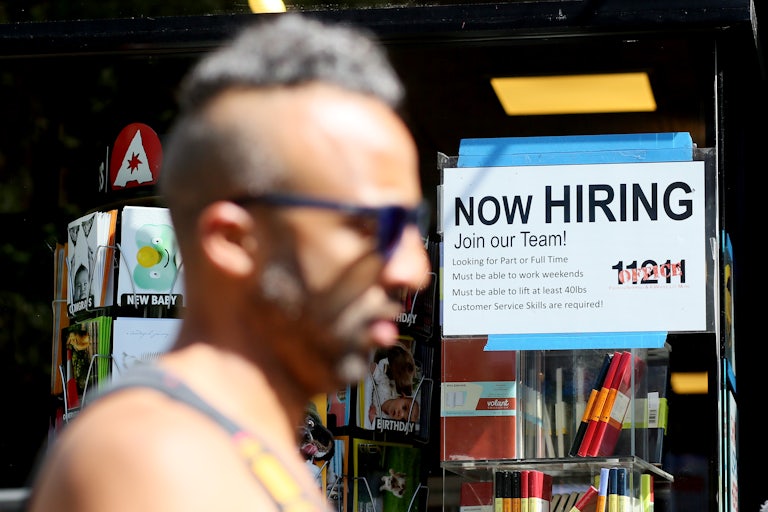
The U.S. labor force held relatively steady in March, with unemployment sticking near a 50-year low, according to a report released Friday by the Bureau of Labor Statistics.

Non-farm employers added 236,000 jobs in March, a slower pace than in recent months but almost precisely as expected, while the unemployment rate remained at 3.5 percent. The unemployment rate in February 2020—just before the pandemic kicked off in earnest in the United States—was also 3.5 percent. Unemployment for Black people fell to 5 percent, a record low.

The labor force participation rate, or the number of people in the labor force, was mostly unchanged, ticking up one-tenth of a percent to 62.6 percent. The leisure and hospitality sectors, which were some of the hardest-hit at the peak of the pandemic, added the most jobs in March as businesses begin to recover.

Crucially, hourly earnings also held fairly steady, with average wages increasing 0.3 percent in March, up just a little from an average of 0.2 percent in February. This is the lowest increase since the fourth quarter of 2019.

Harvard economics professor Jason Furman warned that “average hourly earnings are poorly measured and volatile,” but if the rate holds, it could be a sign that inflation is on its way out. Slower wage gains help keep businesses’ operating costs down, which means employers will be less likely to keep consumer prices high to offset in-house expenses.

Both the employment gains and the potential decrease in inflation are huge wins for President Joe Biden, who has been under fire since he took office for sky-high inflation and unemployment, due to first Covid-19 and then Russia’s invasion of Ukraine.

People have been jumpy about the economy lately, particularly after a string of high-profile bank failures, including Silicon Valley Bank’s. Economists have been warning that a recession is on the horizon—some even claim that “a recession is underway now”—and the Federal Reserve has kept up its relentless campaign of interest rate hikes, although it has decreased by how much.

But Friday’s jobs report is a good sign that a soft landing, when inflation is brought down without tipping the economy into a recession, could still be possible.

Tennessee Republicans Expel Two Democrats From the Legislature for Protesting Gun Violence

The GOP-led House has a very twisted definition of “decorum.”

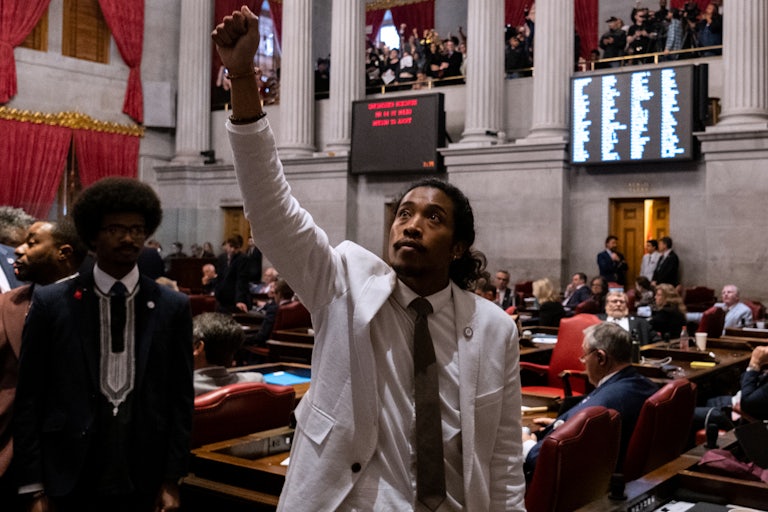
Democratic state Rep. Justin Jones of Nashville
Seth Herald/Getty Images
Democratic state Representative Justin Jones of Nashville during a vote on his expulsion from the state legislature on April 6

The Republican-led Tennessee House of Representatives voted Thursday to remove two Democratic lawmakers from office for breaking “decorum” by interrupting the chamber’s proceedings to draw attention to gun reform.

Representatives Justin Jones and Justin Pearson, who are both Black, are now the first lawmakers in state history to be expelled by the opposing party, in nearly party-line votes. A third Democrat, Gloria Johnson—who is white—survived an expulsion vote. Asked about the discrepancy by a reporter, Johnson responded that “it might have to do with the color of our skin.”

The votes come amid protests by gun-control advocates against Tennessee lawmakers in the wake of the Covenant School shooting that left three children and three adults dead. Last week, as thousands of protesters outside the Capitol building demanded gun reform, the three Democrats walked up to the well of the House and began chanting “No action, no peace” through a bullhorn.

Republicans charged the trio with breaking “rules of decorum,” but the Democrats said they only walked up to the well after being repeatedly silenced by Republican House Speaker Cameron Sexton. They say their mics were cut off throughout the week whenever they tried to speak about gun violence or about the thousands protesting right outside the building. On a Tennessee radio show last week, Sexton called the trio’s actions an “insurrection.” (One of Sexton’s former colleagues, then-Representative Terri Lynn Weaver, attended the actual January 6 insurrection but was not expelled from the legislature.)

On Monday, all three representatives were stripped of their committee assignments and had their membership IDs disabled.

During Thursday’s vote, Jones pointed out that numerous other members of the House have avoided expulsion while committing far more severe violations, including child molestation:

The tolerance for other violations seems to have continued even this week.

On Monday, Republican Representative Justin Lafferty—who once defended the three-fifths compromise—reportedly shoved Jones, who is Black, on the floor of the House. The assault occurred while protesters entered the chamber and chanted from the gallery. Lafferty and Jones were both recording the scene on their phones. Lafferty then turned toward Jones and appeared to shove him. A voice is heard in Jones’s video saying, “Hey, get your hands off me.” Lafferty has not been charged with any breaching of “decorum.”

Before Thursday’s votes, the Tennessee House did advance some “safety” and mental health–related bills; none dealt with gun regulation, and none confronted more systemic issues surrounding violence prevention. Back in 2020, Tennessee Republicans shut down a red flag law that in fact could have stopped the Covenant School shooter. The following year, Governor Bill Lee signed legislation allowing people 21 and older to openly carry handguns without permits. Since then, state Republicans have been looking to expand the right to people as young as 18—and for any firearm, not just handguns.

Biden Administration Tries to Have It Both Ways on Trans Student Athletes

Activists are calling a proposed Department of Education rule a “betrayal.”

Stephen Maturen/Getty Images

The Biden administration proposed a rule Thursday to prevent schools from flat-out banning transgender students from playing on the sports team that matches their gender identity.

The move comes as attacks on trans rights are picking up nationwide, with particular emphasis on prohibiting trans girls from playing on girls’ sports teams.

Under the proposal, public schools at all levels would not be allowed to “categorically” ban trans students from playing on the team that aligns with their gender. Instead, schools would have to develop “team eligibility criteria” that factor in the sport, the level of competition, and the grade or education level of the athletes.

But this means that schools could still bar trans athletes from elite sports.

The proposed rule … recognizes that in some instances, particularly in competitive high school and college athletic environments, some schools may adopt policies that limit transgender students’ participation,” the Department of Education said in a fact sheet. “The proposed rule would provide schools with a framework for developing eligibility criteria that protects students from being denied equal athletic opportunity, while giving schools the flexibility to develop their own participation policies.”

It specified that “these criteria could not be premised on disapproval of transgender students or a desire to harm a particular student.”

Trans rights activists slammed the proposal as a betrayal. Instead of actually addressing the issue, writer Erin Reed said, “it’s actually a roadmap to telling schools how to discriminate.”

Civil rights lawyer Alejandra Caraballo pointed out that this could divert resources away from more consequential fights.

The proposal was announced just hours after the Supreme Court ruled that a 12-year-old trans girl in West Virginia must be allowed to compete on her school’s girls’ cross country and track teams. West Virginia implemented a law banning trans girls from girls’ teams in 2021, but that law is being challenged in court. The Supreme Court said that the law cannot be enforced until the case is decided.

Biden’s proposed regulation is one of his administration’s first forays into the highly contentious arena of trans rights. Republican-led states have ramped up their attacks on LGBTQ rights, particularly for trans and nonbinary people. Twenty states, such as Florida, Texas, and Montana, have banned trans girls from playing on girls’ sports teams. Most recently, on Wednesday, Kansas’s Republican-controlled legislature overrode Democratic Governor Laura Kelly’s veto of a bill banning trans girls from playing girls’ sports.

LGBTQ rights activists have slammed these laws as sexist and misinformed. The ACLU pointed out that by singling out trans girls, the laws reinforce the dangerous myth that trans women are sexual predators.

Pediatrician and geneticist Eric Vilain told NPR in 2021 that most laws about trans athletes are not based on science. Being trans doesn’t automatically give an athlete a physical advantage, he said. Instead, the laws—which primarily target elementary and high school students—create opportunities to degrade and humiliate girls by forcing them to prove their gender.