Breaking News
Breaking News
from Washington and beyond

Florida Republican Calls to “Crush” Pride Month for Being “Anti-Christian”

Anthony Sabatini is outdoing the rest of his party with the bigotry.

Rainbow heart
Paul Morigi/Getty Images

A Florida Republican politician suggested that Pride images are “anti-Christian” hate symbols and called for the government to immediately “crush” Pride Month.

Anthony Sabatini, who currently serves as the chair of the Lake County Republican Party, slammed Pride Month as “anti-American” and proposed ways the state government could effectively end LGBTQ pride celebrations.

“There’s a great reset going on. And I say, well, if you look around, really, I think the great reset is a gay reset. I mean, if you look at Pride Month, that’s pretty much, like, the whole program,” Sabatini, who is running for Congress, said at an event. It is not clear when the event took place, but video of his speech was posted to Twitter on Friday by liberal activist Lauren Windsor.

“We have to end Pride Month, okay?” Sabatini continued to applause from the audience. “We have to crush Pride Month. It has to go away.”

“It’s time to crush Pride Month and the businesses that promote that toxic anti-American garbage.”

Sabatini suggested the Florida government should pass a law banning all counties, school boards, city commissions, and even businesses from promoting Pride Month in any way. He pointed to the city of Mount Dora, which marked Pride by hanging rainbow banners along the streets.

“First we need to crush Pride Month” by banning people from spending state or local funds on it, Sabatini said. “We need to bend our civil rights laws to make it actionable legally for when they do do that because it’s an anti-Christian hate symbol.”

Republicans across the country are steadily making the U.S. more hostile to LGBTQ people, and Florida is leading the charge. State lawmakers have passed laws expanding “Don’t Say Gay,” banning discussions of personal pronouns in schools, and prohibiting transgender people from using the bathroom that aligns with their gender on any public property. Meanwhile, Governor Ron DeSantis earlier this month shared what is possibly the most bigoted ad ever for his presidential campaign.

And it’s not just at the state level. The Supreme Court ruled in June that businesses can refuse to serve LGBTQ people, which has already spurred more discrimination. And on Friday, the House of Representatives passed a defense budget that bans the Department of Defense from flying Pride flags or reimbursing travel costs for service members who seek gender-affirming care.
Here Are the Democrats Who Helped Pass the “War on Woke” Defense Bill

Four Democrats joined Republicans to pass the radical bill targeting abortion, LGBTQ rights, and more.

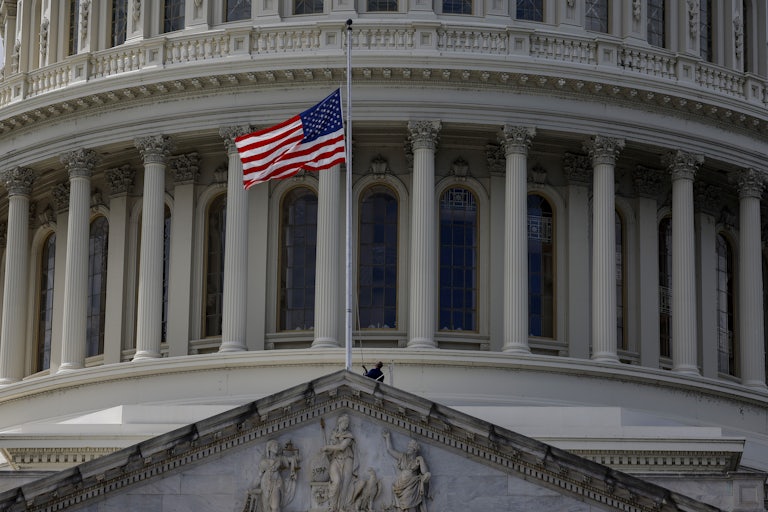
Capitol building
Anna Moneymaker/Getty Images

The House of Representatives on Friday passed a defense budget that was loaded with Republican amendments aimed at furthering their culture wars.

The House voted 219–210 for the newly extreme bill, which now bans the Department of Defense from flying Pride flags, funding diversity, equity, and inclusion initiatives, and reimbursing travel costs for service members who need to get an abortion.

Four Democrats broke ranks to vote with Republicans. Here are the Democrats who voted for the defense budget in all its bigoted glory.

  • Donald Davis of North Carolina
  • Jared Golden of Maine
  • Marie Gluesenkamp Perez of Washington
  • Gabe Vasquez of New Mexico

This is not the first time that some of these members have sided with Republicans. Golden and Perez voted in May to repeal President Joe Biden’s student debt relief program and to end the federal student loan repayment freeze. Davis also voted Thursday to include the Pride flag ban amendment in the defense budget.

Two Democrats Help Republicans Pass Vile Ban on Pride Flags in Military

Even three Republicans voted against the measure, and yet…

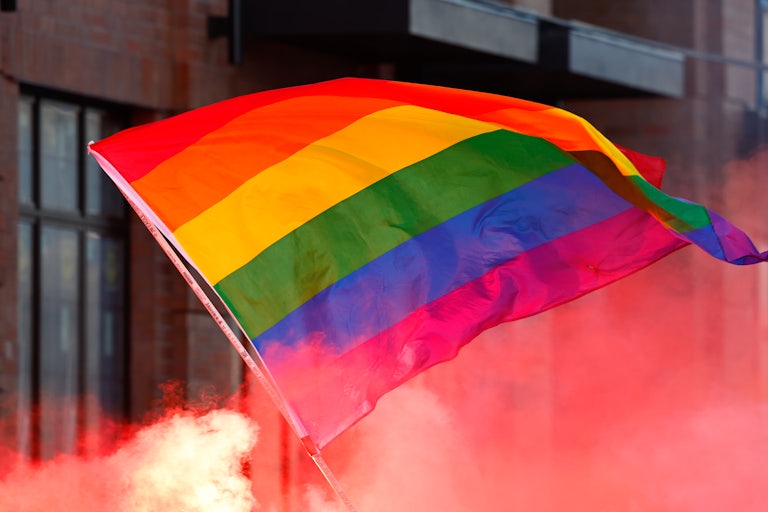
Pride flag
Rich Graessle/Icon Sportswire/Getty Images

Two Democrats—one poised to be the party’s next anointed Kyrsten Sinema—helped Republicans codify Donald Trump’s policy banning the Defense Department from displaying Pride flags.

The amendment to the national defense bill came from Republican Representative Ralph Norman, as part of the stream of culture war issues the party took up before they voted to shove another nearly trillion more dollars into the military industrial complex.

In a 218–213 vote late Thursday, the House approved the amendment that would ban members of the armed forces or civilian employees from displaying any flag other than the American, or other limited approved flags like state or military service ones, or flags of another country that is “an ally or partner of the United States.” The amendment was widely interpreted as one targeting Pride flags in particular.

A Norman aide noted that while the Pentagon hasn’t flown a Pride flag, the goal of the amendments is to get ahead of the trend of more and more agencies displaying Pride flags, even simply on social media accounts. Acts as extreme as the Navy having a rainbow Twitter banner during Pride month this year were enough to light the fire underneath 218 House members to put the foot down on letting anyone imagine that military members might be gay.

The amendment codifies a Trump-era (and Biden-upheld) policy that bans Pride flags from military bases. Such an amendment even got three Republican dissenters in Representatives Brian Fitzpatrick, Mike Lawler, and Marcus Molinaro.

Still, two Democrats decided the bigoted ban was one worth adding to the defense bill: Michigan’s Elissa Slotkin and North Carolina’s Don Davis.

Davis may be triangulating as he anticipates unfavorable gerrymandering from state Republicans. Nevertheless a weak excuse, as it is politically inept for Democrats to legitimize such causes as anything more than paltry culture war. Relatedly, Davis also joined eight Democrats—including those who voted against student debt relief—in approving Republican Chip Roy’s amendment to ban funds from going towards teaching critical race theory.

Such urgent priorities these Democrats bravely gave credence to.

Slotkin, for her part, said her vote was “to ban hateful flags from flying on military bases, particularly the Confederate flag,” arguing that the most sound way to ban “hateful flags” was by pursuing a near-universal flag ban.

Slotkin may very well have believed her vote to be more about banning hateful symbols at the relatively smaller expense of banning Pride flags. Even if that was the case—and considering that the entire Democratic caucus otherwise voted against the amendment—the vote adds to a broader record of the Democrats’ heir-apparent Michigan Senate candidate dissenting against other caucus-wide causes.

Previously, Slotkin has opposed student debt assistance on a vote supported by 93 percent of the caucus, voted against 85 percent of her caucus on whether the United States should simply study the impact of its sanctions on other countries, voted to overturn locally enacted criminal justice and voting rights reforms in Washington, D.C., and even voted against 94 percent of her caucus to bar security clearance from anyone who has used cannabis.

Slotkin also does not openly support Medicare for All, the Green New Deal, or abolishing the death penalty. And now, she has signed on to a Republican-led bill that bans members of the armed service from displaying a Pride flag.

Michigan is part of Democrats’ growing midwestern blue wall—a region where the party has shown, over and over again, how strong commitments to progressive causes can actually manifest into meaningful change for millions of people. But Slotkin is proving over and over again her incongruence with that possibility.

This article has been updated.

Republicans Successfully Weaponize the Defense Bill for Their Culture Wars

Republicans have successfully used the defense bill to target abortion, diversity, and LGBTQ people.

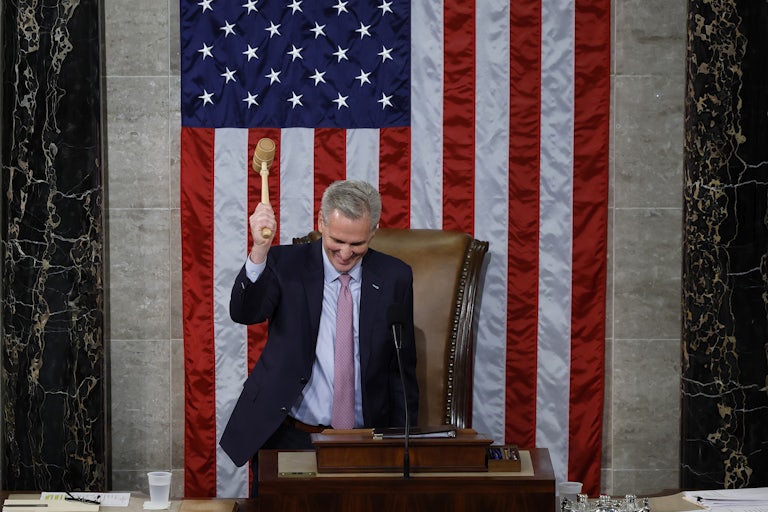
House Speaker Kevin McCarthy bangs the gavel in the Capitol
Chip Somodevilla/Getty Images
House Speaker Kevin McCarthy

House Republicans voted Friday to add hundreds of amendments to the defense bill, successfully using the budget as a tool in their culture wars.

The House of Representatives voted 219–210 for the amended bill, completely along party lines. The measure now goes to the Democratic-controlled Senate, where the GOP’s ideological amendments have little chance of passing.

The Republicans’ extreme changes include banning the Department of Defense from spending federal funds on diversity, equity, and inclusion initiatives, which military officials consider critical not only for recruiting fresh talent, but also for combating extremism in the ranks.

The GOP has also blocked the military from reimbursing travel expenses for service members who have to travel for an abortion. Another amendment prohibits the Defense Department from reimbursing travel costs for people who travel for gender-affirming care.

The DOD would be barred from flying Pride flags, and using federal funds to support green energy initiatives.

The radical, bigoted bill has little chance of making it through the Democratic-controlled Senate. But it’s a clear sign of the lengths that Republicans will go to wage war on things they disagree with (instead of, you know, actual issues).

Arizona Republican Says He “Misspoke” During Rant About “Colored People”

Representative Eli Crane’s comment immediately sparked outrage in the chamber.

Representative Eli Crane
Anna Moneymaker/Getty Images
Representative Eli Crane

Arizona Republican Eli Crane gave a nod to the times of segregation on the floor of the U.S. Congress on Thursday.

“My amendment has nothing to do with whether or not colored people or black people or anybody can serve. OK? That has nothing to do with any of that stuff,” Crane began, prompting shock throughout the floor.

Crane’s comments came as he offered an amendment to the nation’s annual defense spending cornucopia that he said would ban the consideration of “race, gender, religion, or political affiliations, or any other ideological concepts as the sole basis for recruitment, training education, promotion, or retention decisions.”

The amendment was just one of many GOP-pushed amendments dealing with culture war issues, rather than, for instance, reappropriating the destructive and wasteful military spending towards anything that actually serves people.

The comments prompted Representative Joyce Beatty, former chair of the Congressional Black Caucus, to ask for the words to be struck down from the record. “I find it offensive, and very inappropriate,” Beaty said. “I am asking for unanimous consent to take down the words of referring to me or any of my colleagues as ‘colored people.’”

Crane injected, requesting to amend his comments to “people of color,” but Beatty insisted the words be removed, which they were by unanimous consent.

“In a heated floor debate on my amendment that would prohibit discrimination on the color of one’s skin in the Armed Forces, I misspoke,” Crane said afterward. “Every one of us is made in the image of God and created equal.”

Language is always evolving, and the connotations words hold are grounded in the histories surrounding them. “Colored people” is associated heavily with the times of slavery, segregation, and Jim Crow: times during which the term referred to Black people as property, and then as categories to be avoided or held separately from white society.

Consequently, the term is a relic of the ills in America’s past—and not a term one may use if they’re interested in staying away from that past.

Meanwhile, also this week, Crane’s Senate Republican colleague Tommy Tuberville insistently refused to acknowledge that white nationalism is racist.