Breaking News
Breaking News
from Washington and beyond

Michigan Becomes First State in 58 Years to Repeal Anti-Union “Right-to-Work” Law

The Democratic legislature and governor are delivering on their victory.

Michigan Governor Gretchen Whitmer claps while holding a folder. Other people clap behind her.
Bill Pugliano/Getty Images
Michigan Governor Gretchen Whitmer

Michigan is delivering on its first Democratic trifecta in decades. On Friday, it became the first state in 58 years to repeal anti-worker so-called “right-to-work” laws.

Governor Gretchen Whitmer signed the legislation Friday after the legislature sent it to her desk earlier this week.

The bill marks a huge tide shift for the labor movement. Indiana was the last state to repeal such a law in 1965, only for it to be reinstated by Republicans in 2012. That same year was when Michigan passed its anti-union right-to-work law, and since then, the state has lost some 40,000 union members.

Michigan’s repeal comes amid a resurgence of the labor movement, as union membership is increasing across the country along with labor actions like strikes. That may bode well for organizers in other states looking to roll back the anti-worker law. Twenty-six other states have right-to-work laws, according to the National Conference of State Legislatures.

Right-to-work laws erode union power by allowing workers to forgo paying dues for union membership while still reaping the benefits. The laws, backed heavily by Republicans and their corporate lobby friends, consequently weaken union membership, treasuries, and overall organizing capabilities. Conservatives often frame it as a pro-business argument: that companies will choose to go where the laws are enacted, which stimulates economic growth. Implicit in that calculation is why companies would do that: to be able to more easily exploit their workers at the behest of their bottom line.

“‘Right to work’ is a lie designed to weaken workers’ rights and lower wages,” said Sean M. O’Brien, the general president of Teamsters. “Today, Michigan’s elected officials honored their state’s proud labor history by rejecting this dangerous and deceptive anti-union legislation.”

Whitmer promised in 2018 to repeal the anti-worker law. And after voters reelected her with wide margins in November and gave her party majorities to match, she now delivers on the promise.

“Now that workers’ rights have been restored, Michigan is once again leading the way for the country in showing what is possible when working families are put first,” said Janella James, executive director of the Michigan Nurses Association. “We want to thank Governor Whitmer and the Legislature for listening to workers and setting our state on a better path. Today marks the beginning of a new chapter in Michigan’s history.”

Kentucky Governor Vetoes Extreme Anti-Trans Bill Pushed by Republicans

Democratic Governor Andy Beshear vetoed the bill, saying it will lead to an increase in suicide among Kentucky youth.

Anna Moneymaker/Getty Images
Kentucky Governor Andy Beshear

Governor Andy Beshear on Friday vetoed a massive bill targeting transgender rights in Kentucky, one of the most extreme measures in the country.

The bill passed both the state House and Senate last week in a record sprint, mainly along party lines. The Senate voted 30–7 for the measure, a veto-proof majority, and so could override Beshear’s move as soon as next week.

If it becomes law, Senate Bill 150 would ban all gender-affirming care for trans minors in Kentucky and would force doctors to detransition any minors in their care. It would prohibit discussing sexual orientation or gender identity in public schools at any level, prevent trans students from using the bathroom that corresponds to their gender identity, and would allow teachers to refuse to use a student’s preferred pronouns.

“Senate Bill 150 allows too much government interference in personal health care issues and rips away the freedom of parents to make medical decisions for their children,” Beshear said in a statement.

“I am also vetoing Senate Bill 150 because my faith teaches me that all children are children of God and Senate Bill 150 will endanger the children of Kentucky,” he continued, citing studies that showed a connection between receiving gender-affirming care and lowered levels of depression and suicidal thoughts in LGBTQ children. “Senate Bill 150 will cause an increase in suicide among Kentucky’s youth.”

The ACLU of Kentucky described the bill when it passed as “the worst anti-trans bill in the country.”

“This dangerous bill and others like it across the country are nothing more than a desperate attempt to score political points by targeting people who simply want to live their lives,” interim executive director Amber Duke said in a statement. “True democracy requires meaningful and informed debate and engagement from the public. The shameful process on display in the Kentucky House undermines the public trust in government.”

The bill was rushed through the House and Senate in a record daylong sprint. A different omnibus anti-trans measure had looked dead in the water last Wednesday night. But the next morning, Republicans resurrected and expanded the text, forcing it through despite long and often emotional arguments against it from Democrats and trans rights activists.

Kentucky is just the latest state to have lawmakers try to curtail LGBTQ rights. This week alone, Florida advanced an anti-trans bill so broad and extreme it could also prevent people from getting breast cancer treatment. Georgia, meanwhile, passed a bill banning gender-affirming care for minors and criminalizing medical workers who provide that care.

House Republicans Pass “Parents Bill of Rights” That Actually Just Polices Schools and Students

The bill is another Republican attack on education, this time on the national level.

Anna Moneymaker/Getty Images

The Republican-led House on Friday passed its so-called “Parents Bill of Rights,” 213-208. Framed as a positive piece of legislation, the bill actually aims to police teachers and school staff and thus obstruct the independent flow of education for students.

The radical bill calls for school districts to post curriculum information and provide parents with lists of reading materials available in school libraries. Such practices have already been test-run in places like Florida. Teachers there have been forced to empty classroom libraries, cover them up, or even catalog each book into a central system to check for compliance with their districts’ restrictive standards.

The legislation also (incorrectly) implies that parents are never listened to in schools. It calls for school districts to consider community feedback when making decisions, allow parents to address school boards, and notify parents of violent activity happening on school grounds. By including already standard practices in the bill, Republicans are couching their more radical demands in what seems like a reasonable bill.

If anything, the bill’s nod toward school board meetings appears to be implicit approval of attacks school staff have already endured. School boards and teachers across the country have expressed concerns surrounding classroom freedom, and even for their own lives. Whipped up by Republican officials, a loud minority has targeted schools and protested everything from Covid-19 safety precautions to classroom material.

In 2021, the National School Boards Association sent a letter to the Biden administration asking for an investigation into violent threats against school board members. They described the threats as potentially “equivalent to a form of domestic terrorism and hate crimes.” After receiving the letter, Attorney General Merrick Garland directed the Justice Department to carry out an inquiry. House Republicans have since aimed to discredit the letter and the inquiry.

It’s unlikely the “Parents Bill of Rights” will make it pass Biden’s desk, but by passing the radical legislation, House Republicans are escalating animus toward already overworked and underappreciated teachers. They moreover are further nationalizing the attack on academic freedom that has already been taking place from Florida and Texas to Michigan and South Carolina.

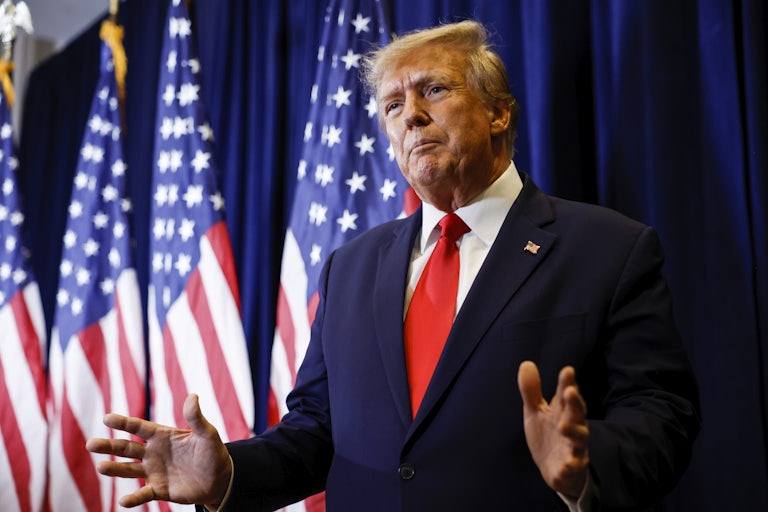
Trump Threatens “Death & Destruction” If He’s Charged

Trump argued that filing charges against him would lead to major violence.

Anna Moneymaker/Getty Images

In the wee small hours of the morning, one Manhattan man found himself confronting the harsh realities of what it would mean for him to actually be arrested.

Early Friday, twice-impeached former President Donald Trump, who is the subject of numerous criminal inquiries, posted on Truth Social warning that “death & destruction” could come if he is charged for paying hush money to porn actress Stormy Daniels—a scheme allegedly done in order to cover up the pair’s affair occurring just months after Trump’s wife Melania had given birth to their child, Barron.

“What kind of person can charge another person, in this case a former President of the United States, who got more votes than any sitting President in history, and leading candidate (by far!) for the Republican Party nomination, with a Crime …,” Trump began in his run-on rant, “when it is known by all that NO Crime has been committed, & Also known that potential death & destruction in such a false charge could be catastrophic for our Country?”

“Why & who would do such a thing? Only a degenerate psychopath that truely hates the USA!”

Trump’s menacing posts follow an ongoing right-wing campaign to discredit the Manhattan District Attorney Alvin Bragg, tasked with investigating Trump’s role in the hush-money payment. Even members as high up as Kevin McCarthy and Elise Stefanik spread antisemitic conspiracy theories, insinuating Bragg is a puppet of George Soros for pursuing the investigation. Now the attacks have escalated to Trump calling Bragg a “degenerate psychopath” and a “Soros backed animal.”

While earlier Trump-beckoned protests brought out just a paltry handful of loyalists, the latest calls from Trump display a concerningly desperate escalation, especially given his track record in inciting violence.

The Wildest Things Members of Congress Said During the TikTok Hearing

“Does TikTok access the home Wi-Fi network?”

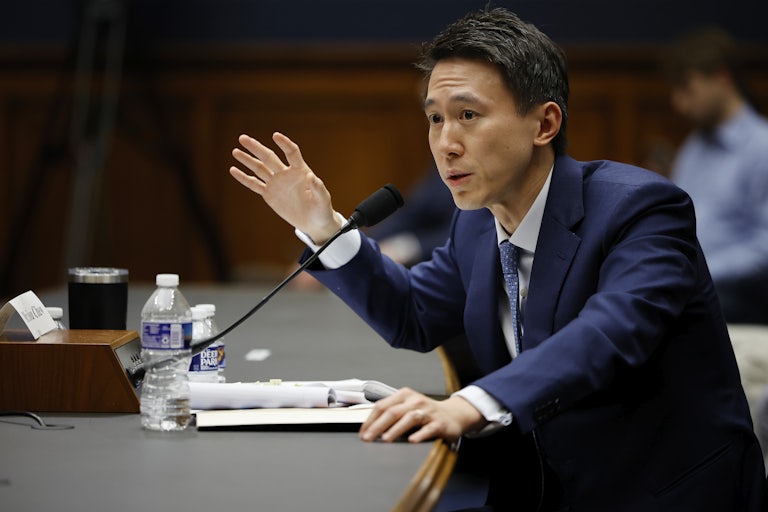
TikTok CEO Shou Zi Chew testifies before a mic. He raises his right hand.
Chip Somodevilla/Getty Images
TikTok CEO Shou Zi Chew testifies before the House Energy and Commerce Committee on March 23.

TikTok CEO Shou Zi Chew testified before the House Energy and Commerce Committee on Thursday to answer questions about the app’s data privacy policies.

The Biden administration has ordered TikTok to sell its American operations to a U.S.-based firm or face being banned nationwide, citing national security concerns. TikTok and the broader issue of U.S.-China relations is one of the few topics on which both parties seem united.

Chew fielded—but was rarely given time to answer—questions from Democrats and Republicans alike about data privacy, content moderation, child safety, and potential ties to the Chinese Communist Party. But he was also asked a lot of weirder questions too.

Here are some of the wildest things members of Congress said during the five-and-a-half-hour hearing.

1. North Carolina Representative Richard Hudson asked, “Does TikTok access the home Wi-Fi network?”

“Only if the user turns on the Wi-Fi,” Chew replied, visibly confused. “I’m sorry, I may not understand the—”

Hudson: “So if I have [the] TikTok app on my phone, and my phone is on my home Wi-Fi network, does TikTok access that network?”

Chew: “You will have to access the network to get connections to the internet.”

2. Texas Representative Randy Weber said, “TikTok is indoctrinating our children with divisive, woke, and pro-CCP propaganda.”

That’s the whole sentence, yes.

3. Representative Buddy Carter did not understand facial filters.

Carter asked if TikTok used phone cameras to identify body or face data, to which Chew replied that the app does not collect such information. The only facial data TikTok does use is to identify where users’ eyes are if they use a filter to appear if they are wearing sunglasses, he said. That data is stored only on the user’s device and is deleted after they stop using the filter.

“Why do you need to know where the eyes are?” Carter asked.

4. Representative Kat Cammack asked about a video only one TikTok user commented on.

Cammack shared a clip of a TikTok video in which the user implied they wanted to attack the committee meeting. The Florida Republican said the video had been up for 41 days, before the hearing date was made public, and demanded to know why it hadn’t been taken down despite violating TikTok’s content policies.

The video had very low engagement and only one comment, meaning it would have taken TikTok moderators longer to find and flag it. It actually started to get more attention online after Cammack shared it. Within minutes, as the hearing was ongoing, the account was banned.

5. Multiple Texas representatives complained about the name “Project Texas.”

TikTok has already announced a plan it calls Project Texas to move all of its U.S. data to servers in Texas. The social media company says that doing so will protect U.S. data from any national security threats.

But multiple Texas representatives took issue with the name. “Please rename your project,” August Pfluger said. “Texas is not the appropriate name. We stand for freedom and transparency, and we don’t want your project.”

While this was not the main issue of the hearing, Pfluger’s comments are ironic considering Texas has made several moves in recent weeks to restrict its residents’ ability to control their own bodies and access information online.