Breaking News
Breaking News
from Washington and beyond

Supreme Court Deals Major Blow to Free Speech With TikTok Ruling

President Joe Biden is reportedly already looking for ways to reverse the law.

A person protests in favor of TikTok outside the U.S. Supreme Court
Allison Robbert/The Washington Post/Getty Images

The Supreme Court on Friday upheld Congress’s ban on TikTok, marking the end of the popular video-sharing platform’s presence in the United States.

“There is no doubt that, for more than 170 million Americans, TikTok offers a distinctive and expansive outlet for expression, means of engagement, and source of community,” the court wrote in its per curiam. “But Congress has determined that divestiture is necessary to address its well-supported national security concerns regarding TikTok’s data collection practices and relationship with a foreign adversary. For the foregoing reasons, we conclude that the challenged provisions do not violate petitioners’ First Amendment rights.”

In a concurring opinion, Justice Neil Gorsuch added that while the case’s expedited timeframe had left him less than certain about its details and its outcome, “the question we face today is not the law’s wisdom, only its constitutionality.”

“Whether this law will succeed in achieving its ends, I do not know,” Gorsuch wrote. “A determined foreign adversary may just seek to replace one lost surveillance application with another. As time passes and threats evolve, less dramatic and more effective solutions may emerge. Even what might happen next to TikTok remains unclear.”

TikTok is reportedly prepared to shut down its app on Sunday, when the ban is scheduled to take effect, though the actual language of the law technically only mandates that the social media platform be taken off of app stores to prevent new users from downloading it.

On Thursday, U.S. officials revealed that President Joe Biden would not enforce the ban through the end of his presidency, handing the responsibility of interpreting the law to President-elect Donald Trump.

Experts have said the app will not disappear from users’ phones, though it will be restricted from the app store, and new updates will no longer be available—eventually rendering the app unusable, reported the Associated Press.

In oral arguments before the court, TikTok said that the law banning its presence in the U.S. was a violation of the company’s First Amendment rights. The government claimed the app’s erasure from the American market was a matter of national security, arguing that its parent company, Beijing-based ByteDance, could share data with the Chinese government or spread Chinese propaganda to American consumers. But that concern belies the fact that TikTok, which is headquartered in California and Singapore, has never operated in mainland China. (A sister app to the platform, Douyin, has captured the attention of the Chinese market.)

Justices on both sides of the ideological spectrum appeared skeptical of TikTok’s arguments, pointing out that the law did not target free expression on the app itself but rather ByteDance’s foreign ownership and the residual implications of a powerful foreign algorithm in the U.S.

At one point during the proceedings, Justice Elena Kagan pressed the government on what it meant by labeling TikTok’s manipulations as “covert,” pointing out that the content algorithms fueling all social media companies are a “little bit of a black box,” and something that wouldn’t differentiate it from any other tech company operating in America.

Some members of the court acknowledged the ban was a draconian approach to firewalling information from a foreign government.

Trump has pledged to save the platform, though it’s unclear how his team intends to do so. The incoming 47th president filed a brief with the court last month, urging the bench to pass on ruling on the ban until he takes office, when his lawyers argue he could “pursue a political resolution that could obviate the Court’s need to decide these constitutionally significant questions.”

Once inaugurated, Trump could issue a 90-day pause on the ban so long as a sale is in progress. But that could be difficult, as Chinese law restricts the sale of TikTok’s proprietary algorithm, according to Bytedance’s attorneys. And Solicitor General Elizabeth Prelogar—who represented the Biden administration in the case—told the court last week that the 90-day respite isn’t a guarantee.

But Trump has not always been on TikTok’s side. Before he left office in 2020, Trump attempted to eradicate TikTok via an executive order. He claimed that the video-sharing platform “[threatened] the national security, foreign policy, and economy of the United States.”

ByteDance announced shortly after President Joe Biden signed the ban—which gave TikTok an ultimatum to either sell its IP to an American owner or stop operating within the U.S.—that the company didn’t “have any plans to sell.” But that may have changed since the law passed at the start of the year. Last month, James Lewis, director of the Strategic Technologies Program at the Center for Strategic and International Studies, told NPR that China could be willing to trade off TikTok and its proprietary algorithm to American investors in exchange for a better deal from Trump on his massive tariff proposal.

Some of Trump’s allies could be waiting in the wings for that to happen. Major Republican donor Jeff Yass reportedly owns a 15 percent stake in TikTok. Trump’s former campaign manager Paul Manafort has business ties to the Chinese media industry, and former Treasury Secretary Steven Mnuchin revealed his own plans to acquire the social media company via an investor group just a day after the ban passed with overwhelming bipartisan support in the House.

But other options remain, should TikTok never return. When the Indian government pulled the plug on the social media app due to a violent feud with China on their shared border, TikTok dropped its 200 million users. In the app’s wake, companies with format competitors to TikTok, including Youtube and Instagram, absorbed many of TikTok’s influencers onto their own platforms.

This story has been updated.
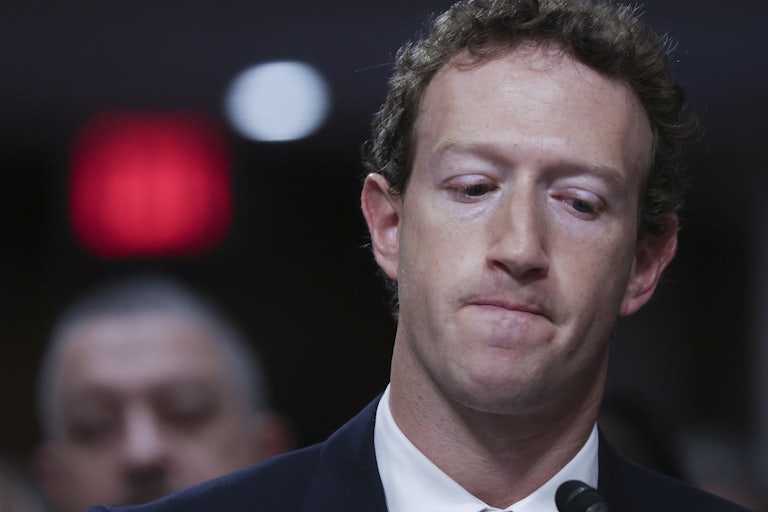
Zuckerberg Sucked Up to Trump Adviser Before Changing Meta Rules

Mark Zuckerberg reportedly met with Stephen Miller just before publicly announcing the changes to Meta.

Mark Zuckerberg looks down
Alex Wong/Getty Images

It didn’t take much to get Mark Zuckerberg to go along with Donald Trump’s aims.

According to The New York Times, Zuckerberg met with Trump adviser Stephen Miller in late November and was told by Miller that he could help America, but on Trump’s terms. Miller said that Trump was taking on diversity, equity, and inclusion principles, as well as cracking down on immigration.

Zuckerberg didn’t have a problem with any of it, the Times reported, citing anonymous sources. The Meta CEO told Miller and other Trump officials that he wouldn’t get in the way of Trump’s agenda and would focus on making tech products. He blamed the DEI initiatives at his company Meta on Sheryl Sandberg, his former chief operating officer, and said that things were changing at the company. This meant a reset, including layoffs.

In early January, Zuckerberg even gave Miller a private meeting where he explained the upcoming changes at Meta, and on January 10, the tech mogul announced to the public that Meta would be getting rid of its DEI policies.

The whole series of events indicates that Meta’s overhaul seems to have occurred in close coordination with Trump and his team, who are much more emboldened than they were eight years ago. Miller is more powerful now than he was in Trump’s first term, and has fewer internal opponents.

All of this doesn’t bode well for the next four years. Miller’s pet issue is immigration, and Trump has already pledged to begin mass deportations shortly after he is sworn in. Miller will be helping the president-elect draft many executive orders in the early weeks and months after the inauguration, and Republicans in Congress will only be too happy to help with extreme bills like the Laken Riley Act.

Zuckerberg isn’t the only tech baron falling in line behind Trump, as Jeff Bezos, Elon Musk, and others are changing their policies and sending the president-elect money. With loyal extremists like Miller in Trump’s inner circle, and the country’s powerful tech oligarchs staying out of his way, there aren’t many people capable of checking the next president.

Trump Loses It for Some Reason After FBI Shutters DEI Office

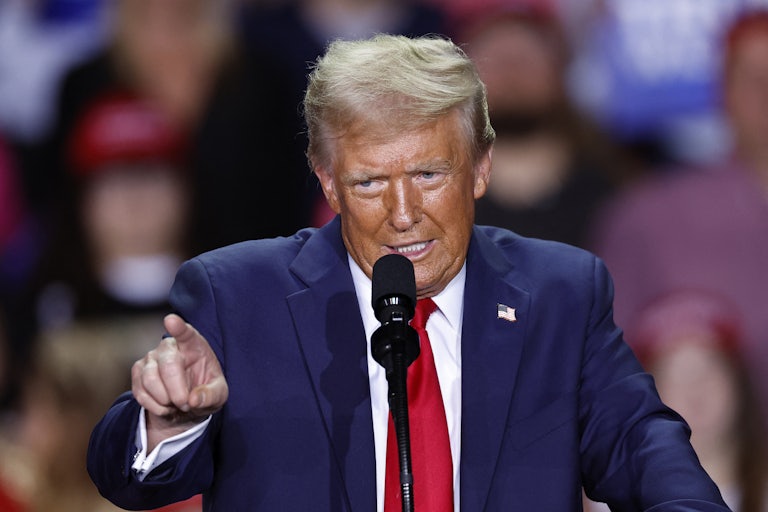
Donald Trump has issued a new demand after reports that the FBI is closing its diversity, equity, and inclusion office.

Donald Trump speaking at a mic
KAMIL KRZACZYNSKI/AFP/Getty Images

It isn’t enough for the FBI’s DEI office to be shut down—Donald Trump wants it gutted, and with receipts.

“We demand that the FBI preserve and retain all records, documents, and information on the now closing DEI Office—Never should have been opened and, if it was, should have closed long ago,” the president-elect wrote on Truth Social. “Why is it that they’re closing one day before the Inauguration of a new Administration? The reason is, CORRUPTION!”

The FBI began phasing out the office, officially titled the “Office of Diversity and Inclusion,” or ODI, in December, the agency first confirmed to Fox News on Thursday.

The FBI came under fire recently as many on the right openly blamed the deadly truck attack on New Year’s Day in New Orleans on the agency’s DEI policies.

“The priority of the last four years has been DEI, not IEDs,” New York Republican Representative Dan Meuser told Fox News at the time. “You talk to anyone who’s willing to speak within these agencies, that’s what their focus has been.… President Trump’s a serious guy, he’s bringing in serious people. It’s not about DEI; it’s about the safety and security of the American people.”

“An FBI Agent with a nose ring who can barely speak coherent English sentences told the media that a terrorist driving a truck with an ISIS flag killing 10 Americans is NOT a terrorist attack!?!” conservative YouTuber and serial plagiarist Benny Johnson wrote on X, referring to a video of FBI Special Agent Alethea Duncan, who is Black, speaking perfect English at a press conference. “Seriously. Listen to this. We need Kash Patel NOW!”

The ODI office isn’t closing because of corruption, like Trump is claiming in all caps on Truth Social. It’s likely closing for the same reason Walmart, Meta, McDonald’s, and others are reneging on DEI policy: Trump is back. Either they’re caving to Trump in advance, or they’re excited to go mask-off again with their everyday bigotry.

“I feel liberated,” one top banker told the Financial Times on Tuesday. “We can say ‘retard’ and ‘pussy’ without the fear of getting cancelled.… It’s a new dawn.”

It’s also why the historically lauded Civil Rights Division of the Justice Department is in jeopardy too.

More on the attack on DEI:

ICE Warns Republicans’ Racist Immigration Bill Is a Total Bust

Not even U.S. immigration officials think the Laken Riley Act is a good idea.

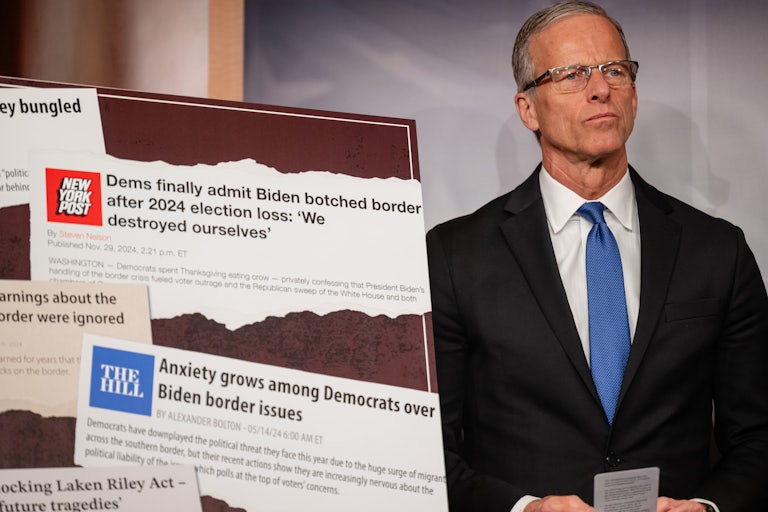
Senate Majority Leader John Thune stands by a poster during a press conference on the Laken Riley Act
Jon Cherry/Getty Images

Republicans’ prized immigration bill, the Laken Riley Act, is apparently too expensive to implement, according to U.S. Immigration and Customs Enforcement.

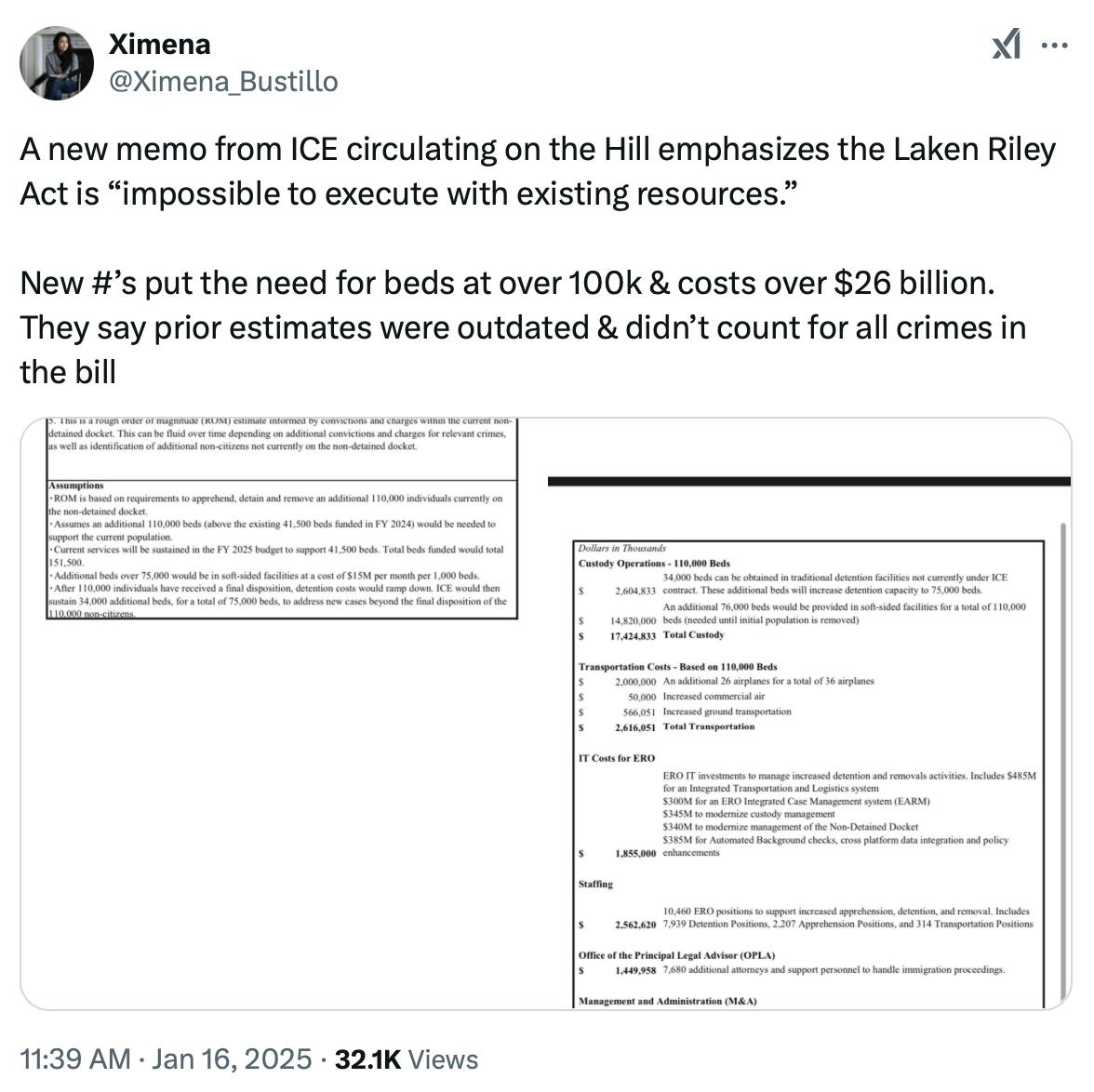
A new memo from ICE has been circulating in Senate offices that spells out the staggering cost of carrying out the bill if it were signed into law: $86 billion over three years, far exceeding House Republicans’ estimate last week of $3 billion per year. The memo gives a line-by-line assessment of the agency’s capacity to implement the act, saying that “full implementation would be impossible for ICE to execute within existing resources.”

Screenshot of a tweet
Screenshot

If passed, the bill would allow the detention of undocumented immigrants merely suspected of committing a nonviolent crime, with no protections for children or DACA recipients, also known as Dreamers. The House has already voted to approve the bill, with 48 Democrats joining every Republican to send the bill to the Senate, where it is currently being debated after a Thursday vote was postponed.

More than 70 amendments to the bill have been filed, delaying its passage further. The bill enjoys support from Senate Democrats as well, and even has two Democratic co-sponsors in Ruben Gallego and John Fetterman. Among some of the most egregious (and expensive) parts of the bill is the power it grants to state and local governments to help carry out immigrant detention, and some of the amendments concern that provision.

In Republican-led states, such as Florida, Republican leaders are offering their resources to assist in detaining immigrants in accordance with this bill, as well as Donald Trump’s plans for mass deportation. But as this memo from ICE shows, the Laken Riley Act will result in chaos and massive costs for the U.S. immigration system, no matter how many states are on board. Ultimately, conservatives’ immigration dreams are just expensive fantasies.

Trump Names Three MAGA Stars to Serve as His Hollywood Ambassadors

What is the reason?

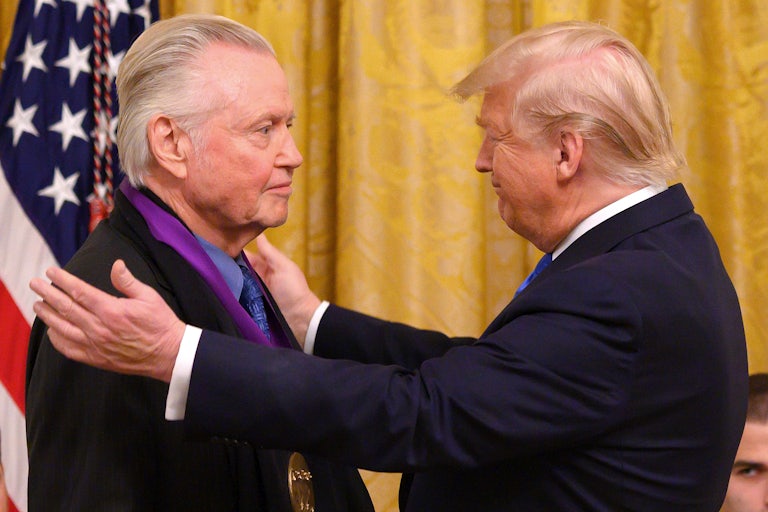
Donald Trump puts both hands on Jon Voight's shoulders after placing the medal around his neck
ANDREW CABALLERO-REYNOLDS/AFP/Getty Images
Donald Trump awards the National Medal of Arts to actor Jon Voight in the White House on November 21, 2019.

Trump is appointing a group of aged action movie actors to serve as “ambassadors” to Hollywood.

“It is my honor to announce Jon Voight, Mel Gibson, and Sylvester Stallone, to be Special Ambassadors to a great but very troubled place, Hollywood, California,” the president-elect wrote on Truth Social Thursday. “They will serve as Special Envoys to me for the purpose of bringing Hollywood, which has lost much business over the last four years to Foreign Countries, BACK—BIGGER, BETTER, AND STRONGER THAN EVER BEFORE! These three very talented people will be my eyes and ears, and I will get done what they suggest. It will again be, like The United States of America itself, The Golden Age of Hollywood!”

Stallone, Voight, and Gibson have each come out in support of Trump in recent years. Stallone even called him the “second George Washington,” while Voight proclaimed him to be the “greatest president since Lincoln.” And Gibson, who happens to have a long history of antisemitism and racism, said Kamala Harris had the “IQ of a fence post.”

The announcement had mixed reactions. Trump supporters appeared to be giddy.

“Trump made Rocky and Braveheart ambassadors to Hollywood. We’re living in the best timeline,” said a large pro-Trump X account.

“A week ago, an action movie written by Sylvester Stallone dropped their trailer. It’s about human trafficking, run by corrupt government officials and the mob. It looks like Trump is expanding his influence to Hollywood, and I expect the Left to vehemently oppose this movie, just like they did with ‘Sound of Freedom,’” wrote another, making a blatant argument for state-sponsored conservative media propaganda.

Others noted the fitting selection of the three MAGA stars.

“Sylvester Stallone was a nightmare on set for decades, Mel Gibson is a racist antisemite, Jon Voight is estranged from his family and isn’t allowed to see his grandchildren. Perfect fit!” the Reverend John Donnelly wrote.

What Stallone, Gibson, and Voight will actually do as “special ambassadors” and how much influence they’ll actually have over the industry remains to be seen.

More on how the Trump transition is going: