Newsletter
Power Mad
A weekly review of the rogues and scoundrels of American politics

The Republican Plot to Weaponize the Government Against Political Enemies

Trump’s “Schedule F” plan to eliminate workplace protections for the civil service was averted in 2020. But the GOP still dreams of the purge.

Mario Tama/Getty Images

During his presidency, Donald Trump was constantly at war with the civil service. It’s not hard to see why someone like him might find himself at odds with Washington’s army of dedicated public servants. Our federal workforce, however flawed, is an engine of fairness that strives to consistently minister to the needs of all Americans. It’s also proven to be a last line of defense against corruption and misrule. Naturally, Trump and other figures within the Republican Party want to destroy it. And should the GOP retake the White House, they might get their chance. Few have thought through the implications of what happens if Trump wins in 2024, but it begins with the revival of “Schedule F,” one of the Trump administration’s most devious plots against the U.S. government.

Among other efforts to target the civil service, Trump chiseled away at some of the employment protections that the federal workforce enjoys. Most federal government workers are nonpartisan bureaucrats who work under presidents of either party; there are currently only a few thousand genuine political employees. One important protection for this larger group of nonpolitical civil servants is the Merit Systems Protection Board, which can hear disputes and has the authority to reinstate federal employees who it determines were unjustly fired. This agency helps keep these employees free from fear of retaliation for whistleblowing or refusing to participate in corrupt entanglements.

Trump tried his best to break the agency by leaving all three board member positions vacant. It didn’t quite work—while hobbled, the agency was able to persist. But Trump and his enablers came up with a different scheme. The administration exploited a loophole in the law that allows the president or the Office of Personnel Management to redesignate some members of the federal workforce so they no longer fall under the Merit Systems Protection Board’s protection.

To that end, Trump issued an executive order in October 2020 to create an entirely new category of federal staff called “Schedule F,” which would effectively politicize these expressly nonpolitical roles and do away with some of their job protections as well. As Slate’s Donald Moynihan reported, this plan would have made select members of the civil service subject to a “political loyalty test,” which they needed to pass if they wanted to keep their jobs. Even if only a small number of employees were directly affected, the move would be sufficient to bring the entire federal workforce to heel. Given the latitude to simply fire agency attorneys and other bureaucrats who enforce the rules of the road, Trump could transform the bureaucracy from a workforce whose members all swear an oath to uphold the Constitution to one that would act as his personal wrecking crew. Civil servants would then either have to get in line with Trump’s aims or risk losing their livelihoods and careers.

Trump ultimately ran out of time to fully implement this plan, and Biden immediately rescinded the former president’s executive order upon taking office. But the GOP and its backers are still very interested in reviving the plan. Axios’s Jonathan Swan wrote a detailed report in July about the prospects of a reelected Trump bringing Schedule F back; numerous profiles of the Trumpian “new right” have made it clear that figures in this orbit understand that they can’t institute their illiberal plans in a government with a nonpartisan civil service.*

What would the United States be like if the civil service were to become a mere handmaiden to an unscrupulous chief executive? The past offers some clues: For much of the nineteenth century, the federal bureaucracy operated in what was known as the “spoils system,” in which every new presidential administration would purge the civil service of the old guard and stack it with loyalists. This was, of course, a hothouse for corruption, but it wasn’t until this arrangement resulted in the assassination of President James Garfield that reformers gained the upper hand and passed the Pendleton Act, which established a beachhead for a merit-based system to replace the entrenched patronage system. This work wasn’t completed until the 1970s, when the post-Nixon reforms brought us the Merit Systems Protection Board.

But if Republicans have their way, it wouldn’t simply be a return to the spoils system of old. It will likely be much worse. Today’s GOP, after all, doesn’t believe in peaceful transfers of power or that the president can or should be constrained by the law. Moreover, it now conceives of itself as an instrument of retribution rather than problem solving or policymaking. Consider what Schedule F world might look like: The next Republican administration could use the federal government to punish its opponents. Democrats might find their Social Security or veterans’ benefits delayed or denied. They might no longer be able to obtain passports. Emergency disaster aid might flow only to those deemed loyal to the administration. Corporations that refuse to pay tribute might be punished. Transform the civil service from an open hand to a closed fist, and things get very frightening very quickly.

To their credit, Democrats are fighting back: Virginia Representative Gerry Connolly and Senator Tim Kaine have introduced legislation that “block[s] positions from being classified outside the existing system unless Congress consents to it” in their respective houses of Congress. And via an amendment, Connolly got similar language into the must-pass National Defense Authorization Act that’s currently awaiting a Senate vote. But Democrats must also find a way to raise the salience of this frightening prospect with voters ahead of the next presidential election, because whether the federal bureaucracy becomes the corrupt arm of an authoritarian regime is on the ballot in 2024.

This article first appeared in Power Mad, a weekly TNR newsletter authored by deputy editor Jason Linkins. Sign up here.

* This piece originally misidentified the date of this story.
Latest From Politics

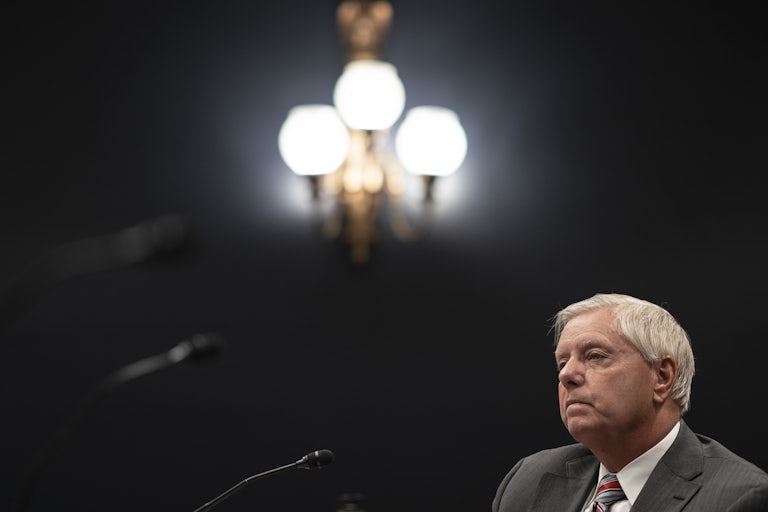
Democrats: Steal This Move From Lindsey Graham

The South Carolina senator’s ideas may be bad—but wow, he’s so confident in them!

Drew Angerer/Getty Images
South Carolina Senator Lindsey Graham

This week, South Carolina Senator Lindsey Graham looked out over the political landscape and decided it was high time for a bad idea—specifically, a bill that would impose a nationwide ban on abortions after 15 weeks of pregnancy. Graham’s decision had an immediate impact. His fellow Republicans, by and large, spent the week either pretending not to know him or criticizing him for serving up two scoops of hot midterm-elections discord. Meanwhile, everyone working on the next round of political advertising for Democrats got to go home early, their scripts written for them. It was, in other words, quite a step on the ol’ rake for Graham. It’s also something that Democrats should try to emulate.

Please bear with me. I’m obviously not saying that Democrats should propose an abortion ban, or should go out and commit some chaos-causing unforced error. It’s not the substance that Democrats should imitate but the style. As Discourse Blog’s Rafi Schwartz noted, Graham was at least making a “bold legislative move” and being honest about what he believes. It simply happens to be the case that he’s being bold and honest about something that’s vastly unpopular with the public, and with terrible timing—you know, a moment when GOP candidates for office are scrubbing their websites of their abortion positions in the wake of the repeal of Roe v. Wade. But if Graham can put so much swagger behind such a rancid policy, Democrats should feel similarly emboldened to walk with confidence behind their own set of much more popular ideas.

I mention this because Democrats have a long history of being skittish about their own positions and accomplishments. It took many election cycles before Democrats got comfortable enough with the Affordable Care Act—their biggest policy accomplishment until they passed the American Rescue Plan in 2021—to actually run on it. They only really embraced it in 2018, to great success. More recently, Democrats squandered the advance time afforded to them by the leak of Supreme Court Justice Samuel Alito’s draft decision in Dobbs v. Jackson Women’s Health Organization. They were too scared to act on a controversial issue—in this case, abortion—until they truly had no other option. Since then, we’ve seen examples that boldly seizing the moment works. In a New York special election, Pat Ryan campaigned on an abortion rights message as anger about Dobbs was cresting, and scored an upset win.  

Democrats have been quicker to the jump on Graham’s proposal—and because they are currently playing a much stronger hand, they should be just as bold. But there’s another equally important reason why they need to match Graham’s intensity: They have to counter the media narrative that meeting Republicans in the middle is the most politically acceptable response. As Jezebel’s Laura Bassett noted, this both-sidesism led the political press to echo Graham’s claim that 15 weeks constitutes a “later-term” abortion. “This is a 15-week abortion ban, it’s not ‘later in pregnancy.’ It’s not even close to the halfway point in a pregnancy. Republicans want journalists to accept their framing,” Bassett wrote.

Democrats shouldn’t fold and compromise with Graham’s position. And they should be just as uncompromising in backing President Joe Biden’s condemnation of GOP extremism. Biden’s speech about Trump’s “semi-fascist” inclinations was greeted with similar equivocation from the media, which Crooked Media’s Brian Beutler characterized as a “multi-day fainting-couch routine.” Beutler noted that this response didn’t actually “reflect anything organic bubbling up from the public.” It was merely a product of the media’s own squeamishness, which shouldn’t push Democrats to “retreat to the safety of conventional ideas that weren’t working.” Beutler continued: 

[The media is] reacting the way they think they’re supposed to react to maintain [their] “neutral” bona fides—by policing norms and obsessing over how it’ll affect the horserace; by neither validating [nor] invalidating the critique. That’s not to say their reaction is unimportant, if it persists unanswered or successfully drives Democrats into retreat, the idea that Democrats overplayed some ill-defined “hand” will crystalize into public opinion. As we learned during the Trump presidency, the best way to normalize the critique, to get journalists to accept that it is just part of our discourse now, is to just plow ahead with it, over their sniffing, until it no longer seems extraordinary even to them.

As Beutler went on to point out, all Democrats “should want GOP extremism and criminality to remain the thematic center of politics at least between now and the election.” That Mitch McConnell desperately wants to change the subject is a clear indication that Democrats shouldn’t just allow fascism or “semi-fascism” to happen.

Chances are, the Democrats won’t retain majorities in both houses of Congress. But they can’t do much about the country’s historical tendency to reward the party out of power in the midterms, nor can they alter the reality of electoral math or partisan gerrymandering, or the rude mechanics of a system that’s tilted toward the Republican Party in multiple ways. 

The good news is that should Democrats come up short, it will be due to these realities and not because they ran on a bunch of bad policy ideas or bankrupt ideological beliefs. The party’s popular positions will survive a defeat in 2022, as will its case against the GOP’s authoritarian turn—which, let’s face it, will only get worse. There is an equally important election in 2024. Democrats have good ideas and better enemies. That’s why they should all possess the confidence of Lindsey Graham. 

This article first appeared in Power Mad, a weekly TNR newsletter authored by deputy editor Jason Linkins. Sign up here.

Latest From Politics

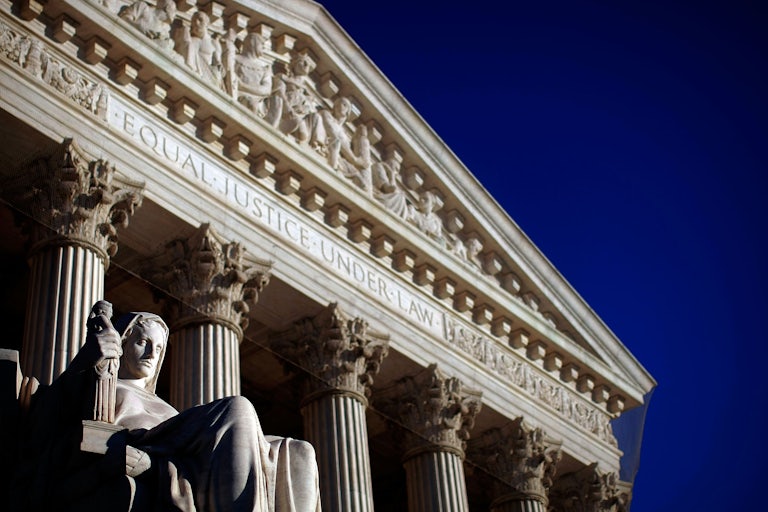
The Rise of Right-Wing Hacks in Federal Courts

Judge Aileen Cannon, of the now-infamous special master ruling, is the latest star of a conservative legal movement that gleefully engages in sloppy jurisprudence—with profound consequences for us all.

Win McNamee/Getty Images

Over Labor Day weekend, Trump-selected judge Aileen Cannon ordered the appointment of a special master to review the material seized by the Justice Department from Mar-a-Lago—a move that will allow the president to delay the ongoing investigation. It’s a result that everyone with half a brain could have spotted from a million miles out: Trump sought out the judge most willing to bend the rules in order to help him wriggle his way out of trouble. 

But this didn’t prevent many legal experts from reacting with slack-jawed shock to Cannon’s order. “This special master opinion is so bad it’s hard to know where to begin … her analysis of standing is terrible,” tweeted law professor Neal Katyal. “Judge Cannon’s order is riddled with fundamental legal errors and is the opposite of judicial restraint,” added lawyer Ted Boutrous. Former FBI agent and Just Security editor Asha Rangappa insisted that “Cannon clearly did not have a strong grasp of the salient issues.” The Atlantic’s Andrew Weissmann ran down the many ways in which Cannon’s decision was “untethered to the law.” Former Nixon White House counsel John Dean quote-tweeted Weissmann, writing “It’s a mess!” Everywhere you looked someone was reacting in similar fashionBut … how could she?

To answer that question, we need to get the experts caught up on current events. It should be apparent to everyone by now that the conservative legal movement and its foot soldiers in the judiciary have ideological goals in mind and a political agenda they want to pass via the superlegislature once known as the judicial system. But many members of the judicial commentariat seem to be stuck in the world they remember, not the world we live in now. To these experts, the right is still beholden to the law—it still needs to tick the appropriate jurisprudential boxes, consider long-standing legal precedent, and follow the established rules. 

With that in mind, the experts look at Cannon’s decision and see balderdash everywhere. What they don’t get is that Cannon looked at her balderdash and thought, “Well, who’s going to stop me?” There are no “judge cops,” you see, only other judges, and if all roads eventually lead to the Roberts court, there’s no reason for her to worry too much about whether she’s stuffed a bunch of legal half-assery into her rulings. As TNR’s Matt Ford has reported, Cannon’s hardly the first lower court judge to indulge herself in some right-wing hackery. She won’t be the last.

The Supreme Court has led the way with decisions that are increasingly untethered to judicial precedent, the Founders’ ideals, and in some instances, the very facts of the cases on their dockets. Because of this, conservatives have been generally emboldened to stake more aggressive claims in their suits and filings, in order to test the limits of preposterousness, like velociraptors pushing against the weaknesses in Jurassic Park’s fencing. That is why even though a lawsuit to take down President Joe Biden’s student loan forgiveness plan suffers from some fatal standing issues, Texas Senator Ted Cruz is said to be “brainstorming” a workaround. He knows that he’s as likely to prevail with nonsense as he is to succeed with some supergenius-level lawyering.

As TNR contributor Aaron Regunberg noted in these pages, the alternate reality unfolding in front of us has already made wide swaths of the bar exam look more like a historical document than a test of current legal knowledge. In a world where jurisprudence is unmoored, what will future generations even learn in law school?  At some point you wonder if conservatives will keep bothering to even offer up slopcore legal reasoning, when it’s just as easy to offer jabberwocky instead.

Legal experts can gawk at the goings on in disbelief, exclaiming, “This can’t be happening!” all they like. But it is happening and has happened. Those trying to confront this moment by repeatedly insisting that this weirding of the judicial system can be repaired if only someone explains the rules hard enough are, as Slate’s Dahlia Lithwick and Mark Joseph Stern point out, displaying the impotent “tendency to just keep on lawyering the other side’s bad law in the hopes that the lawyering itself will make all the bad faith and crooked law go away.” 

Lithwick and Stern continue: 

[In] this new age of legal Calvinball, one side invents new “rules” and then the other scrambles to try to play by them. For every single legal thinker who read the Mar-a-Lago order to mean, quite correctly, that ex-presidents are above the law, furrowing your brow and pointing out its grievous errors only takes you halfway there. The better question is what, if anything, do you propose to do about it? The furrowing is cathartic, but it’s also not a plan.

So then, what is the plan? As TNR’s Simon Lazarus argued, liberals must forcefully discredit the legal arguments that the Supreme Court’s conservative bloc is offering while there’s still time to rebut them. But as Lithwick and Stern point out, the most immediate solution to this dire problem is one that Democrats have been heretofore skittish about contemplating—adding judges to the courts. 

The good news for now, though, is that we can begin by adding judges at the lower court level, where the much larger case backlog justifies such a move, and hopefully avoid the all-but-certain national mainstream media–driven trauma that would follow any attempt to pack the Supreme Court. Increasing the number of judges in these venues could help the jurisprudential traditions that are now being gutted gain a new foothold and lessen the opportunity for conservatives to forum-shop their way to victory. The bad news, of course, is that unless Democrats are planning on holding both houses of Congress, Biden only has a few weeks left to do the job.


This article first appeared in Power Mad, a weekly TNR newsletter authored by deputy editor Jason Linkins. Sign up here.

Latest From Politics

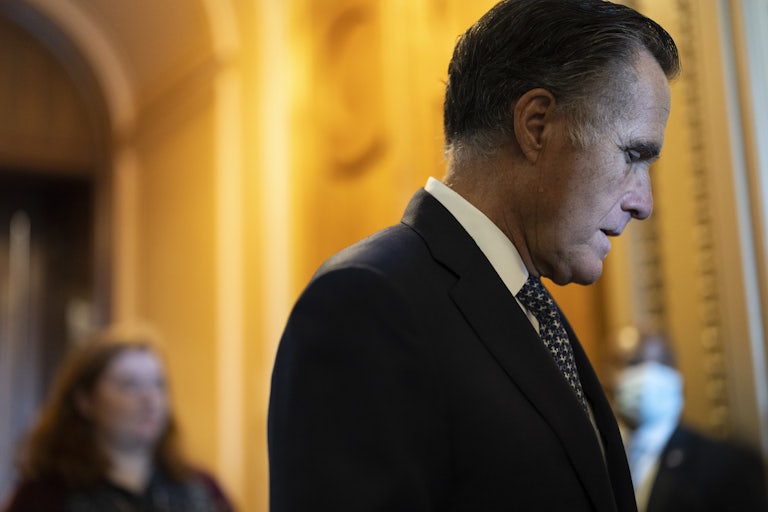
The Stupid Myth That Mitt Romney’s Mistreatment Gave Us Trump

Some conservatives argue that the way Democrats pilloried the Utah senator in 2012 pushed the Republican Party toward Trumpism. They should take a long look in the mirror.

Mitt Romney
Anna Moneymaker/Getty Images
Utah Senator Mitt Romney

As the Republican Party descended headlong into Trumpism, one lingering question has doggedly remained a point of fascination for pundits and political analysts: Did they fall, or were they pushed? There is a long list of culprits blamed for sending the GOP past the point of no return, from Jeb Bush to Barack Obama; from the Citizens United decision to gerrymandering. Nixon, FDR—even Kim Kardashian has made this list. But on social media in recent days, we’ve seen a slight uptick in one popular version of the Trump origin story: Republicans were radicalized by the tawdry way liberals treated Mitt Romney during his 2012 election run.

I’m not normally interested in what a few people happen to be tweeting. But this is no mere passing fancy. The lore surrounding Republicans being forced into a psychotic break because Mitt Romney was treated indelicately has been around for a long while. As Vox’s Zach Beauchamp reported in 2020, “Many conservatives have embraced” the idea that “Democrats smeared the kind and decent Romney so brutally … that Republicans became inured to this kind of argument and convinced there was no advantage to playing nice anymore.… Call it the ‘look what you made me do’ theory of How We Got Trump,” Beauchamp writes.

It’s an alluring cop-out. It’s clear that many really want to believe it. But I have long memories of the 2012 election and its aftermath, and folks, these claims don’t add up.

Make no mistake: The people behind Obama’s reelection campaign did what they deemed necessary to win. Romney was mercilessly characterized as an out-of-touch plutocrat, a step back in the direction of the vulture capitalists who brought the economy down in 2008. Romney’s biggest problem was that this particular shoe fit a little too snugly.

But sure, the Obama team wasn’t pure as the driven snow during that campaign, and liberals didn’t exactly strive to be some model of decorum either. Obama fans dined out on lots of shallow, mean-minded stuff like Romney’s equestrian interests and the saga of his family’s roof-bound pooch. Obama and his allies had plenty of ignoble moments as well. Romney’s comment that he “liked to fire people” was ripped from its context and used to paint him as an unfeeling toff. Then–Vice President Joe Biden knew he was punching below the belt when he told the crowd at a Danville, Virginia, rally that Republicans were “going to put y’all back in chains.”

But politics, as they say, ain’t beanbag; most of this stuff was fairly normal, relative to presidential campaigns. Little of this particularly rose to the level of, say, the Swift Boat Veterans for Truth. One thing that came close was an egregiously mendacious ad by an Obama-affiliated super PAC that essentially blamed Romney for a steelworker’s wife’s cancer diagnosis and death, while Romney was running Bain Capital.

But when it came to doing Romney dirty, Democrats had some pretty strong Republican rivals. While Obama criticized Romney’s Bain Capital past, it was Newt Gingrich who released an entire documentary about Romney’s allegedly destructive tenure as the firm’s head. Over the course of four months in 2011, Bill Kristol wrote seven separate columns for The Weekly Standard about how much he disliked Romney and wanted a different candidate to wrest the nomination from him. The antipathy of conservatives dogged Romney throughout the campaign and prompted some of his worst moments: his weird insistence that he was “severely conservative”; his infamous call for immigrants to “self-deport” themselves; and his quest to earn the endorsement of Donald Trump, who was then at the height of his reign as King of the Birthers.

In the wake of the Bain Capital cancer ad, campaign spokeswoman Andrea Saul went on television to defend Romney and, along the way, said, “To that point, if people had been in Massachusetts, under Governor Romney’s health care plan, they would have had health care.” This was a huge mistake. Saul was subsequently pilloried by conservatives for defending him by invoking such a (gasp) liberal achievement—by that point, Obamacare was the law of the land and it was verboten for Romney to mention his Massachusetts health care innovation. Romney was even forced to cut a line from his book about bringing that reform to the entire nation.

This was perhaps the greatest wrong done to Romney. The entire reason he had emerged as a presidential contender among Republicans was because he understood that there were problems that needed solving and that conservatives needed to compete with liberals in a war of ideas to solve them. Romney may be the only Republican in Washington who’s actually notched a recent major policy accomplishment that was celebrated across partisan lines: His Commonwealth Care was an example of this brand of politics; when there were enough Republicans interested in co-opting liberal issues and beating Democrats to market with solutions, Romney was top dog. He won the Conservative Political Action Conference straw poll four times between 2007 and 2012. But as I wrote in 2012, the party turned on him: “For all of the grief that Romney has taken for his multitude of flip-flops over the years, those are not, collectively, as damaging to Romney’s ambition as the way the Republican Party has flopped on him.”

Conservatives may want, even need, this ersatz martyrdom of Mitt Romney to exist to explain away their Trumpian turn, to spin the story that liberals’ treatment of Romney’s shortcomings gave them no choice. This all neatly forgets the fact that Republicans very much could have taken a second path but chose to abandon it. They sure have a funny way of treating their martyr, though. In 2020, CPAC chairman Matt Schapp told Greta Van Susteren that the four-time straw-poll winner would not be physically safe if he attended the conference. The fact is that Republicans have long been, and continue to be, Romney’s most dedicated persecutors. And through their persecution of him, they gave themselves permission to make their radical turn a long time ago.


This article first appeared in Power Mad, a weekly TNR newsletter authored by deputy editor Jason Linkins. Sign up here.

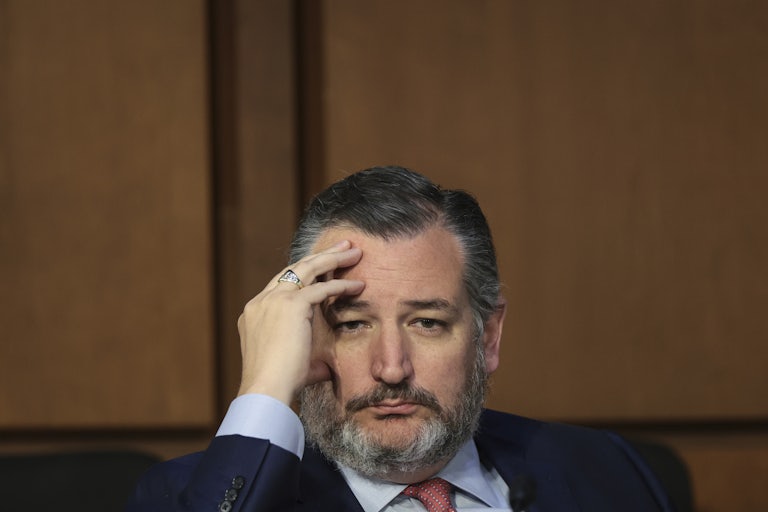
With a Single Word, Ted Cruz Gave the Game Away About the Right-Wing Supreme Court

The Texas senator’s recent complaint about the Inflation Reduction Act accidentally told the truth about the court’s war against the administrative state.

Win McNamee/Getty Images
Texas senator Ted Cruz

“Did the Inflation Reduction Act quietly save the administrative state?” That’s the big question that TNR’s Kate Aronoff took up this week after The New York Times and others reported on an eye-catching bit of fine print in the Inflation Reduction Act, or IRA. Running through the legislative text is language that “define[s] the carbon dioxide produced by the burning of fossil fuels as an ‘air pollutant.’” The detail may seem minor, but its inclusion could be a “game changer,” designed “specifically to address the Supreme Court’s justification for reining in the EPA” in last term’s West Virginia v. EPA decision, at least according to the Times’ Lisa Friedman. 

As we’ve noted on these pages before, the high court’s conservative bloc has recently ramped up its war against the administrative state. To that end, it has demonstrated a propensity for disallowing executive branch agencies from having the broadest possible latitude in interpreting the legislative branch’s instructions. So the way the IRA defines carbon dioxide in this explicit fashion, in the Times’ telling, is a defense against these judicial dark arts. 

This language shift didn’t go unnoticed by conservatives, and it elicited a very curious response from Texas Senator Ted Cruz, who said, “It’s buried in there … the Democrats are trying to overturn the Supreme Court’s West Virginia v. EPA victory.”

But as Aronoff explained, the mere existence of this language in the bill’s text doesn’t actually repeal anything. The Supreme Court’s decision in West Virginia v. EPA still stands, and its larger implications should remain a cause for worry. But even if including this revised definition of carbon dioxide doesn’t overturn a Supreme Court decision, it might herald the overturning of a school of thought among liberals on how to confront the court, and signal that Democratic legislators intend to apply some more strategic thinking to the challenges posed by the court’s conservative majority.

Cruz’s statement was a moment when the mask slipped. It’s rather unusual to characterize a Supreme Court decision as a “victory.” It’s a weird thing to say about an allegedly august institution that bills itself as a neutral caller of ball and strikes as it interprets the Founders’ intentions and sorts through a body of legal precedent. It’s like saying that the umpires defeated the Houston Astros in the 2021 World Series. And as MSNBC’s Steve Benen notes, Cruz was being oddly salty about congressional lawmakers simply doing their job: using their majority to pass laws. “I understand that Cruz disagrees with the underlying policy,” writes Benen, “but why take issue with a democratic governing process?”

In this case, I think the Texas senator’s complaints fairly neatly expose what’s at work: Cruz sees the high court’s conservative majority as a “victory” in an ongoing ideological project. And he’s not wrong—that is precisely how the court’s conservative bloc see it as well. Their end goal has long been apparent: They want to kneecap Congress and install themselves as an unelected superlegislature with veto power over the executive and legislative branches. 

What makes the “administrative state” work is the interplay between these branches. Traditionally, the Supreme Court has granted the executive branch agencies broad discretion to interpret laws, which allows them to be nimble as the times change but the laws don’t. As I’ve previously noted, “An EPA that couldn’t rely on that leeway would need Congress to constantly pass new laws directing it how to proceed on every matter in its purview and then pass additional new laws covering the same ground as circumstances changed.” 

The IRA’s revised definition of carbon dioxide won’t thwart the Supreme Court’s conservatives, but it demonstrates that Democrats on Capitol Hill are taking their threats more seriously. As frequent TNR contributor Simon Lazarus tells me, “The most important takeaway from the IRA provisions is not exactly what they say, or how they will strengthen arguments against, for example, the court deploying the major questions doctrine to overturn important new EPA actions. Rather, what is important is the political fact that Democrats acted at all to take on [a Supreme Court] intent on micromanaging Congress and executive agencies and in the interest of Republican agendas and interests—in particular, the priorities of Republican megadonors who also happen to have funded the justices’ ascent to the power they now possess on the court.” 

This week’s news augurs something of a sea change, in which Democrats are alert and alive to the challenge and have started to think more strategically about countering the conservative judicial movement. This is long overdue. Back in 2021, President Biden asked a White House commission to weigh various ideas to reform the Supreme Court during a time of grave concerns about its legitimacy; the commission’s report offered scant solutions. As recently as July, there were concerns in liberal circles that Biden was failing to meet the problems that the Roberts court presented head-on.  

As Lazarus wrote in these pages back in June, liberals “must embrace a hybrid genre of political-legal combat,” discredit the legal arguments of the conservative bloc, and advance new and novel legal arguments of their own. The language in the IRA that’s being touted by environmental advocates may be the first stirrings of this larger battle. But at the very least, we can all finally acknowledge the facts as Ted Cruz understands them: The Supreme Court’s conservative justices are ideological actors, through and through. 


This article first appeared in Power Mad, a weekly TNR newsletter authored by deputy editor Jason Linkins. Sign up here.