Breaking News
Breaking News
from Washington and beyond

Poll: Two-Thirds of Americans Don’t Have Confidence in Supreme Court

The drop in confidence comes as the Supreme Court debates the future of the abortion pill.

Supreme Court building
DANIEL SLIM/AFP/Getty Images

Nearly two-thirds of Americans don’t have confidence in the Supreme Court, a report released Monday found, an all-time low that comes as the justices weigh a controversial and unpopular case about abortion access.

A poll conducted by NPR, PBS NewsHour, and the Marist Institute for Public Opinion found that 62 percent of Americans say they have not very much confidence or no confidence at all in the Supreme Court. This is the lowest number since this poll was first conducted in 2018, when almost twice as many people said they had confidence in the court.

Similarly, 68 percent of people think that Supreme Court justices should have term limits, instead of receiving lifetime appointments. These results spanned the political spectrum.

Marist, NPR, and NewsHour surveyed nearly 1,300 adults between April 17 and 19, meaning the poll was conducted a week after a Texas federal judge ruled that mifepristone, one of the medications used to induce an abortion, had been improperly approved by the Food and Drug Administration and should be yanked from the U.S. market. The Department of Justice appealed the ruling, and the Supreme Court issued an eleventh-hour stay on Friday while the lawsuit plays out.

This was the court’s first major decision on abortion access since it overturned Roe v. Wade last summer. That ruling was hugely unpopular, as almost two-thirds of Americans believe that abortion should be legal in all or most cases, according to the Pew Research Center.

The Marist poll found that 64 percent of Americans also oppose a ban on medication abortion, and a majority of those people do regardless of political affiliation. Almost the same number of people (61 percent) think judges should not be able to overrule FDA approval of a drug. As Rachel Rebouché, the dean of Temple University’s law school, previously told The New Republic, abortion access is not the only issue at play in the mifepristone case. The lawsuit is also “about deference to a federal agency’s expertise.”

The Supreme Court has become increasingly politicized, from the appointment process to the justices themselves, and people are starting to see it. That politicization chips away at public trust in the institution. It’s no longer clear that the court will uphold people’s rights, as opposed to wielding its almost absolute authority to impose its personal beliefs on the country.

“The Supreme Court’s decision on medication abortion comes at a critical time for the Court as an institution,” warned Lee Miringoff, director of the Marist Institute, in the poll release. “With Americans’ confidence in the Court on a decline, the Court’s decision will likely fuel the flames of debate and not squelch them.”
Did Fox Fire Tucker Carlson?

An announcement said the television host has already aired his last show.

Tucker Carlson
Jason Koerner/Getty Images

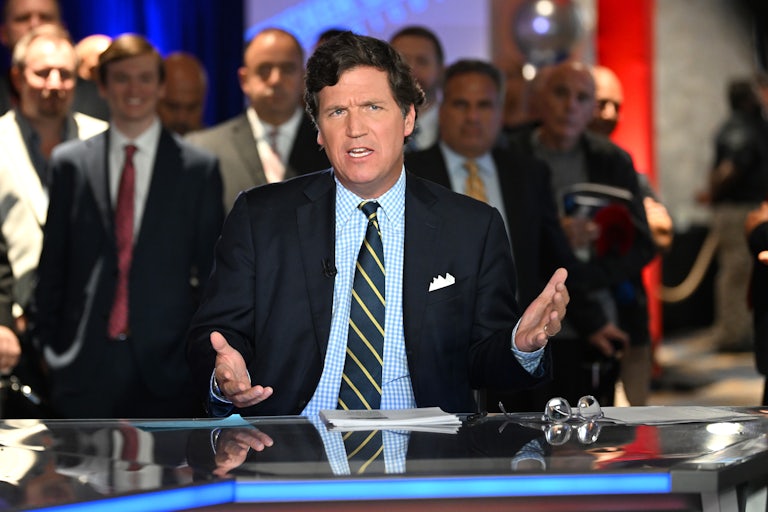
Tucker Carlson is leaving Fox.

The news comes just days after Dominion Voting Systems and Fox Corporation reached a $787.5 million settlement in a massive $1.6 billion defamation lawsuit brought by Dominion.

Throughout the lead-up to the trial-that-never-was, a stream of documents revealed how many Fox hosts and executives, including Carlson, knowingly perpetuated lies surrounding the 2020 election and false conspiracies surrounding voting systems like Dominion’s rigging the election.

It’s unclear whether Carlson was fired. But in a press release Monday, Fox noted that his “last program was Friday April 21st.” Given the separation is effective immediately, and Carlson has no formal opportunity to say goodbye, the exit does not appear to be on entirely good terms.

The Washington Post reports that “a person familiar with the company’s thinking” believes that Carlson’s comments about Fox’s management may have led to the departure. The revelations in the Dominion case were just the tip of the iceberg; had the trial continued as planned, more details about the inner workings of Fox may have been revealed.

Carlson’s departure follows a series of incredibly deferential interviews to both Donald Trump and Elon Musk.

Two weeks ago, Carlson hosted Trump in an hour-long special, in which the Fox host barely said a word, while the twice-impeached former president rambled on, telling fantastic tales of courthouse workers crying as he was arraigned—and praising Saudi Arabia, Vladimir Putin, and Xi Jinping.

Days later, in a two-part special with Musk, Carlson spent most of his time serving as the equivalent to a Twitter Blue subscriber brainlessly responding to every Musk assertion with laugh emoji after laugh emoji.

In his last segment on air, between bites of pizza and plugging a conspiratorial special about the establishment forcing everyone to eat bugs, Carlson seemed (or pretended) to have no idea that his departure was coming.

“We’ll be back on Monday,” Carlson said, while closing his segment last Friday.

This story has been updated.

Ron DeSantis Short-Circuits When Asked About Dropping Poll Numbers

The Florida governor is a walking meme.

Courtesy of CNN

Ron DeSantis’s costume is beginning to rip at the seams.

Ever since the Florida governor began leaning more and more into the possibility of his 2024 candidacy, he’s more and more adopted mannerisms of the previous Republican president, Donald Trump: his vocal cadence, his hand motions, and his relishing of not answering questions and attacking the media. DeSantis is under the illusion that he’s projecting strength and not, in fact, looking incredibly pathetic.

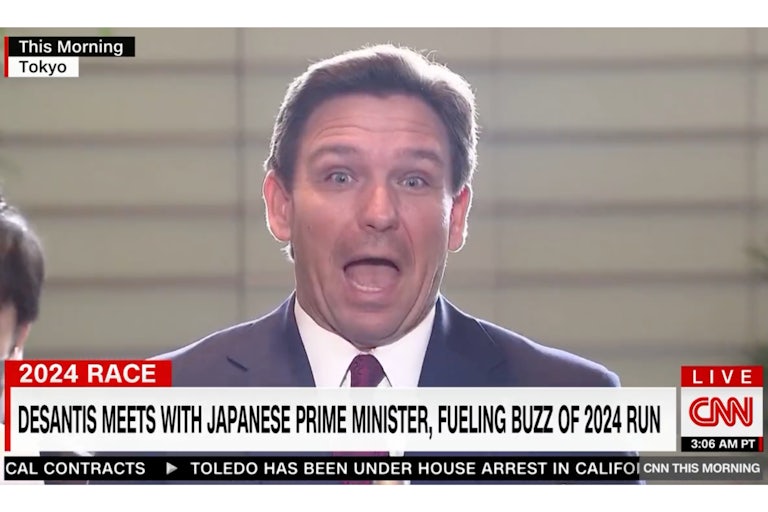
But the laborious efforts are beginning to wear on the not yet announced presidential hopeful. During a visit to Japan to meet with Prime Minister Fumio Kishida, the Florida governor was asked about his thoughts about polling behind Trump.

And his face seemed to be glitching, perhaps while hearing the trigger word of what his blueprint is based off of.

The comments came while the Florida governor has constantly been everywhere but Florida. While Fort Lauderdale was flooding under the weight of the rainiest day in its history, DeSantis was journeying around Ohio to sell his book. Over the past few weeks, he’s visited other states and even Washington, D.C., courting Republicans and gloating about his radical agenda in Florida. It’s gone incredibly poorly, as DeSantis has a meager handful of endorsements, while Trump has already secured the approval of an array of members of Congress and governors—including many members in DeSantis’s own state.

Sarah Huckabee Sanders’s Bud Light Ad Is So Bad It’s Funny

Someone in her marketing team has to be pranking her with this one.

Sarah Huckabee Sanders
Al Drago/Bloomberg via Getty Images

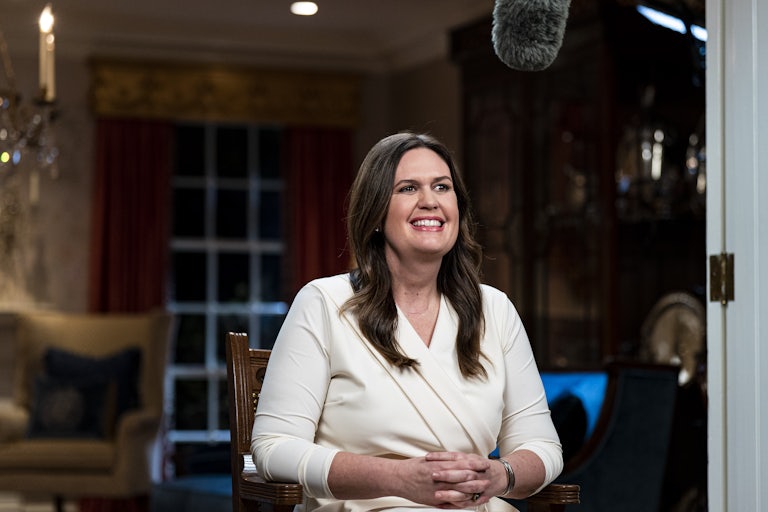
Arkansas Governor Sarah Huckabee Sanders unveiled a line of beer koozies celebrating the “real women of politics” with possibly the worst ad known to mankind.

While the video never mentions Anheuser Busch by name, it’s a clear response to a Bud Light ad featuring transgender activist Dylan Mulvaney. The sponsored video—less than a minute long and more than a month old—has sparked a bizarre, bordering on unhealthy obsession among conservatives.

Sanders’s koozies feature photos of her and other right-wing women governors. She promoted the launch on Twitter Sunday by announcing, “Real women don’t have to fake it.”

Frankly, she needs to fire her marketing team.

Women fake stuff all the time, from cheekbones to interest in men’s talking points to … other stuff.

Sanders herself also fakes concern for democracy, children’s welfare, and the truth.

Supreme Court Protects Access to the Abortion Pill, for Now

Access to mifepristone will remain available while the legal battle plays out.

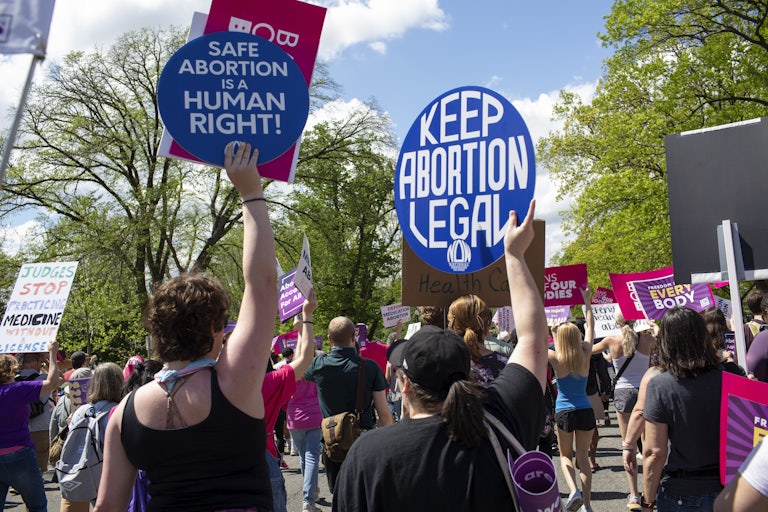
Activists holding abortion rights signs like "Safe abortion is a human right" and "Keep abortion legal."
Probal Rashid/LightRocket/Getty Images

The Supreme Court on Friday halted lower court rulings that would have restricted access to the abortion pill mifepristone, leaving national access to the pill in place—for now.

A Texas federal judge ruled two weeks ago that mifepristone, one of the medications used to induce an abortion, had been improperly approved by the Food and Drug Administration and should be yanked from the U.S. market. The Department of Justice appealed the decision, first to the Fifth Circuit Court, which only partially stayed the ruling. The Justice Department then appealed the case to the Supreme Court, which issued a temporary administrative stay while it considered the appeal.

The high court has now decided to temporarily stay the Texas court’s ruling. The court will issue a final decision on the abortion pill at a later time.

The stay means that nationwide access to mifepristone will remain unchanged as the lawsuit moves through the appeals process. The abortion pill is still available nationwide, without restriction.

Danco Laboratories, which manufactures mifepristone, had argued that a partial stay on the pill would “irreparably injure” its business because it would have to change its drug labels, recertify providers, and get approval for a supplemental new drug application, all processes that could take months. Danco also pointed out that it could not comply with both the Fifth Circuit ruling and the injunction out of Washington.

Medication abortions make up more than half of all abortions performed in the United States. These drugs can be ordered online and delivered via mail, making them a key resource for people who live in states that have cracked down on abortion access since Roe v. Wade was overturned last summer. The Supreme Court’s decision Friday is a temporary relief to nationwide abortion access.

A bigger issue at play, though, is that nonelected judges who do not have medical backgrounds are now making decisions about medication. As Rachel Rebouché, the dean of Temple University’s law school, previously told The New Republic, “The question for appellate courts is not just about abortion but about deference to a federal agency’s expertise.”

The Texas case “undermined” the FDA’s authority, she said. “To take seriously that it ignored risks, risks unsupported by any credible evidence, suggests questions as to what federal courts might decide about other federal agencies’ decisions.”