Breaking News
Breaking News
from Washington and beyond

For Some Reason, Dominion Settles With Fox in Defamation Lawsuit Over Election Lies

This was set to be an unprecedented trial, forcing Fox executives and insiders to the stand.

Chip Somodevilla/Getty Images
Members of the legal team representing Dominion Voting Systems leave the Leonard Williams Justice Center where Dominion sued Fox News in Delaware Superior Court on April 18.

After a months-long legal battle between Dominion Voting Systems and Fox Corporation, it all ended in a poot.

On Tuesday, Fox and its cable networks reached a settlement agreement worth $787.5 million, in what was originally a $1.6 billion defamation lawsuit brought by Dominion. The settlement nips away what may have been an unprecedented trial process that would’ve brought an array of insiders—Fox hosts, executives, and others—to take the stand.

The day was slated to be one that opened up the possibility for more revelations into Fox and the lies swarming within it. Instead, the promise of further accountability for the network slowly, and then all at once, fizzled away.

Hours were spent picking jurors for the case, even having to substitute one juror who said they were awake all night and were not in a capacity to go through the rest of the trial. Then a short lunch recess was called, around 12:40 p.m. Eastern time.

Opening statements were set to begin at 1:30 p.m. But then time passed. And more time passed. In the interim, Delaware Superior Court Judge Eric Davis ordered the formal appointment of a special master to look into whether Fox complied with its court-ordered discovery obligations. (The order followed Davis sanctioning Fox last week for not handing in evidence on time, including audio recordings from a former Fox producer suing the network, alleging that she was harassed, retaliated against, and made to be a scapegoat in the Dominion case.)

Finally, almost two and a half hours later, just minutes before the clock ticked to 4 p.m., Judge Davis made the announcement: “The parties have resolved their case.”

“Money is accountability,” Dominion lawyer Justin Nelson said, referring to the nearly $800 million settlement agreement. Dominion’s legal team made no mention that Fox would have to issue an apology or retraction on air for the lies it spread about the 2020 election.

With the settlement, Dominion decided that the short-term win was worth more than continuing the battle against one of the most crooked “news” agencies in the business. That Rupert Murdoch’s Fox was willing to fork over so much cash gives a hint at what more still was left to be exposed.

Sure, all media outlets face some form of legal challenge from time to time, but Fox takes the cake: The corporation is constantly embroiled in legal battles related not just to unethical journalistic practices but sexual harassment and discrimination against employees.

And that’s just among the cases that actually make it to court. Who knows how many cases are either quashed internally or don’t receive enough attention to challenge such a behemoth corporation? Dominion, occupying center stage, has exposed many lies undergirding Fox, including ones spread by the network’s most popular hosts. And now, in its settlement, it relinquishes that battle and lets Fox off the hook.

And the corrupt network is already celebrating and ready to move on, confident in its ability to settle any future legal challenges just as well.

“We acknowledge the Court’s rulings finding certain claims about Dominion to be false,” Fox’s P.R. team said in a statement. “This settlement reflects FOX’s continued commitment to the highest journalistic standards.”

“We are hopeful that our decision to resolve this dispute with Dominion amicably, instead of the acrimony of a divisive trial, allows the country to move forward from these issues.”

That’s right, folks: Don’t hold on to the lies Fox told about voting systems, or the dishonesty of its own hosts and executives who knew they were sharing lies all along. That all can just be a section on Fox’s endless Wikipedia page; let’s “move forward.”

This story has been updated.
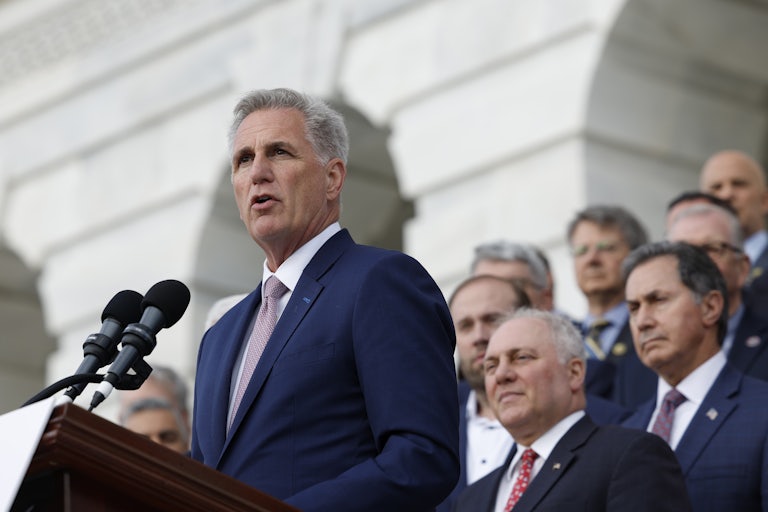
Kevin McCarthy Begs Republicans to Back His Unfinished Debt Ceiling Plan

This isn’t the first time McCarthy has had to ask his party to please just get behind him.

Anna Moneymaker/Getty Images

Kevin McCarthy’s debt ceiling bill goes up for a vote next week—despite being so unpopular in his own party that he is reportedly begging people to back it.

The House speaker unveiled a plan Monday to raise the debt ceiling into next year, so that the United States won’t default on its debt. Democrats and Republicans are locked in a protracted battle over the debt limit, and the GOP had previously indicated they were willing to hold the debt ceiling hostage in order to reduce government spending.

McCarthy offered few specifics about his plan, which has turned many of his fellow House Republicans off. Although House Rules Chairman Tom Cole told CNN Tuesday the debt limit bill will go up for a vote next week, McCarthy reportedly begged his colleagues to back the measure in a closed-door meeting earlier in the day.

McCarthy told Republicans that his deal isn’t about getting everything they want but about getting President Joe Biden back into negotiations, according to CNN. But many Republicans are unsure about the bill, particularly members of the House Freedom Caucus.

The far-right wing of the House Republicans was primarily responsible for forcing all of us to sit through seemingly endless rounds of votes for House speaker in January. Scott Perry, who chairs the caucus, said McCarthy’s debt proposal was too vague. “I don’t know what’s in the package completely—that’s the issue,” he told reporters.*

Anna Paulina Luna said the proposed budget cuts “should go further,” while Andy Biggs—who ran against McCarthy for speaker—said the proposal was a “long ways away” from what he would support.

“I’m not at the table,” Biggs said.

Other, more moderate Republicans also think the debt limit bill needs work. Nancy Mace said that holding the vote next week is “probably not” enough time to convince her to support the measure. Marc Molinaro said the GOP is “making progress, but we’re still taking a look at it.”

McCarthy promised not to touch Medicare or Social Security when cutting federal spending, a particular sticking point in the budget debate. Republicans have generally tried to end the entitlement programs since they began nearly a century ago, despite the idea being wildly unpopular. Slashing Social Security and Medicaid have repeatedly been suggested during recent debt ceiling debates.

Republican Matt Gaetz has proposed a plan for Medicaid work requirements, while Dusty Johnson proposed a separate plan for food stamp work requirements. It’s unclear which, if either, plan will make it into the bill. While work requirements would definitely reduce Medicaid costs, they would do so by denying health care to countless people.

McCarthy holds a razor-thin majority in the House, and he needs 218 votes to get his bill passed. It’s unclear if he can rally all the support he needs to push the measure through. Democrats are refusing to compromise on the debt ceiling, and if the battle goes on much longer, the United States could be in serious trouble.

The government already hit the debt ceiling in January, and Treasury Secretary Janet Yellen has previously warned the U.S. could default on its debt by the summer if the cap isn’t raised. “It’s simply a recipe for economic and financial catastrophe to think we can pay some of our bills and not all of them,” Yellen told the Senate Finance Committee in mid-March.

* This piece originally misstated the leader of the Freedom Caucus.

Democrats Should Listen to Mitch McConnell for Once

McConnell has made the Republican Party’s stance on Dianne Feinstein and the Judiciary Committee more than clear.

Mitch McConnell sounded the death knell Tuesday on any chance of Dianne Feinstein staying in Congress. For once, Democrats should listen to him.

Feinstein hasn’t been in the Senate for more than six weeks due to complications from having shingles. Her absence has put many key votes, including judicial confirmations, on hold. Senate Majority Leader Chuck Schumer said he would grant her request to let another Democratic senator temporarily serve in her place on the Judiciary Committee.

A few Republicans have said they will refuse to let that happen, but McConnell put the final nail in that coffin Tuesday. “Senate Republicans will not take part in sidelining a temporarily absent colleague off a committee just so Democrats can force through their very worst nominees,” the chamber minority leader said in a floor speech.

Calls for Feinstein to step down have begun to grow, even within her own party. Representatives Jamaal Bowman and Alexandria Ocasio-Cortez tactfully urged the senator to resign on Monday, joining their colleagues Ro Khanna and Dean Phillips.

Feinstein announced in February that she would not run for reelection. She has had a long and storied career, but it has been sullied in recent years by reports that she is no longer mentally capable of serving.

If she does not step down now, she will effectively hand control of the Senate to Republicans. The GOP will be able to hold up votes and even determine the outcome of judicial nominations, which are becoming increasingly important as human rights battles play out in courts across the nation.

If Feinstein does resign, California Governor Gavin Newsom would appoint her replacement, and President Joe Biden’s judicial nominees would no longer be stuck in limbo with a split Judiciary Committee.

Some people have come to Feinstein’s defense. Senator Kirsten Gillibrand said Monday that Feinstein “has the right…to decide when she steps down,” while former House Speaker Nancy Pelosi blamed the calls to resign on sexism.

But as Senator Amy Klobuchar said Sunday, “this isn’t just about California, it’s also about the nation.” Feinstein’s final act of service to her country could be ceding power. It would be an act of service to herself to do so with her dignity intact.

Iowa Senate Rolls Back Child Labor Law in the Dead of Night

While most of their constituents were asleep, Iowa Republicans voted to make it easier to hire minors to work in places like meat freezers.

Luke Sharrett/Bloomberg/Getty Images
Iowa state Capitol building. An Iowa state flag is flying in front.

Before the sun had even risen on Tuesday, the Iowa Senate passed a bill to loosen child labor laws, allowing the employment of kids in previously restricted fields like roofing, demolition, and working in meat freezers.

Republicans pushed through Senate File 542 just before 5 a.m. Tuesday morning after a marathon session, with only two Republicans voting against the bill. The bill now moves to the House, and Republicans have trifecta control in Iowa.

Pushed by lobbyists including the Iowa Restaurant Association and Iowa Grocery Industry Association, the bill would allow 14- to 17-year-olds to work in some fields that violate federal labor law, such as freezers or meat coolers (settings notorious for child and migrant labor violations).

The bill also allows 15-year-olds to do loading work for items up to 30 pounds. A waiver from the labor commissioner can increase that number to 50 pounds, and it can also enable them to do assembly-line work.

The bill also extends the amount of time companies can have kids under 16 work—until 9 p.m. during the school year and until 11:00 p.m. during the summer. It moreover allows the employment of minors for up to six hours a day during a school week, two hours higher than currently allowed. Employers could have kids above the age of 16 work the same number of hours as adults.

Senators spent hours debating the bill, and the hours stretched on thanks to Republican stalling. The bill’s floor manager, Senator Adrian Dickey, as well as Senate Majority Leader Jack Whitver refused to answer questions from Democrat Bill Dotzler during debate. After further closed-door sessions and several failed Democratic attempts to amend the bill, the Republican-led Senate finally voted to pass the bill in the wee hours of the morning.

Republicans have framed the bill as both a benefit to children and a means to help fill in a supposed labor shortage.

On the former, Republicans blocked a Democratic amendment on additional workers’ compensation for teenagers who get injured while working. And on the latter, opponents have argued that the labor shortage didn’t just happen out of nowhere.

“The biggest reason we have a labor shortage is because our wages are too low,” state Senator Clair Celsi told Iowa Starting Line. “Most of the states touching Iowa all have higher wages.” Thirty states have a minimum wage higher than Iowa’s $7.25 per hour.

Bureau of Labor Statistics figures show that unemployment rates per job opening in Iowa have in fact reached, and at some points dipped even lower than, pre-Covid rates. The claims of a labor shortage seem more about preventing labor from demanding better benefits and conditions; such a goal can be all the more easily accomplished when employing minors who may not be primed to join a union or demand more rights.

The bill seeks to create more legal pathways to justify the preexisting issue of corporate child labor exploitation already rampant in this country.

The Senate voted on the child labor law just days after Iowa Representative Sami Scheetz encountered what appeared to be a minor working at a construction site; Scheetz allegedly asked the worker his age, and the site supervisor told the worker in Spanish to say he was 18.

Twitter Quietly Rolls Back Ban on Misgendering Trans People

Twitter reversed a policy to protect trans people from hate speech on the platform.

Rafael Henrique/SOPA Images/LightRocket/Getty Images

Twitter secretly changed its hateful-conduct policy to remove protections for transgender users, opening them up to even more online abuse.

The social media network implemented a rule in 2018 prohibiting users from referring to trans people by the wrong gender or by their dead name, meaning the name they were given prior to transitioning. Under the policy, misgendering or deadnaming trans people was considered “targeting others with repeated slurs, tropes or other content that intends to degrade or reinforce negative or harmful stereotypes about a protected category.”

That rule was in place until April 7, according to the internet archive the Wayback Machine. But by the next day, the second sentence had been removed from Twitter’s policies. As civil rights lawyer Alejandra Caraballo pointed out, this opens the door to even more abuse toward trans people, who are already subjected to a lot of hatred both on- and offline.

Twitter did not announce the change, meaning that people are only just learning about it 10 days after the fact. GLAAD slammed the switch as “the latest example of just how unsafe the company is for users and advertisers alike.”

“Social media companies committed to maintaining safe environments for LGBTQ people should be working to improve hate speech policies, not deleting long-standing ones,” GLAAD president and CEO Sarah Kate Ellis said in a statement, noting that civil rights groups, including the Anti-Defamation League, have categorized misgendering and deadnaming people as a form of hate speech.

Ellis also pointed out that TikTok, Pinterest, and Meta have trans protection policies, making Twitter an outlier.

Hate speech has risen dramatically on Twitter since Elon Musk took over in October, although he insists otherwise. A report released in December by Media Matters and GLAAD analyzed tweets from nine prominent right-wing figures and accounts and found that in the first month under Musk’s leadership, there was a 1,200 percent increase in retweets of posts that use the word “groomer,” a homophobic slur.

The social media research group National Contagion Research Institute found that in the 12 hours after Musk bought Twitter, use of the n-word increased almost 500 percent. Musk has let Nazis back on Twitter, given blue verification check marks to the Taliban, and shared transphobic memes and Nazi photos himself.