Breaking News
Breaking News
from Washington and beyond

Florida Passes Anti-Drag Ban So Extreme It Could Ban All Pride Parades

The bill is so vaguely worded that Pride organizers are already worried about celebrations this year.

Sean Drakes/Getty Images
Celebrated drag personality and Palace ambassador Tiffany Fantasia co-hosts the fifteenth annual Miami Beach Pride Parade, wearing a custom dress that declares “Drag Is Not a Crime,” on April 16.

Florida passed a bill Wednesday that could stop all Pride parades and festivals in the state.

The measure passed the House of Representatives by a vote of 82–32 and is now headed to the desk of Governor Ron DeSantis, who is expected to sign it into law. The bill passed the Senate last week by a vote of 28–12.

If it becomes law, the measure would prohibit government entities and employees from issuing permits to organizations that may hold “adult live performances” in the presence of minors. Anyone that does can be charged with a misdemeanor.

The measure would also ban businesses from allowing minors to attend an “adult live performance,” which is defined as a show performed in front of a live audience that “depicts or simulates nudity, sexual conduct, sexual excitement, or specific sexual activities … lewd conduct, or the lewd exposure of prosthetic or imitation genitals or breasts.” Any business that breaks this law will face a fine of up to $10,000 and could lose its license.

“This bill is a blatant attack on free expression, parental rights, and choice,” said Democratic Representative Lavon Bracy Davis. “What are you afraid of? What is it about drag queens that terrify you? Pray tell, why are we censoring artistic expression?”

“I know this chamber has shown quite the concern for impersonation. Well right now, we are impersonating democracy.”

Democrat Fentrice Driskell pointed out that Florida already has laws in place to protect children from being exposed to obscene content, the main argument from the bill’s backers. “Even though the plain text of the bill may not say ‘drag’ ... there’s a greater context happening here, and we all know it,” she said.

Her colleague Daryl Campbell warned that Republicans may currently be targeting the LGBTQ community. But “for those watching, they will come after you when it’s in their interest.”

If DeSantis signs the bill into law, it will go into effect immediately, a little more than a month before Pride Month begins in June. Festivals such as St. Pete Pride in St. Petersburg, the state’s largest Pride celebration, could lose their permits.

The measure is so vaguely worded that Pride organizers in the state have already expressed concern. “We do believe that this might be the last Pride as you know it,” Patrick Gevas, one of the organizers of Miami Beach Pride, told NBC 6.

Critics have slammed the bill as being overly broad, which could have unintended consequences. Republicans backing it have admitted that the measure would prevent performances of The Rocky Horror Picture Show and the musical Hair.

But the measure will also have an intended consequence: “erasing” LGBTQ people from existence. Florida Republican Representative Randy Fine said last week that if passing the bill “means erasing a community because you have to target children, then, damn right, we ought to do it!”

The ACLU slammed the bill when it first passed the Senate as “an extreme governmental overreach of power.” “This is not democracy. This is not freedom,” the group said in a statement.

Florida is the latest state to advance a (vaguely worded, extreme) measure attacking drag performances, which have become a particular target for the right wing in recent years. In March, Tennessee became the first state to pass a law banning drag performances, but the measure was blocked by a judge before it could go into effect on the grounds that it was overly broad and violated free speech rights.

DeSantis has also set his sights on drag performances, revoking the liquor licenses for multiple businesses that have hosted drag shows—even though undercover agents sent to one show “did not witness any lewd acts.”
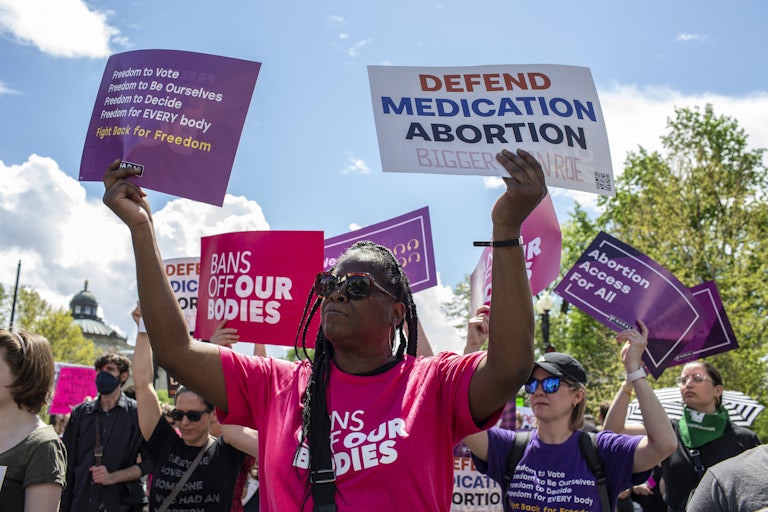
The Latest Wrinkle in Republicans’ Quest to Ban the Abortion Pill

A new lawsuit against the FDA seeks to preserve access to the pill, regardless of what the lower courts have said.

Probal Rashid/LightRocket/Getty Images

The maker of the generic version of the abortion pill mifepristone sued the Food and Drug Administration on Wednesday in an effort to keep the drug accessible nationwide.

A complicated legal battle over mifepristone is playing out in the U.S. judicial system. A Texas federal judge ruled two weeks ago that the drug, one of the medications used to induce an abortion, had been improperly approved by the FDA and should be yanked from the U.S. market. The Department of Justice appealed the decision, first to the Fifth Circuit Court, which only partially stayed the ruling. The Justice Department then appealed the case to the Supreme Court, which issued a temporary administrative stay.

The Fifth Circuit’s ruling, if upheld, will judicially nullify the Abbreviated New Drug Application, or ANDA, for the pills made by GenBioPro, which the FDA approved in 2019. GenBioPro says its pills are used in about two-thirds of the 500,000 medication abortions that happen in the United States each year.

GenBioPro sued the FDA for indicating in court filings that if the Supreme Court does not intervene, then the agency will abide by the lower rulings and pull GenBioPro’s drug from the market. The company argued that doing so would violate laws about the process for withdrawing a drug’s approval.

“In addition to the severe harm to GenBioPro’s commercial viability from suspension of its ANDA, catastrophic harm also results to members of the public, including doctors and patients, who have developed extensive reliance interests in the approval and availability of GenBioPro’s mifepristone,” the company said in the lawsuit.

GenBioPro also said that it has repeatedly asked the FDA for assurances that its approval status will be protected, but the FDA has not responded. “Because of the FDA decision and the enforcement threat and uncertainty it has created, GenBioPro is suffering irreparable financial and reputational harm, severely threatening its core business model and commercial viability,” GenBioPro said.

The GenBioPro lawsuit is an attempt to keep mifepristone available, regardless of whether the Supreme Court decides to stay or uphold the lower court rulings. The nation’s high court is expected to issue a decision Wednesday.

Medication abortions make up more than half of all abortions performed in the United States. These drugs can be ordered online and delivered via mail, making them a key resource for people who live in states that have cracked down on abortion access since Roe v. Wade was overturned last summer.

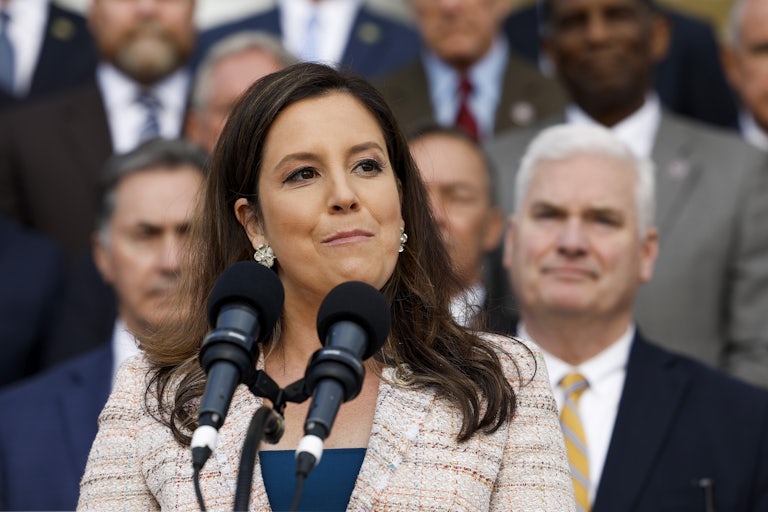
Elise Stefanik Likes to Talk About Crime Until It Happens in Her Own District

A 20-year-old woman was shot and killed after her friend turned into the wrong driveway. That was in Republican Representative Elise Stefanik’s district.

Elise Stefanik
Anna Moneymaker/Getty Images

On Saturday night, a group of friends had driven up the wrong driveway as they were searching for another friend’s house. And as they turned their vehicles around, the owner of the home shot at them.

The 65-year-old homeowner, Kevin Monahan, fired two shots and killed 20-year-old Kaylin Gillis, authorities said—for the simple offense of being in the passenger seat of a vehicle that pulled into a wrong driveway before promptly turning around. The violent shooting occurred in upstate New York, in the district represented by Republican Representative Elise Stefanik.

On Tuesday, Stefanik tweeted a Notes-app-style statement that her “heart breaks for the tragedy of the loss of Kaylin Gillis’ young life” and that she fully supports efforts “to ensure justice is served.” But within the hour, Stefanik went back to her regularly scheduled programming of whipping up outrage about crime in New York City.

Stefanik has spent much of her career fearmongering about crime, all the more so amid the Manhattan district attorney’s indictment of twice-impeached former President Donald Trump. She, along with other Republicans, has attempted to discredit Manhattan District Attorney Alvin Bragg by trying to frame New York City as a bastion of crime.

Stefanik, not even a member of the House Judiciary Committee, was invited to join a hearing Monday that falsely framed New York as awash in crime. The New York City crime narrative is a popular one, but as witnesses in the hearing pointed out, New York City is safer than many of the places House Republicans leading the smear campaign come from.

The campaign has been all the more vacuous given that Republicans have put forth no actual solutions to crime that may be taking place, other than building more jails and throwing more people in them. Seldom have they genuinely pursued a broader policy vision they pretend to care about, whether it be improving people’s mental health or combating social alienation.

Meanwhile, Stefanik and other Republicans have blocked any attempt to prevent shootings like the one in her district or in Kansas City, Missouri, where 16-year-old Ralph Yarl was shot after accidentally ringing the wrong doorbell. After the Nashville school shooting last month, Stefanik called the move for gun control “overly political.” Never mind that more than 160 mass shootings have taken place just this year in America.

Republicans have made it easier, again and again, to access guns in a country ravaged by mass shootings. They have fomented social distrust, in a society where hate and divisiveness have become as American as apple pie.

And in Stefanik’s weak-hearted chicanery, she embodies precisely how hollow it all is. Instead of confronting why our society has produced such anger and why that anger is allowed to so easily access weapons of killing, Stefanik and Republicans are instead inflaming that anger and making sure it is as armed as possible.

Florida Expands “Don’t Say Gay” Law Through High School

The law bans classroom discussion on sexual orientation or gender identity.

David Dee Delgado/Getty Images

Florida’s Board of Education voted Wednesday to dramatically expand the state’s infamous “Don’t Say Gay” law through high school.

Governor Ron DeSantis signed the original law, officially named the Parental Rights in Education law, in March 2022. The law bans schools from teaching students in kindergarten through third grade about sexual orientation or gender identity, arguing that those topics are not age- or developmentally appropriate.

The amendment approved Wednesday expands that ban. Instruction on sexual orientation and gender identity was originally banned from pre-kindergarten to third grade. Now, “for Grades 4 through 12, instruction on sexual orientation or gender identity is prohibited unless such instruction is either expressly required by state academic standards … or is part of a reproductive health course or health lesson,” the amendment states.

Teachers who provide such instruction anyway risk losing their teaching license. Parents can also decide to remove their student from any health classes.

“It was NEVER, EVER, EVER about ‘protecting children,’” warned former Democratic state Representative Carlos Guillermo Smith, ahead of the vote.

The LGBTQ rights group Equality Florida slammed the measure after it was passed. “The lust for government censorship is insatiable,” the group said.

The proposal will go into effect after a procedural notice period, which lasts about a month, an Education Department spokesperson told the AP.

Florida is cracking down on discourse around sexuality and gender identity, often in ways that are overly broad and extreme. A Republican representative introduced a bill in February that would bar any kind of sex education in public schools until sixth grade, and then allow abstinence-only sex ed in the grades after. The bill, which passed the House and is in the Senate, is so vague that it would also prohibit younger students from discussing their periods with school officials.

DeSantis is widely expected to announce a 2024 presidential run, and he has made clear he is waging war on anything he deems “woke.” He’s been in a weird legal battle with Disney World for a year, since the company’s then chairman condemned the “Don’t Say Gay” law. He has promised to defund diversity, equity, and inclusion programs on college campuses; limited what can be taught or read in schools; and had his allies force out the president of a liberally minded college.

Tennessee Lowered Permitless-Carry Age on the Day of the Nashville Shooting

Younger Tennesseeans will not be prosecuted for carrying a gun without a permit.

Jon Cherry/Bloomberg/Getty Images

After a mass shooting, one might reasonably expect a society to enact some sort of legislation or change to prevent such a thing from happening again. Imagine almost the exact opposite: loosening gun laws on the same day as a mass shooting. That, in fact, is what happened in Tennessee.

On March 27, a school shooting in Nashville left three children and three adults dead. Also on March 27, a Tennessee judge approved an agreement that would allow 18 to 20-year-old Tennesseans the right to carry a gun without a permit.

The decision came in response to an out-of-state firearms group that was suing Tennessee, arguing it is somehow unconstitutional to prevent 18-year-olds from carrying guns sans permits.

And in late January, Tennessee Attorney General Jonathan Skrmetti decided to settle the case, agreeing that his office would not prosecute people between the ages of 18 and 20 who carry guns without permits. The proposal was officially approved on the same day as the Nashville shooting.

“It is the 16, 17, 18 and 19-year-olds killing and doing the shooting, wreaking havoc,” mother and retired U.S. Army member Eboni Anderson told Action News 5. “And the leaders are … just saying … ‘Go ahead … leave [guns] on a silver platter and go kill yourselves. We’re aware of this.’ I can only hope the younger generations are aware they’re giving us the guns because they want us to kill each other.”

Skrmetti’s decision had gone through with little awareness, even on the side of elected officials; Action News 5 reported that numerous leaders did not know the change until they had reached out to them for comment.

The weakening of gun safety provisions in Tennessee should not be seen as an aberration. Last week, Tennessee Republicans shut down a “red flag” law that could have prevented the shooting in the first place. They had shut down a similar bill two years ago as well. Tennessee Republican Governor Bill Lee made permitless carry legal in 2021, and his fellow state Republicans have been working to expand the permitless-carry privilege to include all guns, including the likes of AR-15 rifles and shotguns. The legislation would also have Tennessee recognize any out-of-state permit as valid “as if it is a firearm carry permit issued in this state.”

As of 2020, Tennessee was among the top-10 deadliest states in the country from firearms. And in the aftermath of a devastating mass shooting and yet another data point in the over 160 American mass shootings of 2023, Tennessee Republicans show no sign of wanting to change that statistic.