Newsletter
Power Mad
A weekly review of the rogues and scoundrels of American politics

This Is How the Right Is “Rebranding” the Pro-Life Movement

If you want to know what the post-Dobbs future looks like, look at what the state of Texas did to Kate Cox.

Drew Angerer/Getty Images
Texas Attorney General Ken Paxton speaks outside the U.S. Supreme Court on November 1, 2021, in Washington, D.C.

Ever since the Supreme Court handed down its decision in Dobbs v. Jackson Women’s Health Organization, the Republican Party has gotten a crash course in what it feels like to be the dog that caught the car. To the surprise of no one who’s spent the past few decades warning what might happen if the abortion rights protections offered by the 1973 ruling in Roe v. Wade perished at the hands of a conservative court, the Dobbs ruling rather swiftly unleashed dystopia across the land and brought a voter backlash with it—so severe that GOP elites, when last we checked in, were contemplating a “rebranding” of the pro-life movement.

That task will become all the more impossible given the persecution this month of a pregnant woman in Texas, which tells you all you need to know about the Republican vision of a post-Roe America.

In late November, Kate Cox learned that her unborn child had a dire genetic disorder called trisomy 18 that typically leads to a stillbirth or, in rare instances, a very short and unhappy life. Making matters worse, Cox had previously delivered two children by C-section, which created potentially life-threatening consequences for her delivery. And so, understandably, she wished to end her pregnancy.

But Cox lives in Texas, where it is illegal to perform an abortion except in some “narrow exceptions”—to save the life of a pregnant patient or prevent a “substantial impairment of major bodily function.” Her doctor, playing by the new rules of the road and having determined that Cox qualified for such an exception, obtained a ruling from a judge that would have permitted her to have an abortion. Texas Attorney General Ken Paxton then went to elaborate lengths to thwart her. Beyond merely getting the Texas Supreme Court to intervene, he sent threatening letters to area hospitals warning of the legal consequences of treating Cox. He also made sure to invoke Texas’s infamous abortion bounty law and sic the Lone Star State’s anti-abortion vigilantes on her and anyone else who might help her obtain the procedure. Cox ended up having to flee the state just to get the care she needed.

It’s worth underscoring some basic facts. Cox was no libertine, seeking to use abortion as a form of birth control in the popular caricature of abortion-seekers that the right likes to promulgate. She has two children and very much wanted a third. Doctors were able to offer her doomed child mercy and keep alive the possibility of her adding to her family at some point in the future. Paxton, however, took the position that the only just outcome would be for her to run the risk of leaving her children without a mother and her spouse without a wife, all for the sake of a warped ideology that’s already failed on its own terms.

The pro-life rebranding is thus proceeding exactly as I predicted it would, with the most extreme elements of the anti-abortion movement driving policy forward and grabbing headlines for the fringe ideas they’re birthing and the militancy by which they carry them to term. 

Texas Senator Ted Cruz is running scared from this story. Meanwhile, among the Republican presidential candidates, who have the most at stake when it comes to putting lipstick on the party’s anti-abortion pig, mealy mouths are the order of the day. As NBC News reported, none of the candidates “were willing to outright say they disagreed with Texas’ decision to deny Kate Cox an abortion, but they also weren’t jumping to defend the Republican politicians in the state.” There never were such sterling examples of courage and conviction. Nikki Haley, who has strained herself trying to locate a middle position on this issue, offered this nonsense: “We have to humanize the situation and deal with it with compassion.”  

What Haley doesn’t grasp is that we don’t need to reinvent the wheel. Humanity and compassion are qualities that were ever-present in the pre-Dobbs status quo. How do we know this? We know this because prior to the Supreme Court’s ruling, whenever people like Kate Cox needed humanity and compassion, they got it from their doctors. Humanity and compassion just ran seamlessly in the background, and these women never ended up in the news, fleeing their states, fearing for their lives, or watching their state’s attorney general try to destroy their families. Humanity and compassion didn’t just vanish by accident—the anti-abortion movement is hunting it to extinction.

I don’t personally believe that Republicans have any deeper thoughts to their extreme hostility to reproductive rights beyond a simple but deeply held belief that women are chattel. But you can judge for yourself. Their talk of humane exceptions to abortion bans is bunkum. Their talk of leaving abortion restrictions to the states: hogwash. Their talk of compromise is a lie. They even lie to themselves about how unpopular their position is. Left to their own devices, they will identify people like Kate Cox—a loving mother who played by the rules—and subject them to stupefying cruelty. And there will always be a next Kate Cox; there already are some next Kate Coxes in the news. The rebranding is well underway.

This article first appeared in Power Mad, a weekly TNR newsletter authored by deputy editor Jason Linkins. Sign up here.

Trump Is Coming for Your Health Care—Again

The Republican Party’s “repeal and replace Obamacare” zombie is back, and it’s even more brain-dead than before.

Scott Olson/Getty Images

The possibility that we might, as The New Republic’s editor Michael Tomasky put it, “sleepwalk” into a second Trump presidency is very real, which is all the more shocking given the mounting evidence that Trump Redux could well end America as we know it. The New Republic’s Matt Ford capably laid out how few guardrails remain in place, including, as Brian Beutler noted in his Off Message newsletter, “the likelihood that Trump will have carte blanche if not active participation from Congress.” The Atlantic, our doughty journal of ruling-class opinion, has even dedicated an entire upcoming issue to the topic.

That Trump poses a unique threat to our civic fabric and our democratic institutions is an important argument to make—and as Democrats proved in the recent midterms, it’s a winning argument as well. Still, it’s important to remember that in addition to being a wannabe despot, Trump is also an extremely conventional Republican politician with very stupid and harmful policy ideas. And lately, he’s been reminding us about one in particular: his plan to throw people off of their health insurance and make coverage worse and more expensive.

Over the Thanksgiving weekend, Trump announced his plan to revive one of the Republican Party’s less-liked vaudeville routines, the two-step known as “repeal and replace Obamacare.” “I’m seriously looking at alternatives,” he wrote on Truth Social. Despite the fact that reports immediately pointed out what a political loser the issue has been for the GOP, which essentially gave up on the idea of scuttling the Obama-era law in the most recent midterms, Trump has done nothing but push it even harder. “I don’t want to terminate Obamacare,” he wrote, “I want to REPLACE IT with MUCH BETTER HEALTHCARE. Obamacare Sucks!!!”

Okay, we get the point. For a long while, repealing and replacing the Affordable Care Act was among the Republican Party’s biggest priorities and also one of its most prolonged failures. Its failure was largely due to Obamacare’s ever-growing popularity but also to Republicans’ inability to propose a better replacement. Republicans view health care as a privilege won by those who rise to the top of the free market. Economic dislocation of any kind, in their view, is the result of individual moral failings. The Affordable Care Act, by contrast, literally redistributes taxpayer money to subsidize health care for those who can’t afford it. This is the bill’s cardinal virtue and the thing that enables all of its most popular components. That makes it complete anathema to Republicans.

This is probably why Trump’s own push to replace Obamacare ended up producing the American Health Care Act, which I once described as not so much a health care plan as “the opening salvo in a multi-part revenue baseline manipulation scheme that was supposed to pave the way for a massive tax cut for the wealthy.” While the bill was touted as the Republican alternative to Obamacare, its main feature was to guarantee worse coverage at higher costs—and throw millions of people off of their insurance to boot. In other words, it was a Republican health care plan. In fact, it was so effective at accomplishing standard Republican health care goals that when the White House tried to counter the Congressional Budget Office’s dire estimations of the damage the bill would do, the administration’s own analysis found that the CBO left off an additional two million people who were going to lose their insurance.

Republicans have mostly greeted Trump’s calls for repealing and replacing Obamacare with exasperation. The Hill reported that his renewed interest in gutting the law caused “new political headaches for Republicans locked in a highly competitive battle to win back the Senate majority.” Most Republicans admitted that the legislative margins were too tight to contemplate taking the matter up again and that there was a lack of consensus among members as to what a replacement might look like. Still, Ron DeSantis has also made Obamacare repeal a central plank in his campaign. And at least one Republican vying to flip a Senate seat from blue to red, Tim Sheehy, followed Trump’s call by coming out in favor of the “full privatization” of health care.

Trump may have only opened this political Pandora’s box a crack, but Democrats should pry it open with a crowbar. They have made this a winning issue before and could easily do so again. Obamacare is very popular; as Politico noted last week, roughly three in five Americans like the law. Many undecided voters may be unsure that a second Trump term spells doom for American democracy, but it may be enough to remind them that he and the GOP could spell doom for their health care.

This article first appeared in Power Mad, a weekly TNR newsletter authored by deputy editor Jason Linkins. Sign up here.


Billionaire Philanthropy Is a Scam

A new study describes in grotesque detail the extent to which the ultrarich have perverted the charitable giving industry.

Chip Somodevilla/Getty Images
Bill Gates, founder of Microsoft and co-chair of the Bill and Melinda Gates Foundation

Money gets a bad rap in some quarters. It’s said that it “isn’t everything,” that it cannot “buy you happiness,” that loving it is “the root of all evil.” But if there’s one thing that money is absolutely stupendous at doing, it’s solving problems. Naturally, the more money you have, the more problems you can solve. Which is why the fact that we’ve allowed a large portion of an otherwise finite amount of wealth to become concentrated in the hands of an increasing number of billionaire plutocrats is something of a crisis: Since they have all the money, they call the shots on what problems get solved. And the main problem they want to solve is the public relations problem that’s arisen from their terrible ideas.

Naturally, the ultrarich put on a big show of generosity to temper your resolve to claw back their fortunes. Everywhere you look, their philanthropic endeavors thrive: They’re underwriting new academic buildings at the local university, providing the means by which your midsize city can have an orchestra, and furnishing the local hospital with state of the art equipment. And a sizable number of these deep-pocketed providers have banded together to create “The Giving Pledge,” a promise to give away half of their wealth during their lifetimes. It all sounds so pretty! But as a new report from the Institute for Policy Studies finds, these pledgers aren’t following through on their commitments—and the often self-serving nature of their philanthropy is actually making things worse for charitable organizations.

As the IPS notes, the business of being a billionaire—which suffered nary a hiccup during the pandemic—is booming. So one of the challenges that the Giving Pledgers face is that the rate at which they accrue wealth is making their promise harder to fulfill. The 73 pledgers “who were billionaires in 2010 saw their wealth grow by 138 percent, or 224 percent when adjusted for inflation, through 2022,” with combined assets ballooning from $348 billion to $828 billion.

According to the report, those who are making the effort to give aren’t handing their ducats over to normal charities. Instead, they are increasingly putting their money into intermediaries, such as private foundations or Donor Advised Funds, or DAFs. As the IPS notes, donations to “working charities appear to be declining” as foundations and DAFs become the preferred warehouses for philanthropic funds. (As TNR reported recently, DAFs are a favorite vehicle for anonymous donors to fund hate groups—while also pocketing a nice tax break.) This also has spurred some self-serving innovations among the philanthropic class, “such as taking out loans from their foundations or paying themselves hefty trustee salaries.” More and more of the pledgers are conflating their for-profit investments with their philanthropy as well. And wherever large pools of money are allowed to accrue, outsize political influence follows.

The shell games played by billionaire philanthropists are nothing new. The most common of these are the two-step process by which the ultrarich make charitable donations to solve a problem that their for-profit work caused in the first place. It’s nice that the Massachusetts Institute of Technology’s Institute for Integrative Cancer Research exists, but it’s soured somewhat knowing that the $100 million gift David H. Koch seeded it with was born from a profitable enterprise that included the carcinogens sold by Koch subsidiary Georgia-Pacific. In similar fashion, Mark Zuckerberg’s Chan Zuckerberg Initiative “handed out over $3m in grants to aid the housing crisis in the Silicon Valley area,” a problem that, Guardian contributors Carl Rhodes and Peter Bloom note, Zuckerberg had no small part in causing in the first place.

And at the top of the plutocratic food chain, a billionaire’s charitable enterprise can become a philanthropic Death Star. This week, The Baffler’s Tim Schwab took a deep dive into the Bill and Melinda Gates Foundation and discovered that the entity essentially exists as a public relations stunt to justify Gates’s own staggering wealth. One noteworthy highlight involved Gates reaching out to his upper-crust lessers during the Covid pandemic, seeking additional money on top of the foundation’s own commitment, creating a revenue stream that could tie an ethicist into a knot. “During a global pandemic, when billions of people were having trouble with day-to-day expenses even in wealthy nations,” Schwab asks, “why would an obscenely wealthy private foundation start competing for charitable donations against food banks and emergency housing funds?”

As the IPS study notes, perhaps the worst aspect of all of this is that ordinary taxpayers essentially subsidize these endeavors: According to their report, “$73.34 billion in tax revenue was lost to the public in 2022 due to personal and corporate charitable deductions,” a number that goes up to $111 billion once you include what “little data we have about charitable bequests and the investments of charities themselves,” and balloons to several hundreds of billions of dollars each year “if we also include the capital gains revenue lost from the donation of appreciated assets.”

The IPS offers a number of ideas for reforming the world of billionaire philanthropy to better serve the public interest. There are changes to the current regime of private foundations and Donor Advised Funds that would ensure that money flows to worthy recipients with greater speed and transparency. Regulations could ensure that such organizations aren’t just another means by which billionaires shower favors on board members—and that would give foundation board members greater independence to act on their own ideas and prevent the organization from being used as one rich person’s influence-peddling machine. But for my money, the one way we could solve this problem is to institute one of the most popular policy positions in the history of the United States, and tax the rich to the hilt.

This article first appeared in Power Mad, a weekly TNR newsletter authored by deputy editor Jason Linkins. Sign up here.
Poor Josh Hawley Can’t Help Himself

The Missouri senator’s dumb Citizens United stunt is the epitome of his political career.

Valerie Plesch/Getty Images
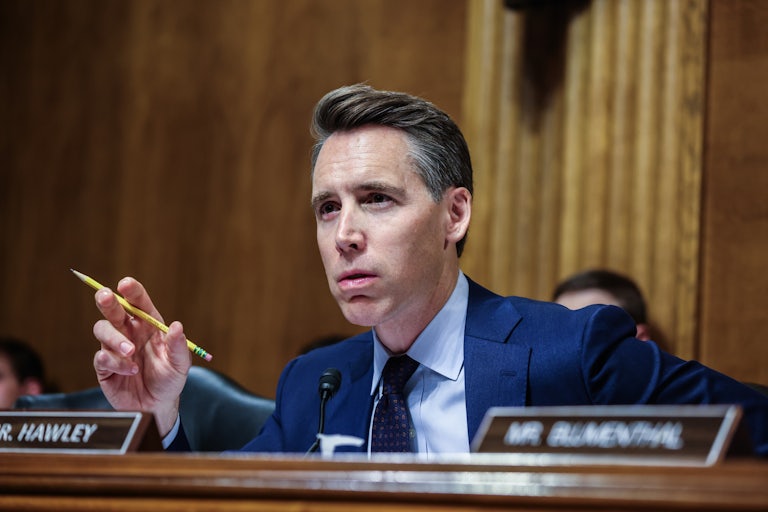
Missouri Senator Josh Hawley

Josh Hawley is at it again. Over a brief career in Washington, the elfin senator from Missouri—when he’s not egging on and then fleeing from insurrectionists—has attempted one pseudo-populist or culture-war gimmick after another to propel him to a higher level of celebrity than he currently enjoys. Alas, while his ideas have gained some prominence on the right, Hawley’s own star isn’t ascending at nearly the same rate. But he is nothing if not undaunted, and this week he unveiled a plan to “overturn Citizens United.” I’m putting that in scare quotes for a reason. Hawley’s latest legislative burlesque is wholly fake—and threadbare even by his gutter standards.

There are many—mainly on the left—who’d like to somehow overturn Citizens United v. FEC, the execrable 2010 decision that unleashed a tidal wave of funny money into our politics and demonstrated that the Supreme Court didn’t need to have a 6–3 conservative tilt to cock up the entire country. It would be great if we could pass a law and set things right, but here’s the rub: Congress can’t fix it, sorry! As MSNBC’s Jordan Rubin explained, overturning the decision would require one of two unlikely events: the Supreme Court choosing to reverse itself or the successful enactment of a constitutional amendment. “That’s because the 2010 case was decided on constitutional grounds—under the First Amendment—as opposed to statutory grounds,” writes Rubin.

The fact that Hawley, even with the assent of Congress and the president, literally cannot “overturn” Citizens United makes this matter done and dusted. But it’s still worth prodding his proposal to assess the full measure of his ambitions—which turn out to be appropriately deceptive. You see, for all of Hawley’s bluster, he’s only targeting one sliver of the boodle that the Supreme Court’s allowed to come sluicing through the gates: corporate money. For all this posturing, Hawley would leave unchecked the flood of dark money.

If you’re authentically aggrieved by the Citizens United decision, this is where the profound misrule lies: Political nonprofits—mainly 501(c)(4)s—can accept unlimited donations and don’t have to disclose their donors, even when the nonprofit then sends the money to super PACs, which do have to disclose donors. As Open Secrets has documented, contributions from shell companies and dark money sources have ballooned in the last two election cycles, with more than $612 million flowing into federal political committees in 2022. Rubin reports that “the nonprofit One Nation donated $53.5 million to the GOP-aligned Senate Leadership Fund, the largest political contribution of any organization that election cycle.”

“Safe to say,” Rubin concludes, “leaving nonprofits out of the equation wouldn’t solve the dark money problem.” But this is what Hawley’s proposal pointedly does.

It really doesn’t take a ton of spelunking to get to the bottom of what Hawley’s trying to do with this sudden stance against Citizens United: This is just a new layer of the senator’s song and dance against what he terms “woke” corporations, and of the broader project of conservative nationalism that TNR contributing editor Osita Nwanevu characterized as “Trumpism for intellectuals,” in The New Yorker back in July 2019.

TNR’s Matt Ford saw a similar level of playacting in a previous Hawley proposal to belatedly jump into the right’s war against Disney with a stunt bill purportedly aimed at reducing the value of the entertainment conglomerate’s valuable copyrights. As Ford pointed out, however, not only was that proposal extremely unlikely to pass constitutional muster, it would very likely “lead to taxpayers giving a multibillion-dollar payout to Disney for its property losses” if it was successfully enacted.

It’s extremely unlikely that Hawley doesn’t understand the fatal flaws in the ideas he’s going to such flamboyant lengths to promote. The senator, after all, has degrees from the two schools that are locked in tight competition to be America’s Slytherin—Stanford University and Yale Law. As Rubin notes, Hawley also used to clerk for Chief Justice John Roberts, so surely he understands the difference between constitutional and statutory grounds.

But even if Hawley’s anti–Citizens United measure is a complete joke, he’s probably getting exactly what he wants out of the effort: favorable headlines from credulous media outlets such as Real Clear Politics, which announced “Sen. Josh Hawley To Introduce Bill Reversing Citizens United,” or Above the Law, which took the cake with “Unlikeliest Of Heroes Josh Hawley Takes On Mitch McConnell To Get Big Corporate Money Out Of Politics.” Even some liberals fell for it: a DailyKos poster titled their blog post, “I agree with … Josh Hawley?” (Don’t worry, “Greg from Vermont,” you really don’t!)

The political press has been on a recent tear of ignominy lately. Media Matters’ Matt Gertz caught multiple outlets selling the GOP’s recent proposal to pay for the proposed Israeli aid package with deficit-ballooning cuts to the IRS as an “offset” this week, in another example of a framing that could have been avoided if anyone bothered to acquire some basic literacy about the legislative process and operating budgets. That Hawley’s sham of a bill has no chance to “overturn Citizens United” doesn’t take a deep dive into the particulars to figure out. To be honest, many of the ruses perpetrated by George Santos, who survived an expulsion vote on Wednesday, were a lot harder to penetrate than Hawley’s latest caper, if only anyone would bother to try.

This article first appeared in Power Mad, a weekly TNR newsletter authored by deputy editor Jason Linkins. Sign up here.
Kyrsten Sinema’s Delusional Exit Interview

The Arizona senator believes she single-handedly saved the U.S. Senate.

Kevin Dietsch/Getty Images
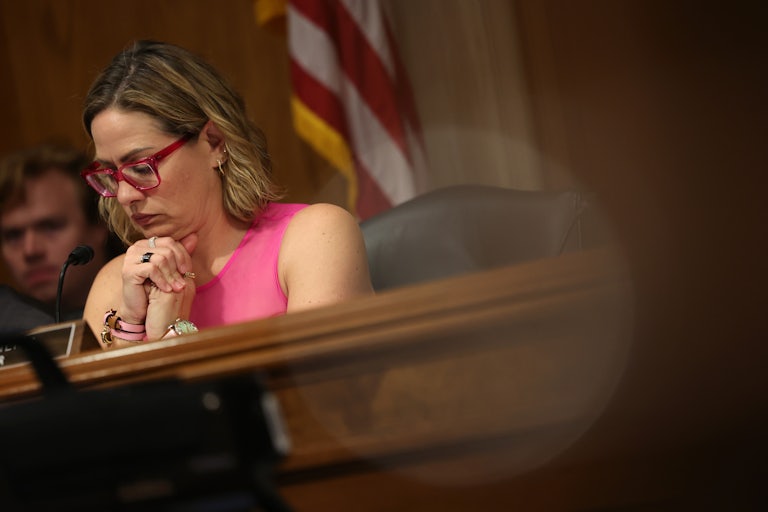
Arizona Senator Kyrsten Sinema

What does the future hold for Kyrsten Sinema? The Arizona senator, who’s best described as a dull person’s idea of an interesting person, famously flounced from the Democratic Party last December. While she’s remained a part of the Democratic caucus since then, she’s now seeking reelection outside of its auspices and against a more institution-minded member of her former party, in the form of Representative Ruben Gallego—who’s not been subtle about his antipathy for the incumbent. So for the first time in a long while, Sinema’s been forced to consider the possibility that her time in Washington may be coming to an end.

But if remarks attributed to her in a new book by McKay Coppins are any guide, she seems sanguine about her future and determined to go out with her trademark delusions of grandeur. As Insider reported this week, Sinema makes a cameo in Coppins’s Romney: A Reckoning, in which she’s totally not mad about her dim reelection prospects. “I don’t care. I can go on any board I want to. I can be a college president. I can do anything,” she apparently told Mitt Romney. “I saved the Senate filibuster by myself. I saved the Senate by myself. That’s good enough for me.” She is, sadly, correct about her chances of cashing out. But the idea that she “saved the Senate” raises a rather obvious question: “From what, though—and for who?”

Beyond the fact that Sinema’s claim to have been the sole savior of the filibuster is significant Joe Manchin erasure, depriving the West Virginia senator of the recognition he’s earned for hurting West Virginians, children, and the planet, she’s incorrect on the merits: You can’t simultaneously be a Senate institutionalist and support the filibuster, which is a parliamentary aberration that flies in the face of the Framers’ designs. The fact that so many have come to think of it as some sort of legitimate Senate tradition is the constitutional equivalent of the Mandela effect, where people end up convinced that their false memories, such as the famously incorrect collective belief that Sinbad starred in a movie called Shazam!, are real.

As The New Republic’s Matt Ford has explained on multiple occasions, Sinema distinguished herself in one way regarding the filibuster: for her willingness to provide a continual stream of ahistorical and utterly gobshitted rationales for why supermajority rule in the Senate actually serves some noble purpose. But chief among Ford’s observations was that the filibuster almost exclusively impedes the Democratic Party from governing: “For Democrats to achieve any of their policy priorities … they have to navigate a 60-vote gauntlet and the assent of 10 GOP senators. Republicans, on the other hand, can cut taxes, slash the federal budget, and stuff the courts with right-wing judges with a simple majority.”

There’s the answer to the question of who she saved the filibuster for. As for the matter of what she accomplished by doing so … well, there we find more disrepute. Among Sinema’s more vaunted accomplishments is her role in blocking Democrats from passing a measure to shore up voting rights during a time when Democratic voters were facing a well-funded, nationwide effort by Republicans to deny them the ability to participate in our democracy. As Ford pointed out, her rationale in this instance was wholly illogical from the standpoint of self-preservation: “Sinema’s refusal to let her party wield its majority power may, ironically, hasten the end of that power—including her own as a senator who’s up for reelection in 2024. Who knows how many of her voters will be disenfranchised by then?”

Sinema cannot lay claim to having been left behind by a party that moved to a radical new place, either, given that the intensity of her opposition to the Democratic Party’s designs hit a fever pitch once a dyed-in-the-wool centrist took charge of the White House. Even as Biden brokered truces with progressive lawmakers, Sinema broke away, taking a leading role in helping to water down the Build Back Better Act. Worse still was her hand in helping to kill off the pandemic-era expanded child tax credit, where her steadfast opposition to taxing corporations and the wealthy cut off the one funding mechanism that Manchin was willing to countenance to keep it running.

A Sinema aide has disputed the accuracy of the remarks attributed to her in Coppins’s book, but the fact that she comes across as being self-aware about becoming a fully vested sellout who’s now eligible to level up her buckraking game completely tracks, seeing as she spent the twilight of her Senate career denying children a fraction of the largesse that the country’s plutocrats have carted off for themselves. Her evolution, famously characterized by the Associated Press’s Brian Slodysko as from “Prada socialist to corporate donor magnet,” has long been on full display, as has her comical antipathy to actually communicating with her constituents.

With all that in mind, no one should really be surprised if the Arizona voters who put her in power come out next year to kick her to the curb. In the end, Sinema’s career in Washington was hampered by the fact that she was stuck having to represent the Grand Canyon State in the Senate, instead of just being what she clearly wanted to be: the personal valet to hedge funders and the private equity industry on Capitol Hill. May the voters now send her on her way to serving these masters.

This article first appeared in Power Mad, a weekly TNR newsletter authored by deputy editor Jason Linkins. Sign up here.

Editor’s Picks