Newsletter
Power Mad
A weekly review of the rogues and scoundrels of American politics

The Industry Devouring the American Dream

Private equity’s tentacles reach nearly every aspect of our lives, and it’s making everything worse.

Scott Olson/Getty Images

Do newspaper endorsements matter? It’s a question that’s been kicked around a lot in recent years. Some editors laud the tradition; others think it’s time for them to end. I’ve always felt that these sledgehammerings from on high, purporting to help voters pick and choose, are no substitute for the woven tapestry of journalism that creates a well-informed public. But that doesn’t mean that I’m cheering the news that one major publisher has announced that it is dispensing with them altogether. And that’s because this particular decision is being handed down by a firm called Alden Global Capital, best known for being at the vanguard of a recent trend: private equity devouring the world.

The New York Timesreport on the matter offers only Alden’s point of view, which sounds innocuous enough at first blush. In a forthcoming editorial set to run in Alden’s publications, the firm says its decision to spike endorsements was done in the spirit of “advanc[ing] a healthy and productive discourse” and reducing “acrimony.” The “common ground,” it writes, “has become a no-man’s land between the clashing forces of the culture wars.”

But as The Nation’s Washington correspondent (and TNR’s former editor) Chris Lehmann notes at length, red flags abound. “The ‘no man’s land’ rhetoric here is especially risible,” he writes, “given that Alden has laid siege to local news markets on its relentless binge of media acquisition.” Indeed, Alden isn’t so much known for advancing the discourse as it is for gutting it; the “no-man’s land” it speaks of has become more of a “no-newspapers land” under its watch, as it lays off employees and closes newsrooms across the country, leaving the aforementioned tapestry of journalism in tatters. But this is just the damage that one private equity firm is doing to one industry.

The tale the private equity industry tells about itself is a virtuous one: They’re savvy investors rescuing ailing firms and making them profitable. Naturally, popular culture has provided an alternative story: that of leveraged buyouts and hostile takeovers. But as Mother Jones’s Hannah Levintova explained, yesteryear’s mythmaking doesn’t really capture how much the industry has evolved. It’s no longer the case that private equity firms mainly hunt down dying businesses to pluck profit like carrion from their bones. Now, she writes, “the bulk of the work done by modern-day private equity firms is not to finish off sick companies, but rather to stalk and gut the healthy ones.”

Consequently, there is almost no aspect of American life that hasn’t been financialized; there is always fresh meat at the private equity smorgasbord. As The Financial Times reported in June 2021, the private equity industry’s assets amounted to more than $3 trillion. And its acquisitions run the gamut: As Levintova notes, the industry acquired numerous for-profit colleges, “enveloped the health care sector,” and gobbled up nursing homes, with the end result being lower graduation rates, increased student debt, higher medical costs, and a rise in the mortality of nursing home patients. Elsewhere, we learn that these firms have devoured trailer parks, neighborhood grocers, and big retail chains. (One thing private equity consistently fails to do is make things better. As TNR contributor Jon Skolnik recently noted, “In the retail sector alone, the industry is estimated to have killed at least 1.3 million jobs since 2009.”)

Beyond the staggering array of assets that private equity firms are absorbing, there is also the broad impact of their rapaciousness to consider. The industry bears some responsibility for climate change and surprise medical bills. It even somehow got its mitts on billions of dollars’ worth of forgivable bailout loans from the Paycheck Protection Program, even though the industry was excluded from those proceeds. Private equity was such a bedevilment to Taylor Swift that it’s surprising she’s not yet penned an “All Too Well (Taylor’s Version)”–style ballad about her experiences.

So private equity is hoovering up every piece of the American dream it can. And in recent years, it’s been targeting one of the most essential parts of the lives we all hope to build for ourselves: where we live. As ProPublica reported in February, private equity–backed companies have “stormed into the multifamily apartment market, snapping up rentals by the thousands and becoming major landlords in American cities,” raising rents and chewing up tenants in their profit-squeezing schemes. And Marketwatch reported in July that the industry has upped its stake in the available stock of single-family homes, competing against ordinary home buyers in a mad dash to snatch up available housing stock and shift it onto the rental market.

That ordinary American families now have to outbid Jeff Bezos for their dream home is a grim and dystopian fact of life. Fortunately, there is some pushback: U.S. Representative Adam Smith, who represents Washington state’s 9th district, has introduced the Saving Homes From Acquisition by Private Equity Act, which, if enacted, would “create a significant federal real estate transfer tax on institutional investors and private equity firms who purchase single-family homes on the open market,” raising revenue that states can then use to build or maintain affordable housing and “slow the consolidation of single-family home ownership among the investor class.”

Democrats should climb aboard this bandwagon; defending ordinary Americans from clear and obvious plutocratic predators is what the Good Life agenda is all about. But the party needs to get to it quickly: Before long, there might not be enough newspapers left to endorse the defenders of the American dream.

This article first appeared in Power Mad, a weekly TNR newsletter authored by deputy editor Jason Linkins. Sign up here.
The United States of Plutocracy

As if dodgy oligarchs and shifty tax cheats didn’t have enough help hiding their ill-gotten gains, your state government may have stepped up to join the con.

Graphica Artis/Getty Images

What do you think of when you think of tax havens? For many, the idea evokes Swiss banks or Caribbean islands—far-flung locales where shell companies stack high and shady enablers in fine suits ooze around every street corner. The truth, however, is that havens for illicit and ill-gotten boodle aren’t nearly as exotic as the Robert Ludlum novel in your mind. If there’s one thing that we’ve learned from recent disclosures—such as the Pandora Papers—on the lengths that the rich and powerful will go to stash their wealth, it’s that the most innovative and disruptive tax havens in the world are the ones right next door.

The U.S. is growing in stature as one of the premier locations for oligarchs of all stripes to safely stash their cash. As TNR contributor Casey Michel has noted, the top grifters in the kleptocracy extended universe aren’t just parking their loot in popular Western capitals, they’re buying up real estate in Cleveland—where Ukrainian kleptocrat Ihor Kolomoisky was, at one point, “the largest commercial real estate holder” in the city. There’s a sizable amount of corrupt money flowing through America’s think tanks as well. And the Pandora Papers revealed that there is a small army of stateside lawyers ready to come to the aid of those who need to keep their filthy lucre hidden.

But it’s underappreciated how one of the biggest enablers of this whole corrupt regime might be your state government. According to a new report from the Institute for Policy Studies, or IPS, a growing number of states have become havens for illicit wealth due to the systematic degradation of regulations governing trusts. These instruments, which are probably best known for their utility in allowing affluent parents to sock away money for their children, are being used more and more by bad actors who want to obscure their fortunes or simply avoid paying taxes on them.

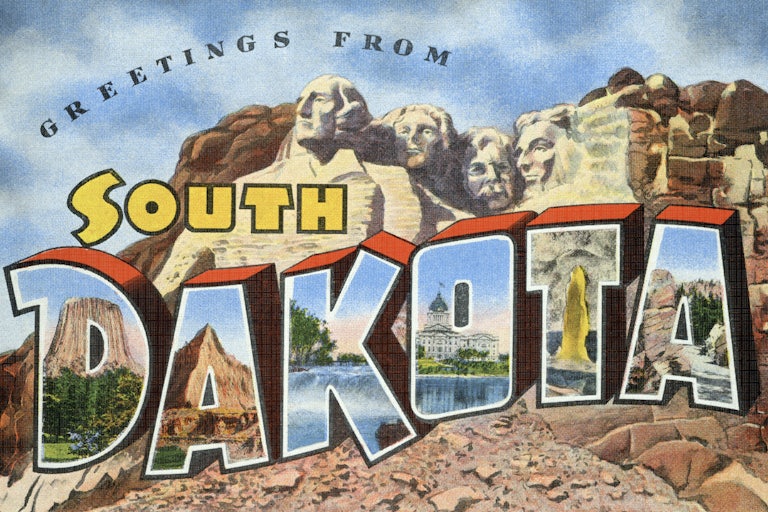
As Tim Noah wrote a year ago, the release of the Pandora Papers shone a light on the state that also gets top billing for the IPS: South Dakota, which pioneered the undoing of trusts by repealing what’s known as the “rule against perpetuities,” the backbone regulation that limits the amount of time money can be held in trust. The IPS’s new study reveals the extent to which South Dakota has touched off a race to the bottom among states who want to deregulate the industry further: More than half of U.S. states have repealed the rule against perpetuities.

But that’s just a start—13 states have gone further to enable these stateside tax havens. The upshot is that tax dodgers and kleptocrats suddenly have a lot of options: They can now effectively stash their wealth in perpetuity if they want. Many states even permit the person who establishes the trust to be the beneficiary of that trust as well—an arrangement that practically legalizes tax dodging.

And as the IPS’s Kalena Thomhave and Chuck Collins note at length, the deterioration of the laws governing trusts have many ill effects on ordinary people, from the way “investments by anonymous trusts in real estate” help to “push up the cost of housing for locals” to the democracy-debasing effect of permitting foreign oligarchs and like-minded thieves to stash their plunder here in the U.S.

This corrupted regulatory state impacts our lives in numerous ways. As Thomhave and Collins report, ordinary people don’t derive any material benefit from their states transforming themselves into safe-deposit boxes for oligarchs. They also note that there “is a significant correlation between regressive state taxation systems, which hurt the poorest residents, and trust-subservient state laws.” But the worst effect by far is the way this misrule further entrenches inequality of all stripes:

The wealthy deploy their power to further shape the rules, news, and culture of society, including trust law. They block popular reforms by capturing the political system and ensuring dysfunctional gridlock. This leads to further consolidation of wealth dynasties, impervious to taxation and accountability. It also leads to more social breakdown and polarization as our collective capacity to solve big problems—like responding to a pandemic or ecological disruption—is rendered inoperative.

At The New Republic, we’ve found ourselves asking more and more: Are states OK? A recent book by Jacob M. Grumbach, Laboratories Against Democracy: How National Parties Transformed State Politics, argues that the states have become “the wrecking ball” of democracy, subverting the desires of their citizens and throwing roadblocks in the way of their right to seek redress with their vote. Now this IPS report shows just how many states are signing up to be the haven of illicit money and harbor the ultrawealthy from paying their taxes. Should state governments serve plutocratic elites or their own citizens? A growing number are making the wrong choice.

This article first appeared in Power Mad, a weekly TNR newsletter authored by deputy editor Jason Linkins. Sign up here.
The Loneliness of Donald Trump

The former president says he made several secret new friends during his time in the White House. Not that they did him any good.

Pete Marovich/Getty Images

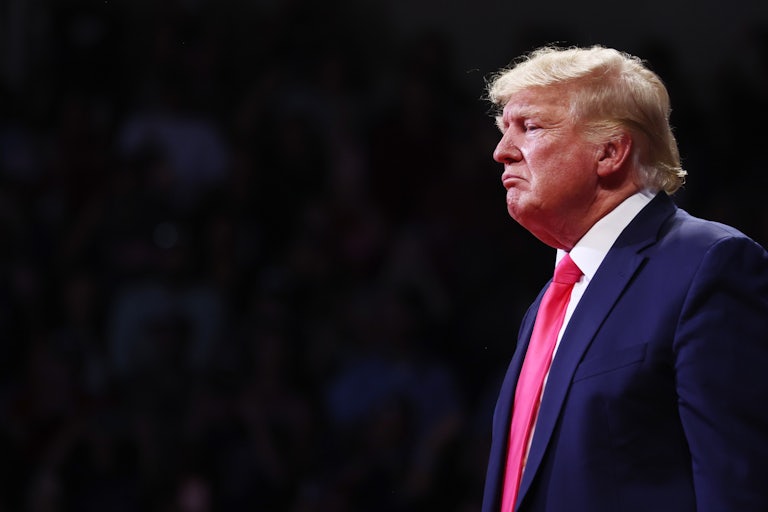
Who will be the last author to write about the great mistake that was the Trump presidency? Maybe no one, and certainly not anytime soon. This week, a hungry media is gorging on a steady diet of scooplets from The New York Times’ Trump-whisperer Maggie Haberman’s new book, Confidence Man: The Making of Donald Trump and the Breaking of America, which comes out October 4. The arrival of this new deep dive has, predictably, resurfaced all the metamedia debates that arise anytime a tidbit-laden tome on the Trump presidency emerges, the most pressing of which is: Is it right for a reporter to hold back newsy scoops for a book deal?

As Alex Shephard explained on these pages, there are a lot of nuances to consider. But if you’re really hung up on the ethics of these arrangements, you can at least take solace in the fact that anytime one of these books gets published, all of the good parts end up getting excerpted in the media for free, so you never have to actually buy them. More pointedly, you might also cast a pitying glance on the whole Trump sector of the publishing industry because there is so little left to learn about the man. Yes, there are new incidents and accidents, hints and allegations, but the Trump story’s been the same ever since David Roth wrote the definitive piece on the man’s psyche back in 2017.

So, aside from the outcomes of a few legal imbroglios, what questions remain unanswered? Here’s where I’ll confess to having one long and lingering inquiry: Does Trump still think running for president was a good idea? And here, Haberman has hooked me in with a cryptic answer to that very question. Trump told her that it was worth it to become president because he made a bunch of secret famous friends.

“The question I get asked more than any other question: ‘If you had to do it again, would you have done it?’” Trump says, in part of the book recently excerpted in The Atlantic. “The answer is, yeah, I think so. Because here’s the way I look at it. I have so many rich friends and nobody knows who they are.” Nobody knows who they are? So, like, Spiderman?

The thing is, though, Trump having friends of any sort would be quite a development. This is not to say that his squad doesn’t roll deep. Trump has cronies and hangers on and a slew of enablers and fixers. He basks in the captive audience of whoever happens to be at Mar-A-Lago on any given day. He has a bunch of people we’d refer to as “known associates” (because they did crimes). He is on intimate enough terms with some conservative media types that they occasionally give him a ring to—you know—call off the coup he started. He has business partners who help him do more scams. He’s constantly in the company of an ever-worsening battery of attorneys. Heck, he’s even recently done a round of golf with his fraud bro Brett Favre.

But among this coterie of yes-men, bagmen, con men, and attorneys-at-flaw, does he actually like, have any real friends? By all accounts, Trump doesn’t elaborate in Haberman’s book. We just have to trust him that those secret friends are definitely with him, laughing just out of frame.

Believe it or not, this is a matter the media has already thought about a disturbing amount. Does Donald Trump have any real, honest-to-God friends? Like the type who listen to you and support you—and, maybe, tell you honestly when you’ve done something appalling? A 2016 New York Times piece identified two possible friends, only one of whom returned their calls. Other accounts suggest that billionaire financier Tom Barrack was his best friend. The two have since had a rather public falling out—though now that Barrack has been indicted for numerous crimes, perhaps the two will soon reconnect over their common struggles.

You know why I think Trump has never had any proper friends, the kind who aren’t afraid of telling him the truth? He became president of the United States. A real friend might have interceded: “Wait. You want to be president—like, THE president?” And from there, that person would maybe offer, “Aren’t you up to your solar plexus in real estate tax fraud? Which you’re currently getting away with? Do you really think that becoming the most scrutinized living human is a good idea?” There’s a reason most white-collar criminals lobby politicians rather than become them: They have someone in their lives to deter them from a wrongheaded ambition that would capsize their schemes.

The closest thing Trump had to a friend when he was deciding to run, it seems, was Howard Stern, who urged Trump to consider the fact that he “only had about 10 good years left before he ‘starts to drool’ on himself,” which were better spent at “leisure” instead of being responsible for every single thing imaginable. Unfortunately for all of us, Trump did not heed this advice! Sure enough, when Reuters caught up with Trump in April 2017, they found a regretful wretch, pining for the ease of his “previous life.” There can be no doubt that the Trump in the parallel universe where he didn’t run for president is infinitely happier, even if he didn’t make any secret friends (or lead our rapid descent into fascism).

In the end, Trump only has pallid and paltry answers to the question of why he decided to make the world-historical error in judgment to run for president instead of just being an idle rich celebrity. The good news is his future chroniclers won’t have to pursue these answers. Should Trump run for president again, we’ll know exactly why: He needs to hold that office to shelter himself from all the legal trouble he’s in. No one will ever again have to attempt to plumb the depths of this depthless man.

This article first appeared in Power Mad, a weekly TNR newsletter authored by deputy editor Jason Linkins. Sign up here.
The Republican Plot to Weaponize the Government Against Political Enemies

Trump’s “Schedule F” plan to eliminate workplace protections for the civil service was averted in 2020. But the GOP still dreams of the purge.

Mario Tama/Getty Images

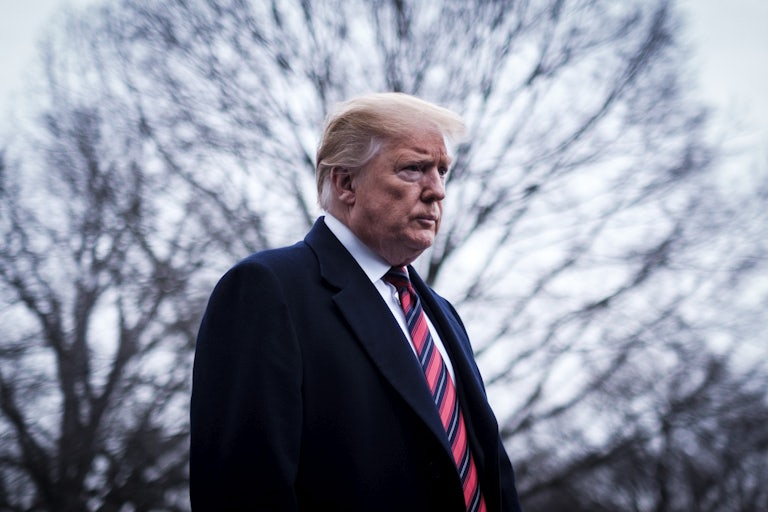
During his presidency, Donald Trump was constantly at war with the civil service. It’s not hard to see why someone like him might find himself at odds with Washington’s army of dedicated public servants. Our federal workforce, however flawed, is an engine of fairness that strives to consistently minister to the needs of all Americans. It’s also proven to be a last line of defense against corruption and misrule. Naturally, Trump and other figures within the Republican Party want to destroy it. And should the GOP retake the White House, they might get their chance. Few have thought through the implications of what happens if Trump wins in 2024, but it begins with the revival of “Schedule F,” one of the Trump administration’s most devious plots against the U.S. government.

Among other efforts to target the civil service, Trump chiseled away at some of the employment protections that the federal workforce enjoys. Most federal government workers are nonpartisan bureaucrats who work under presidents of either party; there are currently only a few thousand genuine political employees. One important protection for this larger group of nonpolitical civil servants is the Merit Systems Protection Board, which can hear disputes and has the authority to reinstate federal employees who it determines were unjustly fired. This agency helps keep these employees free from fear of retaliation for whistleblowing or refusing to participate in corrupt entanglements.

Trump tried his best to break the agency by leaving all three board member positions vacant. It didn’t quite work—while hobbled, the agency was able to persist. But Trump and his enablers came up with a different scheme. The administration exploited a loophole in the law that allows the president or the Office of Personnel Management to redesignate some members of the federal workforce so they no longer fall under the Merit Systems Protection Board’s protection.

To that end, Trump issued an executive order in October 2020 to create an entirely new category of federal staff called “Schedule F,” which would effectively politicize these expressly nonpolitical roles and do away with some of their job protections as well. As Slate’s Donald Moynihan reported, this plan would have made select members of the civil service subject to a “political loyalty test,” which they needed to pass if they wanted to keep their jobs. Even if only a small number of employees were directly affected, the move would be sufficient to bring the entire federal workforce to heel. Given the latitude to simply fire agency attorneys and other bureaucrats who enforce the rules of the road, Trump could transform the bureaucracy from a workforce whose members all swear an oath to uphold the Constitution to one that would act as his personal wrecking crew. Civil servants would then either have to get in line with Trump’s aims or risk losing their livelihoods and careers.

Trump ultimately ran out of time to fully implement this plan, and Biden immediately rescinded the former president’s executive order upon taking office. But the GOP and its backers are still very interested in reviving the plan. Axios’s Jonathan Swan wrote a detailed report in July about the prospects of a reelected Trump bringing Schedule F back; numerous profiles of the Trumpian “new right” have made it clear that figures in this orbit understand that they can’t institute their illiberal plans in a government with a nonpartisan civil service.*

What would the United States be like if the civil service were to become a mere handmaiden to an unscrupulous chief executive? The past offers some clues: For much of the nineteenth century, the federal bureaucracy operated in what was known as the “spoils system,” in which every new presidential administration would purge the civil service of the old guard and stack it with loyalists. This was, of course, a hothouse for corruption, but it wasn’t until this arrangement resulted in the assassination of President James Garfield that reformers gained the upper hand and passed the Pendleton Act, which established a beachhead for a merit-based system to replace the entrenched patronage system. This work wasn’t completed until the 1970s, when the post-Nixon reforms brought us the Merit Systems Protection Board.

But if Republicans have their way, it wouldn’t simply be a return to the spoils system of old. It will likely be much worse. Today’s GOP, after all, doesn’t believe in peaceful transfers of power or that the president can or should be constrained by the law. Moreover, it now conceives of itself as an instrument of retribution rather than problem solving or policymaking. Consider what Schedule F world might look like: The next Republican administration could use the federal government to punish its opponents. Democrats might find their Social Security or veterans’ benefits delayed or denied. They might no longer be able to obtain passports. Emergency disaster aid might flow only to those deemed loyal to the administration. Corporations that refuse to pay tribute might be punished. Transform the civil service from an open hand to a closed fist, and things get very frightening very quickly.

To their credit, Democrats are fighting back: Virginia Representative Gerry Connolly and Senator Tim Kaine have introduced legislation that “block[s] positions from being classified outside the existing system unless Congress consents to it” in their respective houses of Congress. And via an amendment, Connolly got similar language into the must-pass National Defense Authorization Act that’s currently awaiting a Senate vote. But Democrats must also find a way to raise the salience of this frightening prospect with voters ahead of the next presidential election, because whether the federal bureaucracy becomes the corrupt arm of an authoritarian regime is on the ballot in 2024.

This article first appeared in Power Mad, a weekly TNR newsletter authored by deputy editor Jason Linkins. Sign up here.

* This piece originally misidentified the date of this story.

Democrats: Steal This Move From Lindsey Graham

The South Carolina senator’s ideas may be bad—but wow, he’s so confident in them!

Drew Angerer/Getty Images
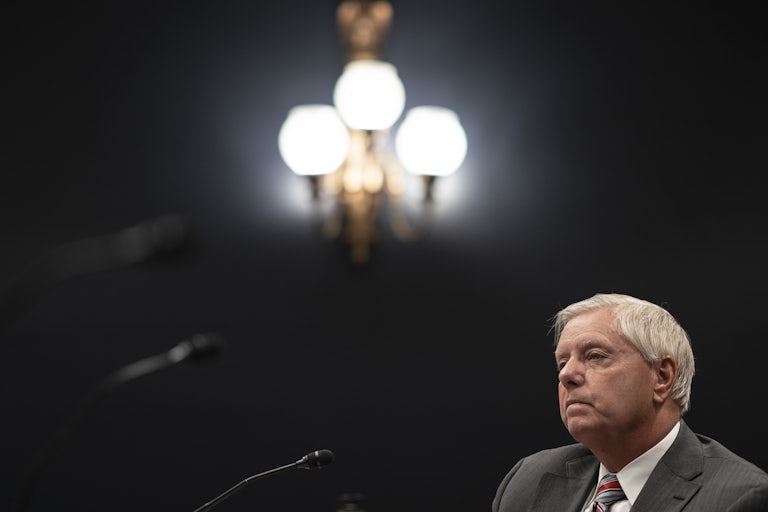
South Carolina Senator Lindsey Graham

This week, South Carolina Senator Lindsey Graham looked out over the political landscape and decided it was high time for a bad idea—specifically, a bill that would impose a nationwide ban on abortions after 15 weeks of pregnancy. Graham’s decision had an immediate impact. His fellow Republicans, by and large, spent the week either pretending not to know him or criticizing him for serving up two scoops of hot midterm-elections discord. Meanwhile, everyone working on the next round of political advertising for Democrats got to go home early, their scripts written for them. It was, in other words, quite a step on the ol’ rake for Graham. It’s also something that Democrats should try to emulate.

Please bear with me. I’m obviously not saying that Democrats should propose an abortion ban, or should go out and commit some chaos-causing unforced error. It’s not the substance that Democrats should imitate but the style. As Discourse Blog’s Rafi Schwartz noted, Graham was at least making a “bold legislative move” and being honest about what he believes. It simply happens to be the case that he’s being bold and honest about something that’s vastly unpopular with the public, and with terrible timing—you know, a moment when GOP candidates for office are scrubbing their websites of their abortion positions in the wake of the repeal of Roe v. Wade. But if Graham can put so much swagger behind such a rancid policy, Democrats should feel similarly emboldened to walk with confidence behind their own set of much more popular ideas.

I mention this because Democrats have a long history of being skittish about their own positions and accomplishments. It took many election cycles before Democrats got comfortable enough with the Affordable Care Act—their biggest policy accomplishment until they passed the American Rescue Plan in 2021—to actually run on it. They only really embraced it in 2018, to great success. More recently, Democrats squandered the advance time afforded to them by the leak of Supreme Court Justice Samuel Alito’s draft decision in Dobbs v. Jackson Women’s Health Organization. They were too scared to act on a controversial issue—in this case, abortion—until they truly had no other option. Since then, we’ve seen examples that boldly seizing the moment works. In a New York special election, Pat Ryan campaigned on an abortion rights message as anger about Dobbs was cresting, and scored an upset win.  

Democrats have been quicker to the jump on Graham’s proposal—and because they are currently playing a much stronger hand, they should be just as bold. But there’s another equally important reason why they need to match Graham’s intensity: They have to counter the media narrative that meeting Republicans in the middle is the most politically acceptable response. As Jezebel’s Laura Bassett noted, this both-sidesism led the political press to echo Graham’s claim that 15 weeks constitutes a “later-term” abortion. “This is a 15-week abortion ban, it’s not ‘later in pregnancy.’ It’s not even close to the halfway point in a pregnancy. Republicans want journalists to accept their framing,” Bassett wrote.

Democrats shouldn’t fold and compromise with Graham’s position. And they should be just as uncompromising in backing President Joe Biden’s condemnation of GOP extremism. Biden’s speech about Trump’s “semi-fascist” inclinations was greeted with similar equivocation from the media, which Crooked Media’s Brian Beutler characterized as a “multi-day fainting-couch routine.” Beutler noted that this response didn’t actually “reflect anything organic bubbling up from the public.” It was merely a product of the media’s own squeamishness, which shouldn’t push Democrats to “retreat to the safety of conventional ideas that weren’t working.” Beutler continued: 

[The media is] reacting the way they think they’re supposed to react to maintain [their] “neutral” bona fides—by policing norms and obsessing over how it’ll affect the horserace; by neither validating [nor] invalidating the critique. That’s not to say their reaction is unimportant, if it persists unanswered or successfully drives Democrats into retreat, the idea that Democrats overplayed some ill-defined “hand” will crystalize into public opinion. As we learned during the Trump presidency, the best way to normalize the critique, to get journalists to accept that it is just part of our discourse now, is to just plow ahead with it, over their sniffing, until it no longer seems extraordinary even to them.

As Beutler went on to point out, all Democrats “should want GOP extremism and criminality to remain the thematic center of politics at least between now and the election.” That Mitch McConnell desperately wants to change the subject is a clear indication that Democrats shouldn’t just allow fascism or “semi-fascism” to happen.

Chances are, the Democrats won’t retain majorities in both houses of Congress. But they can’t do much about the country’s historical tendency to reward the party out of power in the midterms, nor can they alter the reality of electoral math or partisan gerrymandering, or the rude mechanics of a system that’s tilted toward the Republican Party in multiple ways. 

The good news is that should Democrats come up short, it will be due to these realities and not because they ran on a bunch of bad policy ideas or bankrupt ideological beliefs. The party’s popular positions will survive a defeat in 2022, as will its case against the GOP’s authoritarian turn—which, let’s face it, will only get worse. There is an equally important election in 2024. Democrats have good ideas and better enemies. That’s why they should all possess the confidence of Lindsey Graham. 

This article first appeared in Power Mad, a weekly TNR newsletter authored by deputy editor Jason Linkins. Sign up here.