Newsletter
Power Mad
A weekly review of the rogues and scoundrels of American politics

It’s Time for Democrats to Make Some Enemies

With the presidential primary all but over, a yawning void in the news hole just opened up. Biden and his allies should pick some fights—and give the media some fresh material.

Alex Wong/Getty Images
Democratic Representative Jamie Raskin

It’s possible that the 2024 presidential primary will go down as the shortest in American history. This week’s blink-and-you’ll-miss-it Iowa caucus wrapped up about 34 minutes after polls closed, with Donald Trump the winner by a predictably wide margin. The GOP nomination contest will stumble forward, reeking of anticlimax, but with Trump comfortably dominating the GOP field and the Democratic nominee locked and loaded, the competitive portion of the primary is over (if it ever started). Nothing remains but playing out the string.

So what now? While you shouldn’t underestimate the political media’s desperate need to gin up suspense where none exists, at some point soon it’s going to become impossible to conjure the illusion that it’s still a contest. There will be a huge space in the news hole to fill, and Democrats ought to have an unrelenting plan for filling it.

The New Republic’s editor, Michael Tomasky, in setting the table for this campaign season, has repeatedly stressed the need to name some enemies and pick some broad public fights with these foes. Now, as the media fiends for drama amid a lifeless campaign season, is a ripe opportunity for some good old-fashioned naming and shaming. This can’t be the stuff of wonks and white papers—this is about emotions and morality, a gut punch to the bad guys.

President Joe Biden opened this particular book by going long on the threat that Trump poses to democracy. There’s nothing wrong with restating these terms, especially as it was a winning message in the midterms two years ago. But not every voter that Biden needs to reach is going to be fully convinced that such an existential threat is in the offing. So it pays to locate some less esoteric enemies, to whom everyone can relate. Here, a slew of corporate enemies abound: junk-fee crooks; private equity goons; the gangsters of the pharmaceutical industry; banks plucking high overdraft fees out of the pockets of people living paycheck to paycheck; a small universe of price gougers, wage thieves, and consumer predators.

Democrats should be using their bully pulpit to actually bully these miscreants, drawing down on anyone who’s preventing ordinary Americans from claiming their fair share of a robust economy. Another way you can save democracy, after all, is to give people the belief that they can use it to empower people who’ll fight for them. But Democrats have to earn these stripes through political combat—and they need to force Republicans to pick a side, as well. More often than not, the GOP can be put on the defensive. Trump’s plan to team up with the privateers of the health care industry to dismantle protections for patients with preexisting conditions is already giving his fellow Republicans headaches.

That brings us to the other commodity with which Democrats need to fill the space left by the absent primary: derogatory information about Republicans. This is one area where Democrats simply don’t seem to be on the same page. As The New Republic’s Greg Sargent reported this week, Representative Jamie Raskin and his colleagues on the House Oversight Committee have done yeoman’s work, surfacing a tremendous amount of documentation proving that President Trump “pocketed at least $7.8 million in payments from foreign governments during his presidency” and that the cataloging of “far more such foreign booty” was “thwarted when GOP capture of the House deprived them of subpoena power.” The path to furthering this investigation is blocked in the House, but Raskin has, in recent days, “approached Senate Democrats and made the case that they might consider using their subpoena power to continue the investigation into the unconstitutional payments.”

The problem, Sargent says, is that Raskin is hitting a roadblock in the Senate, which is divided on whether to take the next step and jump into the fray—especially given that “to refer any ignored subpoenas for prosecution, the Senate must marshal 60 floor votes to overcome the inevitable GOP filibuster.” But the point of this exercise shouldn’t be to levy a bunch of criminal convictions—it’s to surface newsworthy information that the media might mill into content. The Senate may prefer to be the “cooling saucer” of democracy, but to provide for democracy’s future, it’s going to have to spill some tea.

The fact that the Democrats are of two minds on the matter is emblematic of the asymmetry of America’s political warfare. Republicans can be counted on to speak with one voice, picking topics on a daily basis on which to do a Two Minutes Hate, keeping the right-wing media Wurlitzer filled with fresh sheet music to call the next dance. Democrats can’t match the GOP in terms of propaganda infrastructure, but they can marshal far more relevant and substantive topics of conflict than the Republican Party’s typical culture-war fare. As Brian Beutler noted in his Off Message newsletter, Raskin did successfully break into the media transom—and if Democrats could learn to parcel such damning information in small portions, that slow drip could keep the media fed for days on end.

Again, the point of these conflicts isn’t necessarily to get “wins” in the form of defeated enemies or laws passed in the short term, it’s to take back some measure of control over what we spend the next few months talking about, put Republicans on the back foot, and constantly remind Americans that Democrats are on their team and will crush the people who are cheating them out of the good life they deserve.

And for a reelection campaign that’s been dogged by constant critiques of Biden’s advanced age, Democrats need a shot of vitality, which some good old political knuckle-dusting can bring. They can be an energetic, capacious party, filling this liminal space until the general election with fighting words and a promise to crush crooks. The 2024 campaign is looking more and more like it might be a referendum on whether the Democrats can put up a fight or not. I’d strongly advise them to get in the ring.

The Fourteenth Amendment Scolds Abetting Trump’s Return

The pundit class has finally found a section of the Constitution they can’t abide. By coincidence, it’s the part that’s designed to protect the nation from an insurrectionist.

Kamil Krzaczynski/Getty Images

The media spent a large part of Donald Trump’s presidency waiting for the moment that he might become presidential. Like fools, they manned this post in spite of the fact that Trump had very specifically refused to comport with one of the central notions of the constitutional order: that there are reasonable limits on presidential power. Trump was hardly the first to abjure the notion that the chief executive was in any way constrained, but he was perhaps the most flamboyant occupant of the Oval Office at flouting this norm—the weeks he spent cultivating and then inciting an attack on the Capitol being the ne plus ultra of his misrule.

A lack of accountability since then has served our nation poorly. Three years on from the January 6 insurrection, but before the primary elections have even begun, Republican lawmakers are already refusing to commit to certifying this November’s winner. I suppose the silver lining here is that there won’t be much violence a year from now—there’s no need to ransack a Capitol whose occupants have provided for its pillage in advance.

This week, however, Trump’s lawyers upped the stakes considerably, contending that the president could not be prosecuted for ordering SEAL Team Six to assassinate a political opponent, unless he was swiftly impeached by Congress and convicted for the crime in the Senate first. That’s cold comfort to Trump’s murdered rival, to say nothing of any impeachment-minded lawmakers, who in this infernal thought exercise would obviously be the next under the gun of Trump’s mercenaries.

We are, however, not completely unarmed against Trump’s thuggery: Article 3 of the Fourteenth Amendment lays out a fail-safe, disqualifying anyone who played a part in inciting an insurrection from holding office again. Unfortunately, while it is rare for the Supreme Court to disarm anyone, it will, in all likelihood, deny the American people this protection. But the Roberts court has been vastly aided and abetted by our political media, who after waiting so long for Trump to discover virtue, have quickly declared the Article 3 tool to be a vice—either searingly unfair to use in this instance or invalid on its face. When the decision eventually comes, the press will have created an environment in which the Supreme Court’s disregard for the Constitution’s text won’t be viewed as a radical act.

That this consensus was reached so quickly is something of a surprise, as the dominant mode of the pundit class is to venerate the Constitution as a peerless document, the final answer to all questions. As The New Republic’s Osita Nwanevu has written, this reverence may be unearned. But the media has gone to strange lengths to specifically discount this one part of the Constitution that was designed to prevent the crisis we now face.

An indelible example of this rough treatment was published in The New York Times on December 28, the day that Maine’s secretary of state decided that a plain reading of Article 3 compelled her to remove Trump from her state’s ballot. The Times could not let the matter pass without injecting opinion into what purported to be a straight news story, referring to Article 3 in derogatory terms: “an obscure clause of a constitutional amendment enacted after the Civil War.” The Fourteenth Amendment, in toto, is about 400 words long. There are no “obscure” parts to it—no small-print footnotes stuffed away in the back pages or lost-to-memory secret lore that requires Nicolas Cage’s help to unearth.

Those who’ve been more up front about their opinion-mongering haven’t been any less meretricious in their treatment of Article 3. Writing for his newsletter, Indignity, Tom Scocca provides a concise survey of those who’ve recently endeavored to “pretend” that the Fourteenth Amendment doesn’t say what it says, from the “half-baked excuses” from pundits to the “feeble political claims” of legal experts doing business as Constitution doubters.

One example that stands out for its sheer mendacity comes from Yale Law professor (and it’s almost always a Yale Law professor) Jed Rubenfeld, who pooh-poohed Article 3 for The Wall Street Journal’s opinion section, admonishing those who might wield it to save the country from harm that while the “Colorado Supreme Court didn’t exactly get the law wrong” when it plucked Trump from its ballot, the “problem” was “there was no law to get right,” on account of the fact that “almost no case law exists on Section 3 of the 14th Amendment.”

Indeed, one of the big reasons that there’s precious little case law on that particular part of the Fourteenth Amendment is that it’s hitherto proven to be such an adequate bulwark against a president ordering an insurrection that hardly any presidents have tried it. It’s generally pretty hard to generate case law when everyone agrees not to break a law. But Rubenfeld’s reprimands ring pretty hollow if we must, at the first instance of this law being broken, concede that the plain text of the Constitution is invalid.

The most idiotic case against the Fourteenth Amendment solution is the one that’s been made the most often: the idea that the people, and not judges, must decide Trump’s fate. As Kurt Lash recently scolded from the New York Times opinion page, this battle for the Republic must take place in voting booths or not at all: “Let the people make their own decision about Donald Trump.”

But where did Article 3 of the Fourteenth Amendment come from, if not “the people?” These words were ratified through the same democratic process as every other amendment to the Constitution. They weren’t put there by gods or monsters. Moreover, as The New Republic contributor Andrew Koppelman pointed out, “The people” have, on two occasions now, unambiguously rejected Trump. In 2016, their decision was thwarted by the Electoral College; in 2020, Trump reacted to his Electoral College loss by trying to overthrow its decision through the corrupt means that this Constitutional amendment was specifically written to prevent. How many times do “the people” have to render a decision before they’re allowed to use the Constitution to enforce it?

There is every possibility that, this November, the American people will, for a third consecutive time, do exactly what Lash demands and again decide that Trump is unfit to rule. It will be well within the realm of possibility that the popular vote will once again be overruled by the Electoral College—or there may simply be enough Republicans on hand to deny the American people the right to the decision they’ve rendered. How will those chiding the effort to forestall this fate through lawful means account for themselves, should this come to pass? What is it about the broken America they’re helping to usher in through their empty, repetitive screeds that they find so appealing? Are the clicks really that good?

This article first appeared in Power Mad, a weekly TNR newsletter authored by deputy editor Jason Linkins. Sign up here.

This Is How the Right Is “Rebranding” the Pro-Life Movement

If you want to know what the post-Dobbs future looks like, look at what the state of Texas did to Kate Cox.

Drew Angerer/Getty Images
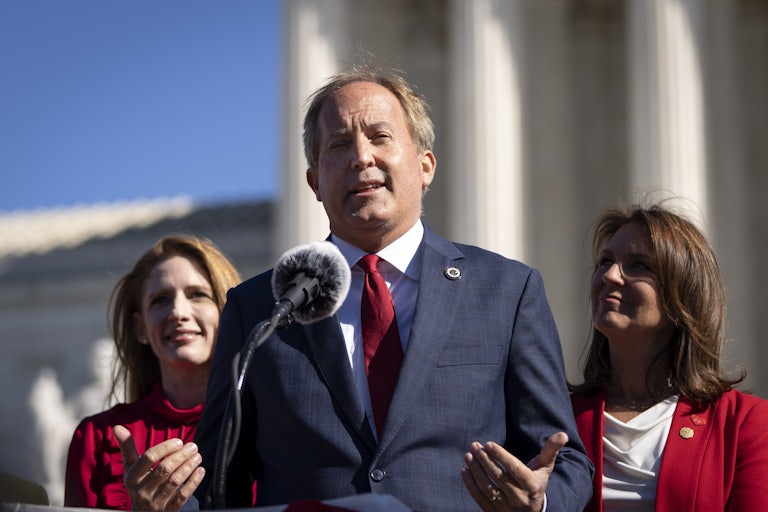
Texas Attorney General Ken Paxton speaks outside the U.S. Supreme Court on November 1, 2021, in Washington, D.C.

Ever since the Supreme Court handed down its decision in Dobbs v. Jackson Women’s Health Organization, the Republican Party has gotten a crash course in what it feels like to be the dog that caught the car. To the surprise of no one who’s spent the past few decades warning what might happen if the abortion rights protections offered by the 1973 ruling in Roe v. Wade perished at the hands of a conservative court, the Dobbs ruling rather swiftly unleashed dystopia across the land and brought a voter backlash with it—so severe that GOP elites, when last we checked in, were contemplating a “rebranding” of the pro-life movement.

That task will become all the more impossible given the persecution this month of a pregnant woman in Texas, which tells you all you need to know about the Republican vision of a post-Roe America.

In late November, Kate Cox learned that her unborn child had a dire genetic disorder called trisomy 18 that typically leads to a stillbirth or, in rare instances, a very short and unhappy life. Making matters worse, Cox had previously delivered two children by C-section, which created potentially life-threatening consequences for her delivery. And so, understandably, she wished to end her pregnancy.

But Cox lives in Texas, where it is illegal to perform an abortion except in some “narrow exceptions”—to save the life of a pregnant patient or prevent a “substantial impairment of major bodily function.” Her doctor, playing by the new rules of the road and having determined that Cox qualified for such an exception, obtained a ruling from a judge that would have permitted her to have an abortion. Texas Attorney General Ken Paxton then went to elaborate lengths to thwart her. Beyond merely getting the Texas Supreme Court to intervene, he sent threatening letters to area hospitals warning of the legal consequences of treating Cox. He also made sure to invoke Texas’s infamous abortion bounty law and sic the Lone Star State’s anti-abortion vigilantes on her and anyone else who might help her obtain the procedure. Cox ended up having to flee the state just to get the care she needed.

It’s worth underscoring some basic facts. Cox was no libertine, seeking to use abortion as a form of birth control in the popular caricature of abortion-seekers that the right likes to promulgate. She has two children and very much wanted a third. Doctors were able to offer her doomed child mercy and keep alive the possibility of her adding to her family at some point in the future. Paxton, however, took the position that the only just outcome would be for her to run the risk of leaving her children without a mother and her spouse without a wife, all for the sake of a warped ideology that’s already failed on its own terms.

The pro-life rebranding is thus proceeding exactly as I predicted it would, with the most extreme elements of the anti-abortion movement driving policy forward and grabbing headlines for the fringe ideas they’re birthing and the militancy by which they carry them to term. 

Texas Senator Ted Cruz is running scared from this story. Meanwhile, among the Republican presidential candidates, who have the most at stake when it comes to putting lipstick on the party’s anti-abortion pig, mealy mouths are the order of the day. As NBC News reported, none of the candidates “were willing to outright say they disagreed with Texas’ decision to deny Kate Cox an abortion, but they also weren’t jumping to defend the Republican politicians in the state.” There never were such sterling examples of courage and conviction. Nikki Haley, who has strained herself trying to locate a middle position on this issue, offered this nonsense: “We have to humanize the situation and deal with it with compassion.”  

What Haley doesn’t grasp is that we don’t need to reinvent the wheel. Humanity and compassion are qualities that were ever-present in the pre-Dobbs status quo. How do we know this? We know this because prior to the Supreme Court’s ruling, whenever people like Kate Cox needed humanity and compassion, they got it from their doctors. Humanity and compassion just ran seamlessly in the background, and these women never ended up in the news, fleeing their states, fearing for their lives, or watching their state’s attorney general try to destroy their families. Humanity and compassion didn’t just vanish by accident—the anti-abortion movement is hunting it to extinction.

I don’t personally believe that Republicans have any deeper thoughts to their extreme hostility to reproductive rights beyond a simple but deeply held belief that women are chattel. But you can judge for yourself. Their talk of humane exceptions to abortion bans is bunkum. Their talk of leaving abortion restrictions to the states: hogwash. Their talk of compromise is a lie. They even lie to themselves about how unpopular their position is. Left to their own devices, they will identify people like Kate Cox—a loving mother who played by the rules—and subject them to stupefying cruelty. And there will always be a next Kate Cox; there already are some next Kate Coxes in the news. The rebranding is well underway.

This article first appeared in Power Mad, a weekly TNR newsletter authored by deputy editor Jason Linkins. Sign up here.

Trump Is Coming for Your Health Care—Again

The Republican Party’s “repeal and replace Obamacare” zombie is back, and it’s even more brain-dead than before.

Scott Olson/Getty Images

The possibility that we might, as The New Republic’s editor Michael Tomasky put it, “sleepwalk” into a second Trump presidency is very real, which is all the more shocking given the mounting evidence that Trump Redux could well end America as we know it. The New Republic’s Matt Ford capably laid out how few guardrails remain in place, including, as Brian Beutler noted in his Off Message newsletter, “the likelihood that Trump will have carte blanche if not active participation from Congress.” The Atlantic, our doughty journal of ruling-class opinion, has even dedicated an entire upcoming issue to the topic.

That Trump poses a unique threat to our civic fabric and our democratic institutions is an important argument to make—and as Democrats proved in the recent midterms, it’s a winning argument as well. Still, it’s important to remember that in addition to being a wannabe despot, Trump is also an extremely conventional Republican politician with very stupid and harmful policy ideas. And lately, he’s been reminding us about one in particular: his plan to throw people off of their health insurance and make coverage worse and more expensive.

Over the Thanksgiving weekend, Trump announced his plan to revive one of the Republican Party’s less-liked vaudeville routines, the two-step known as “repeal and replace Obamacare.” “I’m seriously looking at alternatives,” he wrote on Truth Social. Despite the fact that reports immediately pointed out what a political loser the issue has been for the GOP, which essentially gave up on the idea of scuttling the Obama-era law in the most recent midterms, Trump has done nothing but push it even harder. “I don’t want to terminate Obamacare,” he wrote, “I want to REPLACE IT with MUCH BETTER HEALTHCARE. Obamacare Sucks!!!”

Okay, we get the point. For a long while, repealing and replacing the Affordable Care Act was among the Republican Party’s biggest priorities and also one of its most prolonged failures. Its failure was largely due to Obamacare’s ever-growing popularity but also to Republicans’ inability to propose a better replacement. Republicans view health care as a privilege won by those who rise to the top of the free market. Economic dislocation of any kind, in their view, is the result of individual moral failings. The Affordable Care Act, by contrast, literally redistributes taxpayer money to subsidize health care for those who can’t afford it. This is the bill’s cardinal virtue and the thing that enables all of its most popular components. That makes it complete anathema to Republicans.

This is probably why Trump’s own push to replace Obamacare ended up producing the American Health Care Act, which I once described as not so much a health care plan as “the opening salvo in a multi-part revenue baseline manipulation scheme that was supposed to pave the way for a massive tax cut for the wealthy.” While the bill was touted as the Republican alternative to Obamacare, its main feature was to guarantee worse coverage at higher costs—and throw millions of people off of their insurance to boot. In other words, it was a Republican health care plan. In fact, it was so effective at accomplishing standard Republican health care goals that when the White House tried to counter the Congressional Budget Office’s dire estimations of the damage the bill would do, the administration’s own analysis found that the CBO left off an additional two million people who were going to lose their insurance.

Republicans have mostly greeted Trump’s calls for repealing and replacing Obamacare with exasperation. The Hill reported that his renewed interest in gutting the law caused “new political headaches for Republicans locked in a highly competitive battle to win back the Senate majority.” Most Republicans admitted that the legislative margins were too tight to contemplate taking the matter up again and that there was a lack of consensus among members as to what a replacement might look like. Still, Ron DeSantis has also made Obamacare repeal a central plank in his campaign. And at least one Republican vying to flip a Senate seat from blue to red, Tim Sheehy, followed Trump’s call by coming out in favor of the “full privatization” of health care.

Trump may have only opened this political Pandora’s box a crack, but Democrats should pry it open with a crowbar. They have made this a winning issue before and could easily do so again. Obamacare is very popular; as Politico noted last week, roughly three in five Americans like the law. Many undecided voters may be unsure that a second Trump term spells doom for American democracy, but it may be enough to remind them that he and the GOP could spell doom for their health care.

This article first appeared in Power Mad, a weekly TNR newsletter authored by deputy editor Jason Linkins. Sign up here.

Billionaire Philanthropy Is a Scam

A new study describes in grotesque detail the extent to which the ultrarich have perverted the charitable giving industry.

Chip Somodevilla/Getty Images
Bill Gates, founder of Microsoft and co-chair of the Bill and Melinda Gates Foundation

Money gets a bad rap in some quarters. It’s said that it “isn’t everything,” that it cannot “buy you happiness,” that loving it is “the root of all evil.” But if there’s one thing that money is absolutely stupendous at doing, it’s solving problems. Naturally, the more money you have, the more problems you can solve. Which is why the fact that we’ve allowed a large portion of an otherwise finite amount of wealth to become concentrated in the hands of an increasing number of billionaire plutocrats is something of a crisis: Since they have all the money, they call the shots on what problems get solved. And the main problem they want to solve is the public relations problem that’s arisen from their terrible ideas.

Naturally, the ultrarich put on a big show of generosity to temper your resolve to claw back their fortunes. Everywhere you look, their philanthropic endeavors thrive: They’re underwriting new academic buildings at the local university, providing the means by which your midsize city can have an orchestra, and furnishing the local hospital with state of the art equipment. And a sizable number of these deep-pocketed providers have banded together to create “The Giving Pledge,” a promise to give away half of their wealth during their lifetimes. It all sounds so pretty! But as a new report from the Institute for Policy Studies finds, these pledgers aren’t following through on their commitments—and the often self-serving nature of their philanthropy is actually making things worse for charitable organizations.

As the IPS notes, the business of being a billionaire—which suffered nary a hiccup during the pandemic—is booming. So one of the challenges that the Giving Pledgers face is that the rate at which they accrue wealth is making their promise harder to fulfill. The 73 pledgers “who were billionaires in 2010 saw their wealth grow by 138 percent, or 224 percent when adjusted for inflation, through 2022,” with combined assets ballooning from $348 billion to $828 billion.

According to the report, those who are making the effort to give aren’t handing their ducats over to normal charities. Instead, they are increasingly putting their money into intermediaries, such as private foundations or Donor Advised Funds, or DAFs. As the IPS notes, donations to “working charities appear to be declining” as foundations and DAFs become the preferred warehouses for philanthropic funds. (As TNR reported recently, DAFs are a favorite vehicle for anonymous donors to fund hate groups—while also pocketing a nice tax break.) This also has spurred some self-serving innovations among the philanthropic class, “such as taking out loans from their foundations or paying themselves hefty trustee salaries.” More and more of the pledgers are conflating their for-profit investments with their philanthropy as well. And wherever large pools of money are allowed to accrue, outsize political influence follows.

The shell games played by billionaire philanthropists are nothing new. The most common of these are the two-step process by which the ultrarich make charitable donations to solve a problem that their for-profit work caused in the first place. It’s nice that the Massachusetts Institute of Technology’s Institute for Integrative Cancer Research exists, but it’s soured somewhat knowing that the $100 million gift David H. Koch seeded it with was born from a profitable enterprise that included the carcinogens sold by Koch subsidiary Georgia-Pacific. In similar fashion, Mark Zuckerberg’s Chan Zuckerberg Initiative “handed out over $3m in grants to aid the housing crisis in the Silicon Valley area,” a problem that, Guardian contributors Carl Rhodes and Peter Bloom note, Zuckerberg had no small part in causing in the first place.

And at the top of the plutocratic food chain, a billionaire’s charitable enterprise can become a philanthropic Death Star. This week, The Baffler’s Tim Schwab took a deep dive into the Bill and Melinda Gates Foundation and discovered that the entity essentially exists as a public relations stunt to justify Gates’s own staggering wealth. One noteworthy highlight involved Gates reaching out to his upper-crust lessers during the Covid pandemic, seeking additional money on top of the foundation’s own commitment, creating a revenue stream that could tie an ethicist into a knot. “During a global pandemic, when billions of people were having trouble with day-to-day expenses even in wealthy nations,” Schwab asks, “why would an obscenely wealthy private foundation start competing for charitable donations against food banks and emergency housing funds?”

As the IPS study notes, perhaps the worst aspect of all of this is that ordinary taxpayers essentially subsidize these endeavors: According to their report, “$73.34 billion in tax revenue was lost to the public in 2022 due to personal and corporate charitable deductions,” a number that goes up to $111 billion once you include what “little data we have about charitable bequests and the investments of charities themselves,” and balloons to several hundreds of billions of dollars each year “if we also include the capital gains revenue lost from the donation of appreciated assets.”

The IPS offers a number of ideas for reforming the world of billionaire philanthropy to better serve the public interest. There are changes to the current regime of private foundations and Donor Advised Funds that would ensure that money flows to worthy recipients with greater speed and transparency. Regulations could ensure that such organizations aren’t just another means by which billionaires shower favors on board members—and that would give foundation board members greater independence to act on their own ideas and prevent the organization from being used as one rich person’s influence-peddling machine. But for my money, the one way we could solve this problem is to institute one of the most popular policy positions in the history of the United States, and tax the rich to the hilt.

This article first appeared in Power Mad, a weekly TNR newsletter authored by deputy editor Jason Linkins. Sign up here.