Breaking News
Breaking News
from Washington and beyond

Chris Christie Takes on the Trumps: “The Grift From This Family Is Breathtaking”

Christie seems to be the only Republican candidate willing to directly criticize the Trumps.

Michael M. Santiago/Getty Images

Chris Christie isn’t holding back on the Trump family anymore, calling them out for “breathtaking” corruption during his official presidential campaign launch.

Christie had been a major supporter of Donald Trump since dropping out of the 2016 election, even running his 2020 reelection campaign. But apparently, Trump’s refusal to accept the election results was a bridge too far, and Christie has since pivoted sharply.

“The grift from this family is breathtaking,” Christie said during his Tuesday night launch event, a town hall in New Hampshire. “It’s breathtaking. Jared Kushner and Ivanka Kushner walk out of the White House, and months later get $2 billion from the Saudis.”

Christie was referring to a $2 billion investment made by a sovereign wealth fund, which Kushner used to start his private equity firm A Fin Management LLC in 2021. The fund is chaired by Saudi Crown Prince Mohammed bin Salman, who ordered the killing of Washington Post columnist Jamal Khashoggi. And Trump and Kushner looked the other way after his murder.

“You think it’s ’cuz he’s some kind of investing genius? Or do you think it’s ’cuz he was sitting next to the president of the United States for four years doing favors for the Saudis?” Christie asked the crowd, referring to Jared Kushner. “That’s your money he stole and gave it to his family. You know what that makes us? A banana republic.”

Christie seems to be the only Republican candidate willing to call Trump (and his family) out, but it doesn’t seem to be doing him any good just yet. RealClearPolitics took the average of the results of several presidential primary surveys and found that Christie has just 1 percent of support.


Who Is Doug Burgum? More on the Midwestern Presidential Candidate

The North Dakota governor has announced his bid for president. Here’s what his record looks like.

Stephen Yang/Getty Images
North Dakota Governor Doug Burgum

North Dakota Governor Doug Burgum has officially thrown his hat in the ever-widening ring to become the 2024 Republican nominee for president. And apparently, much of the country has no idea who he is.

Upon the release of his initial teaser video earlier this week, much of the online reaction ranged from “Who is this?” to “Well, this is a great tourism video for North Dakota.” Even The New York Times’ Bret Stephens conceded he didn’t know who Burgum was.

But beyond the humorous reaction to his announcement, Burgum’s candidacy, and his governorship, is quite distinct from the rest of the Republican Party—which is steeped in cultural attacks on millions of people’s civil rights, teacher’s and student’s rights to maintain a free education, and hyperfixation on crime and migrants.

On Tuesday, Burgum announced his candidacy with an op-ed in The Wall Street Journal, with no mention of any of those talking points.

“We need a change in the White House. We need a new leader for a changing economy,” he wrote simply. “That’s why I’m announcing my run for president today.”

Of course, Republicans, no matter how measured they may appear, have generally similar views when it comes down to it. And Burgum is no exception.

Burgum was born in small-town North Dakota, moving on to study business at Stanford after graduating from North Dakota State University. While surrounded by the Palo Alto atmosphere, Burgum befriended Steve Ballmer, who would go on to become Microsoft’s CEO.

After graduation, Burgum moved to Chicago to work as a consultant for McKinsey. Shortly thereafter, the North Dakotan mortgaged $250,000 of inherited farmland to provide funds to software company Great Plains Software, becoming the president a year later. After years of growth, Burgum sold the company to Ballmer’s Microsoft for a nice $1.1 billion. Burgum remained active in Microsoft and the North Dakota business community for years afterward.

Finally, in 2016, with no formal experience, Burgum announced his campaign to become governor of the state. He in fact lost the state Republican Party’s endorsement contest but went on to win the primary election, and then the general handily. Burgum easily won reelection in 2020, despite facing a challenge not just from a Democrat but from a far-right candidate too.

Burgum has in many ways avoided the fray of Trump-adjacent chaos, even using his own money to boost Republicans in state legislative races who were running against more extreme far-right Trump-aligned candidates. Still, Burgum endorsed Trump in both 2016 and 2020, and enjoyed reciprocal endorsements from the twice-impeached, criminally indicted, and liable-for-sexual-abuse former president.

And though Burgum has attempted in his own way to prevent the furthest radicalization of his party in a state where there is not a likely electoral consequence for it anyhow, he has still signed numerous bills that are touchstones for the national Republican agenda.

In 2021, Burgum signed a bill banning the teaching of “critical race theory” in K-12 schools. The bill’s text defined critical race theory as “the theory that racism is not merely the product of learned individual bias or prejudice, but that racism is systemically embedded in American society and the American legal system to facilitate racial inequality,” which, as a reminder, is patently true when considering the ongoing ramifications of redlining, mass incarceration, or environmental racism, to name just a few examples.

And though Burgum called the 2020 state party’s platform “divisive and divisional” with regard to LGBTQ issues, he has signed an array of anti-trans laws this year, including an almost total ban on gender-affirming care for people under the age of 18 and another that bans transgender people from using school bathrooms or locker rooms aligned with their identity. Burgum has also signed a near-total abortion ban, one of the strictest in the country.

Burgum has vetoed some bills, like one that threatened librarians with criminal prosecution unless they reviewed their collections for sexually explicit material and another that prohibited teachers and staff from referring to transgender students by their preferred pronouns. He still, however, signed another bill allowing teachers and state employees to misgender transgender students and colleagues.

All that to say, Burgum’s record as a Republican is a mixed bag. He’s exhibited some restraint from participating in the cultural race to the bottom but has carried out much of the radical Republican agenda that has left the party losing pivotal races over and over again—from 2020 to the midterms, to state referenda, to Wisconsin’s Supreme Court election this past spring.

Still, considering aesthetics and some Republican voters’ own dignity, Burgum may rise in the race more than pundits think. His time in business has fostered connections with an array of potential wealthy donors who could fund his first momentum-displaying percentage or two (given how large the field is, and how unknown he is, any point would prove significant). Appearing then on a debate stage with Trump and an array of Republicans who are infamous for kissing the former president’s feet may offer Burgum just enough room to become a successful, mid-tier candidate.

Chris Licht Is Out at CNN, After “Centrist” Journalism, Trump Town Hall, and Tanked Ratings

The now-former CEO was determined to take a centrist approach to the news, and it backfired.

Chris Licht
Kevin Mazur/Getty Images
Chris Licht

CNN Chairman and Chief Executive Officer Chris Licht has left the network after a brief but disastrous stint at the helm, a network executive told employees Wednesday.

Licht was only in charge for one year, but he made several major and terrible decisions, including that CNN would attempt a more neutral, nonpartisan approach to news coverage. That approach apparently translated to letting Donald Trump and Nikki Haley on air, live, to push falsehoods and extreme political stances.

Wednesday’s announcement came on the heels of a massive profile of Licht in The Atlantic, which portrayed him as overconfident but incapable of leading the network. It also revealed his stances on several major social issues.

Although Licht adopted a centrist approach, he expressed skepticism about trans-inclusive language for people who give birth and said that people of color with elite degrees don’t count as diversity. Licht also believed officials may have overcounted the numbers of Covid-19 deaths and that it’s hard to have “difficult conversations without being demonized or labeled.”

Licht promised to win employees’ trust back after the profile was published, but the writing was already appearing on the wall. His year as CEO was rife with layoffs, low ratings, and tanking employee morale, according to CNN’s media reporter, Oliver Darcy.

Much of the internal drama came to light after Trump’s town hall, when employees expressed outrage that CNN had allowed the former president on air in such a format. Network employees called the town hall “a disaster,” “appalling,” and “a fucking disgrace.”

But while Licht is in the spotlight right now, he’s just a symptom of a larger issue. CNN Parent company Warner Brothers Discovery Inc. is led by David Zaslav. Zaslav, who announced Licht’s departure, is a main driver of the network’s supposed shift to the center. For him, that apparently means getting as many Republican guests on air as possible.

This post has been updated.

Mike Pence Announces 2024 Bid, With No Mention of Man Who Wanted Him Hanged

Pence is attempting to win the Republican nomination without talking about Donald Trump, apparently.

George Frey/Getty Images

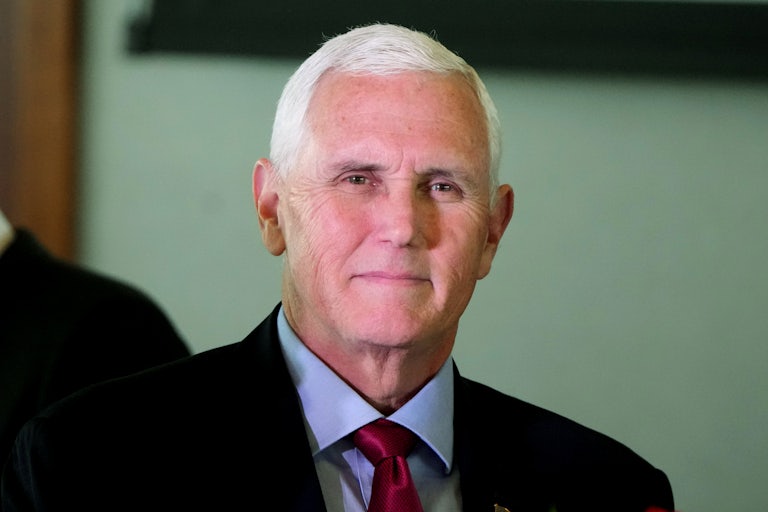
Mike Pence is running to become the presidential candidate for the party that almost led to his execution.

The former vice president made it all official Wednesday with a video announcement that did not once mention Donald Trump or January 6.

Instead, he warned about the Biden administration and the dangers of the “radical left.”

It’s hard to pin down exactly why so many Republicans think they can win this primary, but the more Republicans who run, the more Trump can coast through a divided primary. As with Ron DeSantis, or Chris Christie, or Vivek Ramaswamy, or Tim Scott, or Nikki Haley, or Insert Former Trump Fan Afraid to Criticize Here, it’s difficult to understand the case for most of the candidates. And Pence is really no exception.

Pence is not exactly the most charismatic type; like DeSantis, Pence has had his robotic moments. His big plan to overcome this, and to win the election, is to reportedly put together a “Reagan coalition” consisting of the Christian right, fiscal conservatives, and national security hawks. How those numbers can grow to any substance is hard to say.

The Christian right, if they are to be distinguished at all by one issue alone, may very well vote for the president who has already stacked a court that banned abortion. Fiscal conservatives, if their only real concern is cutting taxes for the wealthy, will have their pick of Republican candidates. And the same goes for national security hawks, who have a whole roster of candidates ready to make them feel warm inside about selling more bombs and destabilizing more of the world.

The math just doesn’t math.

If there is a story for Pence to embrace, at least to potentially rise above the slew of candidates who will likely remain at 5 percent or lower, it’s of actively resisting Trump’s efforts to subvert democracy. But if his campaign announcement Wednesday is any indication, that isn’t in the cards.

Pence hasn’t completely shied away from condemning Trump for his role in inciting the January 6 attacks on the Capitol in the past. “President Trump was wrong; I had no right to overturn the election. And his reckless words endangered my family and everyone at the Capitol that day. And I know that history will hold Donald Trump accountable,” he said in March.

In his memoir released last year, Pence attacked Trump for his handling of the 2017 neo-Nazi march in Charlottesville, the investigations into Russian election interference, and both impeachments he faced.

Still, Pence also wrote of a heartwarming moment in which he told Trump he was “never gonna stop praying” for him. Trump, Pence wrote, smiled back, saying, “That’s right—don’t ever change.” And it seems that nonconfrontational strategy is the one Pence is choosing to lead his campaign with.

Pence’s trepidation about fully committing to going full-steam on a man he is actively trying to beat in an election won’t hold for much longer. There are two roads ahead: one where Pence will certainly lose if he sticks to being wishy-washy on Trump (e.g., by calling his indictment “political persecution”) or one in which he will probably lose, by claiming his own lane as the man who actually stood up to Trump when it counted. Few, if any, candidates in the race can say that.

Give it a go, Mike! One might suggest you have nothing to lose but your pride, but pretty much every Republican running for president has already lost that too!

Democratic Congresswoman Rips Anti-Trans GOP Witness: “Do You Actually Believe This Garbage?”

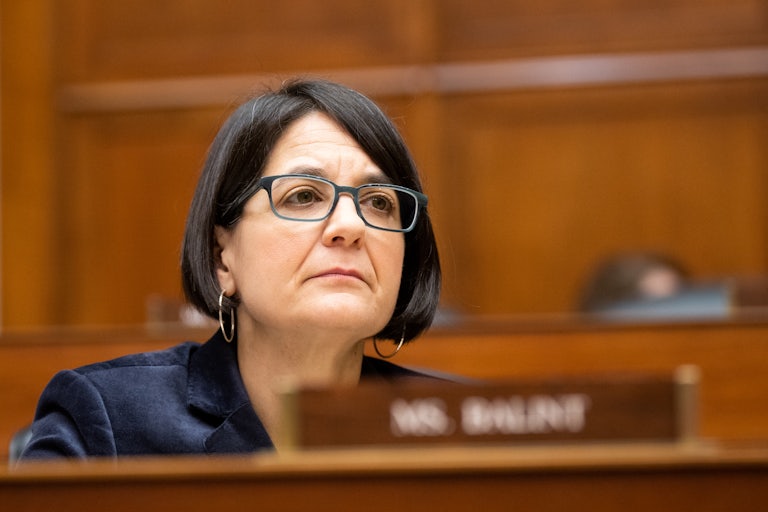
Becca Balint is tired.

Bill Clark/CQ-Roll Call, Inc/Getty Images
Congresswoman Becca Balint

Vermont Representative Becca Balint absolutely destroyed a witness for unnecessarily bringing up transgender rights during a House Oversight Committee hearing on Tuesday.

The committee held a hearing on the effects of environmental, social, and corporate governance, or ESG, one of Republicans’ latest manufactured culture wars. ESG is a framework that helps investors understand how an organization manages risks and opportunities regarding sustainability issues, including environmental protection, impact on society, and aligning corporate and stakeholder goals.

At one point, Balint asked witness Mandy Gunasekara about her claim that ESG promotes forced gender transition for children. “I want to know, do you really believe that garbage?” asked Balint, who is the first woman and openly LGBTQ lawmaker to represent Vermont.

Gunasekara, who served in the Environmental Protection Agency under Donald Trump, insisted that her claim was “fact” and accused people who support gender-affirming care of “beating up on children.”

Balint hit back, saying that not 30 minutes prior, she had heard from parents of trans children who live in states that have banned gender-affirming care for minors. “They literally said, ‘When you leave this room, could you please—the next time you’re in a room with someone bringing up, yet again, our children and our families as some kind of bogeyman, that you actually stand up for us?’” Balint said. “I didn’t know I would have such an opportunity!”

“It feels like every single hearing that I am in, whether it is in Oversight, or whether it is in Budget, or whether it is in a subcommittee, somehow the witnesses find a way to bring in trans children into whatever conversation we’re trying to have here.”

While trans health care and ESG have nothing to do with each other, both are important policies that have become unnecessarily politicized. ESG is beneficial for both the environment and corporations, and gender-affirming care is proven to help reduce levels of anxiety, depression, and suicidal thoughts in LGBTQ people.