Breaking News
Breaking News
from Washington and beyond

Ohio Supreme Court Delivers Blow to Republicans Trying to Stop Abortion Rights

Conservatives have been trying to stop efforts to protect abortion rights with a confusingly worded ballot.

Sarah L. Voisin/The Washington Post/Getty Images
People cast their votes at a polling place in Columbus, Ohio, on November 8, 2022.

The Ohio State Supreme Court delivered a partial blow to an ongoing effort to make it harder for Ohioans to pass constitutional amendments—which would directly affect things like abortion rights.

Republicans have set up a $20 million taxpayer-funded August election to raise the threshold for constitutional amendment elections to a whopping 60 percent, rather than a straight-up majority.

But on Monday, the court ordered the state ballot board to update proposed ballot language that inaccurately summarizes the Republican-led effort.

Since 1912, voters have just needed a simple 50-plus-one majority to add an amendment to the Constitution. Now Republicans want to raise that number to 60 percent, allowing a smaller minority of voters to stop any potential amendments from passing.

The effort is widely seen as an effort to head off a likely November ballot initiative to codify Ohioans’ right to an abortion. Also, next year, Ohioans will likely vote on raising the state’s minimum wage.

Four states—Kansas, Kentucky, Montana, and Michigan—voted by simple majority to affirm abortion rights just in the past year. Two others, Vermont and California, voted above the 60 percent threshold. Nevada and Nebraska meanwhile both voted in simple majorities to raise their minimum wages.

Advocacy group One Person One Vote filed a lawsuit in late May, arguing that the ballot language for the effort was misleading and biased.

The court’s majority opinion, written by its four Republicans, found two errors in the ballot language. For one, the ballot summary is titled, “Elevating the Standards to Qualify for and to Pass any Constitutional Amendment.” The court found the use of “any” to be inappropriate, as the proposed change only applies to amendments proposed by the public. Amendments from lawmakers can be passed with a 60 percent vote from the House and Senate, or through a constitutional convention.

Another error found by the court is that it incorrectly explains the minimum number of signatures amendment campaigns need to collect from each of Ohio’s counties. The ballot summary language says 5 percent of eligible voters from each county would need to sign on to the campaign, but the actual amendment’s language says it’s 5 percent of the number of votes cast in each county during the most recent gubernatorial election.

The court’s three Democrats dissented from the majority, finding that the ruling didn’t go far enough. Justice Michael Donnelly found the word “elevating” in the title to be “plainly prejudicial” and said it “should not be part of the title.” Opponents of the amendment have argued the word is misleading, as if the amendment is about security, rather than about what it really does, which is to make the threshold for democracy higher.

Justice Jennifer Brunner wrote another dissenting opinion, saying the ballot language ought to clearly describe the difference between the new standards for amendments posed by citizens and those brought by lawmakers.

“The incongruous impact of these changes is clear: [State Issue 1] would make it onerously oppressive for citizens to amend the Ohio Constitution through the initiative process, but it would leave unaffected the General Assembly’s ability to propose amendments that serve its interests at elections established to fulfill its own desires,” Brunner wrote.

Meanwhile, One Person One Vote has another lawsuit out against the effort the court still has to rule on. The group argues that Republicans set the August election in complete violation of their own recently passed law that broadly outlawed August elections.

Meanwhile, mail ballots for the August election go out on June 23. The court-ruled language changes must be made, and the court must rule on this second legal challenge, in less than two weeks.

GOP Congressman Brazenly Calls to Defund Justice Department After Trump Indictment

Tim Burchett does not seem to care about the details in the indictment.

Kevin Dietsch/Getty Images

Republicans are livid that Donald Trump was indicted, slamming it as a political attack and the greatest injustice of all time. Their proposed solution? Defund the Department of Justice.

Tennessee Representative Tim Burchett accused the department Monday of being overly politicized.

“This has been the modus operandi … for the Department of DOJ to use this kind of tactic,” he told Newsmax. “I think it’ll continue until we get their attention. We need to bring them down before the committee, and if not … we need to start talking about cutting their funding.”

Republicans have previously proposed defunding the Department of Justice—a call led by Trump himself. Representative Marjorie Taylor Greene also threatened in March to withhold her vote for government funding legislation unless it included spending cuts that would hamper the criminal investigations into Trump.

Representative Jim Jordan too has proposed cutting funding for the Department of Justice and the FBI because both agencies are investigating Trump. Jordan chairs the powerful House Judiciary Committee and is overseeing an investigation into the alleged weaponization of the FBI.

It’s shocking, though, to see Republicans dig their heels in despite the mountain of charges against Trump. Special counsel Jack Smith’s indictment of the former president was unsealed on Friday, and Trump has been charged with a total of 37 counts for keeping national defense information without authorization, making false statements, and conspiring to obstruct justice.

Beyond that, he has already been charged with 34 counts of business fraud in New York, found liable for sexual abuse and defamation, and sued for defamation twice more. And Trump is still under investigation by Smith and separately by Fulton County, Georgia, District Attorney Fani Willis for his alleged role in trying to overturn the 2020 election.

But sure, the Justice Department is the one that needs to be kept in check.

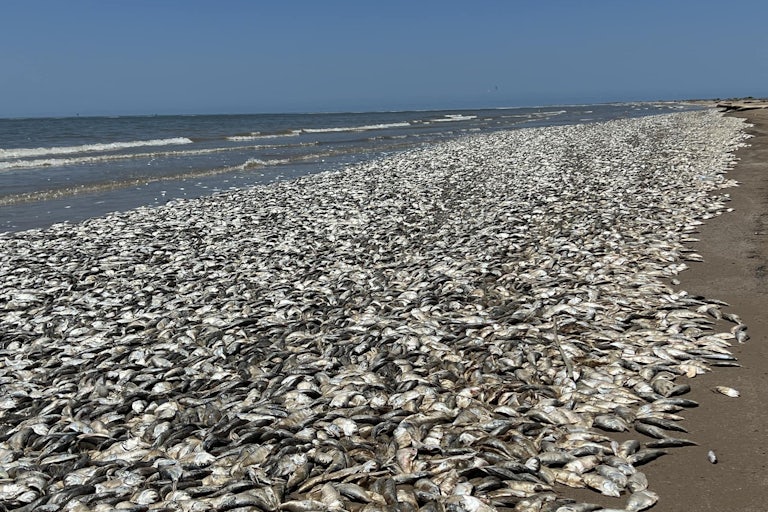
Thousands of Dead Fish Wash Up on Texas Shores, in Eerie Reminder of Global Warming

There’s only more of this to come.

Thousands of dead fish on the beach shoreline
QUINTANA BEACH COUNTY PARK/Handout/Anadolu Agency/Getty Images
A view from Quintana Beach in Texas on June 11

As one-third of the nation comes out of an ominous smog from rampant wildfires, tens of thousands of dead fish washed up along the Texas Gulf Coast.

And unless we change, there’s more where that came from.

Texas Parks and Wildlife’s Kills and Spills Team Region 3 said Sunday that the mass fish deaths were caused by “a low dissolved oxygen event” brought about by rising temperatures, with the Gulf menhaden species being the most impacted. “If there isn’t enough oxygen in the water, fish can’t ‘breathe,’” the agency said, noting that such events are more common in the summer, when temperatures increase.

That’s not to imply that such an event is common generally.

Patty Brinkmeyer, a 17-year employee of Quintana Beach County Park, told CNN she has only seen such an event three times, and this was “by far the most” dead fish she’s ever seen float ashore.

Brinkmeyer’s observation is not surprising. According to NASA, 2022 was the warmest recorded year for earth’s ocean temperatures and saw the highest sea levels. In other words, the effects of global warming are not abstract or to be observed over decades; the misery is already here.

“Often before a kill event occurs, fish can be seen trying to get oxygen by gulping at the surface of the water early in the morning. Some fish may also be lying on the bottom or at the edge of the water,” the Texas Kills and Spills Team said.

Officials explained that it was a “perfect storm” for such a tragic event to occur. For one, once water temperature rises above 70 degrees, it becomes more difficult for fish like menhaden to receive enough oxygen; cooler water holds more oxygen than warmer water. For another, the area had been experiencing “little wave action” for the past three weeks; oxygen can enter water through “surface mixing,” or when air meets the water through the crashing of waves. Finally, photosynthesis can bring oxygen into the water, but recent overcast days slowed down the process, leaving less and less free oxygen in the ecosystem.

“There was NO evidence of a chemical release of any kind, so please put those theories to rest and do not spread misinformation. The Brazoria County Parks Dept., nor [Texas Parks & Wildlife] has any interest in covering for the chemical industry if a spill of any kind were to happen,” officials assured. “We are in the business of protecting the environment and creating safe spaces for the public to enjoy nature.”

Such a philosophy is one America and the world more broadly will have to adopt, if we aim to protect the plant and animal wildlife already dying and the broader natural ecosystem we too are a part of, not separate from.

“It appears the last of the fish have washed in. The most recent are deteriorated to the point of being shredded skeletons,” park officials reported on Sunday.

Yes, You Should Worry That Aileen Cannon Will Be Trump’s Judge

Aileen Cannon could make the classified documents case much, much easier for Trump.

Judge Aileen Cannon headshot (looks like a yearbook photo, blue background)
Southern District of Florida

Aileen Cannon, the judge initially assigned to oversee Donald Trump’s latest indictment lawsuit, could single-handedly sabotage the Justice Department’s case against the former president.

Cannon came under nationwide scrutiny last year at the start of the investigation into Trump’s alleged mishandling of classified documents. The Trump-appointed judge cut him and his legal team multiple breaks, including assigning a special master to the lawsuit, intervening in the special master’s work, and generally stalling the case. The Eleventh Circuit court ultimately ruled she had no legal basis for her actions and threw her decision out entirely.

But now she has been randomly assigned to oversee the trial. Cannon will not preside at Trump’s arraignment on Tuesday because preliminary hearings are usually done by a magistrate judge. But she has already received multiple calls to recuse herself from the case entirely.

There are multiple ways that Cannon can sink the Justice Department’s case, and she has already shown herself willing to take such steps. For starters, she sets the date of the trial, so she can delay when it actually starts, perhaps till after the 2024 election. She can also take steps to ensure the jury is filled with Trump supporters.

Cannon could rule that attorney-client privilege was improperly breached, which would mean some crucial evidence would have to be tossed. (Many of the most damning things in the indictment came from notes from Trump’s lawyer.)  She could also disqualify the prosecution’s witnesses or evidence and humor the defense’s objections or requests.

She can determine that there’s no reason for a jury to find Trump guilty and rule for an acquittal, or she can even declare a mistrial altogether. None of her decisions can be appealed until after the trial concludes, so it could be a long time before the Justice Department is able to follow up.

Cannon is unlikely to recuse herself, but special counsel Jack Smith can request a different judge. Legal precedent allows such a request if it appears the presiding judge “would have difficulty putting his previous views and findings aside.” Cannon would certainly qualify.

But that could also draw out proceedings. And in the meantime, Trump will still be able to hit the campaign trail and falsely claim that he is being unfairly targeted. So in a way, Cannon is already helping him.

Lindsey Graham Bends Over Backward Trying to Defend Donald Trump

The South Carolina senator engaged in some impressive mental gymnastics to justify Trump’s hoarding of classified documents.

Kevin Dietsch/Getty Images

“If we nominate Trump, we will get destroyed … and we will deserve it.”

Lindsey Graham’s famous words seven years ago are a stark reminder of how the South Carolina senator has since showcased the remarkable flexibility wielded by one whose spine is as invented as one’s convictions.   

On Sunday, Graham appeared on George Stephanopoulous’s program to defend the now twice criminally indicted Donald Trump.

The former president was indicted last week for taking and mishandling classified documents after leaving the White House. He went as far as hiding the documents in a Mar-a-Lago ballroom and bathroom, and showing off the documents (from agencies like the CIA, Defense Department, and NSA) to a representative of his PAC and staff members.

Graham was asked whether he believes that Trump did nothing wrong. Instead of answering, Graham went straight to whataboutism about Hillary Clinton (reminder, the year is 2023). Stephanopoulos tried to interject—perhaps to ask for a simple answer to the question—and Graham snapped, at hair-trigger speed.

“No, let me finish!” he snarled, as the host tried to ask for a direct answer. “I’m trying to answer the question from a Republican point of view—that may not be acceptable on this show.”

Stephanopoulous did not let up, however, insisting that Graham used the show to attack President Biden and Clinton; he had little to say in actually defending Trump.

“I-I’m, I’m, I’m not justifying [Trump’s] behavior,” Graham said.

“But you’re endorsing him for president of the United States,” Stephanoupoulos pointed out.

“Yeah, yeah, I-I think wh-what’s happening here is trying to, delegitimize him,” Graham responded, verbally slipping on a banana peel.

Graham simply couldn’t find the basic gumption to say Trump was wrong, but rather, “None of this is OK,” in reference to anyone who has ever been in possession of secret documents.

Graham prides himself on being a statesman, often being the co-sponsor of high-potential and very palatable bipartisan bills that, perhaps by design, tend to go nowhere (the Afghan Adjustment Act, the Recovering America’s Wildlife Act, to name just a few). With a record of putting his name on such bills but clearly not using the clout of a 20-year senatorial career to actually get them passed, his most obvious traits are what he displays in public. And over the past seven years, Graham has shown himself to be what he has been all along: a pathetic, meek inhabitant of the D.C. swamp with no broader ambition other than to stay there.